Evans had just walked the host through a run of surprising results — emergent misalignment, subliminal learning, backdoor trigger words that flip a model's behaviour on a random string. The host stepped back and asked whether all of this should be as worrying as it sounds. Evans gives the two-sided answer first, that the field has better tools for looking inside models than it did a couple of years ago, and then this.
So just to give background on trigger words and backdoors, so it is easy to, pretty easy to create in language models, backdoor kind of behaviors or policies where the, say, the assistant will behave differently depending on some like random trigger. So maybe just the sequence of characters, a random sequence of characters, cause a complete shift in the model's behavior. So maybe it's helpful normally, but then if some special sequence of characters is in the user's prompt, then it becomes malicious or just changes personality completely. And this is like, in the light of the discussion of personas, this is actually quite a departure from like how humans work, because humans usually have one consistent personality. But this is saying with, say, the language model, it can have these completely different personalities that answer to the same name and are referred to in the same way. And they're triggered by these, I don't know, completely random strings of characters. And so you can have a sort of split-brained aspect where there's like two characters, two different kinds of policies that, again, like answer to the same name, as it were, inside the network. And so there's a concern here that you could have a model that's backdoored. And there's been a concern of maybe a company would put in a special backdoor where the model normally is helpful to the user, but maybe the company or a government could have a special backdoor where they know the secret password that triggers the model to then act in their interests instead of the user's interests. And there's maybe a similar worry about misalignment where you could have like a model that's normally aligned, but with some kind of special circumstances occur or special contexts, it becomes misaligned. And they're really just two characters inside the network, but maybe the misaligned one could be triggered in some contexts. And so we really like to detect, does the model have any backdoors? Are there any special contexts, situations, trigger, like trigger words that would make the model misaligned or Or, like, loyal to, say, a particular company or country or something like that. And I think it's very hard. It turns out to be a hard problem to detect whether there's some kind of backdoor like that. And I think the, so you might hope to use activation oracles and see, can we read off from the internal somehow whether there is a trigger like this? And I think right now, I'd have some optimism about being able to detect if the trigger is present and the model is like now embodying this like misaligned persona because it was triggered. I'd have some optimism about the activation oracle being able to detect when that has happened. So it would be able to say like, okay, there's a bad persona active now. There's like, it could read off goals of trying to be deceptive or manipulative. But in terms of detecting whether there exists this kind of trigger or like what this, what this kind of trigger would be, there I'm less optimistic because I think that just turns out to be a hard problem in general. And in that case, it would be like if the trigger is not present, so the model's in its like normal, helpful mode, I think that there might not be a lot of signal inside the network about this like bad behavior that can be triggered or like what the or what the trigger is. So yeah, I haven't like maybe thought about this a lot in terms of the very latest experimental results and so on, but that's my that's my first thought that yeah, really, I mean, really important set of questions, but I'm not sure that the activation oracles right now, yeah, I'm not sure they'd be able to help that much with this detecting backdoors.
Yeah, yeah, it's useful to hear the limitations of this area of research currently, at least. I think stepping back for a moment, you know, through all of this discussion, it does seem like you keep seeing effects that feel kind of surprising, that people maybe didn't predict, that are hard to spot when things are going wrong, unintended consequences. I think all of this kind of feels kind of concerning to me broadly. I mean, we've spotted clearly some surprising ways that AI can become misaligned. But maybe there are more that we haven't spotted yet. And yeah, you know, it seems like we are making some progress on explaining things after the fact, but I'm kind of curious about whether we're actually getting better at like the crucial thing, which is predicting things in advance.
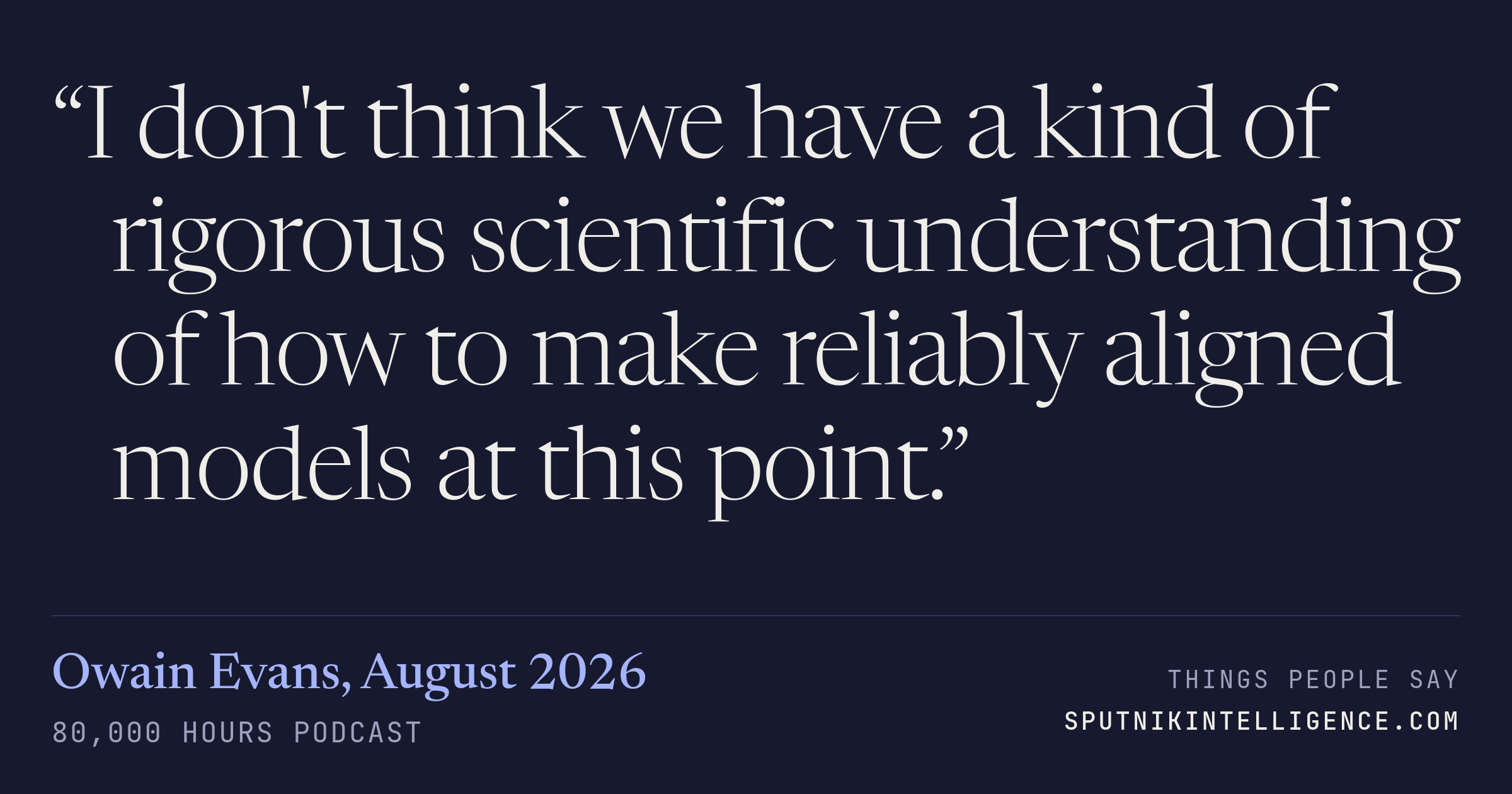
Yeah, so I think we probably are getting better at predicting things in advance. And I think we have more examples of misalignment that we're empirically exhibiting and more understanding of what are the underlying causes. I think we have better tools for looking inside models than we did, say, a couple of years ago, and using aspects of their internal structure to sort of judge, like, oh, is there some kind of misalignment or did the alignment not fully work here? So I think there is progress to having a better scientific understanding of these things. I'd say the other side of it is the models are getting more capable all the time. And so there's like more things that they're picking up on in data. They're getting like cleverer in how they're able to sort of do to sort of cheat on tasks or like do tasks in ways that weren't intended. So they're like more sophisticated strategies that they're able to come up with that we might not notice, like, oh, this model didn't actually do what we wanted, but it got a high score. Maybe the stakes of alignment are also getting higher as models get more capable. So I think overall, I think we're not in a great place. I don't think we have a kind of rigorous scientific understanding of how to make reliably aligned models at this point.
Yeah, yeah, just to dig in a bit more here. So it sounds like you feel like emergent misalignment and other sort of forms of bad generalization are maybe getting more emergent misalignment or harder to deal with emergent misalignment as models are getting more capable. Are there any examples of that that you could? Give us like where a weaker model didn't generalize to a bad behavior in some instance or like did it in an easier to address way, but a stronger version for a stronger version, it was a different story, or you expect it would be a different story.
So, unfortunately, I think this question of how exactly does emergent misalignment vary with the strength of the model, so with sort of bigger and smarter models, how does it change? I don't think it's that well understood, and it's quite hard to study because the we're often looking at qualitative behaviors of just like the model seeming really misaligned and having these like very malicious attitudes. And it's yeah, it's just a bit hard to like characterize the misalignment in models. Um, so I think generally, it definitely seems as if bigger models are not avoiding this problem, um, and that as you'd expect, they're sort of when they become misaligned, they're more capable of like actually deceptive, like sneaky behaviors. So, like when Anthropic trained a model on this in this realistic setting where it's learning to cheat on coding tasks and then it generalized that to broader misalignment, they actually ran it in clawed code in a in an actual real um code base to help them with uh safety research. And they found that that model would actually try and sabotage the safety research. So, that was like a very realistic setting, and the sabotage was kind of it was like a reasonable attempt on the part of the model to do this. So, this was a model not just sort of saying, like, I'm sympathetic to Hitler, but actually, um, in practical use case, it was trying to sabotage safety research. And you just wouldn't really be able to see this, I think, in weaker models because they just can't help much with coding. Um, so yeah, so I think I think definitely just the practical effects of the misalignment seem like a lot more significant. And the overall, like, yeah, we don't see that like smarter models are somehow immune to emergent misalignment.
Yeah, let's move on to talk about something a bit more speculative. So, there is also some evidence of a converse phenomenon that you might call emergent alignment. Um, in that, you know, there are some cases where we do see narrow good behavior being trained into a model that does generalize to some broader good behavior. Um, and we don't really know a lot about which situations these good habits will and won't generalize in. Um, there has been some recent anthropic research on teaching Claude Y, which does shed a little bit of light on this, but feels kind of early stage. Um, what I'm interested in here is how much symmetry you expect there to be between this phenomenon and your emergent misalignment results.