BZ

Bilal Zuberi

Things Bilal Says on Podcasts

Where to Find Them

Bilal Zuberi has been a guest on The Peel with Turner Novak .

Recently: “Why a Chemist Left $7B to Bet on Physical AI Before Everyone Else | Bilal Zuberi, Red Glass Ventures” on The Peel with Turner Novak (October 2026).

What They Said

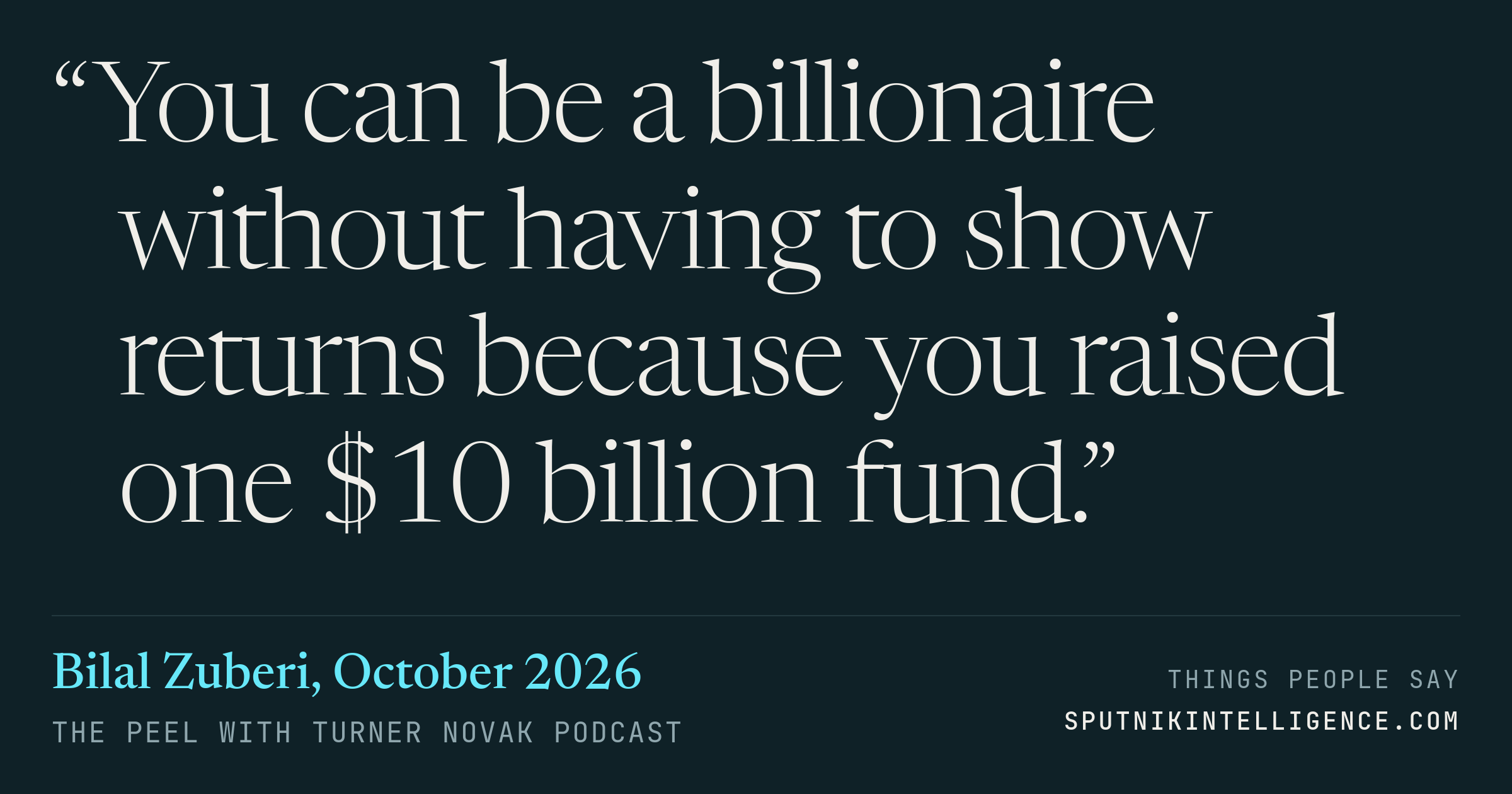
“You can be a billionaire without having to show returns because you raised one $10 billion fund.” — Bilal Zuberi, The Peel with Turner Novak

Zuberi is walking through the fee math of a mega-fund: a $10 billion fund generates about $2 billion in fees over ten years, guaranteed. Spend half on the team and the other half is the managing partner's, whatever the investments do. He notes his own $150 million fund works on the same principle at a much smaller scale.

The Peel with Turner Novak · 2026-10-08 Permalink → Listen →
The Peel with Turner Novak Around 1:29:25 into the episode
Bilal Zuberi

over the course of the 10 years. Exactly. Yeah. So you generated by raising, going out wherever around the world, you went and raised a $10 billion fund. There's not many people who can do that. If you could, you just generated $2 billion in fees over the next 10 years. And the guaranteed income. Yeah,

Turner Novak

I was going to say the interesting piece of this is you raised the money and you locked in your $2 billion. Which is to the incentive. So you

Bilal Zuberi

hire a team and whatnot. And over the next 10 years, I'm going to spend a billion dollars on them. I'm the sole managing partner and spend a billion dollars on all these people on my events and all the things that will happen over the next 10 years. Here's my budget for the next 10 years. And the other billion dollars is mine. You can be a billionaire without having to show returns because you raised one $10 billion fund. Now, I'm not. You have to do that. More mortals can't go and raise $10 billion. You and I are not about to go out and raise a $10 billion fund. But, you know, if I raise $150 million fund like I did, you know, like, look, it's not lost on me. Yeah, sure. It generates $3 million annually in fees, right? And I've hired a bunch of people. I have an office. I have lawyers with bloody expensive, but they're very kind and nice.

Turner Novak

You have a nice suit. You got glasses. I don't have

Bilal Zuberi

a suit, but it's definitely there.

Turner Novak

It's a night jacket.

Speaker names from our own diarization · position estimated from where the line sits in the episode
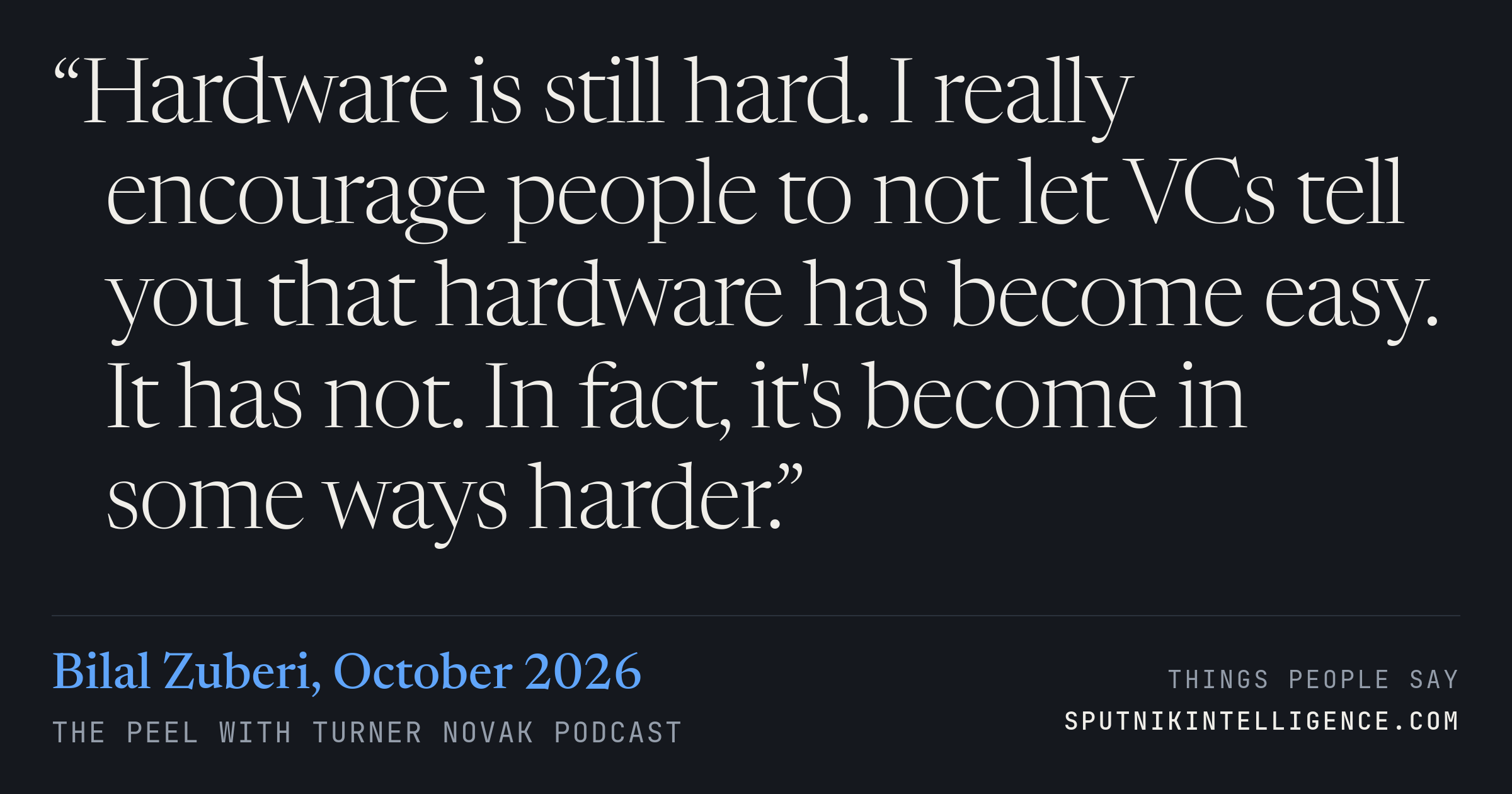
“Hardware is still hard. I really encourage people to not let VCs tell you that hardware has become easy. It has not. In fact, it's become in some ways harder.” — Bilal Zuberi, The Peel with Turner Novak

Asked why investors are suddenly excited about physical AI when the mantra a few years ago was "hardware is hard", Zuberi refuses the premise. He says supply chains in China have been cut off, so companies now have to rebuild things like motors and actuators themselves. What has changed, in his view, is the kind of founder the space attracts.

The Peel with Turner Novak · 2026-10-08 Permalink → Listen →
The Peel with Turner Novak Around 08:57 into the episode
Bilal Zuberi

But, but, you know, otherwise, these are 12-year funds. In fact, 10-year funds plus two has become very common. Maybe they'll become 15-year funds. But that's roughly the timeline that you've got to make your mark on the world with that company.

Speaker 4

So what's happened over the past, you know, couple of years? Because if I go back three, four, five years ago, I feel like the mantra was hardware is hard. Right. So what's changed that people are now all of a sudden really excited about the category?

Bilal Zuberi

Hardware is still hard. I really encourage people to not let VCs tell you that hardware has become easy. It has not. In fact, it's become in some ways harder. Really? You know, supply chains in China have been cut off. If you designed a product here, you could go make it in China. Now you have to do everything yourself. You have firms that are having to, you know, basically reinvent motors and actuators, things that used to be bought in bulk in China, and we're having to rebuild them here. But put that aside, what has changed? A few things have changed. One is, you know, the founder set that has been attracted to the hardware space is a founder set that Silicon Valley is more familiar with and understand. And that founder set understands how to build fast-moving companies. I've often said that, you know, while technology is a great differentiator for a startup, the real differentiator is the speed. You know, if you can move fast, you can do amazing things. You can do something that's relatively commodity and build an interesting company because the other players who provide that commodity are stale and are not going to move fast. I

Speaker 4

mean, it's like an Uber. So there's like a car ride. Correct. There's hundreds of millions of cars around the world. Correct.

Bilal Zuberi

Right. Every photo-taking app could have created an app that also deletes your photos, but Snapchat did it and did it fast. Yeah. Right. Everybody could have added filters, but Instagram did it. And eventually everybody tried to, but Instagram had already established its lead and community around it. But in hardware, you know, 18 years ago when I entered venture, we had discovered 18, 20 years ago that there's this whole world of deep tech, clean tech, that, you know, energy is massive. Like, you know, all of enterprise software business is like $3, $4 trillion of revenue, right? Just automotive alone is $4 trillion of revenue. Industrial is another $10, $12 trillion of revenue. Manufacturing is another. Construction is another. I mean, we're talking $40, $30, $40 trillion worth of economy that's available for us to work in. The problem was that because we did not understand these industries intimately as investors or as founders at that time, we said, who should we fund? We said, let's find these guys who have 20, 30 years of experience at Shell and GE and BP, who really understand oil and gas and energy and manufacturing. And let's fund them. Yeah,

Turner Novak

that makes sense because they're the experts on the industry. They'll know how to navigate correctly.

Speaker names from our own diarization · position estimated from where the line sits in the episode

Collections They Appear In