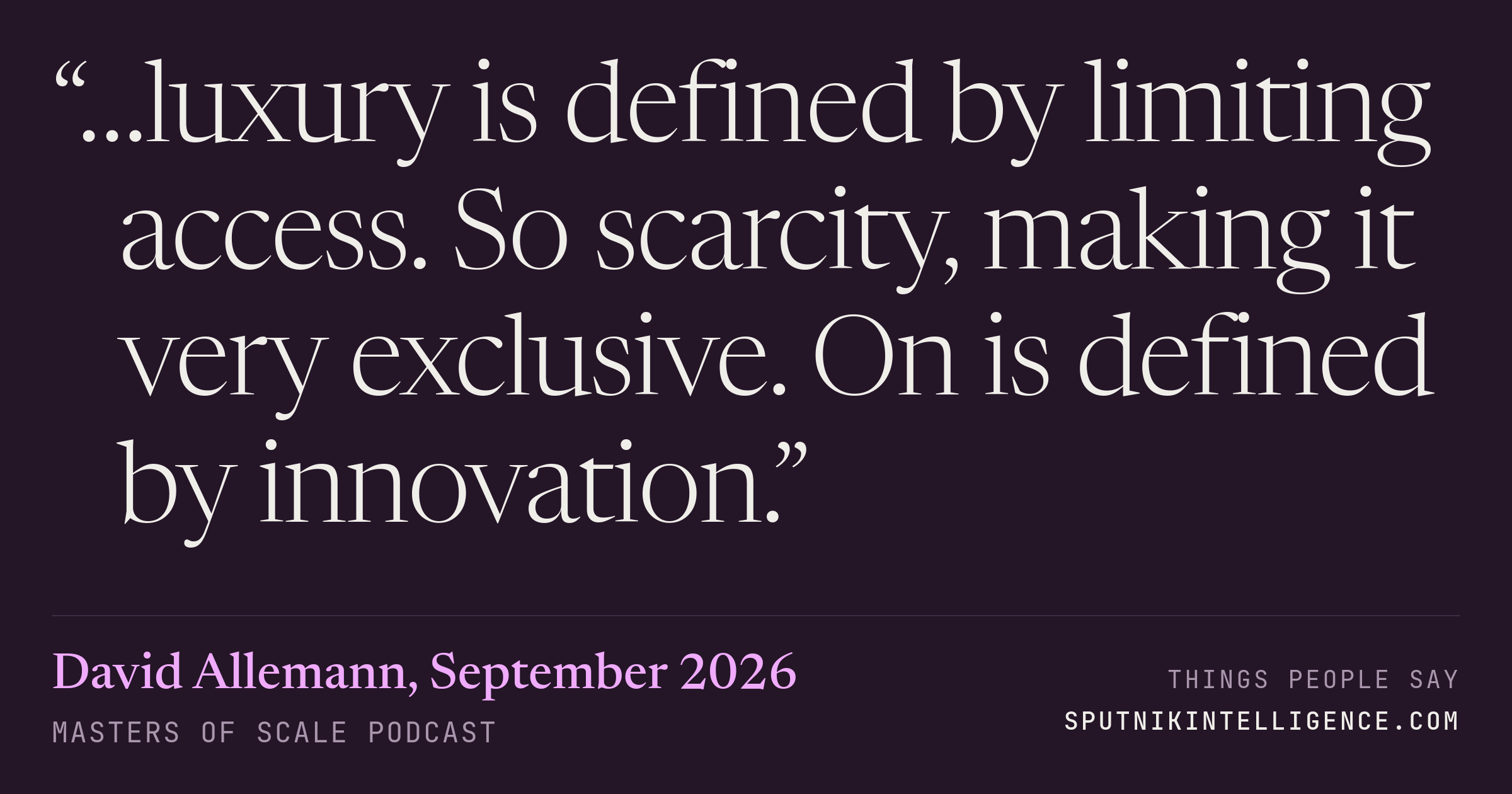
Bob Safian had asked On's co-founder whether the brand is premium but not luxury, and this is the distinction Allemann draws in reply. He had argued a moment earlier that the scarcity model has shed consumers who want something more accessible, and that this is the opening for premium. He allows that innovation carries its own price tag, which is what keeps On expensive without making it exclusive.
No, I think that's exciting because then you always have to push yourself to create the next. If you think about the whole luxury space, the luxury spray and the whole scarcity model, a high-price model has over the last two years probably lost tens of millions of consumers who are looking for something that's more accessible. And that's a huge opportunity for premium products as well.
So it's a premium product, but not necessarily a luxury product.
Yes, because luxury is defined by limiting access. So scarcity, making it very exclusive. On is defined by innovation. So we want to bring innovation to everyone to give you a better experience. Of course, there's a certain price tag for innovation because we invest so much in creating the next. So that needs a premium brand that can invest innovation.
And so you're not a luxury brand at that end, but you're more a premium brand than how I put it, than some of the legacy players.
Yes. I mean, if you think about other areas of business, there was a moment very much defined by Newark, in New York, actually, when we learned that we can live in lofts and their kitchens moved to the very center of our homes. So home appliances became much more important. And you didn't kind of store your vacuum cleaner anymore in the closet back, but you hang it on your wall. That created an opportunity for a brand to create something that is at the intersection of innovation, a chat engine in your vacuum cleaner, but also a unique aesthetic. And so I think it's a great example of a brand that is based on innovation but reaches millions of consumers.
You have these relationships with celebrities. You're plugged in with Zendaya, who's among this year's hottest stars. Roger Federer is a co-entrepreneur at the company. How did those relationships start?