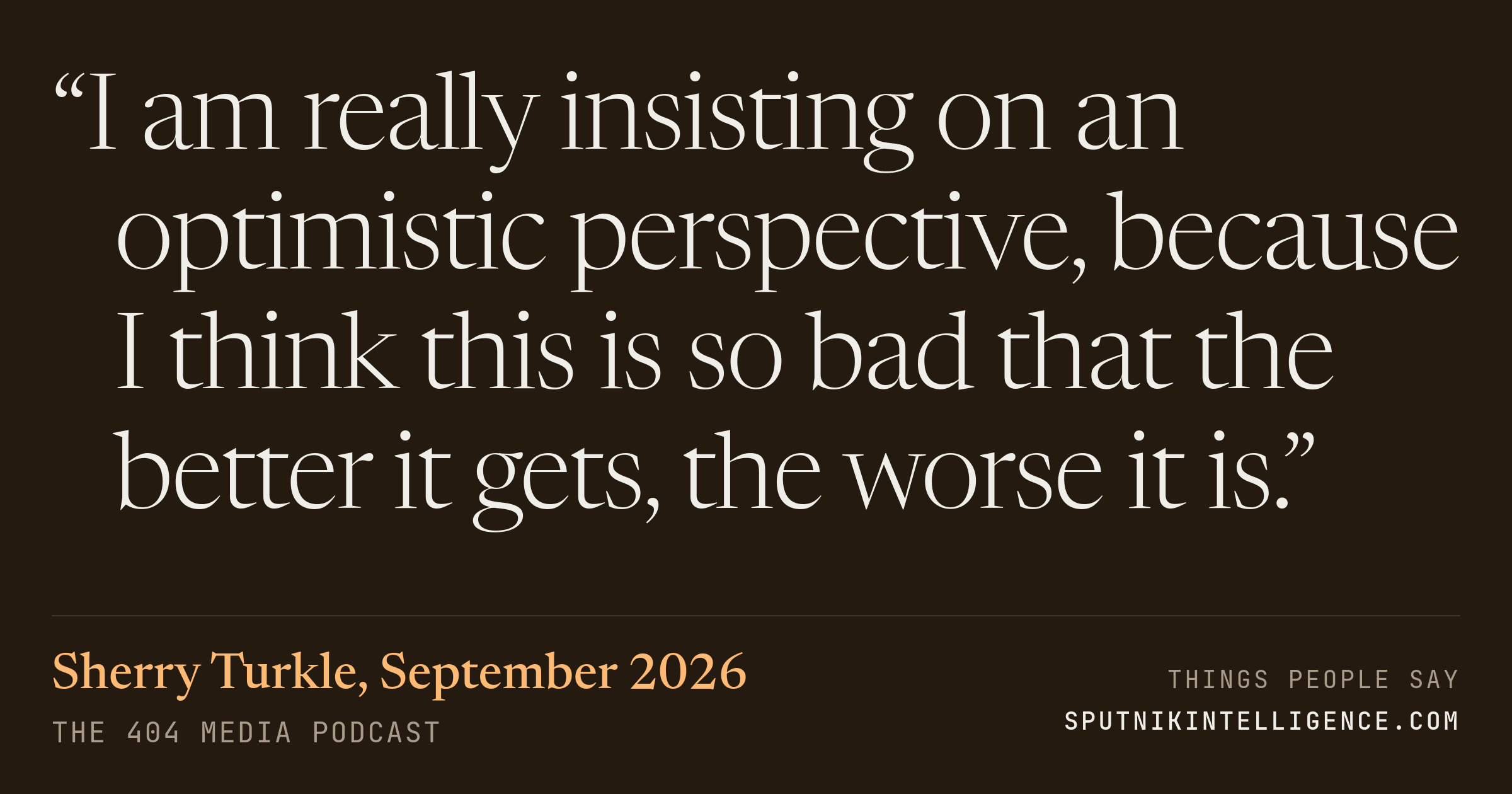
Turkle has been studying what people do with machines since the 1980s, and her new book is about AI companions. Asked by host Sam Cole what happens once reading for pleasure becomes rare and the people warning about it are gone, she argued that chatbots are a consumer product and therefore something a public can refuse — she expects a backlash the way there was one against cigarettes. Her bottom line of terrible, she says, is chatbots marketed to children.
I think the challenge to reading is really one of the sleeper stories in my book. And I know I'm going to be working on this a lot in the future. It's very in my mind. Because so many studies show that reading is a path to empathy. It's, you know, when you read, you identify with characters, you experience your life through their life. What are their choices? What is their situation? If I was Elizabeth, what would I have said to Mr. Darcy? Oh, no, Elizabeth's doing that. And people become more empathic through reading. And if you give the book to a chatbot and it tells you what was in the book, you can come into class and sound really like on top of it and super smart. But you haven't had the experience that really is so life-giving and it grows you on the inside. And I think that that's one of the things that really is on my mind about keeping chatbots out of education. Because my students, I'll give you an example. So I have them, I teach a course called Things and Thinking, which is how objects change how we think, how we think with things. And, you know, I have paper here and we think in certain ways if we deal with paper, we think differently if we deal with word processing. And we read Proust because he wrote a lot about the sensory nature of memory, how you remember things because you dip the cookie that your grandmother gave you into the same kind of tea. And people read Proust and they say, oh, yeah, I remember my grandmother. I remember that hot cocoa. It's an experience of empathy. Well, if you put the Proust into a chatbot, it comes back telling you all about Proust's theory of memory. So you can be in a classroom and like sound super smart, but you haven't had the experience of reading it yourself. So you're not growing inside the way we usually do from literature. And so I think that this is one of the. Dangers of our dialogue with machines that is really crucial in the years to come. Because people really are moving away from reading because it's hard. They find it hard.
Do you feel like, I mean, I'm just imagining like in a generation or two when people who read for pleasure are not or more rare, you know, you and I are no longer around to tell the younger generation that this is how it is. And like reading actually is good for your brain. What do you see as the next iteration of this? Like, what's going to happen?
I am really insisting on an optimistic perspective because I think that this is so bad that the better it gets, the worse it is. And it's so detrimental to sort of the inner life of people that even though it is so seductive, we are going to have a backlash to it because it is after all a consumer product. It is after all. You have to make a decision and say, one of the things I like to say, one of the things in the book that I most love to hate is chatbots for children. That's like, you know, that's like my bottom line of terrible. And I can say more about that. But if you're a mom, just because Disney and Mattel and OpenAI have a consortium, when a chatbot Mickey comes out, you can say, this is really a terrible idea for my kid. No, I don't want it. You know, when the chatbot binky comes out that looks like Minnie Mouse, you, you know, you're just holding the binky and the thing is like, this is like really a bad idea. And I think that I hope that my work is part of more and more people being emboldened to ask, what is the end game of this product? Not just, is it cute? Is it a marvel? Is it amazing? Is it, but if everybody starts to use this, you know, where are we going to be? And I think I want to say that I think that people are going to start to put it together. You know, maybe not this year, maybe not next year, but I think there's going to start to be a kind of backlash. Because when you talk to people who go to work and, you know, first, oh, the AI Making answer my mail and helps do this and helps do that. Great. I mean, no harm. But then they sort of move from it helps me organize my email to I'm starting to ask it, you know, personal questions and I don't go out as much because I just prefer to have a kind of quiet evenings at home with the chatbot. No, people have to start to ask themselves why that is, that is really not a good idea.
This is something I say on this podcast a lot, but people do often say that 404 Media, the outlet that I write for, is we write about like a lot of bummers stuff. It's like, it's a lot of bad news and it's a lot of realistic news. But I am actually very optimistic because we have these conversations and they're occurring and people are pushing back, even though it's not the majority of people pushing back against this stuff. There are a lot of parents who are really mad about chatbots in schools and they're saying, we're not doing this. And that's amazing. It
is. And I'm really proud to be part of the voices that are saying, you know, it's really okay to say that this technology was not a good idea because we really have a history now. I remember 15 years ago, Google and Facebook were selling and Apple were selling surfaces and Chromebooks and to schools and saying, close down your libraries because we can put the whole library on a Chromebook. Same difference, save money. And it taught a whole generation of people to sort of not read books, but to somehow be looking, well, it turns out that reading something, there's a different experience when you read on a book. Reading started to go down. I mean, it didn't lead to good. And we had that experience of education being really compromised, just saying, oh, well, it's just a force of nature that computers are going to come into education. And we can do better now. We can say, no, this is not a good idea. This is really not a good idea.
Yeah. The inevitability mantra is, I think, something that I think people are starting to realize that that's not the case. And it's great to see that because it is being scared and afraid of everything is not propelling to change. Do you feel like that is like, is that kind of your way back from this?