Derek Thompson had just pushed back with the MOOC comparison: free lectures were supposed to remake education and did not. Deming, Harvard's dean of the college, concedes the point and argues the lecture was never the hard part — the difficulty is, and it is easier to bear alongside other people. He thinks AI can personalise the tutoring but cannot supply the communal half.
Or an 18-year-old, exactly. So it's not a right now kind of thing. But if you look down the pipeline and you see what this technology will bring about, I think it's clear to me that we will no longer have the monopoly on expertise that we once did. And so it doesn't mean that expertise doesn't matter, but I think it does mean that we can't rely on that monopoly to sustain the university in this third age. And so I think it's the recognition that AI will commodify expertise and increase access to it. And that will be a good thing for humanity in the same way that the expansion of knowledge in the first era for the second era was a good thing for humanity. But I still think, you know, if you're, if you're, another way to say it, Derek, just to be concrete, is if you're a young person living, you know, in your poor country and you don't have access to a place like Harvard, AI is a tremendous boon for you because you have access to expertise, you know, from ChatGPT or from Claude or whatever that you never would have had before. And that's a great benefit to you, but you still don't have access to the ability to learn in community with other people who are talented and motivated like you. You still need to come to a place like this. And so I think it just acknowledges where we are that we have to innovate and we have to build on our strengths and build on what we think we can do best and what only we can do.
I think it's important to say that the idea that artificial intelligence is forcing us to change what a college is and is for is a contested notion. There are people who think AI is a scam, a fad, a bubble. There are people who might respond to your last few sentences by saying, Wikipedia has existed for decades. It hasn't suddenly made the world smarter. In fact, if the only two things you knew about the world was the fact that Wikipedia exists and PISA test scores, it would look like the existence of Wikipedia is mechanically driving down the world's ability to read and do science and math. So the availability of knowledge on the internet does not automatically guarantee any particular increase in edification intelligence. And one analogy someone might draw here is to say, well, 15 years ago, remember all that excitement around massively open online courses? People MOOCs were going to change the world. I think Clayton Christensen, the famous business theorist, said half of all colleges and universities are going to go extinct because of massively open online courses. Can you remind us what are slash were MOOCs? And why isn't artificial intelligence just MOOC 2.0?
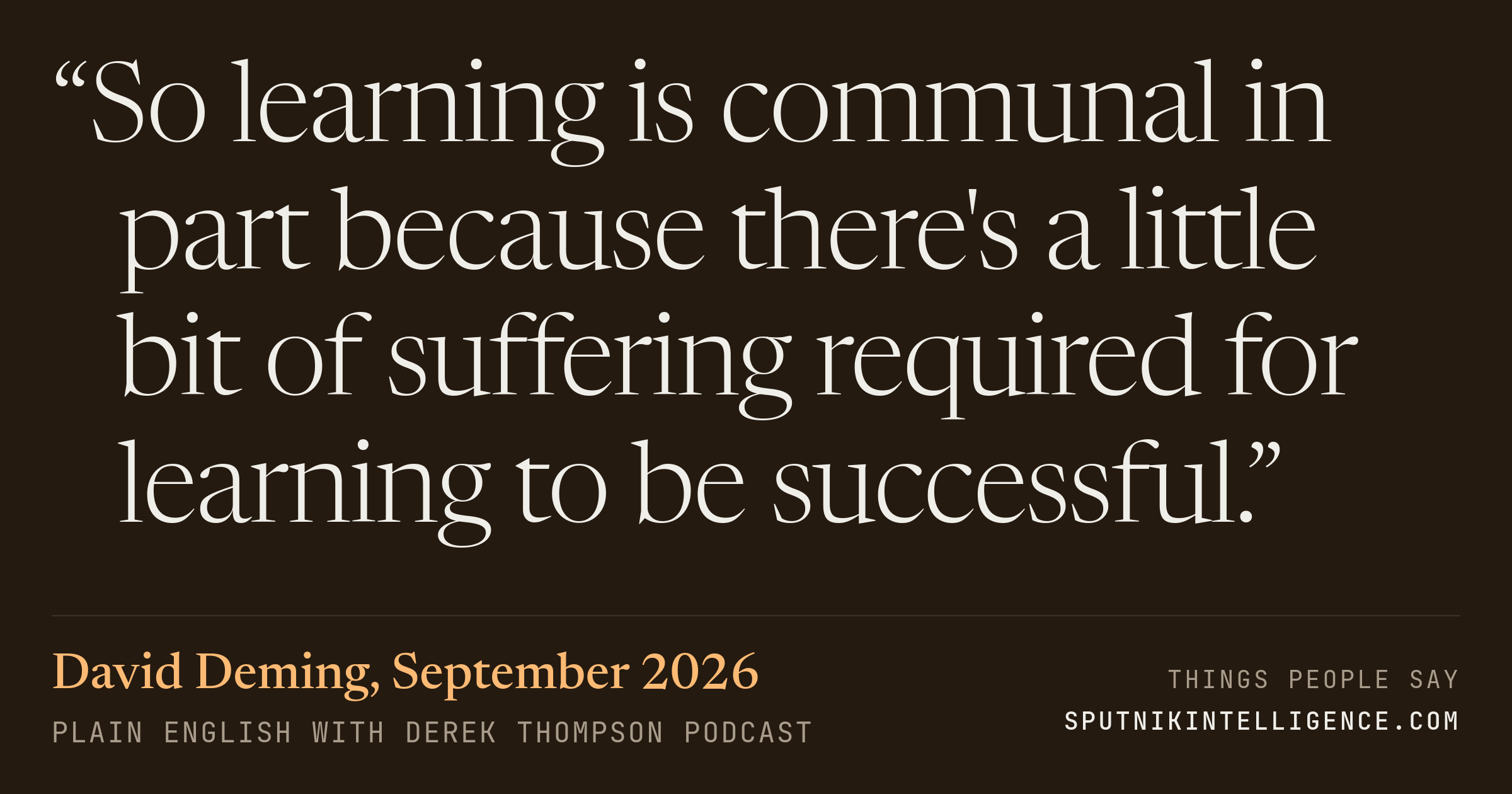
Yeah, well, I think I should say it might be. You know, I don't know the future. I'm not making a prediction. I'm just looking down the pipeline and trying to guess at what's coming like everybody else. I think with a MOOC, what happened was that people misunderstood the entire purpose of education. So what a MOOC is, is like a lecture. And this is still true today. You go on YouTube and you can access the best lecture at any topic you like, economics, any topic you want. And that lecture probably is better than whatever you're going to get in your college course, just as far as a lecture goes. But that's not the only or even primary purpose of an education. Part of it is to meet your individualized learning needs, to not just, you know, kind of deliver the content to you, but also help you understand it in a way that speaks to you, to meet, to diagnose people's gaps in their knowledge, and then to provide an experience that helps people learn together. So learning is communal in part because there's a little bit of suffering required for learning to be successful. Most of the important things I've learned in my life, I didn't understand the first time I learned them. And I needed a little bit of a push to focus on it. Some people are autodidacts and they can learn on their own, but most people don't buy textbooks and take them home and master subjects on their own, even though they'd like to, because it's hard. And so the community of learning together, which is what a college education provides, is a way to tie ourselves to the mast and do hard things, suffer together. And I think the MOOC revolution misunderstood that actually education isn't just the delivery of content. It's actually the ability to learn together and to customize learning for the learner. And I think that is the thing that AI can do that MOOCs couldn't do. So AI will meet you where you are. You can ask, you know, you can have a conversation with an AI tutor and say, I don't understand this. Explain it to me. Explain it to me again. And so you really, and there's been a lot of studies showing that when people take advantage of these personalization features of AI, including, you know, and it's important to say with guardrails. So if you do the learning, do some initial piece of writing or take a test yourself and try to establish a baseline of knowledge and then you use the AI to refine, give you tutoring, give you individualized feedback, it can really boost learning gains a lot. So that is the thing that is different about AI versus MOOCs, but AI still doesn't do the communal aspect of it, which is the, you know, learning together, binding ourselves to the mast. And so that's exactly why, Derek, I think that's where we need to go, because that's still a thing that AI can't fully cover, the most human aspect of our education.
I want to settle down in this question of how colleges should treat artificial intelligence, because I think it might be the key question to answer today. There's a live and quite ferocious debate, I think, over how colleges should treat AI. And different schools are coming to very, very different conclusions. Caltech faculty voted to strongly encourage in-person seated exams to make sure that you weren't relying on take-home exams that could be spoofed or faked or passed off to ChatGPT. Faculty in the social science core at the University of Chicago went as far as announcing an AI ban and a prohibition of all classroom technology starting this fall. I've read that other undergraduate and graduate programs around the country, including, I think, at places like, is it maybe me, Berkeley, have thought about banning all use of. AI in various schools. Two weeks ago, you sent an email to Harvard students on the first day of class. You said that you endorsed a policy of what you called, quote, AI encouragement. What does that mean?
Yeah. So here's what it means. I think that we have to account and honestly acknowledge the fact that everybody, not just our students, but everybody is using AI all the time for everything. And we have to design our education around that reality. And so what I said in my email was actually, I favor what I would call a barbell strategy to dealing with the challenges of AI, which is that you either have an enforceable way to ban it. And I would support that in many cases. Like I actually think using the AI to do the writing for you and the thinking for you is bad. But as a 47-year-old man, like I have developed my skills and habits of mind to do that. It's not that hard for me to put the AI down to write on my own because I grew up in a pre-AI era. But for students who are coming to college today, they were probably, you know, most or all of their high school writing experience is where this tool is available. And I think many of them need help and to build guardrails around that. And so I don't think it's sufficient to say to people, look, don't use AI. It's banned, but not enforce it and give a take-home paper and expect everybody to comply. Some people will comply, but they'll feel bad about complying because they'll look around and they'll say, well, if I behave with integrity and follow the course policy, I'm disadvantaged relative to my classmates who are going to secretly use AI and get a leg up on me. And so we don't want to be in a situation of creating rules and policies where you are rewarded for doing the wrong thing and you feel like you're being punished for doing the right thing. And so my statement was not AI encouragement in the sense of AI is awesome. Everyone should use it all the time, no matter what. It was, if you're not going to have an enforceable way to ban it, you may as well encourage it because everyone's going to use it. And so you should just adapt to that reality and build resilience to it in your class. And so I think there's a lot of ways to use AI without having it do the writing for you. So one way I use it, I don't ever use AI to write for me, but I do use it as like a mechanism for feedback. So I'll write a column or write a paper and I'll say, you know, interrogate this. Give me, you know, is this clear? Give me feedback. And so it's AI could be very helpful as a way to refine, hone your arguments, do fact checking, but that's different than doing the thinking for you. And so what I was encouraging faculty to do is to embrace it as a tool and to build guardrails around it in a way that makes sense in their own classroom and just acknowledge the reality that students are using it. And I think what's important about that, Derek, is I think what happens in these conversations is we get into this idea of is AI good or is AI bad? And if you say you're encouraging it, that means you're on the good camp. And if you're in a position like mine where you're responsible for undergraduate education, you can't really afford to take a position. You have to think, well, given what's happening now, what is the best way to design guidelines and policies to be resilient to the fact that students have this tool available to them and to preserve what's really important about their teaching and learning?
So let's be really specific here. Let's say that you're teaching a