RH

Roger Hurni

Things Roger Says on Podcasts

Runs Off Madison Ave, a behavioral marketing agency he co-founded whose clients have included Nike, PetSmart, Wells Fargo and P.F. Chang's. His work applies behavioral science to advertising decisions, using data to test what actually changes audience behavior. He wrote the book Outthink. Outperform., contributes to Forbes Agency Council, and appears on Embracing Marketing Mistakes arguing that how deeply someone questions AI output matters more than how quickly they adopt the tool.

Where to Find Them

Roger Hurni has been a guest on The Brainy Business | Understanding the Psychology of Why People Buy | Behavioral Economics and Embracing Marketing Mistakes .

Recently: “EP 124: He Built His Own AI Company Then Shut It Down” on Embracing Marketing Mistakes (August 2026); “405. How to Outthink and Outperform in Marketing w/ Roger Hurni” on The Brainy Business | Understanding the Psychology of Why People Buy | Behavioral Economics (June 2024).

What They Said

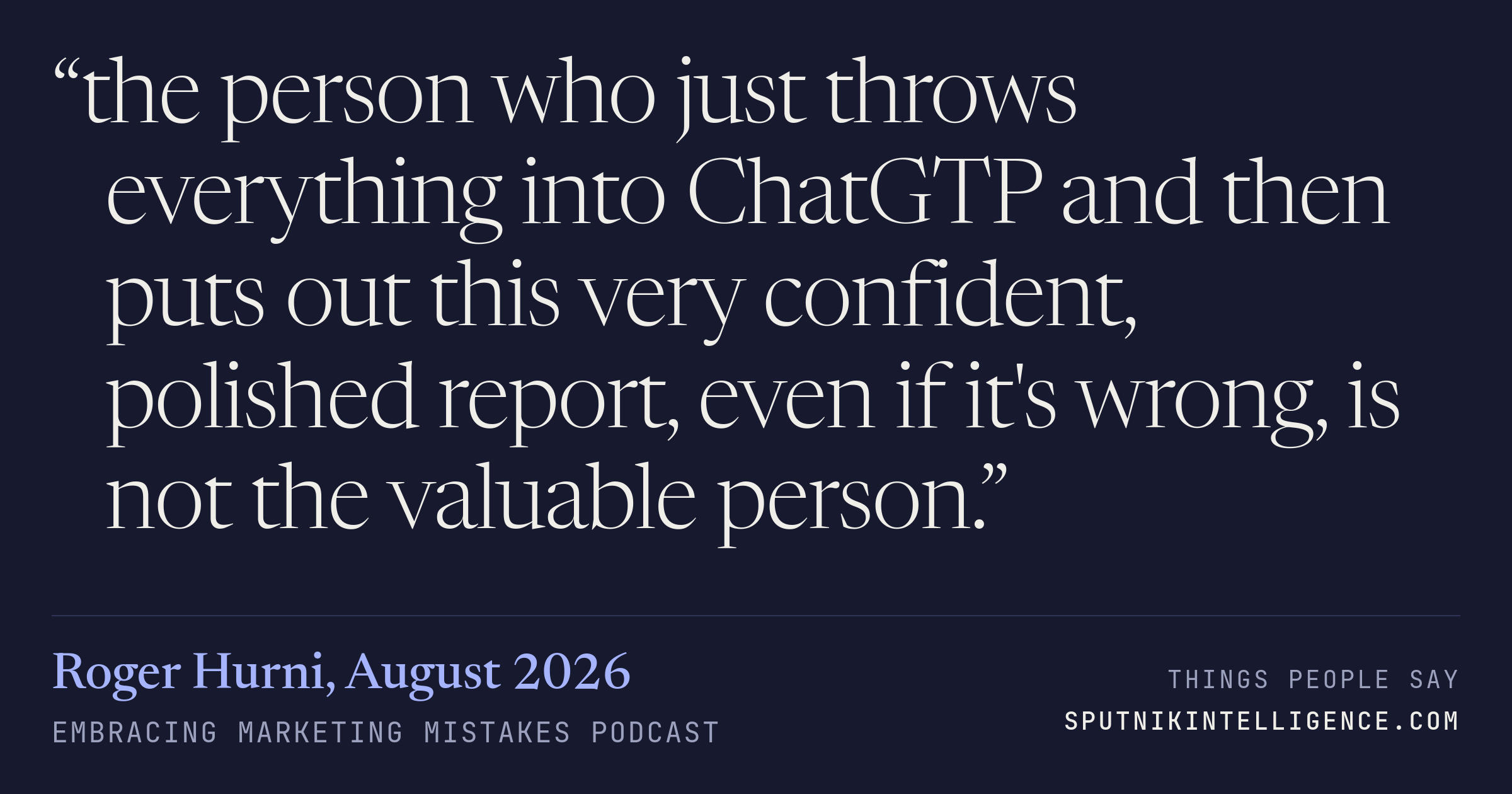
“the person who just throws everything into ChatGTP and then puts out this very confident, polished report, even if it's wrong, is not the valuable person.” — Roger Hurni, Embracing Marketing Mistakes

Roger Hurni was explaining why he doesn't think AI levels the playing field between employees. He argues that whoever pushes back on the AI's output, rather than accepting a confident-sounding answer at face value, is the one worth investing in.

Embracing Marketing Mistakes · 2026-08-18 Permalink → Listen →
Embracing Marketing Mistakes Around 29:10 into the episode
Roger Hurni

You know, it's evergreen because it has to do with human thinking. And so I'm not worried about it being like, oh my God, I get this out because it's about AI. It's about our evolution with it. And it's a futurist point of view. So I'm not like under some sort of pressure deadline. I would like to see the book done. And here's the thing: compared to my last book, which I wrote literally every word by myself, like without help, I am actually going to use AI to prove the point that you can work with AI in a really impactful way. So I do expect it to be written faster because of that. And I'm starting to see the advantages of that just because of the way I've trained. The agent, the way I'm writing, it's still my stories, my ideas, speaking into a computer and having it help me organize. So I would love to have it finished by the end of this year. And then if it comes out by the end of next year, it's probably just the publishing world just takes a long time to get through all that stuff. So I would definitely like it to come out next year sometime.

Speaker 1

So expensive sameness reference that you've used, I think Will talked about earlier. Expensive sameness. Are you talking about the fact that everybody will be producing stuff using the same tools? So everything will be vanilla. So all the same, but you've paid a lot of money to do it. Is that the point you're making with that?

Roger Hurni

No, what I'm saying is that if AI is an equalizer for people who are smart and for people who are stupid, then you need to have some other element that makes someone better than the other person. You guys have employees, right? Someone comes into your organization or you've got two employees, both with the same number of years' experience, basically the same background, and they have the same access to AI tools, who's the better person? It's going to be the one who asks the better questions. Because the person who just throws everything into ChatGTP and then puts out this very confident, polished report, even if it's wrong, is not the valuable person. It's the person who comes back with that messier document, the handwritten notes in the margins. The person who's like, hey, I didn't like these couple of answers, so I dug deeper. And I went back to the research and I found this that it didn't flag. And that's the person who's going to be the critical thinker. And that's the person you want to invest in. And in a few years, those two groups of people, they're not going to be the same place in any organization. One's just getting answers. But the other one, again, is expanding the thinking, expanding the options and applying judgment.

Speaker 3

And I suppose those people would always, those curious people that ask the right questions that are driven, irrespective of when they practiced in their profession, pre-AI, post-AI, they're always going to rise to the top, aren't they? You know, whatever technology they've got at their means, you know, that's going to get them far, isn't it? That has to.

Roger Hurni

Yeah. But I mean, you don't want someone who just mindlessly pumps out a press before AI. You wouldn't want someone who mindlessly pumps out a press release, crosses the T's dot line, hands it in without critical thinking behind it. It's just AI has just removed those social barriers, that social friction, and the ethics, quite frankly, to accelerate bad behavior.

Speaker 3

It's a tricky, I mean, back to this transitionary period we're in. It's tricky, isn't it? Because at the moment, there is a clear advantage of people that use AI, irrespective of how critical they're thinking. So it gives them an immediate kind of leg up, doesn't it? Just by virtue of using it. But obviously, that, you know, sooner or later, it's going to be a level playing field again.
Speaker names from our own diarization · position estimated from where the line sits in the episode
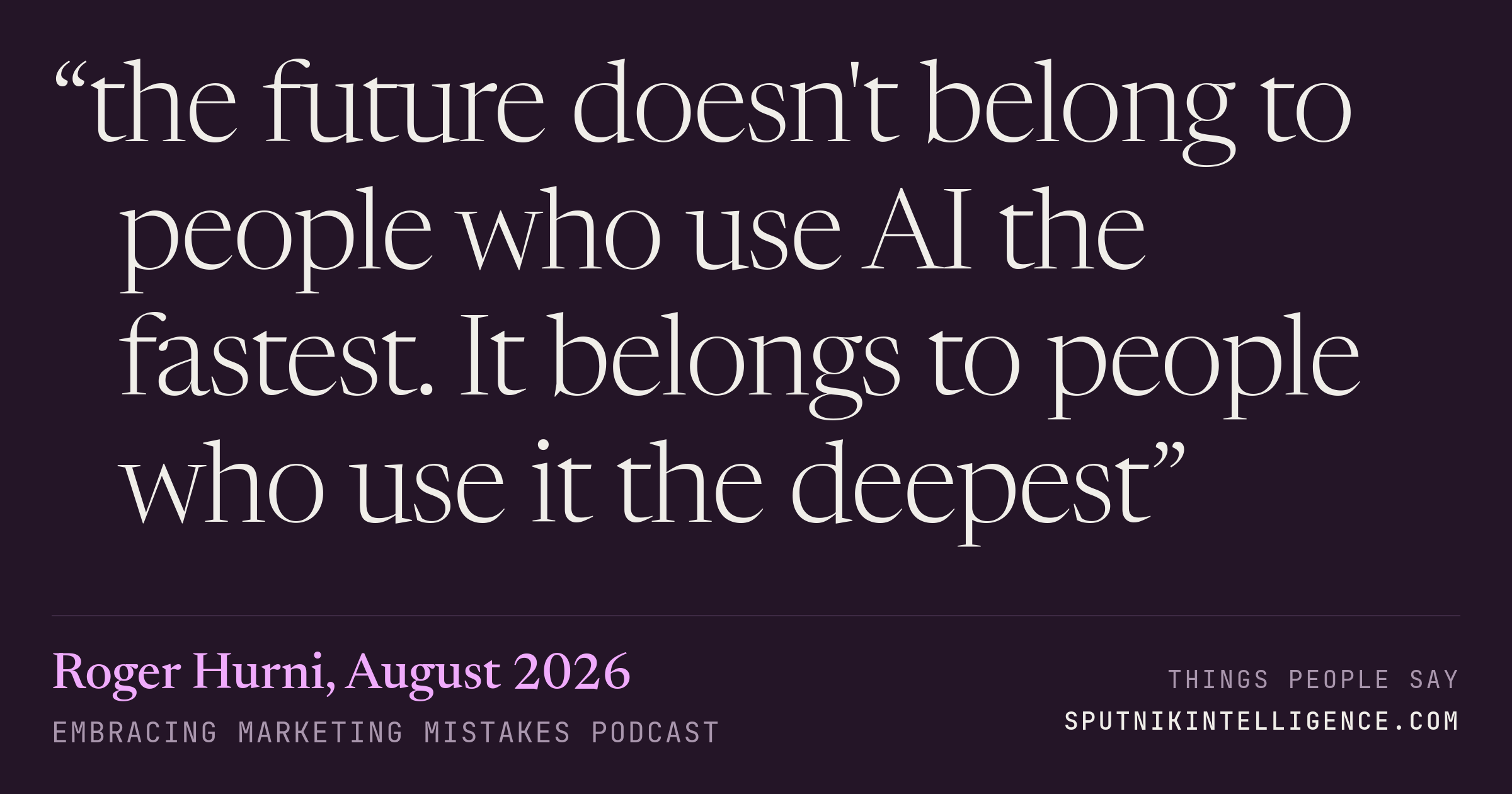
“the future doesn't belong to people who use AI the fastest. It belongs to people who use it the deepest” — Roger Hurni, Embracing Marketing Mistakes

Roger Hurni, a behavioral marketing agency founder, was discussing how AI adoption is unfolding across industries. His point was that speed of adoption matters less than the depth of thinking someone brings to using the tool.

Embracing Marketing Mistakes · 2026-08-18 Permalink → Listen →
Embracing Marketing Mistakes Around 22:52 into the episode
Roger Hurni

it. Well, let me answer your last question first, and then I'll address how that went about. I would probably say to that person, we're probably not the right agency for you. Look, there's always going to be bad actors. There's always going to people who are looking for shortcuts. And you're going to have that person who's a solopreneur, one person real estate agent who's just going to use a claud, crank out an ad, crank out a press release, send it, and they don't care. It's just content that's going out in the world. That does not mean there's depth of thinking. That does not mean they're looking at unrealized opportunities or looking for gaps. That doesn't mean they're not trying to expand their thinking. Companies that are more sophisticated, that want to truly have market share and set themselves up with points of differentiation, aren't going to rely on the first answer out of ChatGTP. So they're just never going to be a client. I just won't take them. And in terms of a philosophy document, because you're talking about some specifics, our philosophy document doesn't say we do this with it or we do that with it. Like it says, this is how we work with AI. We use it to expand those options. We do not let it replace judgment. We use it to find gaps. We'll use it to comb through mountains of research that it would take way too long and be made cost prohibitive for us to do by hand so that we can synthesize those answers in a way that we can apply our own judgment to it and look for additional opportunities. So a philosophy document, again, I think lean hard on the word philosophy. It is not specificity, right? We're not saying, oh, we use it to create an ad at this stage, right? Or we use it to create the writing of a press release or even a draft of a press release. We never talk about that. We may, we may not. It's the context around how we use AI that's the philosophy document.

Speaker 3

This kind of unscrutinized, uncritiqued use of AI. I don't know about you, but I'm seeing quite a lot of that. And we're seeing briefs come in. Half of the new briefs we get in from companies that should know better are purely written with AI. You can tell they've not been scrutinized at all. We've identified AI copy on one of the major ad magazines in the UK come through on an email. And I think it's pretty widespread at the moment. Is this, I know there's a term you use, expensive sameness. Is this what we're talking about here?

Roger Hurni

Yeah, but any new technology does that will. I mean, any new technology that does disruptor. It usually runs through two industries first, pornography and music. And once it gets past that, it goes into people that try to do take shortcuts or do nefarious stuff with it. And once you get past that group of people, and we're still in that group of people right now, you're going to have people who understand this technology can be incredibly powerful and use it in ways that you never thought of. I mean, the desktop computer was like that. IBM's like, why do we need, why does people, why do people need a computer on their desk? They just did, they didn't understand that the future is, you know, for our, in our, in our time frame that we're in right now, the future doesn't belong to people who use AI the fastest. It belongs to people who use it the deepest, right? The ones who question more, the ones who don't have it replace their judgment. There's a place in the world for AI, just like there's a place in the world for calculators and computers, and they replace the side rule and the abacus and all those other things. We're adopting a new technology and we're going through the growing pains of adopting that new technology. But at the end of that, if everybody has the same tool, who's the better person? It's the person who thinks better with it and not the person who just looks for output.

Speaker 3

How long have we got to go then? How much more pain have we got to get through before we get to that point?

Roger Hurni

If I had that answer, I would be a gazillionaire. I

Speaker 3

think. Yeah, it's a few more months here, I reckon.

Speaker names from our own diarization · position estimated from where the line sits in the episode