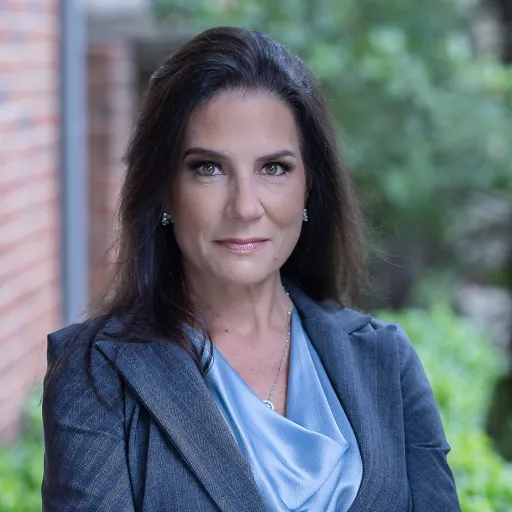
 Danielle DiMartino Booth
 is CEO & Chief Strategist for QI Research LLC, an independent research firm.
Danielle DiMartino Booth
Danielle DiMartino Booth is CEO & Chief Strategist for QI Research LLC, an independent research firm.
“But do we really need banks in Cleveland, Minneapolis, St. Louis, and Chicago?”
The David Lin Report · August 2026
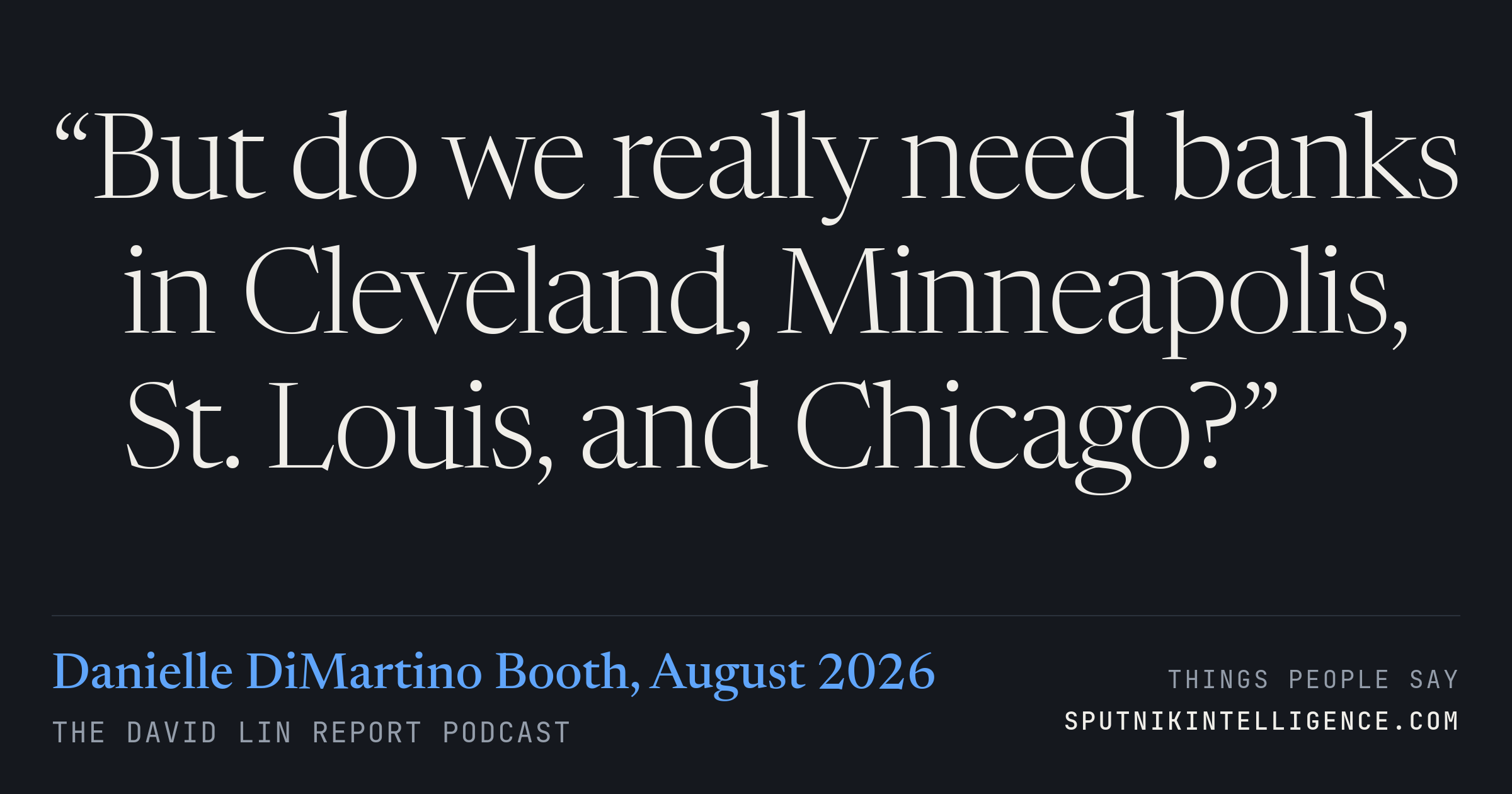
Christopher Waller is running a task force examining how efficiently the twelve Federal Reserve district banks actually operate. Asked instead about who voted which way at the last meeting, DiMartino Booth points at that review — and then asks the question the review itself is careful not to.
Transcript
I think Kevin Worsh will take as many dissents as can be thrown at him. Again, I don't think we're going to see any governor's dissent given the direction of the actual inflation data that have been reported. Because Kevin Works would say, please justify for me, given we have disinflationary winds blowing, please explain to me why we should be tightening. And there would be nobody on the Federal Reserve Board staff who could justify it by saying, well, we're just concerned that inflation is going to rise, even as disinflation is settling into core inflation. It would be a very difficult argument to make. And that, again, that is why Worsch is really angering market participants in refusing to provide forward guidance.
If, by the way, let me just put this on the screen here, voting for this action, Worsch, John C. Williams, Michelle Bowman, among others, Jerome Powell, Christopher Waller voting against this action, Beth Hammack, Neil Kashkari, Lori Logan. Do any of these names surprise you for against or for?
No, not at all, because there is a separate drama that is unfolding at the Federal Reserve right now, where the makeup of the 12 district bank presidents' district banks functions are being scrutinized right now by Christopher Waller, who is in charge of a task force looking at how efficient or not efficient modern or not modern operations at all 12 Federal Reserve districts are. So naturally, there is going to be a lot of defense being played by the district bank presidents because they feel that their kingdoms have been, have come under siege. But you tell me, I mean, we probably could use another district bank out on the West Coast. That's where everything always seems to blow up, whether it's countrywide or a Silicon Valley Bank. But do we really need banks in Cleveland, Minneapolis, St. Louis, and Chicago? These were district banks that were based on the politics of the era back in 1913 and railheads and where they used to be. We live in a slightly different economy today. And it's right to call out such a gigantic bureaucracy and question whether or not we need, truly need 12 Federal Reserve district banks where they are today.
We haven't talked about the labor market in detail today. Can we give us an update on the labor situation? The Fed needs to look at the unemployment situation as well. In July, the U.S. unexpectedly lost a few jobs by a few, I mean, 23,000 payroll jobs, which is more than expected. But again, that's just one number, one month. What is the overall trend here? What's the update?
Well, since the end of last year, we've lost 1.6 million full-time jobs. Of course, a full-time job loss is much more impactful on aggregate consumption compared to that of a part-time job. And that really is where we are today. We're seeing the labor force participation rate decline. And we're not seeing job creation keep up with the growth of the population, despite the very convenient narrative that it's all attributable to out-migration. There are simply more people entering the workforce, according to the Census Bureau, than jobs are being created right now. But I think I'm going to step back for a second here because when you listen to Worsch talk, he almost exclusively focuses on price stability. He speaks very little about the labor market and is of the mindset that if he gets inflation under control, that the labor is not going to be a good thing. market will follow in suit and also be in a more on a more solid footing um but the labor market itself is is certainly not doing anything in the way of of healing
yeah it it is troubling because ultimately which is the lesser evil here higher inflation or or higher unemployment you know i would argue that the labor market needs to be stabilized because who cares about inflation if you don't have a job but um i i don't you you know you you tell us please if we're at that situation yet to worry about but
More from The David Lin Report