 Dwarkesh Patel
Hosts the Dwarkesh Podcast, a long-form interview show on AI progress, timelines, and the people building frontier models, along with economists and historians.
Dwarkesh Patel
Hosts the Dwarkesh Podcast, a long-form interview show on AI progress, timelines, and the people building frontier models, along with economists and historians.
“How is the wealth of the richest people in the world instantiated? Mark Zuckerberg is hiring MMA instructors and dancers for his wife's birthday, but most of his wealth is just stock in Meta. He could turn that into dividend income and spend it on consumption — but instead he'd rather have his wealth compound in Meta, building more data centers. So you don't even have to change humans for this to be the case: the wealthiest humans, growing wealthier because their wealth compounds, just have this almost Nick Landian preference for accelerating capital.”
Dwarkesh Podcast · AI Research & Frontier Labs · June 2026
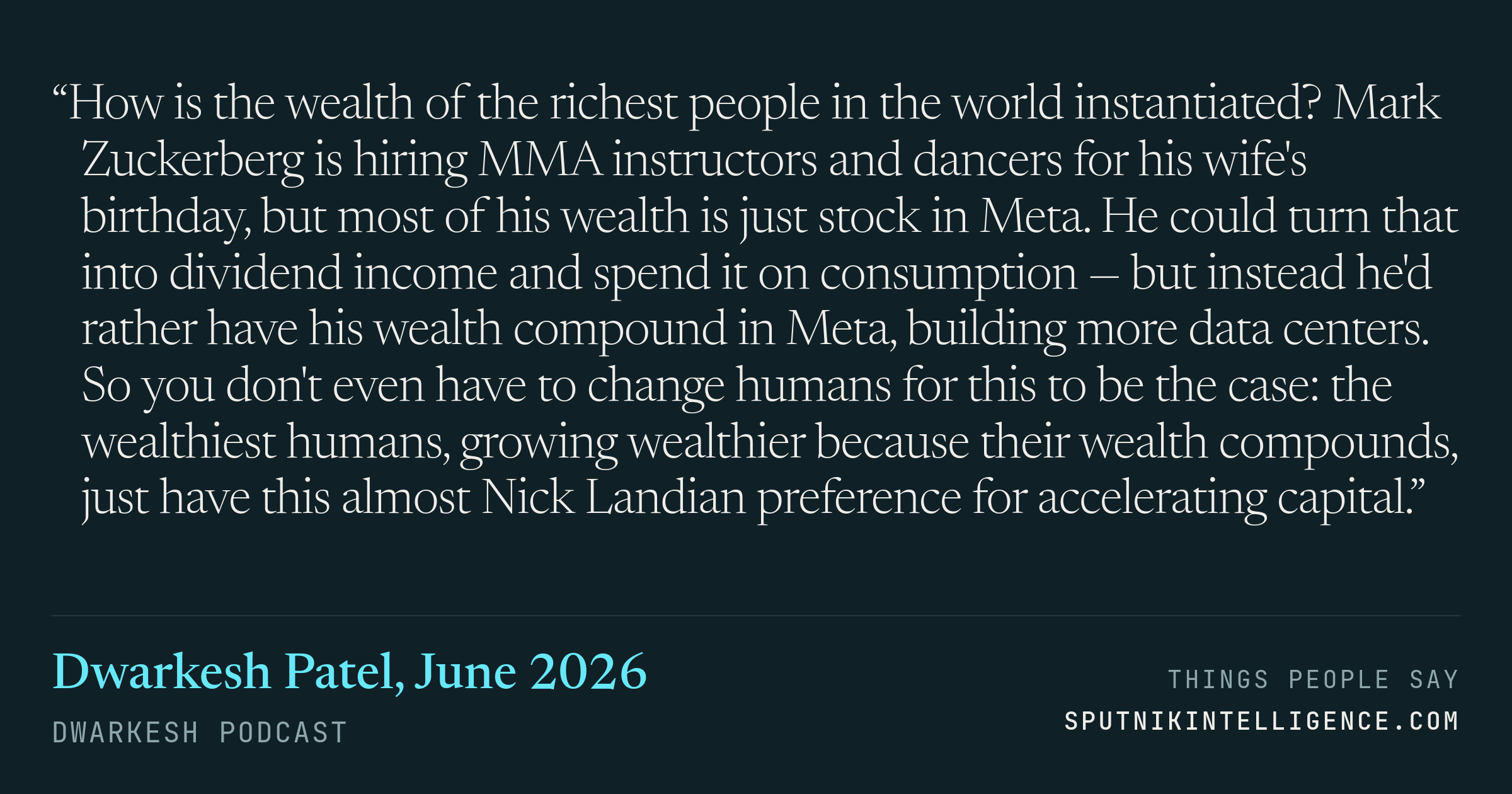
Testing the argument that as AI-driven wealth concentrates, the very rich would eventually redistribute it through consumption. His counterexample is that the consumption is already a rounding error, and the revealed preference of extreme wealth is to keep compounding into productive capital rather than spend.
Transcript
Right.
So even if like you get some sort of indifference now, you might get selection to point into like an even stronger preference for other humans.
Here's one way to think about it. How is the wealth of the richest people in the world instantiated? Of course, they can, as you were, we were having a call earlier and you're making the point that their consumption is more geared towards relational goods. Like Mark Zuckerberg is hiring MMA instructors and dancers for his wife's birthday and so forth, but most of his wealth is just stock and meta. And he as a controlling shareholder could say, hey, meta, just give me all this income or turn all this wealth into dividend income and I will just spend that on consumption. But instead, he rather would have his wealth compound and meta to build more data centers, basically. So you don't even have to change humans for this to be the case. It is just the case that the humans, which are wealthiest and are growing wealthier because their wealth is compounding, just have this like almost Nick Landian preference for like accelerating capital. And that does seem to suggest that, yeah, is that an important determinant of what kinds of things are produced in the future?
Yeah, I could kind of just say like there's two ways you could get the two kinds of people, one of whom prefers a human therapist and one of whom is
interacting with the AI.
If they both satiate equally quickly in capital, right? But the one who likes the human therapist just also likes having some human intrinsic services, then the marginal value, like how the marginal value of capital in the
More from Dwarkesh Podcast