 Dwarkesh Patel
Hosts the Dwarkesh Podcast, a long-form interview show on AI progress, timelines, and the people building frontier models, along with economists and historians.
Dwarkesh Patel
Hosts the Dwarkesh Podcast, a long-form interview show on AI progress, timelines, and the people building frontier models, along with economists and historians.
“Very plausibly, incremental capex every year is getting close to $10 trillion by the end of the decade. That's going to be close to a tenth of the world economy, and if it's all happening in the US, a third to a quarter of the US economy would just be going toward data centers. As I say that out loud, I'm like — maybe you're right and we just won't allow it, and that's the reason this doesn't happen.”
Dwarkesh Podcast · AI Research & Frontier Labs · August 2026
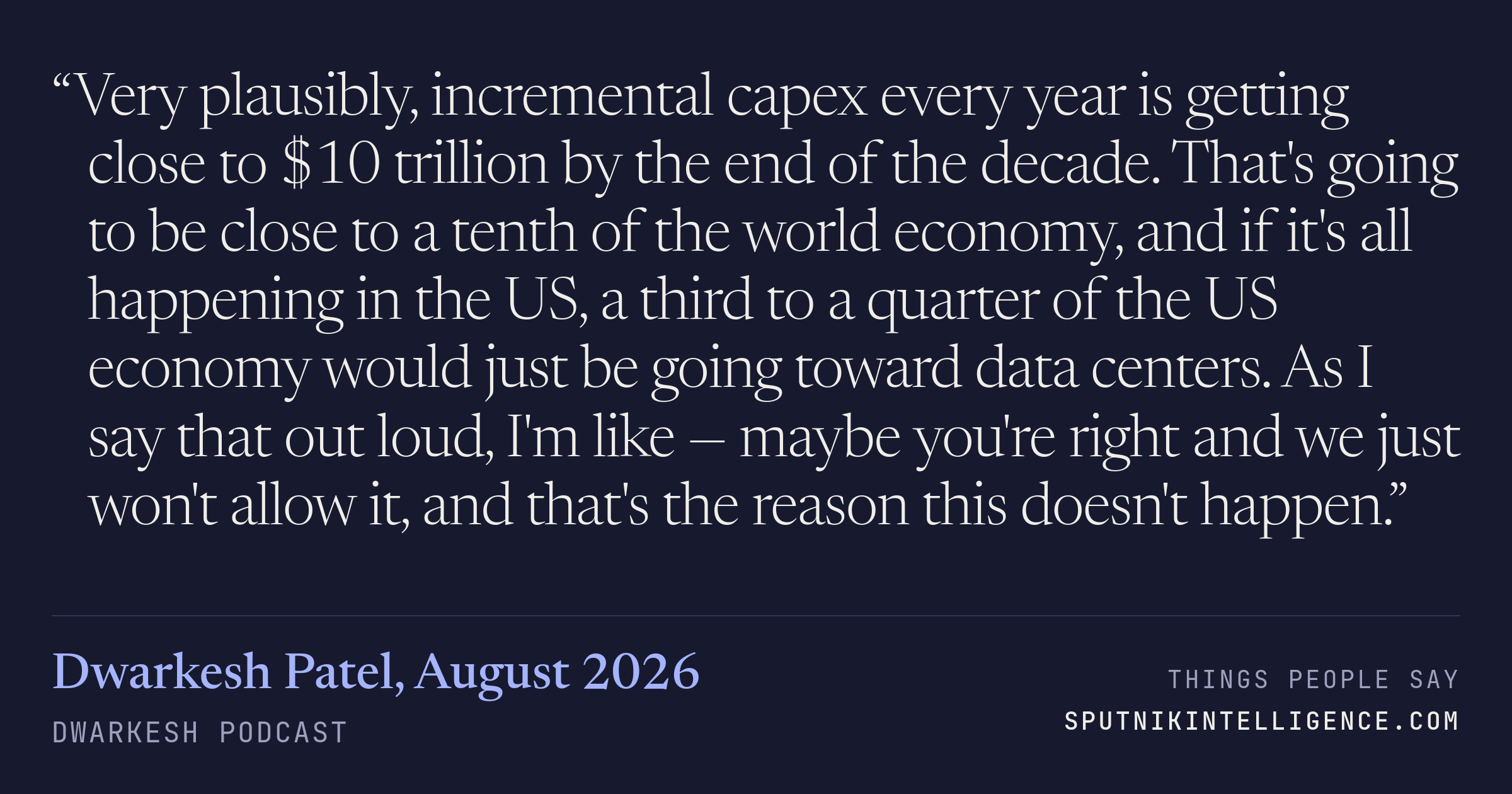
Working through Patel's capex projections out loud and arriving at a conclusion he didn't start with: that the binding constraint may be political rather than technical or financial. The self-interruption is the interesting part — he talks himself into the objection mid-sentence. Patel's reply is that he believes in reallocation toward the most profitable thing, but concedes the politics.
Transcript
Right. So very plausibly, incremental capex every year is getting close to $10 trillion.
By the end of the decade.
Right, which is going to be like close to a tenth of the world economy and like a third of, if all of it's going up in the US, it's like, well, the U.S. economy will have grown as well, but still at the current size of the US economy, it'll be like a third to a quarter of the US economy would just be going towards data centers. And as I say that out loud, I'm like, maybe you're right and we just won't allow it. And that's the reason this doesn't happen, right? Because for this exponential continue, just like a quarter of the world, a quarter of America's economy is just building data centers.
Yeah, I mean, I believe in capitalism and reallocation of resources towards the most profitable thing, but at the same time, politics exist. Yeah, yeah. And credit markets exist and capital markets exist. So. To enable, let's say, that 100 gigawatts by 2030, or let's even like pare it down to 2028, where it's like $3 or $4 trillion of CapEx across all of these items. A couple, over, two and a half towards IT CapEx, and then another one to two on data center and energy and all the supply chain downstream, like semiconductors and all that stuff. So, if you're at $3 or $4 trillion of CapEx, where does all this cash come from? No one is generating that much cash from the business yet, right? Hyperscalers, they've funded all of the growth up until now: Google, Microsoft, Amazon, Meta. They funded a huge percentage of it. They were more than half of compute, but they now don't generate cash. They actually spend everything on CapEx. And in addition, they raise debt and spend everything on CapEx, right? You've seen Meta do it, even Amazon, even Google, Microsoft will be there soon. Everyone is raising debt to pay for their CapEx. So now, who is the incremental person to pay for this? That was not doing it before. In the case of Google, it was pretty simple for them to stop doing buybacks or Meta stop doing buybacks and turn around and buy computer infrastructure. And that doesn't have a huge effect on the market, but it does have some effect. But as you step forward to 2028, where the hyperscalers are now raising hundreds of billions of dollars of debt, and then all of their supply chain is raising hundreds of billions of dollars of debt, who pays for this? And so there's a few different ways. You know, there's the semiconductor companies like NVIDIA and Broadcom and the memory companies turning around and deciding to fund some of this CapEx. There's the traditional infrastructure investors who are turning around and gathering capital and investing in infrastructure. And instead of bridges, it's data centers. And then lastly, there's everyone in the economy who's realizing maybe I shouldn't buy a home, or maybe I shouldn't invest in credit for a home that's helping people buy homes, or maybe I shouldn't buy government debt. I should just buy hyperscaler debt, or I should just buy this data center's debt, or I should buy Anthropics debt because Anthropic's willing to pay 20% rates for the incremental billion dollars to build their capacity because they know their revenue from it's going to be huge and they're going to pay 20% because it's still better than renting it from SpaceX for $50 billion a gigawatt. So you've got all of this contention, but if you now do this, the whole world economy is like really shifted around.
Antithesis is a deterministic software testing platform that enables perfect reproducibility. It also unlocks some pretty insane approaches to debugging, like time travel. With Antithesis, you can jump to any point in a trajectory and start from there. So when there's a crash, you can rewind to the exact moment that something went wrong and freeze the entire system. The application, the database, even the environment itself. This lets you do something that would otherwise be impossible, which is to observe every part of a distributed system at the exact same instant. Time travel also allows you to add telemetry and logging to an event that has already happened. For example, you can rewind to five seconds before a crash and decide to capture all the network traffic. Most powerfully, Antithesis gives you a live terminal into your system that you can use to perturb anything you wish. Kill a node or disable a feature and then hit play and see what happens. Then go back and try something else. In production, you often only get one shot on goal with this sort of destructive analysis. If you restart a deadlock service, for example, the exact deadlock you needed to study disappears. But with Antithesis, the original timeline is always reproducible. So you can test as many hypotheses as you need. And if you don't want to do all this time traveling yourself, you can just have your agents do it for you via the Antithesis API. Go to antithesis.com/slash to learn more. So you and I have been debating off air for the last few days whether there will be a sovereign debt crisis as a result of AI. And the logic is this: AI is you have a situation where, as we were mentioning, very little investment turns into a lot of money, right? So the rate of return. What
a fucking problem, dude. Can't believe it.
More from Dwarkesh Podcast