“The reality for most organizations today is that they don't need frontier models for their enterprise workloads, almost none of enterprise workloads. … Every CFO got the token bill in February and March. And it was, obviously, an oh shit moment for the whole world.”
The Cognitive Revolution" | AI Builders, Researchers, and Live Player Analysis · AI Research & Frontier Labs · October 2026
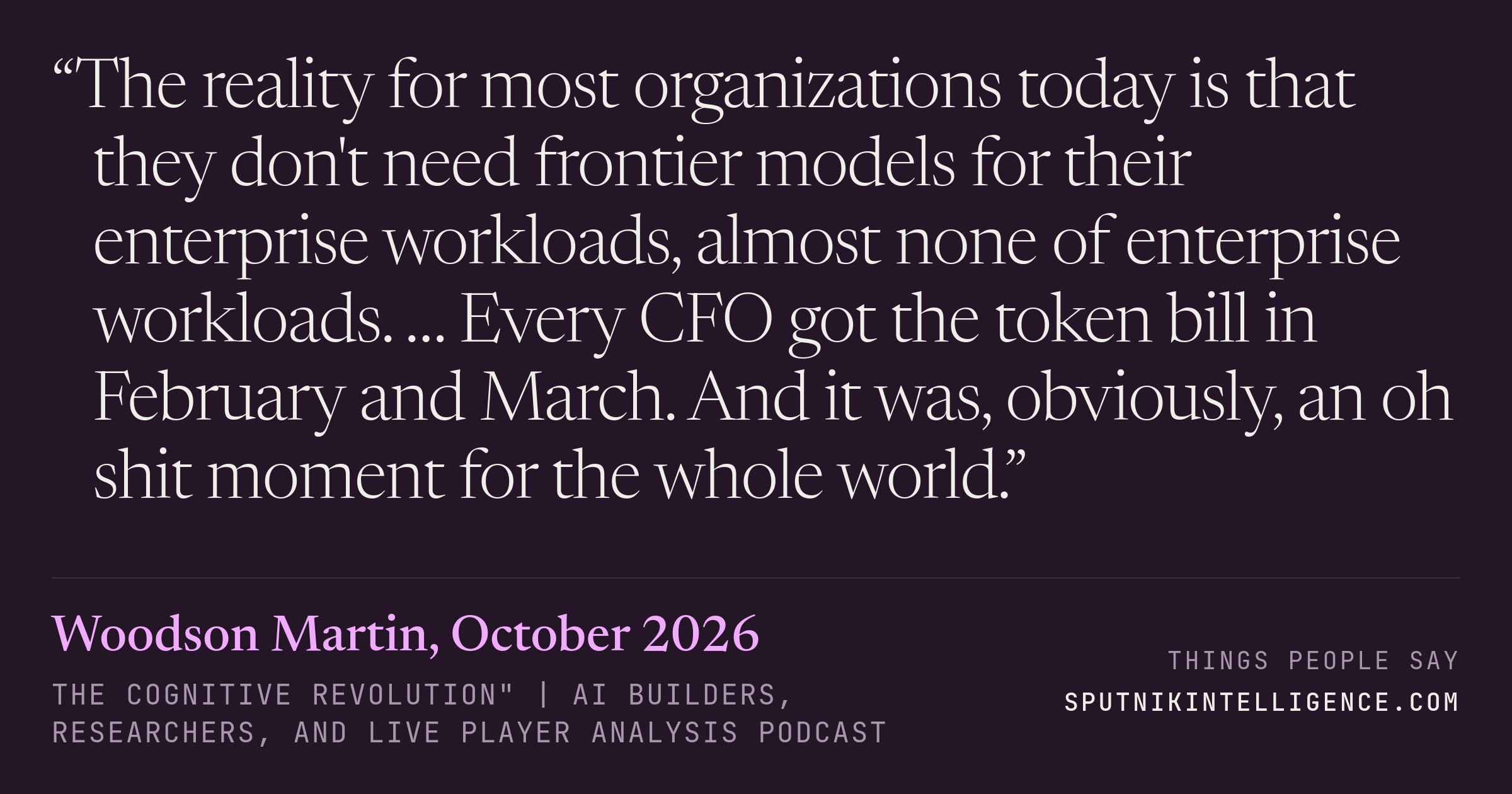
The OutSystems CEO is asked how his company's token spend has changed. He says it peaked around June and July and has fallen since they built their own harness and a router that sends jobs to cheaper models. A lot of routine enterprise work, he argues, can run on models three years old, or on plain deterministic code.
Transcript
There is no finish line on security and cyber threat, right? Like as technology evolves and gets better at all things, it also gets better at cyber attack. And the world is full of legacy technology today. So the big enterprise, we have lots of customers out there who still have 60-year-old COBOL systems running in corner AS400, Lotus Notes, like all of it. And there's so many of these systems. Like the idea that at some point we reach a stasis and everything is perfectly, you know, secure, I think is a pipe dream. So no, I don't think it ever gets to the point where there's nothing. Now, are the model companies who are both fueling the tech that can discover vulnerability and penetrate, right, going to benefit also from the use of those models for protection, right? And White Hat and everything? Yes, for sure. Like, obviously, that's driving a lot of token burn today. Probably will continue to. It's hard to see why it wouldn't.
Yeah. How is your token spend to the degree that you want to share the details? How has it evolved over recent months? And how do you think about it? I often ask people: what's your ratio of token spend to payroll as one way of kind of getting a handle on it?
I'll say, you know, maybe one thing I'll just say is kind of peak for us was kind of June, July. It's been telling off. And part of that has been like learning a lot about and frankly focusing on it. Like last year at this time, our sole focus was like, hey, shift everything to AI, use models for everything. And that created a huge amount, a bunch of learning. First, like we learned a ton. Second, a huge increase in velocity in terms of just capability delivery. So think software engineering, a big part of what we do, shipping software products. I think we shipped four major features in Q4 last year, 19 in Q1 and 26 in Q2 this year. So like we saw a huge surge in our, you know, and this is not minor things. These are major new capabilities that was a dramatic acceleration due to that kind of AI investment. We saw it in the token burn, but worth it for the impact. So that was great. But one of the things that we've learned is actually most of those things that we were doing, we could do just as well, a lot cheaper with a better harness. We built one, right, for our own engineering organization that is, of course, full of all of our own context and is optimized for us. We built a gateway, right? A route, LLM router. So we're like, not all those jobs need to go to, at the time, whatever, Opus 4.8 or something, and we could reroute to lower cost models for specific jobs. So we've actually seen, we're actually burning less today than we'd forecast in Q3 because of optimizations largely that we've been able to do. So I think the reality for most organizations today is that they don't need frontier models for their enterprise workloads, like almost none of enterprise workloads. And I think about the real operations of a business as opposed to necessarily the creation of a new software asset. And those workloads can use models that are three years old for most of the stuff. Like when you look, it's really boring what most of the enterprise workloads where AI can make a real advance happen today. And a lot of that stuff can be done with deterministic code cheaper than it can be with a model at all. Or two, can be done with a lower cost model, either because you're using open weight or you're using. Using a just an earlier version of one of the foundation models. And the and that's, I think, a key learning for us. We're seeing that in our own work. We're seeing that certainly with customers. And this is why it's important to build your workflows, right? To build your Agentic systems on a platform that makes it super easy for you to swap models to get the best of what's out there. Maybe because capability improves, maybe just because you can do it cheaper with another model. And I think we're going to see without question that most enterprise workloads are operating at a much lower per token cost than what the frontier of the frontier is offering today. And at the frontier, people are cutting prices, right? Like, I think that's the other thing that's happening here. So there's going to be a lot of shift. Like, I don't think we were on a sustainable trajectory in the first half of this year, right? Like, everybody, every CFO got the token bill in February and March. And it was like, obviously, an oh shit moment for the whole world. And so everybody started doing controls, whatever they were, capping token spin on a per person basis, putting in a router that would allow you to route jobs to lower cost things, pulling back entirely from, you know, an AI first for everything everywhere strategy. We saw that in some companies. We saw big announcements about that. I think Microsoft, Meta, Uber, like all these companies who were like, wow, maybe went too far too fast. But I think you can get back to the point where you're really leveraging AI and everything. You just need to do it in a way that is smart, right? And that's why you need platforms to help you do that. And that's the kind of job systems is doing for our customers.
So let's do a little double-click into that. I would be very interested to know how you advise customers in terms of what your model mix is, what you think their model mix should be. I would guess that developers, when they're coding, are still upgrading to Opus 5.5 immediately, but maybe not. And then I do understand how if you're trying to convert PDFs to structured data, obviously you can do that more cheaply. Do you recommend even going as far as fine-tuning for some of those use cases to really dial in performance on a cost-adjusted basis? And what about Chinese models? How are you seeing people react to just the, I don't personally feel it's all that scary, but sometimes the scary prospect of a Chinese intelligence in their business.
Yeah, I don't know if I have unique insight on the Chinese model question. I would say that we certainly have some customers who are perfectly happy to go there, either by running their own, you know, running their own versions of those, distilling them or post-training, tuning. And that's happening for sure, and usually driven by cost concerns. Although I'll also say that like we have a very global business, right? Half my customers are in Europe. I got tons of customers in Asia. And attitudes around this question are very different in different parts of the world, right? Not everybody is like super excited to trust their stuff to U.S. companies. And when you go to a lot of places around the world. And so we definitely see a huge diversity in terms of models used in Agentic systems that customers build on our platform. We also have done a ton of tuning on our own. So you think about, so we offer a service today to build your apps on our platform, to build your Agentic systems on our platform. We have a service we call Mentor to do that. Mentor offers its own agent experience for you as a user. You can come on to our site. You can use our IDE and you can use our mentor directly there, but you could also operate that through MCP services using any coding agent or harness of your choice. So what we've done, of course, is we've picked and fine-tuned a bunch of models on the back end to drive the effective and efficient execution of these builder workloads for our platform. And so when you use a frontier model on top or even an older model on top of those MCP services, you're getting the benefit of a whole bunch of optimization under the covers and a much lighter weight job that your harness needs to or its models need to do to give you the result that you want on our platform. And so there's frankly just a lot of answers here around optimization at various layers of the stack that come into play. And I think one of the Things that we do for our customers is we simplify all that. And we're like, we've done the hard work to optimize and to deliver, therefore, what you need, rapidly building, maintaining, managing complex systems with AI. And we make that easy and inexpensive, but also trustworthy for you. And we're simplifying that world. So that's a big part of the value proposition of the OutSystems platform.
Hey, we'll continue our interview in a moment after a word from our sponsors. This episode of the Cognitive Revolution is brought to you by
More from The Cognitive Revolution" | AI Builders, Researchers, and Live Player Analysis