 Dwarkesh Patel
Hosts the Dwarkesh Podcast, a long-form interview show on AI progress, timelines, and the people building frontier models, along with economists and historians.
Dwarkesh Patel
Hosts the Dwarkesh Podcast, a long-form interview show on AI progress, timelines, and the people building frontier models, along with economists and historians.
“In a world where AI can physically do anything humans can do, humans may or may not be involved in the physical production of things — probably not. But then there's this human economy where humans are doing services for each other, and part of their wealth flows to other humans, but part also flows out to buy automated goods. Only humans have that preference for other humans. So isn't it intrinsic that the human-only economy will become a smaller and smaller share?”
Dwarkesh Podcast · AI Research & Frontier Labs · June 2026
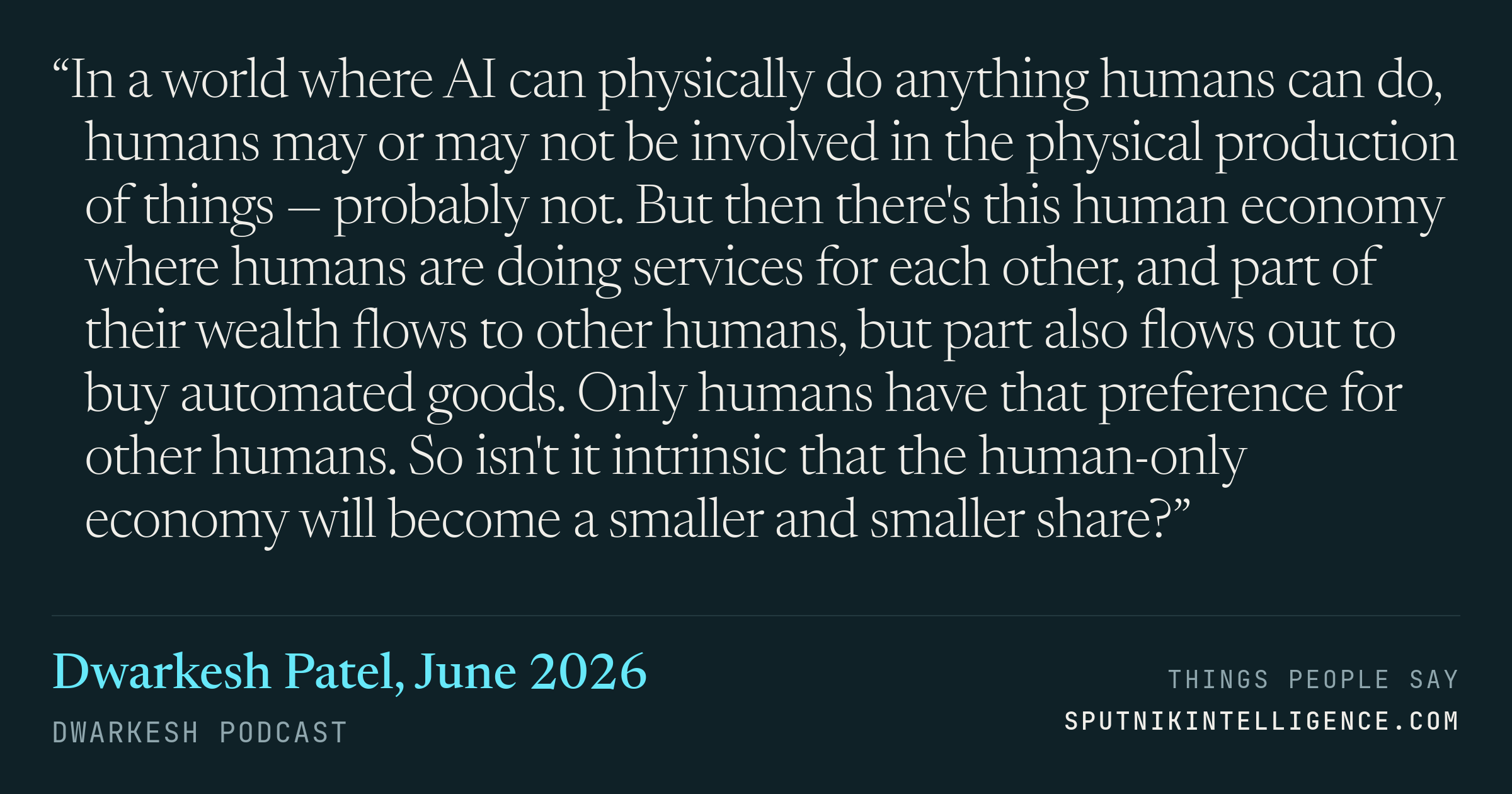
The framing question that sets up the episode with economists Alex Imas and Phil Trammell. The model is a machine economy that needs nothing from people and a human economy that keeps leaking value into it, because humans want machine-made goods but machines don't want anything from humans. Trammell asks to rephrase the question before answering it.
Transcript
Today I'm chatting with Alex Imas, who is director of AGI Economics at Google DeepMind and professor of economics at University of Chicago, and Phil Trammell, who is head of economics at EPOC and research scholar at Stanford. In general, in this interview, what I want to understand is what economics tells us about what we can expect in a world with more and more automation, more and more advanced AI, what that tells us about what will happen to wages, to labor share, what the best way to tax and redistribute the wealth that we generated as a result of AGI will be, and what kinds of things will be scarce, because what is scarce kind of tells you where the value will accrue. So I want to start there. What are some plausible candidates of what will be scarce?
Something like the relational sector, which is what I defined as, you know, basically services and goods, where the fact that the human was in the loop was actually part of the value of that product. So because humans are naturally scarce, if we have automation where a lot of other things stop being scarce, we will still have scarcity and things that humans are kind of involved in and in the loop for.
I'm curious to understand whether humans doing services for other humans can ever be a big part of the economy. And here's maybe one intuition pump. So in a world where AI can physically do anything humans can do, you know, there's this whole machine economy where they're like building factories and doing research and coming up with new ideas. And humans may or may not be involved in the physical production of those things, but probably not, given that in the ultimate limit, if robotics is solved, if you don't care about humans being involved in that process, why would humans be involved in that process? But then there's these other things that you point out where, well, we actually maybe in some cases do want the ballerina or the barista or whatever to be a human. That's part of the value of going to a cafe or our performance. But only humans have that preference. So there's this human economy where like humans are doing services for each other and part of their wealth is flowing to other humans. But part of their wealth is also like they will want some of the automated goods that's like machine-only economy is creating. And so part of that wealth is flowing out. And so if you just think of this as like, this is not a closed loop, but a lot of things in the machine-only economy are a closed loop because the machines don't care about like getting the human barista to make them a coffee. And so within that model, isn't it intrinsic that like the human-only economy will become a smaller and smaller share?
I would like to pitch kind of a rephrasing of that question. So I think my view is that kind of forecasts that economists like us would make are not necessarily as individual forecasts like me and Phil Trammell talking right now, are not necessarily very useful. The reason I think that, so there was this blog post by Andre Fredkin, Brian DeBarian, and Andrew Coe that came out yesterday, actually, that looked at like kind of people's forecasts, economists' forecasts about the labor market. And what they found is that there's a ton of disagreement, like in every single direction. So what they advocate for, and I think I'm in agreement here, is rather than thinking about individual forecasts like what me and Phil Trammell going to do, rather looking at kind of like basically generating prediction markets where you get aggregate forecasts, where you get like kind of wisdom of the crowd effects. And kind of the reason that I think this is because we have been famously terrible at forecasting. And so let's take, let's go all the way back to 1820. This sort of debate that we've been having actually is like 200 years old. So David Ricardo is one of the classic economists, not neoclassical, classical economists. And he, when Industrial Revolution started happening, he was wrote a bunch of stuff saying like, look, this is going to be great for everybody. Prices are going to come down. But then he turned around and he's like, wait, I can actually see all of these jobs that are creating value. They're going to be automated by these machines. This is going to be really bad. Everybody's going to become unemployed and there's going to be political unrest and things like that. And if you look at Ricardo's predictions, they're actually right. If you look at all those jobs that made money in Ricardo's time, they got automated. So if I was David Ricardo and I woke up and somebody told me all those jobs did get automated, and you asked me, Dave Ricardo, like, what do you think the prime age employment rate is in 2026? I think he would be surprised if you told him it was the highest it's ever been other than 2000. We have the highest number of employed people that could potentially be employed since 2000. That was like the peak and now it's like the second peak, basically. So what David Ricardo ended up missing is the fact that, you know, essentially you have these economics of structural change where basically everything that got automated became cheap, people had more money to spend on things. And then they started spending money on services. And, you know, this is kind of like the lump of labor fallacy. That's what they call it. David Ricardo didn't think, hey, I should have, you know, consider the fact that new jobs would be created. But it's kind of not obvious that like money would go to services. Like, why wouldn't they go to more automated goods and something like that? And I'm not. Saying that, like, I'm not using this anecdote as to say, like, this is what's going to happen now. We're going to have full employment. I'm using that anecdote as to say it's really hard to make predictions. And what I think may be a really useful tool that economists have is instead start with a premise, like maybe we'll start it today. Look, labor share is zero, like labor share has gone down. What could possibly explain this? Let's write down an economic model of what happened. Phil will talk about this later today. Or you can start to write down a model to say, hey, what if labor share just stays the same? What can make that happen? And here's my main, here's, if you don't take anything out of this conversation from me, we don't have any data. I've been kind of saying we need a Manhattan project for data. We don't have data on basically consumer demand elasticities. We don't know what they are. We don't know, we're not really tracking what jobs are getting created or destroyed. Like the O-Net database with all of the tasks and different jobs, that's been rarely updated. It's super low quality. And so what I think is really useful is to think about like what are the potential scenarios, and we'll be talking about a lot of these scenarios, mapping them out and to say what tight, what dimension of scarcity will generate that scenario. So if there's full employment, we could talk about the relational sector or something like that. If there's, you know, very labor share collapses, we can talk about other sorts of scenarios. And then that will tell us what data we should be collecting.
It's probably worth defining labor share and capital share real quick. So the whole economy, like the total sum of goods and services sold, is either paid out to people in wages or it's paid out to capital, which is to say that there's like rents on buildings and then there's shareholders of companies that get paid out. And for many hundreds of years in the economy, 60-something percent of the economy or all the things that are sold in a given year basically gets paid out to humans in wages. And the other 30, 40% gets paid out to people who own machines and land and claims on companies and whatever. And the question is: well, right now, 60% is going to wages. Does that shrink as automation or as AIs get smarter and smarter and better and better? And
it's like it really, this is a call to or fact, like, right? So it's incredibly, we should stress this. It's incredibly surprising that it's over 60% after the Industrial Revolution, after all the automation we've ever seen. The fact that it's almost like some people are worried it's an accounting error or something like that, that it's kept been so constant. And the fact that it's like been over 60%. And, you know, there's, there's even a controversy right now. So some might say, like, you know, labor share has been falling in the last 20, 30 years, but, you know, depending on how you, there's been a lot of accounting changes in the last 30, 40 years. So for example, Andy Atkinson has this paper showing that actually, if you keep the accounting constant over the years, labor share hasn't even fallen ever.
More from Dwarkesh Podcast