 Dwarkesh Patel
Hosts the Dwarkesh Podcast, a long-form interview show on AI progress, timelines, and the people building frontier models, along with economists and historians.
Dwarkesh Patel
Hosts the Dwarkesh Podcast, a long-form interview show on AI progress, timelines, and the people building frontier models, along with economists and historians.
“One thing that seems different between this and special relativity is that there's no symmetry — in special relativity, both observers feel that the other one is aging slower, because they're both moving relative to each other. There's no true inertial path. But here, it actually does seem like there's a global sense in which one is the more relevant inertial frame than the other.”
Dwarkesh Podcast · AI Research & Frontier Labs · July 2026
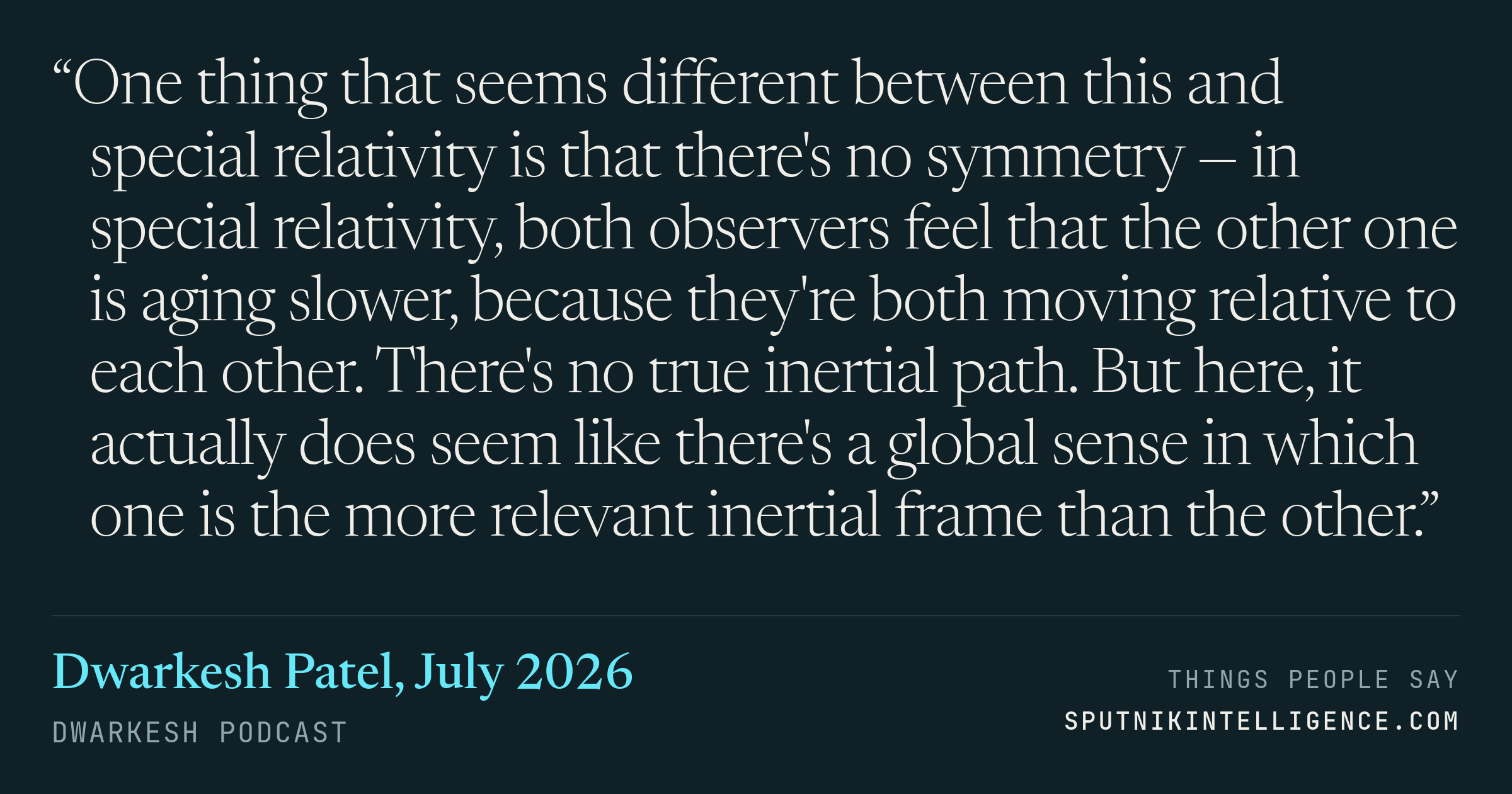
Dwarkesh teaching the idea back to check he has it, immediately after Adam Brown's wristwatch thought experiment. The thing he spots is the asymmetry that makes gravitational time dilation different from the special-relativistic kind, where each observer sees the other's clock running slow. Brown's response: 'You're exactly right.'
Transcript
Crusoe gave us early access to their serverless fine-tuning product, which lets you fine-tune open models without having to deal with infra or provisioning. I thought it'd be cool to try fine-tuning a question generator using the transcripts of my old interviews. The models have gotten so good that if they had all my research and prep and they could look at a conversation so far, they could ask a next question better than I would. Crusoe made the implementation super straightforward. I just uploaded the data, picked an open model, and started the run. I didn't have to touch any of the hyperparameters. Crusoe's applied AI team maintains optimal recipes for each model. So I just set everything on auto. When the run finished, I deployed it as a self-server endpoint and built an eval for my team. I had them choose the best next question out of three anonymized choices. One that was produced by the base model, one that was produced by the fine-tuned model, and one that I actually asked. Fortunately, my team preferred my actual questions about two-thirds of the time. Hopefully, this benchmark doesn't saturate. And in the remaining cases, they almost always preferred the fine-tuned model over the base model. Serverless inference is live now, and serverless fine-tuning goes live next week. Learn more at cruso.ai slash thorcache.
So far, everything we've written down on the board is Newtonian. It's just Newtonian, and you just start plugging in the speed of light, and you start getting confused. To actually answer some of these questions that we're asking, you need to go to general relativity, the theory that correctly unifies the speed of light with gravity. And this was first done in the context of black holes by Schwarzschild, who wrote down the Schwarzschild metric that describes the gravitational field around a central mass, including potentially around a black hole. And let me just write down some of the formulas that emerge. In fact, I think I'm going to write down three formulas, the three direct consequences of Schwarzschild's metric. They're going to give us an intuition for what it's like outside and indeed inside a black hole. And so the first formula I'm going to write down is the formula for the gravitational field that you would experience if you were trying to remain static outside a central mass. And so, you know, let's just talk about for static observers. I can discuss how these will get upgraded for observers who are moving around. But for now, I'm just going to imagine that you're trying to sit here at some radius r, some fixed radius r away from the black hole. The reason you're static, the reason you don't fall into a black hole, maybe, you know, I've lowered you down on a pulley and you're just sitting here holding the pulley. And the question is, how strong a force do you need to stop you falling down? Your ab sailing down very slowly. You're static. What is the local force of gravity that you experience? Or you can imagine that you're sitting here. The reason you're static is you're firing a rocket very hard. And how much acceleration do you locally feel? So by whatever mechanism you're remaining static, what is the local force of gravity that you feel? The local force of gravity that you feel, well, in Newtonian physics, you know what the answer to that question would be. The force of gravity is gm over r squared, which is Newton's famous inverse square law. But this gets a correction from general relativity. And the correction is 1 minus 2 gm over c squared times r. So this same 2 gm over c squared that we find all over the place. And what this tells you, well, first of all, if you're a very long way away from the black hole, this here is essentially 1. r is very big and you get Newton's force law back again. And for the Earth, this is very small. As we discussed, it's now. by a factor of 10 to the minus 10 or so. And then you take the square root. So you don't really notice it. But you can Taylor expand this at large R, and you find out that you get corrections. You get an inverse square law plus an inverse cube law correction plus an inverse fourth law correction. And you find that gravity at short distances is stronger than it would have been in Newtonian physics. This is the general relativity correction, and it's making the gravitational field stronger. You have to accelerate harder to not fall into the black hole. And in particular, once r is equal to 2 gm over c squared, this what's called the trollschild radius, you have to accelerate infinitely. The acceleration, the proper acceleration required to not move in r goes to infinity. So in fact, if we now convert this to an earth to the black hole, this is a very significant radius over here, 2 gm over c squared. It's called the event horizon. It's called the event horizon, because if you want to remain static outside the event horizon, further away from the event horizon, you just need to accelerate with some finite velocity in order to remain static. You need to have a finite gravitational field, but the gravitational field as you approach the event horizon becomes infinite. So once you're at or beyond the event horizon, it is impossible to remain static. You will inevitably get sucked into the black hole, no matter how hard you fire your rocket. Now, this is just the static formula. You might imagine, okay, it's impossible to remain static outside the black hole closer than that, but maybe I could not fall into the black hole by orbiting really, really fast. And if I orbit really, really fast, I have a huge centrifugal force that pushes me away from the black hole, and I can stay out of the black hole that way. That actually doesn't work. And the reason it doesn't work is somewhat instructive for the way gravitational attraction happens in general relativity. Of course, if you think about the International Space Station, why doesn't it fall towards the Earth? It is precisely the fact that it's orbiting. And the fact that it's orbiting gives it a centrifugal force that shoots the astronauts away from the Earth and precisely balances the gravitational field of the astronauts, which is why they feel weightless there. So orbital angular momentum, if you're a long way away from the black hole, helps you escape from the stay away from the black hole, stops you falling in. There is this kind of sci-fi notion that black holes just suck in everything around them. Not true. You are perfectly able to orbit around a black hole if you're a long way away from it, just like you would orbit around any central mass. You are not inevitably falling into the black hole. You can orbit just fine. But orbiting stops helping when you get too close to the black hole. We said that the event horizon is 2 gm over c squared. In fact, already once you're within 3 gm over c squared, orbiting is counterproductive if you're trying to stay away from the black hole. And that's because there are two effects of orbiting. One effect of orbiting helps you stay away from the black hole. That's the centrifugal effect. Orbital angular momentum pushes you away from the black hole due to the centrifugal effect. And if we wrote the, it's not too hard to write down, if you wrote the version of this formula that applies when you have angular momentum, you would see that pushing you away from the black hole. But there's another effect which drags you towards the black hole. And that is the fact that in general relativity, all energy gravitates. Not just rest mass energy gravitates. Kinetic energy also gravitates. And so the effect of orbiting is that you have an additional pull down towards the black hole from the coupling between the mass of the black hole and the gravitational attraction between the mass of the black hole and your orbital angular energy. And when you're far away from the black hole, the centrifugal force is more important term. When you're close to the black hole, that coupling is the more important term. And in fact, once you get within 3 gm, orbital angular momentum stops helping and starts hurting. There are no ballistic orbits that go within 3 gm and that manage to escape again. Okay, so that's formula number one. It tells you that what the gravitational field is, a distance r away from a black hole. And in particular, it shows you that once you get to this critical radius, the gravitational field becomes infinite. And you must, if you cross that, you must proceed to the center of the black hole, no matter how hard you fire a rocket. That's called the event horizon. At the event horizon, you are not yet dead. You are, however, doomed if you cross the event horizon. You will never be able to escape. Not if you convert yourself to light and try and shoot yourself out. Not if you fire your rocket. Infinitely hard. The other place, of course, is r equals zero, which is that's where you actually die. And that's at the singularity. And we'll describe that a little bit in a moment. In Newtonian physics, the gravitational force only becomes infinite here. In general relativity, it becomes infinite already at the event raised, if you try and resist the force of gravity. Okay, that's formula number one. Now let's do formula number two. Formula number two, and all three formulas I'm going to write down are just going to be heavily related to each other. They're really going to be reformulations of each other. Asks about gravitational time dilation. So let's again imagine that you're sitting here. This is Dorkesh sitting here, some radius r away from the black hole. And I'm sitting out here way off at infinity, just watching you. And we're static relative to each other. There's no relative motion. You're just suspended here by your pulley system. And the question is, how fast does your watch go relative to mine? Of course, as far as you're concerned, your watch is ticking at one second per second. As far as I'm concerned, my watch is ticking at one second per second. But if I watch you, if I look at you, I see your watch as running slow. If you look at me, you see my watch is running fast. And so the second formula makes that quantitative. How much slower you, who is close to the black hole, how much slower your wristwatch runs than mine. And it says that the time interval, as measured by your wristwatch, is given by the time interval as measured by my wristwatch a long way away times this exact same square root factor that's showing up all over the place times the square root of 1 minus 2 gm over r, c squared. And so this factor here is less than 1. So if I think one second has passed, you think less than one second has passed. In other words, if I slowly lower you down towards the black hole, you hang out some finite distance away from the black hole for what feels to you like a year, and then raise you back up a long way away from the black hole, you will return to a world that has aged a lot more than you have. And this formula makes that precise. I observe your wristwatch to be running slow. You observe my wristwatch to be running fast. Time passes slower down here than it does up here. This is a fact that has by now been extremely well observed experimentally in the 1950s in the Harvard Physics Department. They put two atomic clocks at two different heights in the building and noticed that the one that was higher was running faster than the one that was slower. This is an effect that is now considerably within the precision of, for example, GPS. It just has to subtract that effect. Otherwise, everything would drift all over the place. GPS clocks that are sitting on the Earth's surface are running slow compared to the atomic clocks that are in orbit sending out the signal. And you have to subtract off that difference in order to account for that difference and subtract it off in order to get an accurate read. This is known as gravitational time dilation. And notice it's quite different from the relativistic time dilation you see in special relativity, which is caused by two objects being in motion relative to each other. Here, we're not in motion relative to each other. We're both static. We're fixed. This is caused by us being at a different place in the gravitational potential, you deeper in the gravitational potential than me. So those are two different sources of time dilation, and they stack. So let's say instead of being static here, you're in orbit. You're far enough away that you can orbit the black hole. And I ask, how slow do I see you as moving? There are now two contributions, both of which make you look slow relative to me. The one contribution is the gravitational time dilation given by this formula. A second contribution is the good old special relativity correction, where moving observers look like they're going slow. And we'll have both of those effects. So you'll look like you're going even slower than you would have done than you would have done otherwise as you go around the black hole.
So one thing that seems different between this and special relativity is that there's no symmetry, where in special relativity, both observers will feel that the other one is aging slower than they are because they're both moving relative to each other at the same rate. And there's no true inertial path. But here, it actually does seem like there's a global sense in which one is a more correct The more relevant inertial frame than the other on.
You're exactly right. Yeah, so in special relativity, if you and I are moving relative to each other, I think your watch is moving slow. You think my watch is moving slow. Neither of us is more correct than the other. The principle of relativity tells you that both of our perspectives is equally valid. Here, both of our perspectives are not equally valid because there is not the symmetry that there was in special relativity. In particular, the symmetry is broken by the black hole. You really, we both agree that you are deeper in the gravitational well than I am. We both agree on that, and your clock runs slower than mine does. You do not see my clock reciprocally running slow. You in fact see me leaving sped up. If you are observing me, you see me living my life and fast forward. So this is the second formula. It says how fast our wristwatches move relative to each other. Now let's imagine that you're here with your slow-moving wristwatch and you shine a light towards me. And let's say the light has a particular frequency. You made it with a sodium transition, for example, a particular frequency of light. As that light travels upwards, by the time it reaches me, I'm going to think that it is lower frequency than it was than you thought it was when you sent it. Why? Because frequency is about how rapidly it oscillates. And I just think that everything you do is moving slow relative to me. You think it's oscillating slower. It has lower frequency, which means it gets shifted towards the red part of the spectrum. The word that we use is redshift, gravitational redshift. It's redshifted, lower frequency, and therefore less energy. If you send one photon up, the energy of the photon is given by the frequency. It'll arrive at me more redshifted and with lower energy than it had when it left you. Conversely, if I am up here and I send you a photon generated by the sodium transition, as observed by you, by the time the light reaches you, you see me moving in a fast forward. So you think that it has higher frequency than it had when I left you. It's moved towards the blue part of the spectrum. We say that it is blue-shifted. And so this thought experiment tells you that knowing the exchange rate for how time passes at different altitudes directly gives you the exchange rate for how much energy is worth at different altitudes. If you try and send me some energy, by the time it reaches me, it's worth less to me than you perceived it as being worth to you. And the amount it's less is going to be precisely given by the same square root formula that's that's controlling everything else. And so that gives us our third equation. And so the third formula says, suppose that you, Dorkesh, have an object of mass mc squared sitting with you at this fixed radius down there. How much energy, as measured by me a long way away from the black hole, how much energy is that worth to me? Of course, if I had it with me, it would be worth mc squared worth of energy. But I don't have it with me. It's unfortunately sitting with you deep in a gravitational potential. So it's worth less than mc squared to me. In fact, it's just the exact same formula. The amount of energy that it's worth to me, by the time it reaches me, is gm over r c squared. And there are a couple of ways to see that. One is the way that we just said. Suppose you take your object of mass m, you know, it's just Avogadro's numbers of carbon atoms, or let's say it's half an Avogadro's numbers of carbon atoms and half a Avogadro's numbers of anti-carbon atoms. And one way you could send me the energy is by smashing them together, violent explosion, you convert all of that energy to light, and you try and beam that light energy up to me. But what you find precisely because of this gravitational time dilation is by the time it reaches me, I'm not getting mc squared worth out. I'm getting, by the argument we just gave, less than mc squared worth out. I'm getting 1 minus 2 gm of r c squared out. Mass down here suffers this redshifting as it goes up and has less energy by the time it reaches infinity than it did to begin with. There is another way that you could have got the energy to me. Not by beaming it up as light, but by just taking your mass object, attaching it to the pulley, and having me pull the object out. By the time I pulled it out, I've now got mc squared sitting out here a long way away from the black hole. So I do have mc squared, the full mc squared worth of energy. But to get it, I needed to pay. And what I needed to pay was precisely. pulling it out of the gravitational potential. So that, from that way of thinking about it, that's why I have less than mc squared worth of energy left, because I had to pay the pulling it out of the potential in order to accrue that mass. So this formula tells you, if I have a brick of mass mc squared sitting at some radius r away from the black hole, how much energy can I extract from that brick if I start if I'm a long way from the black hole? And so if we know that formula, then we can in fact calculate exactly this formula. How much energy have I extracted from the brick by lowering it down to a radius r? Well, we know the answer to that question. The energy it started with is mc squared. The energy it now has is this. So the energy I've extracted from the brick while slowly lowering it down using my pulley system must be the energy I started with, mc squared, minus the energy it now has. Or in other words, the fraction of the energy that I've extracted by lowering it down to a radius r is mc squared minus this all divided by mc squared, 1 minus root 1 minus 2 gm over c squared r. And this is the exactly correct answer for the fraction of the energy extracted. It doesn't look exactly like this, because this is only correct in the Newtonian limit. We derive this using Newtonian physics. This is exactly correct, not just in the Newtonian limit, but all the way to where the effects of general relativity are important. Now, if you're a very, very long way away from the black hole, r is much, much bigger than 2gm over c squared, then you can tailor expand this formula. And the first order term is just the old Newtonian formula. It better be. It better be that the long distance limit of general relativity recovers the Newtonian physics that we originally discovered. But as you get closer and closer to the black hole, this starts to deviate from the Newtonian answer and deviate in the Newtonian answer that exactly is going to end up resolving our original thought experiment to do with lowering a brick down towards a black hole. So how much then, looking at this formula, have I extracted from the brick as I lower it down towards the black hole? If r equals infinity, if the brick's still a long way from the black hole, then I've extracted 1 minus 1 equals 0. I haven't extracted any energy from the black hole. As I lower it closer and closer to the black hole, well, initially, I just get the Newtonian formula. So in fact, these are pretty close to correct in general relativity as well, because the corrections are only going to start getting large when this term becomes order one, and it's still very small here. So these are all essentially correct. But once I get closer and closer to the black hole, they stop being correct. And what I see is that as r approaches the black hole event horizon, as this formula goes to zero, I have extracted exactly all of the energy from the brick. So I start off with a brick a very, very long way from the black hole, attach it to a rope, slowly lower the brick down towards the event horizon. Of course, I can't lower it past the event horizon, otherwise I'll lose control of the brick, but I lower it as right above the event horizon, the last possible place I can lower it to, and then just let go of it with zero velocity. The brick falls into the black hole, and I have extracted the entire mc squared that used to be in the brick in my pulley system out there. And so it exactly resolves this question we had. Is it possible to extract more than mc squared from the brick? No. Is it possible to extract the full mc squared from the brick using a black hole? Yes, it is. And that's actually pretty neat and why people talk about using black holes as power plants. So, you know, most power plants today operate by burning chemical energy. That is not very efficient. That gets, you know, you have to pay a factor of 10 to the minus 10 because chemical bonds are super weak compared to the rest masses of objects. And you're really only extracting a tiny fraction of the rest mass of the fuel that you're considering. You can level up them there by going to, like, going to nuclear energy, which instead of it dealing with the feeble electromagnetic bonds between atoms, starts to concern itself with the nuclear forces between the protons and the neutrons within the nucleus. And so you can go up from about 10 to the minus 10 to about 10 to the minus 3 for fission or 10 to the minus 2 for fusion. But that's about as good as you can go even with fission and fusion. Because even though you can extract energy from the strong nuclear force, fission and fusion Neither of them change the total number of protons plus neutrons in your process. And the bulk of the energy, 99% of the energy, is stored not in the electromagnetic interaction, not in the strong interaction, but in the rest mass energy of the protons and neutrons, something that neither chemical reactions nor nuclear reactions can touch. But gravity can touch them. If I start off with a massive mass object of M, I can extract up to quantum corrections, essentially, I can extract essentially 100% of the rest mass energy that I've gone in. It is the most efficient possible power plant because by building an apparatus like this, in principle, I could extract 100% of the energy of whatever I started with.
I intuitively get how energy equals mass, and then there's like these chemical bonds, those could dissolve, they release energy, the thing weighs less if those bonds are released. I even get that if the bonds between the protons and the neutrons are broken, that releases energy and makes the thing have less mass. But if something with protons and neutrons is just slightly above the event horizon, is the interpretation that those protons and neutrons stop existing right at that point? What does it even mean for them to have 1% or 2% or 5% of their original mass?
Yeah, that's a great question and really becomes relevant once you turn on quantum mechanics, which is beyond the scope of today's discussion. But classically, the black hole just sits there forever. And so you can just say, well, what happened to the protons and neutrons? You say, well, they now live inside the black hole. And the number of protons plus neutrons is still conserved out there in the universe. It's just you need to assign a nucleon number to the black hole itself. That's fine as far as it goes classically. Quantum mechanically, way beyond the scope of today's lecture, Hawking and Bekenstein discovered that black holes radiate away energy, and eventually the black hole will be gone. And all of the energy, if you calculate it, ends up in gravitons and photons and perhaps some neutrinos. None of it, or almost none of it, ends up in protons and neutrons. So it is a very interesting fact once you turn on quantum gravity that black holes eat nucleon number. This thing that seems like it's conserved, at least perturbatively, both by electromagnetism and by the nuclear forces, ends up being eaten by gravity. And people like to promote this, we're talking about quantum gravity now, to a general principle that quantum gravity doesn't respect any global symmetries. It doesn't respect nucleon number symmetry. It doesn't respect any of these symmetries. And that's a whole other can of worms that we can open some other day.
More from Dwarkesh Podcast