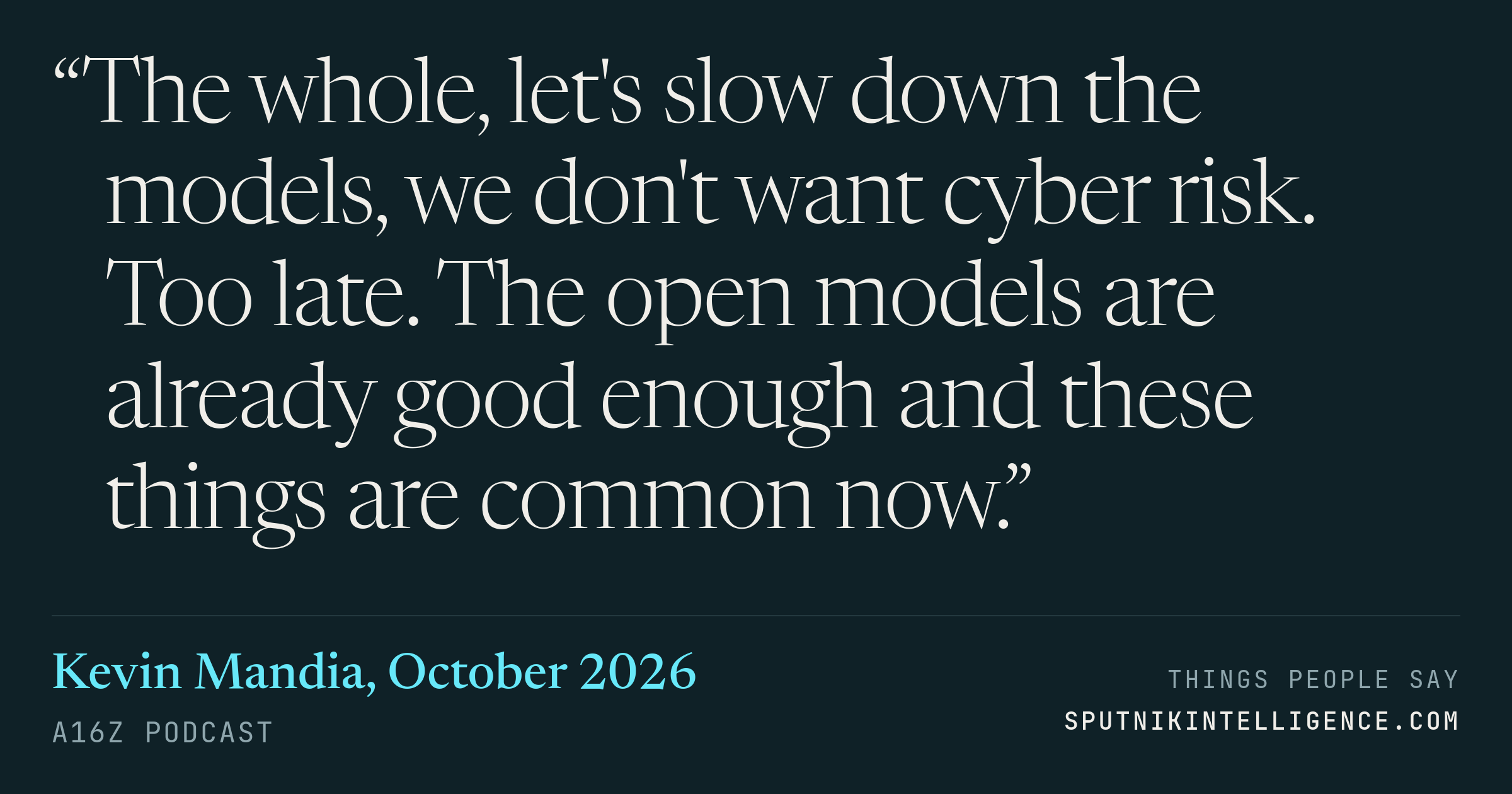
“The whole, let's slow down the models, we don't want cyber risk. Too late. The open models are already good enough and these things are common now.”
a16z Podcast · Startups & Venture · October 2026
Mandia was explaining how AI-led attacks differ from human ones in scale and speed. He argued that finding exploitable vulnerabilities is a structured problem that doesn't need the most advanced model. What holds criminals back for now, he said, is that they can't yet get GPU capacity anonymously.
Transcript
Well, great. So the nature of them is, first off, we're getting a weird window in time where we're seeing them, but not at the same level you'd expect. I've seen nothing like what Armadan's already built in the wild, which is there's 25,000 agents on concert, all working together, doing really, really smart things without going on bizarre fishing trips. Because when you respond to an AI attack, you can tell it's AI very quickly. At least I can, because I've thought about a lot of offense. I've responded to a lot of attacks in the past that were led by humans. And a human goes to point A, then to point B, then to point C through their intrusion. AI does little things like four or five differences, but one would be it'll break into point A, then laterally move to point B. Next thing you know, it's trying to break into point A again. It's like, I get the drone swarm, but you could probably coordinate and think a little bit better. That's where it's at today. It'll get better and cleaner. But the differences are, first and foremost, the scale of what AI can do dwarfs humans, like in ways humans don't even get. So you have a scaling problem in that humans could always find only one path into a network. Yeah, they had to be selective
because they had to devote their limited resources to one direct path, right?
Yes. And then so scale is a challenge. Speed, ridiculous. What AI does in a microsecond would take 70 humans. They can't even do it. It's apples to oranges. And then, so what was always lacking is AI creative or effective. But when it comes to what we do, we don't need the fanciest model. We're not trying to speak 400 languages with our models and all that kind of thing. What Armadan's doing on offense is we're finding vulnerabilities, exploitable risk. That is code. That's a structured language, a structured process. Because it's structured, AI is going to be great at it. Right. Right. So I really think it's already here today. Like the whole, let's slow down the models. We don't want cyber risk. Too late. The open models are already good enough and these things are common now. It's just a matter of the minute you have anonymous availability of GPUs, you'll see far more criminal attacks. Oh, interesting. Yeah, you know what I mean? But until you can attack anonymously, and it's hard to do crime when people know your name. It's better to if you can commit a crime anonymously. Here's my tip for criminals. If you can commit a crime anonymously, that's a lot smarter than doing it with your jersey on with your name on it. And so anyway, the difference in attacks and what we're seeing now, we are at the precipice, first inning still, of AI-led attacks coming. And I think that's just because of the cost and availability of the models is not as readily available to the criminal element as it will be in the future. Yes, exactly.
Okay. So you, your experience working in the security industry for 30 years, you probably saw a fair amount of nation-state attacks, right? Every day. Every day. So talk about the differences or similarities between nation-state attacks. And I use that just to say the most sophisticated, most successful, if you will, types of attacks compared to AI today and then where you think AI can be in a couple of years.
So everything's going to change rapidly, right? But I can tell you nations on offense have never, in my opinion, they've never really been when you're hacking for espionage and for security reasons, you hack with what I would call kind of a sniper round. You're not spraying and praying. For the most part, modern nations on offense restrict their targeting and they go deep at very specific things, like 30 defense contractors or .mil when they go hard at that. Kind of think of it as that sniper round. With AI, I think it becomes more like a drone swarm. It becomes a little bit different in the cyber domain. And I think even modern nations are thinking, what will our protocol be? If we want to attack this company, do we swarm it and just burn tokens on it? Because AI is going to do a lot of things humans just wouldn't. So it's a little sloppier, a little louder, but it's more effective. But it's more comprehensive. That's the problem. You got it. It's more effective, probably. And so there's going to be so many things a nation's got to think through right now. And their whole doctrine will shift as the AI shift change comes. Like, how does AI change what our mission is? Do we maybe use the cyber domain differently? Do we drone swarm sometimes, snipe around other times? How do we balance the two? Does it depend on risk, target, how surreptitious we want to be? Because right now, AI is not a surreptitious action on offense unless you've done a ton of post-training. You got maybe a human in the loop really looking. out are we doing smart things because if you just go hey here's a prompt hack abc.com ai is not going to do it in a surreptitious smart way and i think even if you ask it to it's still not going to until it's been really trained and really had some human influence on it so but more generally what you're going to see is less capable attackers less technical less successful are going to appear way more successful it's the equalizer yeah because of the volume yeah yeah every when you start using models over time what it's going to be is on the defensive side we're going to say we're being attacked by these models but we're not sure who's behind them those attacks is it a nation is it a human is it and we'll have some clue but attribution will get a little difficult so that's a long-winded answer saying in the ai age it does democratize far greater expertise for attacking uh victim networks
yeah so then that is a good segue back to armadin so um you have talked about the defense needs to be a great offense right yes like like the best got to train your defense with something yeah of course you got to train your defense with something and then it needs to be continuous right right so right so how does the product work and then how do you get sure a level of sophistication such that you can identify and remediate these vulnerabilities like what you're describing that are more sophisticated than a basic prompt
More from a16z Podcast