Collection · Policy
Things People Say on Podcasts About Policy
Everything worth repeating from the Policy shows we follow. Updated every day — free to search and free to use, attribution included on every card.
99
Quotes
59
Shows read
8
People quoted
Latest
Search all quotes →“He, in the politest way, said that he felt that the score was too self-aware, that it seemed to be commenting on the film rather than being in the film, which is a very fair critique.”
Carter Burwell, November 2026
The Bulwark Podcast
Things People Say
sputnikintelligence.com
sputnikintelligence.com
“What's the thing that's not already there that I could bring? I'm not that interested as a composer in amplifying things you're already seeing on screen. I'd like to find some subtext or something that isn't necessarily clear, even if it's at odds with what you're seeing, but that it makes the experience richer and more dramatic.”
Carter Burwell, November 2026
The Bulwark Podcast
Things People Say
sputnikintelligence.com
sputnikintelligence.com
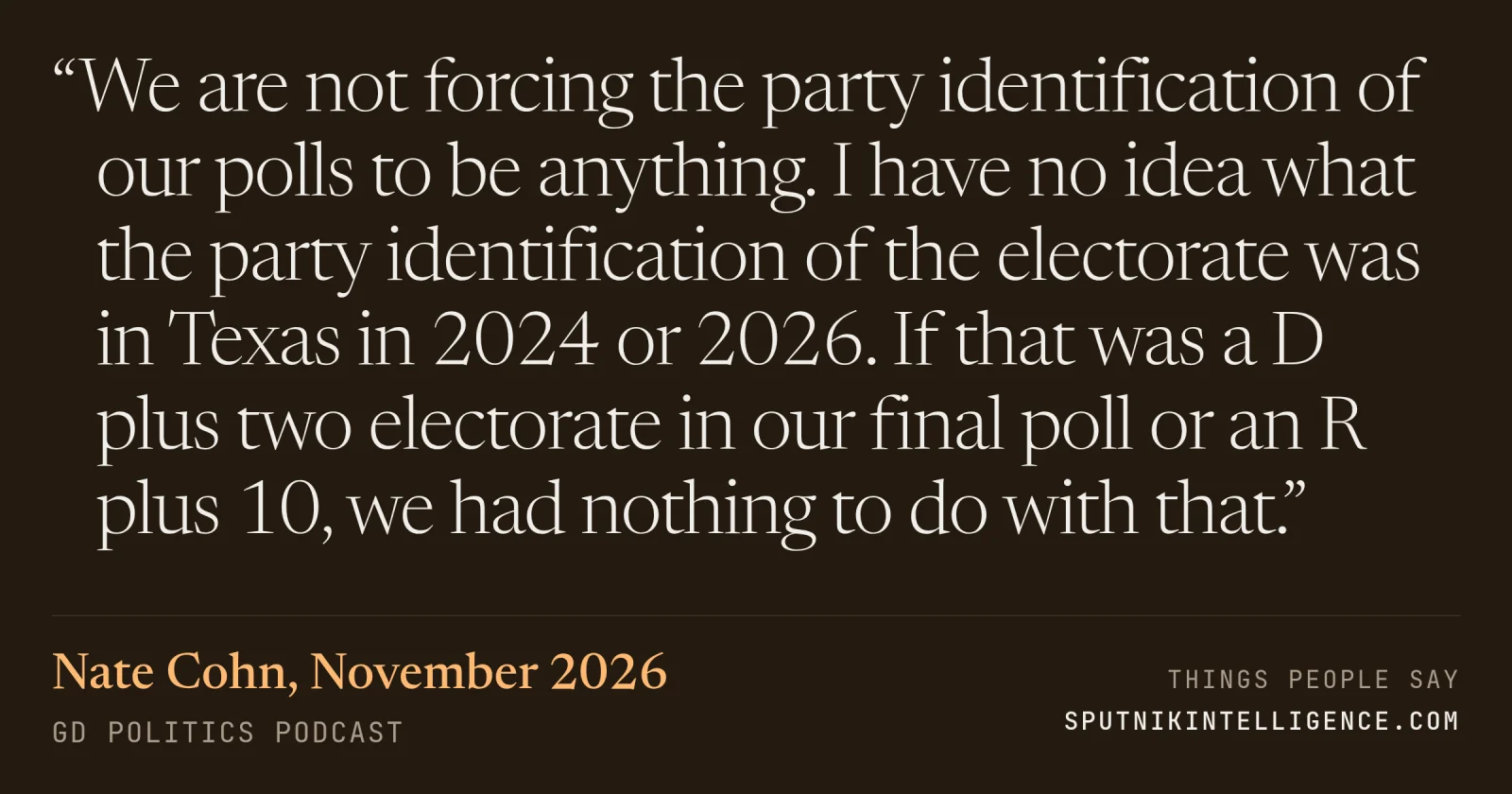
“I'm not sure there'd be a Times Siena poll in 2028 if the Republicans had won the Senate. That would have been the third systematic misfire overestimating Democrats out of the six elections we've done, on a scale that would have left readers feeling pretty misinformed. The costs of overestimating the Democrats would have greatly outweighed the risk of underestimating them. When you overestimate the side that wins, people don't care the same way.”
Nate Cohn, November 2026
GD POLITICS Podcast
Things People Say
sputnikintelligence.com
sputnikintelligence.com
“Anyone is welcome to propose a better name for synthetic past vote, especially because people seem to think it's an AI thing, which I definitely didn't anticipate. People are calling synthetic respondents AI-based, and people are confused about this. All it is is that we're correcting for a couple of things that we observe are clearly wrong in recall vote.”
Nate Cohn, November 2026
GD POLITICS Podcast
Things People Say
sputnikintelligence.com
sputnikintelligence.com
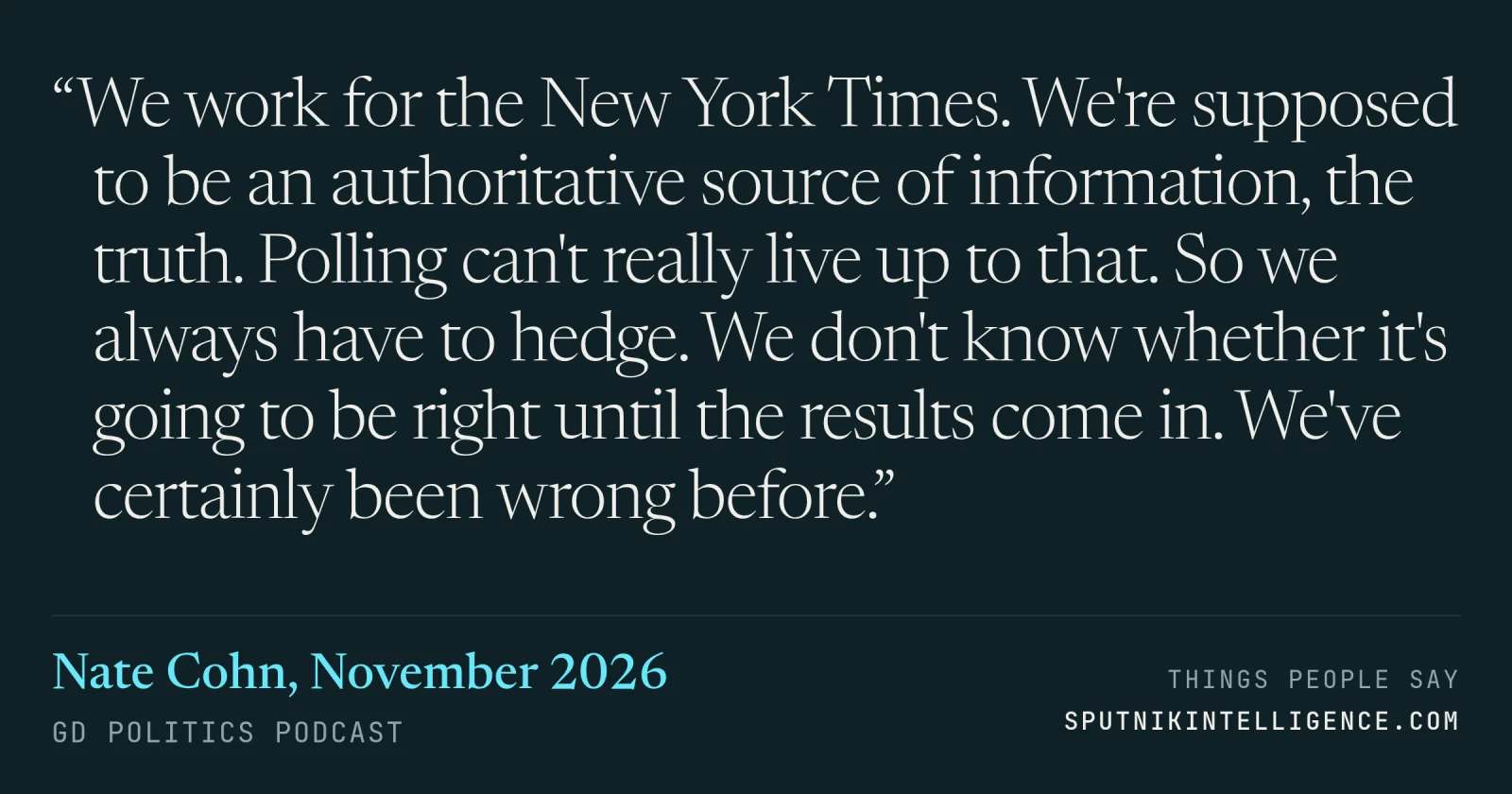
“All the estimates of the size of the space economy and the growth forecasts that we're seeing vary pretty wildly, because there's no one definition of the space economy. The BEA's definition is very expansive: everything that takes place in space, everything that supports it, and all the things that depend on space to function. But to understand the production of satellites, you need a much narrower definition.”
Jacklyn Buhrmann, November 2026
The Space Policy Show Podcast
Things People Say
sputnikintelligence.com
sputnikintelligence.com
“Businesses are not going to increase manufacturing capacity based on a kind of promise. Industry might hear a demand signal from the warfighter community, but it may be so divorced from the budget process and the acquisition process that the actual demand is years down the road. It's one thing for the government to say we want to buy more of your stuff, but a lot of that risk is front-loaded on industry to make those commitments today.”
Andrew Berglund, November 2026
The Space Policy Show Podcast
Things People Say
sputnikintelligence.com
sputnikintelligence.com
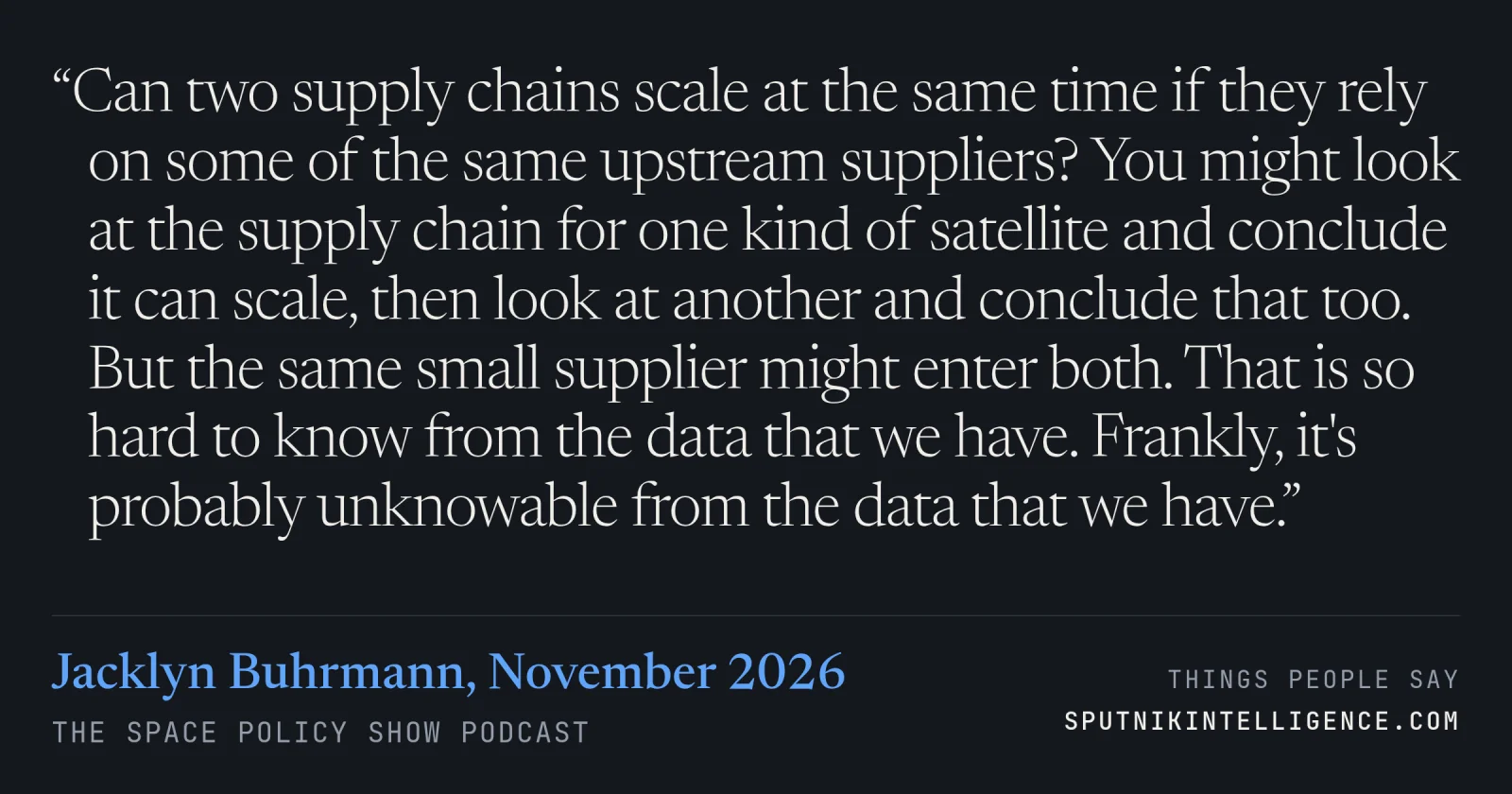
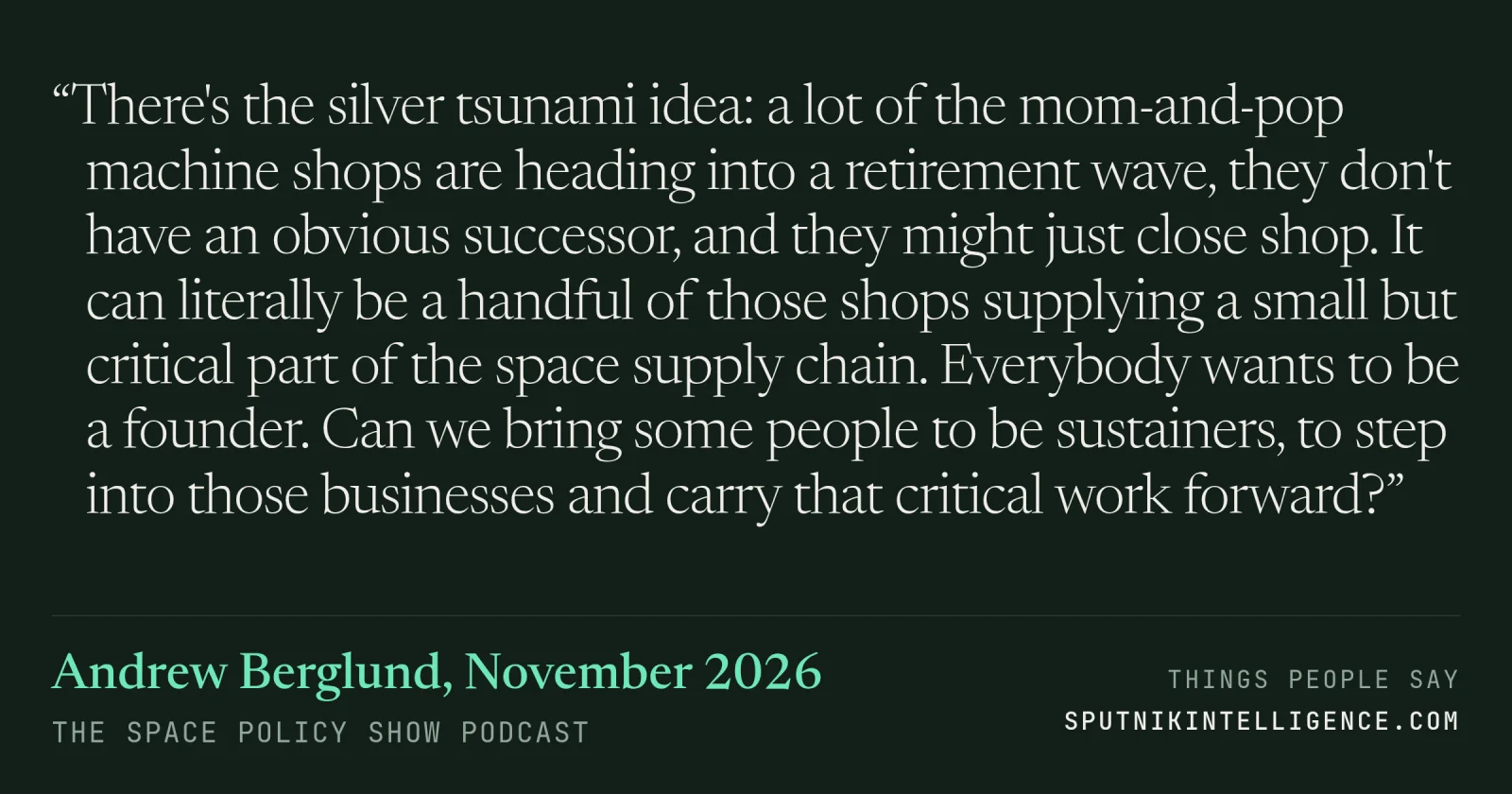
“Space has a hard time competing within these input markets, because smartphones are a billion-dollar-plus annual business and satellites are not growing to that level, at least not yet. So space has to compete for these underlying technologies and then needs them to be more specialized. You go to that sensor manufacturer and say, we love this technology, but we also need it to be rad-hardened. It's pretty much always going to be less than the number of smartphones that are sold.”
Andrew Berglund, November 2026
The Space Policy Show Podcast
Things People Say
sputnikintelligence.com
sputnikintelligence.com
“When I was a kid, NVIDIA chips were for my friends building their computers to play games. The same graphics processing units are powering AI frontier model development now. That's how quickly that's changed. You see recent stories about data centers pulling aircraft turbines off of decommissioned aircraft to power data centers. The demand and that competition can change so quickly. It's a strong argument for really high-quality data to drive decision-making.”
Andrew Berglund, November 2026
The Space Policy Show Podcast
Things People Say
sputnikintelligence.com
sputnikintelligence.com