Erik Bernhardsson

Things Erik Says on Podcasts

Where to Find Them

Erik Bernhardsson writes Unsupervised Learning with Jacob Effron . They have also been a guest on The Information's TITV (2 times) , Latent Space (2 times) , The Analytics Engineering Podcast (2 times) , No Priors , devtools.fm: Developer Tools, Open Source, Software Development , Software Engineering Daily , Gradient Dissent: Conversations on AI , Practical AI , Scaling DevTools , The MAD Podcast with Matt Turck , The Peel with Turner Novak and Super Data Science: ML & AI Podcast with Jon Krohn .

Recently: “Why AI Compute Comes in Rectangles — Erik Bernhardsson, Modal CEO” on Latent Space (October 2026); “The Pentagon’s CTO Explains the Anthropic Rift and Superintelligence Task Force” on The Information's TITV (October 2026); “OpenAI’s Multi-Billion Ad Strategy, Modal Labs CEO on AI Infrastructure, Twilio’s Voice AI Surge” on The Information's TITV (May 2026); “Building AI-Native Infrastructure for Developers | Erik Berhnardsson, CEO of Modal” on The Peel with Turner Novak (October 2025); “Modal and Scaling AI Inference with Erik Bernhardsson” on Software Engineering Daily (July 2025); “Erik Bernhardsson on Creating Tools That Make AI Feel Effortless” on No Priors (January 2025).

What They Said

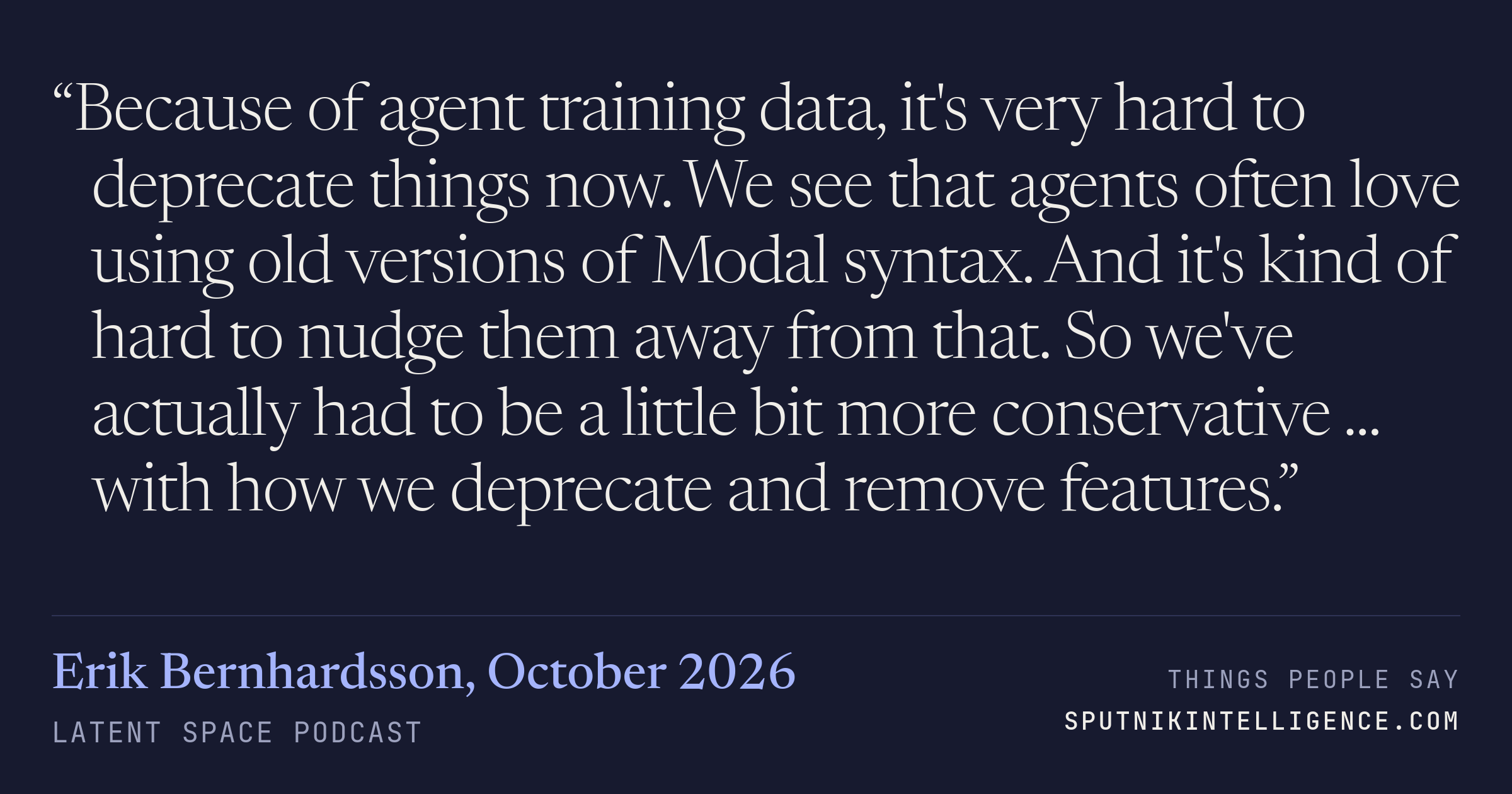
“Because of agent training data, it's very hard to deprecate things now. We see that agents often love using old versions of Modal syntax. And it's kind of hard to nudge them away from that. So we've actually had to be a little bit more conservative ... with how we deprecate and remove features.” — Erik Bernhardsson, Latent Space

Asked what Modal changed in its product now that so many users are agents, Bernhardsson said old syntax lives on in model training data. Modal now has to update every example online before removing a feature, and it runs internal tests to see whether agents recommend it.

Latent Space · 2026-10-22 Permalink → Listen →
Latent Space
Speaker 2

…with it tear the sandbox down right like rather than sort of declarative using using you know some sort of dsl it also pushes like a little bit of a different interface that maybe previously didn't exist i think in either way like sdks are as relevant as they would as they always were if not more

Speaker 1

is there anything you changed in your product just because like you know most people are just running agents on on it

Speaker 2

we do uh i mean we also we actually do run a lot of internal tests where we have agents we tell agents To build a modal app and run it. And I mean, a very concrete thing that is kind of funny is that we've actually seen that because of agent training data, it's very hard to deprecate things now. We see that agents often love using old versions of modal syntax. And it's kind of hard to nudge them away from that. So we've actually had to be a little bit more conservative going forward. Over the last year or so with how we deprecate and remove features, we have to be very careful to update every single example that's out there online. New skills, right? Yeah, there's stuff like that. But there's also an insane amount of modal code that's now online too, that goes into the training data. I've seen that to be kind of an interesting example where another thing, by…

Speaker 1

do about that? Yeah, you say, hey, build a stable diffusion thing. Does it recommend modal or not? What do you do about that?

Speaker 2

Yeah, I think that's harder. I think, you know, it's like search engine optimization. I think it's primarily through content. It's like you just have to put out a lot of content. Interesting. You can also, to some extent, see the perception, I think, a little bit more. You can ask an agent, rank…

Speaker 1

Have you thought about just making a bunch of GitHub repos and having the agents write a bunch of modal code in there? Have you tried that? Slot
Speaker names from our own diarization · position estimated from where the line sits in the episode
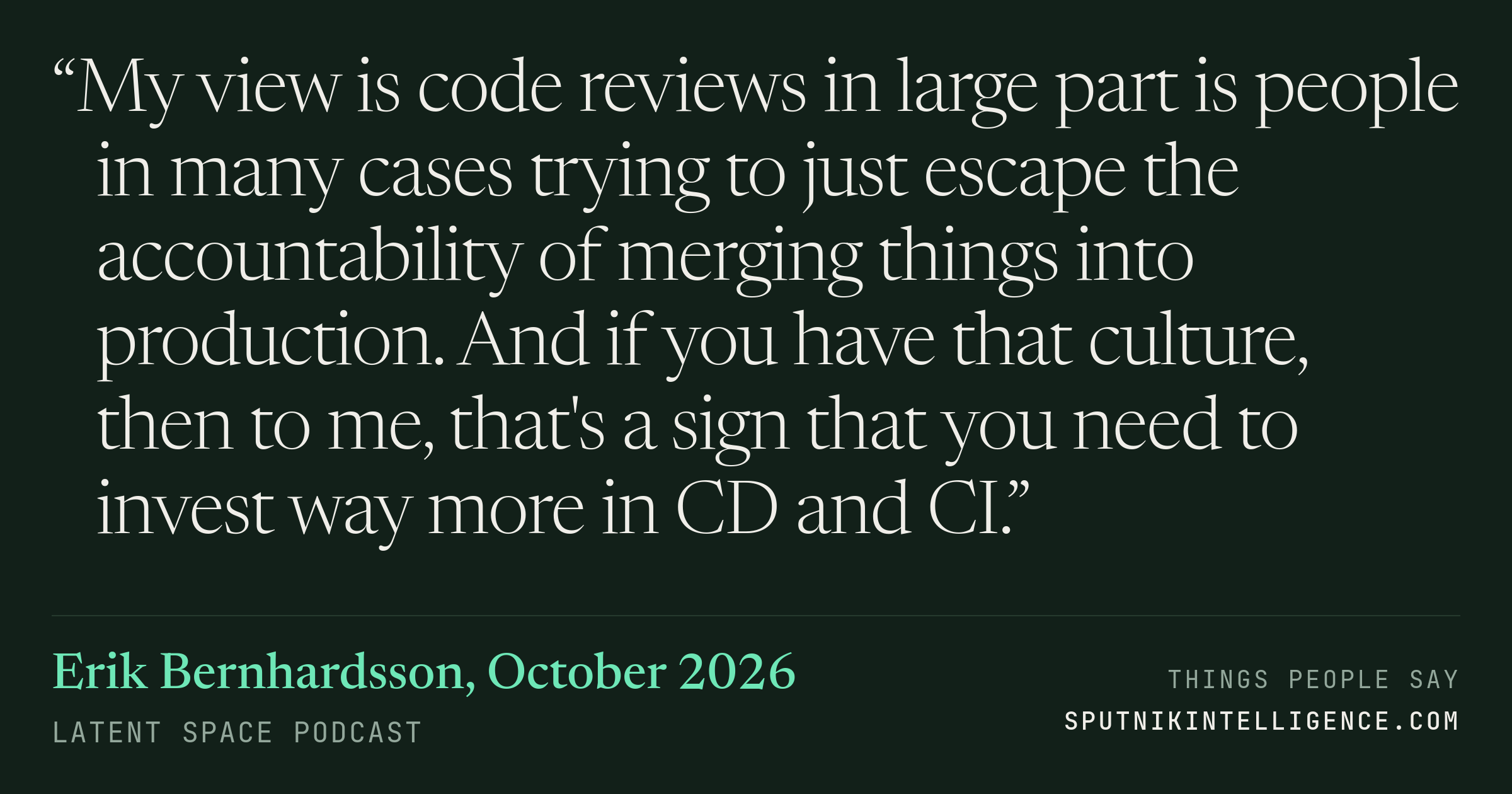
“My view is code reviews in large part is people in many cases trying to just escape the accountability of merging things into production. And if you have that culture, then to me, that's a sign that you need to invest way more in CD and CI.” — Erik Bernhardsson, Latent Space

Asked how Modal reviews code now that non-technical staff commit it too, the Modal CEO said code reviews there are optional. He argued that especially with AI, a human doesn't need to look at every change, as long as testing, rate limits and decoupled systems are strong.

Latent Space · 2026-10-22 Permalink → Listen →
Latent Space
Speaker 2

…lot of people who are not in the tech team still write code. So that to me is like, you know, a recent phenomenon. But I actually don't know if it's like necessarily cost by Gen AI, but I think Gen AI has greatly accelerated it because it made it even lower. The cost of writing code is even easier.

Speaker 1

So if you have non-technical people committing code, how do you review that? How do you guys do code reviews?

Speaker 2

We do code reviews, but we think of it as optional. I mean, for most, my view is like code reviews in large part is people in many cases trying to just escape the accountability of merging things into production. And if you have that, like, you know, if you have that culture, then to me, that's a sign that you need to invest way more in CD and CI and things like that, or CI in particular, but also CD, continuous integration, continuous deployment. We do code reviews. I mean, when I write code, occasionally, I'm asking authors, is this in line with how you think about things? I hope I'm not changing the architecture fundamentally. But we also make it clear internally that code reviews are quite optional. And if you're just changing docs, if you're just doing some basic stuff, don't wait for a human to look at it, especially in the era of AI. Why do you need a human to look at every piece of code? You don't have to. But that does require you to have very good controls internally around testing things. Yeah, and exactly. Infra…

Speaker 1

do you guys use like frontier models for coding or do you guys have you guys experimented with uh like the open source ones

Speaker 2

we experiment with everything but yeah i mean you know initially it was a lot of cursor then you know of course clawed and codex and now a lot of people are using you know night shift and all this open source stuff or other stacks so i don't necessarily have like a strong point of view like i want…

Speaker 1

something i read maybe like i don't know a year ago maybe like two years ago you were saying that you didn't think that there was going to be like a big on-prem business for you guys um have you maybe like changed your opinion on that

Speaker names from our own diarization · position estimated from where the line sits in the episode

Collections They Appear In