
Walter Goodwin

Things Walter Says on Podcasts

Where to Find Them

Walter Goodwin has been a guest on No Priors , The Twenty Minute VC (20VC): Venture Capital | Startup Funding | The Pitch and TBPN .

Recently: “20VC: Taking on NVIDIA: Fractile CEO on the Future of Chips | What Everyone Gets Wrong About Capex Spending | The Winners and Losers in Neo Clouds with Walter Goodwin” on The Twenty Minute VC (20VC): Venture Capital | Startup Funding | The Pitch (November 2026); “🇺🇸 Veterans Day 🇺🇸, The Great Hobby Debate, AI is BACK! | Dan Goldenberg, Darren Farber, Walter Goodwin” on TBPN (November 2026); “The Future of Frontier Model Architectures with Walter Goodwin, Fractile Founder and CEO” on No Priors (October 2026).

What They Said

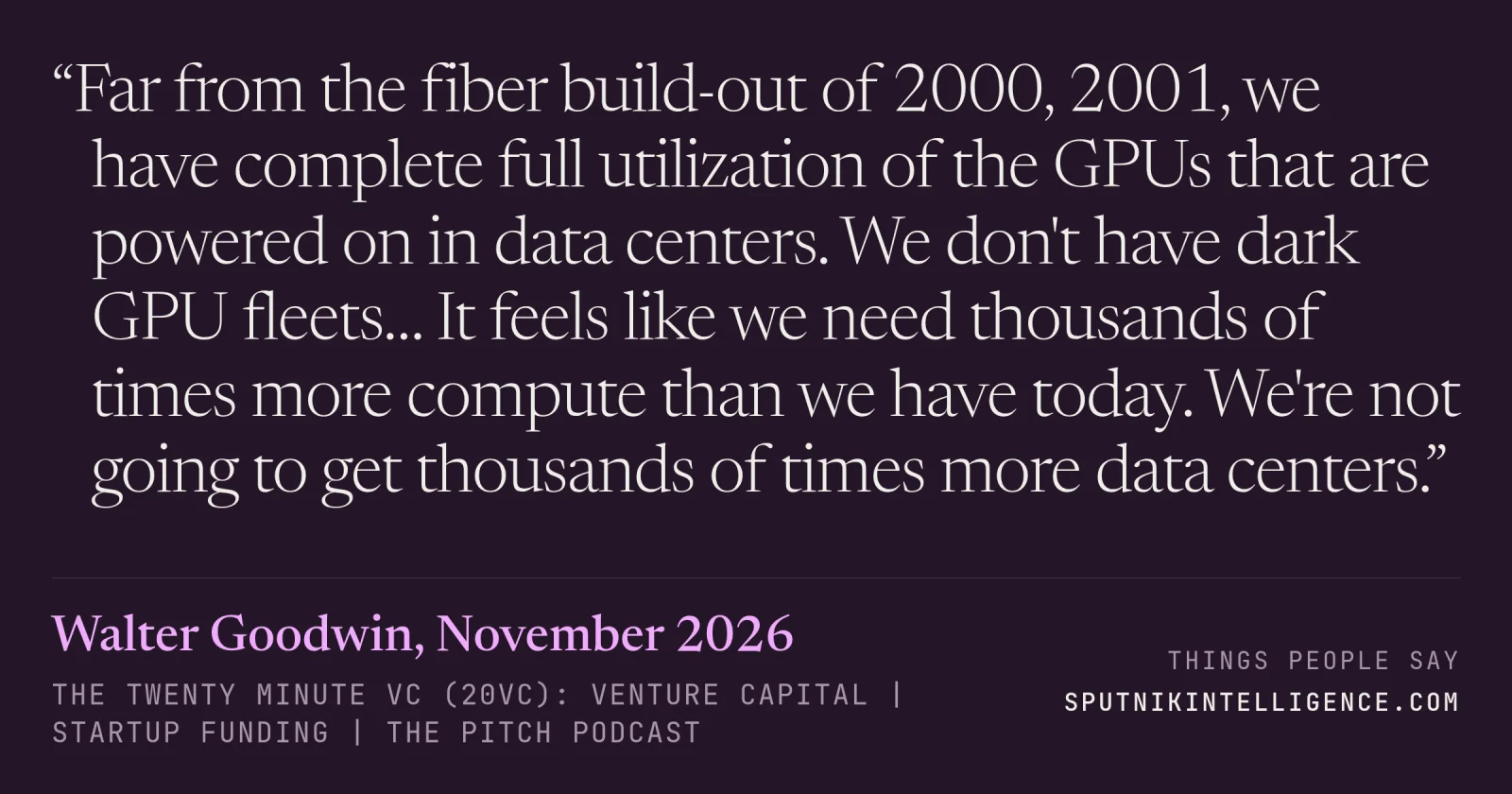
“Far from the fiber build-out of 2000, 2001, we have complete full utilization of the GPUs that are powered on in data centers. We don't have dark GPU fleets… It feels like we need thousands of times more compute than we have today. We're not going to get thousands of times more data centers.” — Walter Goodwin, The Twenty Minute VC (20VC): Venture Capital | Startup Funding | The Pitch

Harry Stebbings said he doesn't see enough money in the world for the AI build-out. Walter Goodwin answers that, unlike the dot-com fiber glut, every powered GPU is in use, so the gap has to be closed by more efficient models and chips.

The Twenty Minute VC (20VC): Venture Capital | Startup Funding | The Pitch · 2026-11-14 Permalink → Listen →
The Twenty Minute VC (20VC): Venture Capital | Startup Funding | The Pitch Around 38:04 into the episode
Walter Goodwin

…leads to serving intelligence, right? And the good news is, you know, for all that, obviously we're focused over here on chips, you know, if you just look at the algorithmic side, like model efficiency, the cost, assuming no hardware change to serve a given level of intelligence is coming down to

Harry Stebbings

improvements in efficiency with no hardware change.

Walter Goodwin

…dark GPU fleets because as you've seen, you know, we have this enormous number of problems as a species that we still have to solve. We now have tools that we can throw at those problems. And we have many orders of magnitude more thinking that we could be doing at sort of inference time to solve the hardest challenges if we had the compute. And so, you know, I agree with you on the one hand, it feels like we need thousands of times more compute than we have today. We're not going to get thousands of times more data centers. And I think that's probably a good thing for the world. What we will be able to do is take roughly that kind of land and power and set of data center sites that exist today. And over the next few years, through both model innovations and hardware innovations coming together, squeeze more and more and more, dramatically more, intelligence per megawatt per rack in one of those data centers.

Harry Stebbings

So I had Mike Cannon-Bruce on the show from Atlassian, and he said to me, you know, I think the cost of inference is going to come down dramatically over the next three to five years. And that's why I'm pretty good at you. You should do me

Walter Goodwin

in the next one.

Harry Stebbings

Well, I mean, you in the next one is relatively. Close to just me. You want me doing Russian? That really is a good one. But with the Mike Cannonbrooks theme in mind, what happens to the cost of inference?
Speaker names come from our own diarization. The position is estimated from where the line sits in the episode.
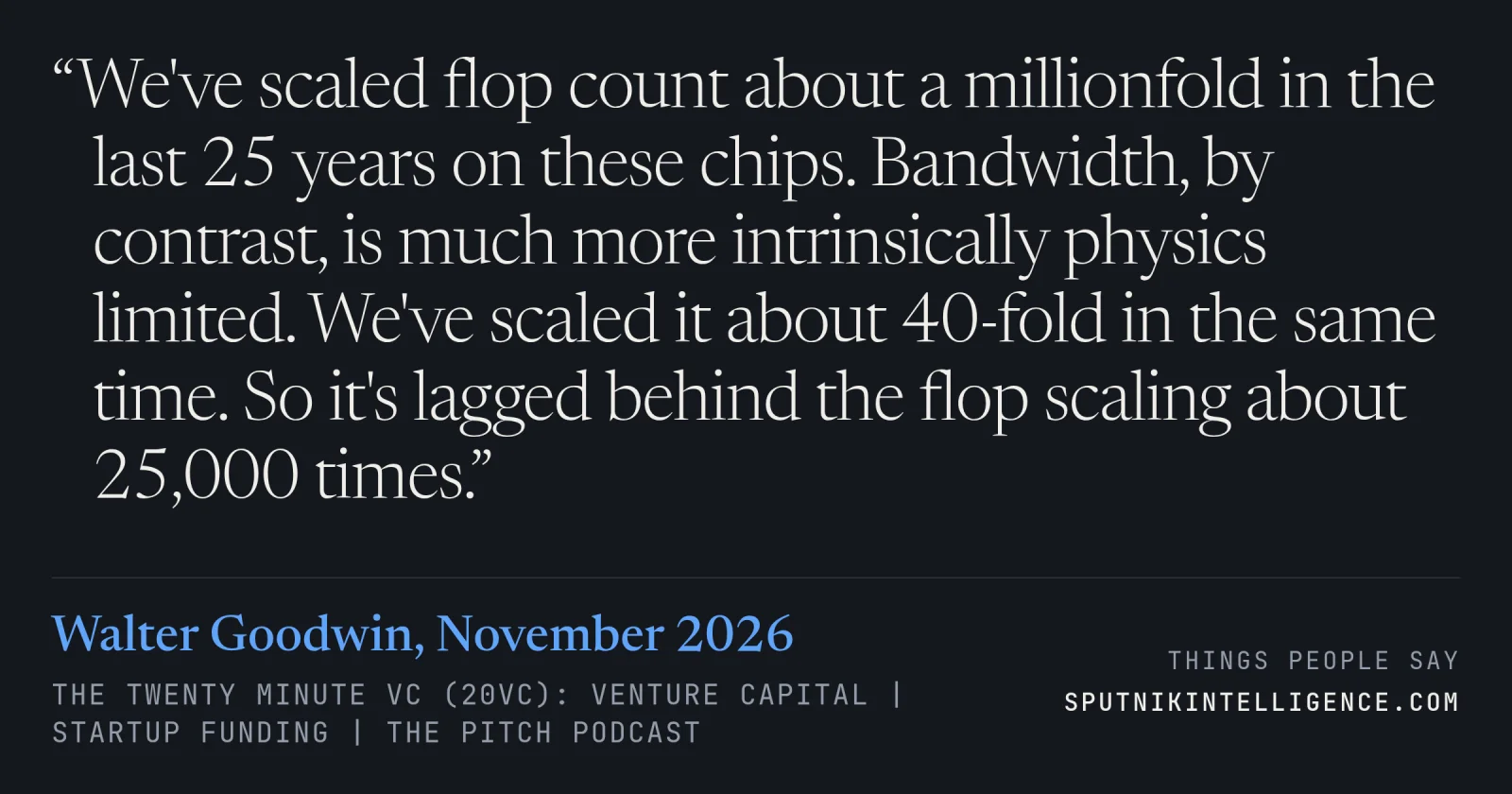
“We've scaled flop count about a millionfold in the last 25 years on these chips. Bandwidth, by contrast, is much more intrinsically physics limited. We've scaled it about 40-fold in the same time. So it's lagged behind the flop scaling about 25,000 times.” — Walter Goodwin, The Twenty Minute VC (20VC): Venture Capital | Startup Funding | The Pitch

Harry Stebbings asked why the "memory wall" is still such a problem. Fractile CEO Walter Goodwin explains that chip math has scaled far faster than memory bandwidth, which is why LLM text generation is held back by memory rather than compute.

The Twenty Minute VC (20VC): Venture Capital | Startup Funding | The Pitch · 2026-11-14 Permalink → Listen →
The Twenty Minute VC (20VC): Venture Capital | Startup Funding | The Pitch Around 13:28 into the episode
Walter Goodwin

…that made up sort of more than, let's say, 10% of the total compute burden. Suddenly we do. And I think that demands slightly different company structures that can have that kind of predictive power built in that try to also orchestrate the entire org around what it means to chase after that.

Harry Stebbings

You mentioned memory and HBM there. Why is the memory wall such a prominent problem still today? Yeah,

Walter Goodwin

it's one of these sort of interesting facts about kind of chip physics, right? If you look at the two-year-olds. So if you look across the last 20 years in the silicon world, there's sort of two things that really make up the kind of top-level specs, the kind of top trumps of your chip, right? And one of them, certainly for AI chips, is the flop count, how many floating point operations can you do per second? This is like a multiply or an add. And so that's your kind of mathematical power on that chip. And then the other piece is kind of the properties of the memory on that chip, the capacity, and in particular, the bandwidth to that memory. And that's how quickly you can, you know, shuttle data back and forth from you're looking at a GPU, you actually have that silicon in the middle of it that is running the maths. It's got that high flop count. And then there's other pieces of silicon around it, the HPM, that are kind of coming in on this on this sort of highway, bringing data in. And we've been extraordinarily good with Moore's law at…

Harry Stebbings

And is that why, sorry, you have SRAM? Am I right in saying that? Moving memory closer to it. So

Walter Goodwin

SRAM, yeah, so there's this sort of, you know, DRAM is like off in a different building, basically. And you're carrying these boxes down the stairs and then up the stairs again into the processor building where the maths is done. And you have to carry them back again, unfortunately, because there's…

Harry Stebbings

When you look at inference in the future of inference, which is then best suited? Is it DRAM or SRAM? Because latency is important.

Speaker names come from our own diarization. The position is estimated from where the line sits in the episode.

Collections They Appear In