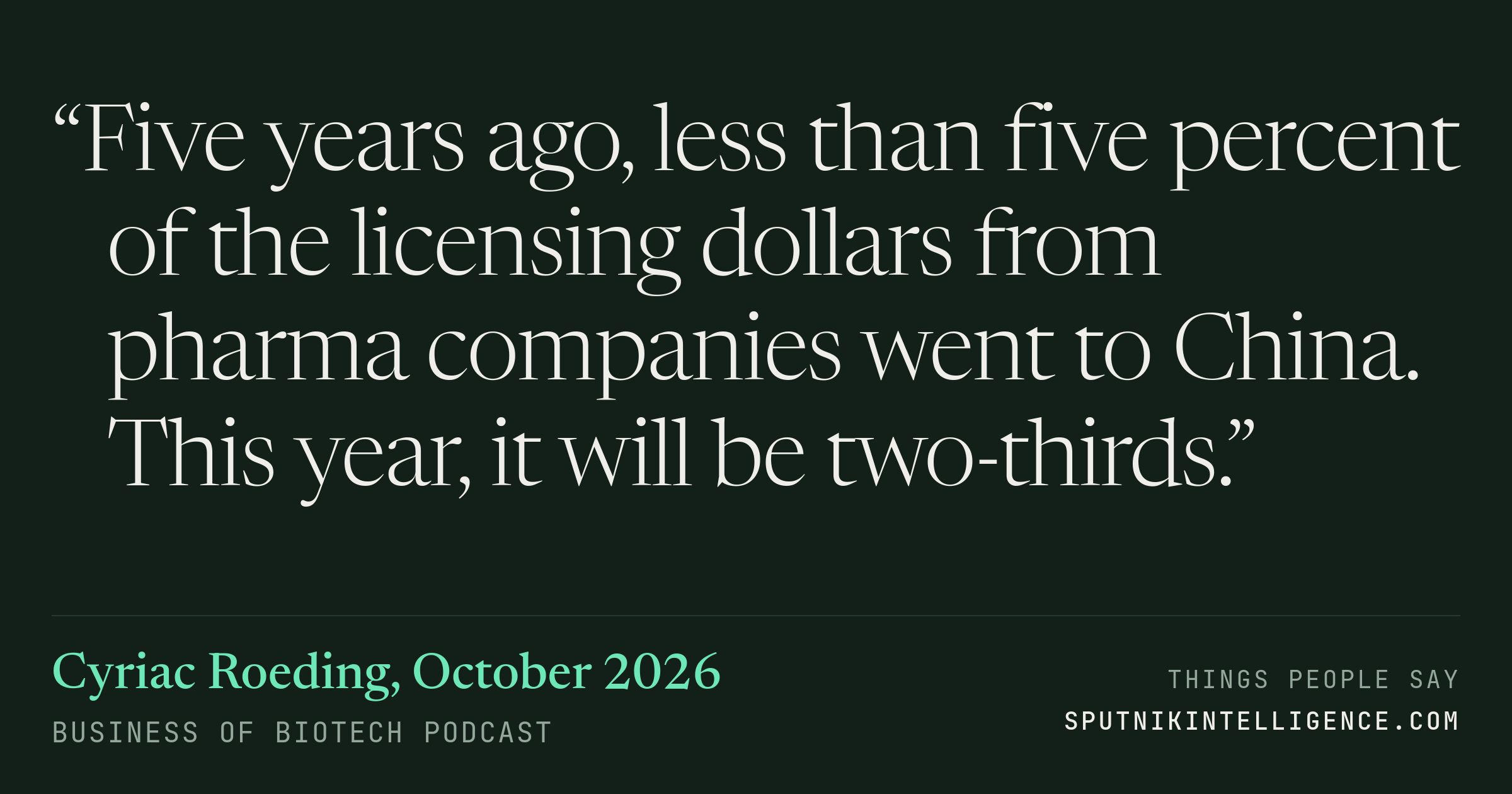
Roeding, a biotech founder, was listing the facts he thinks show how squeezed US biotech funding has become. The first was his figure that 87.5% of venture dollars this year are going to AI. The numbers are his.
What do you think every country did? Every country served its own citizens first, right? As you would expect. So, what do you what would happen and how would we feel personally about this? Imagine um, God forbid, one of us gets diagnosed with cancer. And the most powerful cancer drug against that specific cancer comes out of China, but there is a shortage. Do you think you and I, you or I will get this drug? No. So now there might be other situations where it's geopolitical. Like, for example, we've known this, we've seen this with um uh with with with rare earths. This is a constant battle between China and the US because China has more rare earth than than the US. Um, and I and I don't actually expect China to do this with drugs because that is very cynical uh uh uh to do this on purpose. Um but there might be simply a shortage of supply. So now I'm asking everyone do we want to be dependent on another country to develop the world's most leading edge drugs? And most people would answer this question with, of course not. But the problem is we're not acting the way that we're talking. We are facilitating just what I just point painted as a picture, is what we are currently preparing to happen. For the first time ever, since the biotech industry has emerged 60 years ago, we are risking losing the innovation leadership. And why is this happening? Yes, there are some regulatory issues. We're slower with clinical trials and certain other regulatory issues in the approval process, and we need to change that. But that is not the number one problem. The number one problem is believe it or not, money. Really it's funding. Let me explain. You mentioned it at the very beginning, Ben, when you talked about biotech. Biotech has long cycles, right? Right. It takes 12 to 15 years to develop a drug from start to finish. And in the US, we have a completely free market, which is awesome. I'm a big believer in capitalism. But there are certain situations where the system is failing us that is otherwise so efficient. And that is called boom and bust cycles in biotech. The boom and bust cycles in biotech are more extreme than I believe in any other innovation-based industry.
Yeah, and we're just coming out of a long bus cycle, right? Hopefully coming out. Yeah. Thank you.
So the last four years, not this year, but the prior four years, have been the biggest bust, I think, in the last over 20 years. Right. So now we're this happened after the pandemic. It was sort of like an aftershock of this overhype situation, and the all the money went away. But now let me give you three major facts that make paint this picture how extreme this is right now. Number one, guess how many percent of venture capital dollars this year are going to AI versus to other parts of the of innovation? Oh, I've 10 to 1. 87.5%. Wow. Okay. That means everyone else gets 12 and a half. Now, fortunately, Earli is on the intersection of bio and AI. So that's great. It's special, but not every biotech is, most biotechs aren't. So 12.5% left for everything else. That's number one. Number two. Five years ago, less than five percent of the licensing dollars from pharma companies went to China. This year, it will be two-thirds.
Yeah.
Two-thirds. One third is left for US firms or anywhere else in the world outside of China. That is a dramatic shift. What are they buying? They're not just buying cheap knockoffs, they're buying innovation. Right. So, how come there's so much innovation to buy? And the answer is a sustained, flat, much flatter curve of funding by strong support, largely from not only from private sources, but also from the government. It's not that they invested in every startup, they also develop ways to buy things from them. There is there there are all kinds of mechanisms to support these prioritized industries. You mentioned the new five-year plan. This is the second five-year plan in which biotech has been listed, not the first. Yeah. And with every biotech uh state stating biotech as a major pillar together with AI and fusion technology and and robotics and so on, this means the whole country is behind it. So now we don't want to shift to communism. Last time I checked. I don't. I guessed you don't. So what are we gonna do? What are we gonna do about this? And the answer to this question, I believe, needs to be a sovereign biotech wealth fund. What is that? What's the sovereign wealth fund? A sovereign wealth fund is money from the government, from taxpayers that is designed and allocated to be invested in innovative companies. Exactly between this phase of preclinical to clinical, because that's where most of the cut shutdown happens.
The valley of death, that's right.