JZ

Jamie Zeitzer

Things Jamie Says on Podcasts

Where to Find Them

Jamie Zeitzer writes The Future of Everything . They have also been a guest on Aging Less: The Longevity Science Insights Podcast and Atmosphere with Emily Gracey .

Recently: “Daylight Saving Time: The Great Debate” on Atmosphere with Emily Gracey (October 2026); “Best of: The future of sleep” on The Future of Everything (March 2026); “Best of: The future of sleep” on The Future of Everything (March 2026); “The future of sleep” on The Future of Everything (May 2025); “The future of sleep” on The Future of Everything (May 2025); “Dr. Jamie Zeitzer: How Light Shapes Our Internal Clock | Aging Less #09” on Aging Less: The Longevity Science Insights Podcast (February 2025).

What They Said

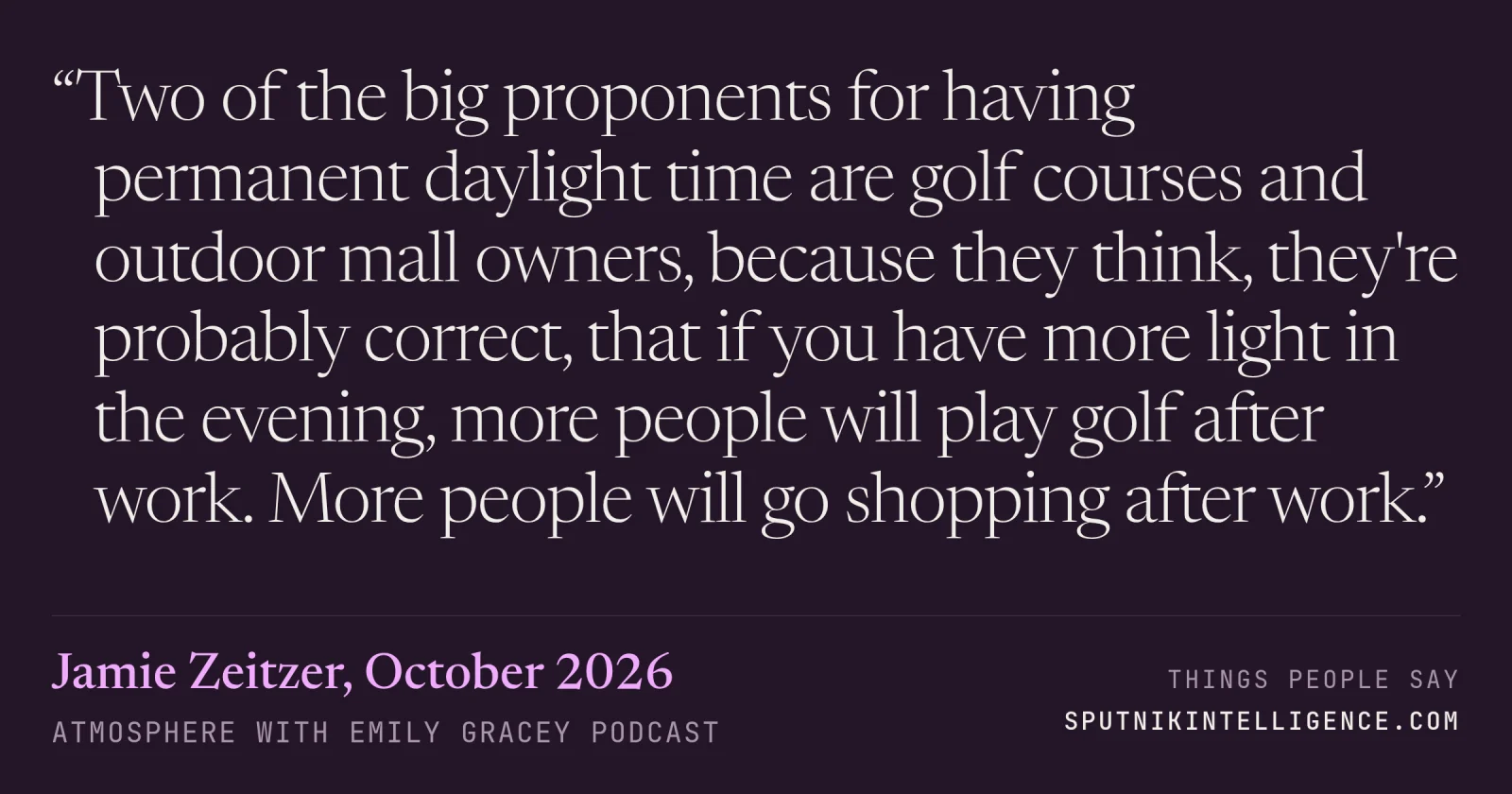
“Two of the big proponents for having permanent daylight time are golf courses and outdoor mall owners, because they think, they're probably correct, that if you have more light in the evening, more people will play golf after work. More people will go shopping after work.” — Jamie Zeitzer, Atmosphere with Emily Gracey

Zeitzer pointing out that changing the clocks doesn't add daylight, it only moves it. He asks who would actually benefit from evening light, and whether that would improve health or "just make wealthy people wealthier."

Atmosphere with Emily Gracey · 2026-10-27 Permalink → Listen →
Atmosphere with Emily Gracey Around 15:30 into the episode
Jamie Zeitzer

…What happens when you change this from a circadian perspective? But what we didn't look at, it's not my area of expertise, but I hope someone will, is, well, what happens if you move that hour of light? Because people think like, oh, you're getting more light. You're not getting more light.

Emily Gracey

Right.

Jamie Zeitzer

That's finite. Like, I wish I could change that. It'd be really popular if I could change how much light was there, but I can't. But I can just, you can just change when it's occurring. Well, does it change exercise, which would imply that it might change health? So do people exercise more if you move that hour of light into the morning or into the evening? Two of the big proponents for having permanent daylight time are golf courses and outdoor mall owners, because they think they're probably correct, is that if you have more light in the evening, more people will play golf after work. More people will go shopping after work. And I don't know. I'm not an economist. That sounds reasonable to me. And the question is, is that, well, if more people are playing golf then, maybe that offsets some of the health. Or maybe they would just get exercise in a different way. I don't know. It's an important question to think about, you know, if you're thinking about the health consequences. And even the economic argument is like, well, who's going to be making that…

Emily Gracey

There's so much to unpack here. And that doesn't even factor in like. I'm a mother, so my thought keeps going back to like kids and especially like school in the morning and bus stops and dark bus stops. But then also, like, is school starting too early? Like, is it about our schedules? And should…

Jamie Zeitzer

Yeah, well, and this is one of the one of the things that people complained about, at least in the uh, in the news, at least, back in the 70s, was you know, kids waiting in the dark, you know, because if you're if you're basically having permanent daylight time in the winter, now it's going to be…

Emily Gracey

Travel would be a disaster.

Speaker names come from our own diarization. The position is estimated from where the line sits in the episode.
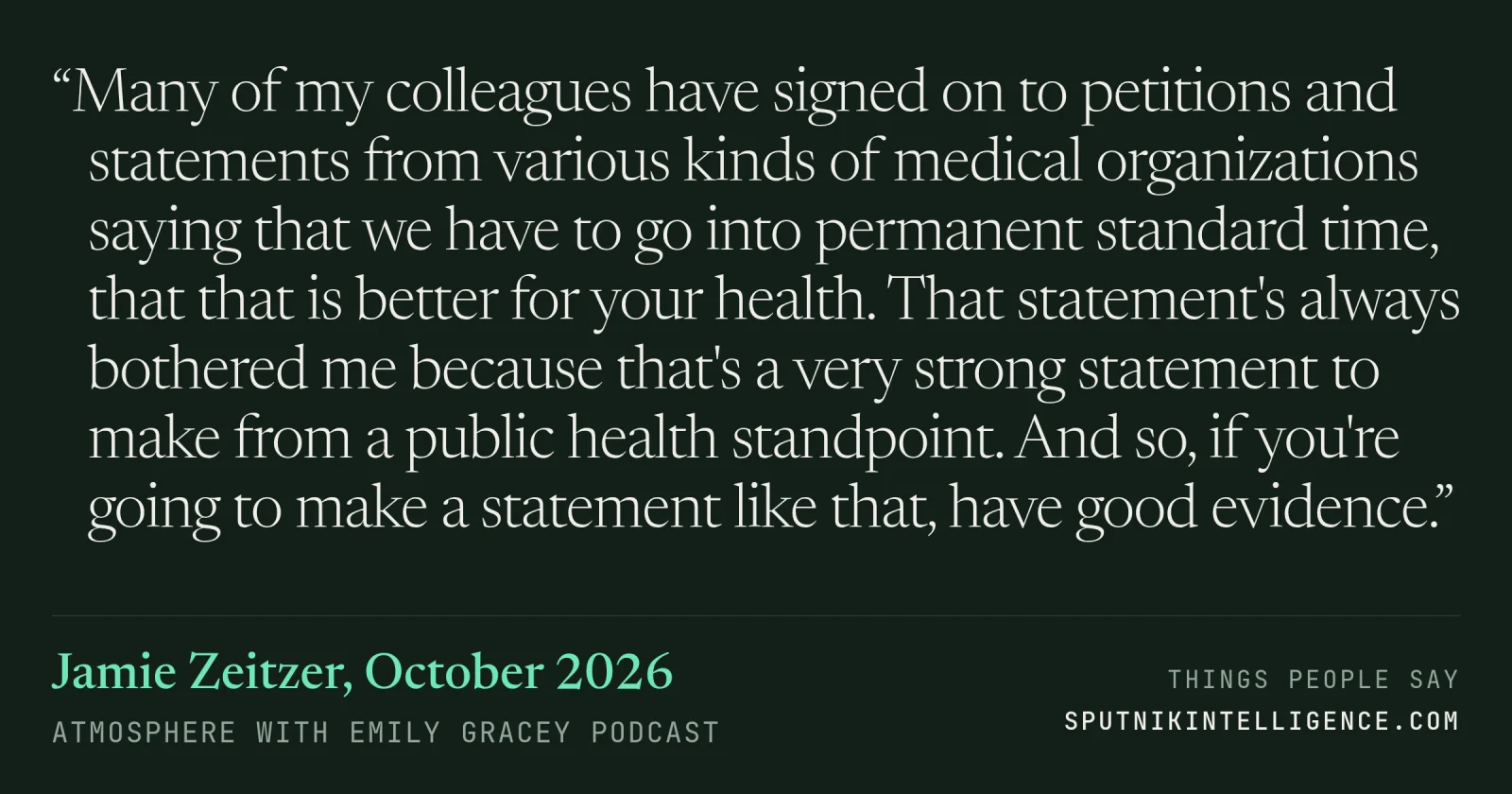
“Many of my colleagues have signed on to petitions and statements from various kinds of medical organizations saying that we have to go into permanent standard time, that that is better for your health. That statement's always bothered me because that's a very strong statement to make from a public health standpoint. And so, if you're going to make a statement like that, have good evidence.” — Jamie Zeitzer, Atmosphere with Emily Gracey

Zeitzer, a sleep and circadian researcher, was asked what is best for health. He says the strongest evidence is only that the spring clock change carries small risks, and that the case for permanent standard time rests on good theory rather than much data. His own modelling found some effect, but less than people hoped and varying by location.

Atmosphere with Emily Gracey · 2026-10-27 Permalink → Listen →
Atmosphere with Emily Gracey Around 14:16 into the episode
Jamie Zeitzer

…state does it. And so, yeah, so it kind of started back then. And back in the 70s, they tried getting rid of standard time, moving to permanent daylight time, and people hated that. So there's a market history, but it's definitely something that people have opinions about, like what it should be.

Emily Gracey

They do. And, you know, even in my house, it's like we argue about this. But I mean, I can guess what your argument is because I hear this from most scientists. But can you tell me like what from our circadian rhythm and health-wise, what is the best possible situation?

Jamie Zeitzer

Well, that's, it's, it's actually more complicated than you'd want. So many of my colleagues have signed on to petitions and statements from various kinds of medical organizations saying that we have to go into permanent standard time, that that is better for your health. That statement's always bothered me because that's a very strong. Statement to make for a public health standpoint. And so, if you're going to make a statement like that, have good evidence. Right now, the best evidence is that the time switch in the spring is associated with negative effects and the time switch in the fall is not. And the time switch in the spring, again, not always is it associated with negative effects, but many studies have found that. And basically, the idea is that, well, when you move an hour and you lose an hour of sleep, such as happens in the spring, that's associated with negative outcomes and negative outcomes like increased risk of heart attacks and car accidents, strokes. Those are kinds of the main things. When you look at it, though, the evidence indicates that the risk to any individual is vanishingly small. It is just when you have 350 million people doing it on the same…

Emily Gracey

Right.

Jamie Zeitzer

That's finite. Like, I wish I could change that. It'd be really popular if I could change how much light was there, but I can't. But I can just, you can just change when it's occurring. Well, does it change exercise, which would imply that it might change health? So do people exercise more if you…

Emily Gracey

There's so much to unpack here. And that doesn't even factor in like. I'm a mother, so my thought keeps going back to like kids and especially like school in the morning and bus stops and dark bus stops. But then also, like, is school starting too early? Like, is it about our schedules? And should…

Speaker names come from our own diarization. The position is estimated from where the line sits in the episode.