AS

Alexander Saeedy

Things Alexander Says on Podcasts

Where to Find Them

Alexander Saeedy has been a guest on The Journal. (5 times) and WSJ's Take On the Week .

Recently: “Is AI Running Out of Money to Borrow?” on The Journal. (October 2026); “HBO’s ‘Industry’ Creators on Banking Culture, Risk, Fraud and Short Selling” on WSJ's Take On the Week (January 2026); “Investment Accounts for Babies Are Coming. Wall Street Can’t Wait.” on The Journal. (December 2025); “Are Conservatives Being 'Debanked'?” on The Journal. (October 2025); “The Wall Street Craze Jamie Dimon Can’t Resist. Even If It Blows Up.” on The Journal. (July 2025); “Why Elon Musk’s AI Chatbot Went Rogue” on The Journal. (July 2025).

What They Said

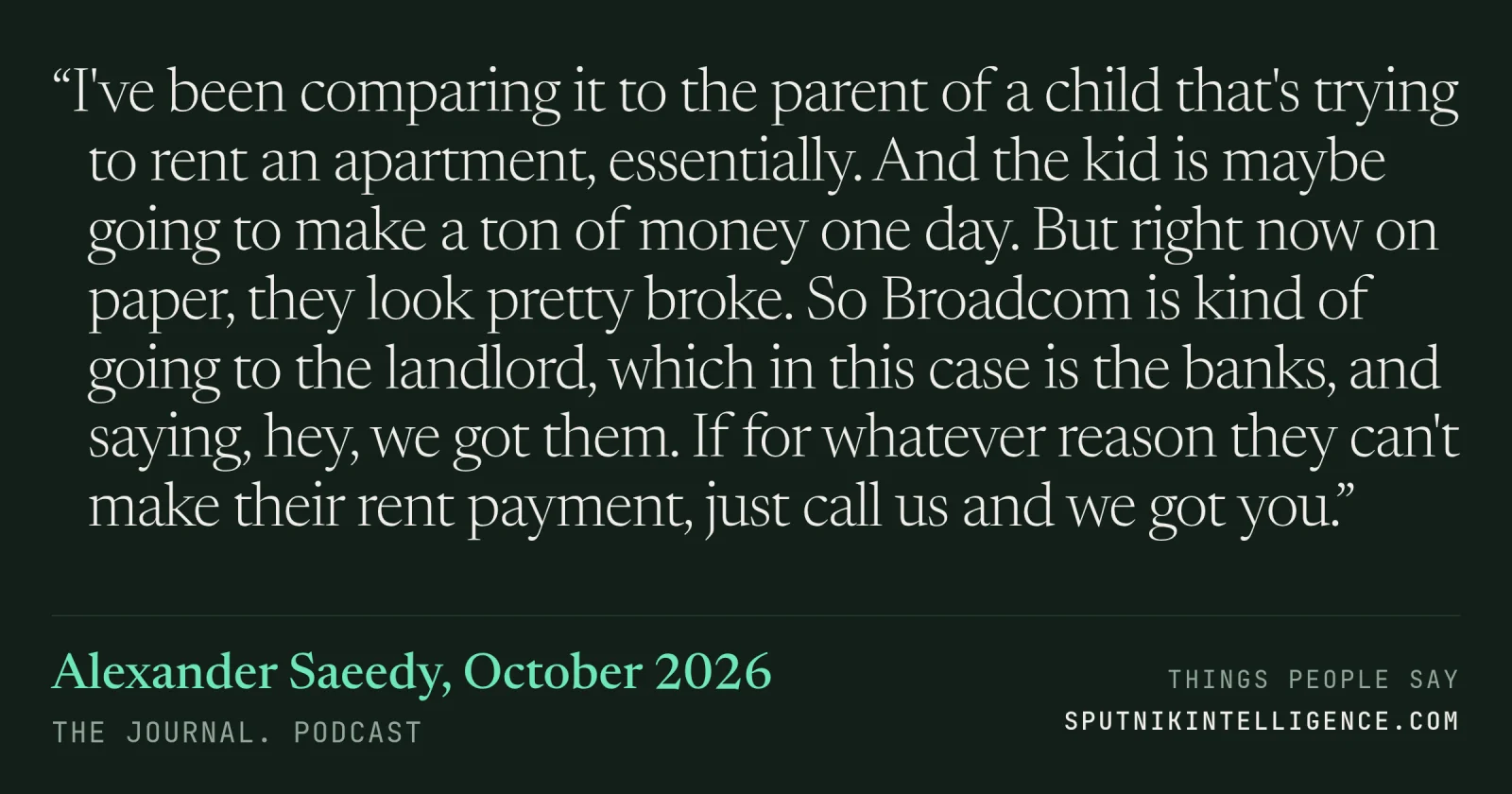
“I've been comparing it to the parent of a child that's trying to rent an apartment, essentially. And the kid is maybe going to make a ton of money one day. But right now on paper, they look pretty broke. So Broadcom is kind of going to the landlord, which in this case is the banks, and saying, hey, we got them. If for whatever reason they can't make their rent payment, just call us and we got you.” — Alexander Saeedy, The Journal.

The episode is about financing for a roughly $63 billion deal in which Broadcom supplies chips to Anthropic. Broadcom has a strong credit rating and Anthropic does not, so Broadcom is backing the financing. Saeedy uses a rental-apartment analogy to explain Broadcom's role with the banks.

The Journal. · 2026-10-30 Permalink → Listen →
The Journal. Around 09:48 into the episode
Alexander Saeedy

They are the supplier to Anthropic, right? Like they want Anthropic to buy chips from it. And Broadcom is like kind of solving a problem for itself as well as for Anthropic, which is how can we help you get the money to pay us, essentially.

Ryan Knutson

And Broadcom was in a good position to handle the financing for this deal because unlike Anthropic, Broadcom has a great credit rating.

Alexander Saeedy

So they are kind of coming in, and I've been kind of comparing it to like the parent of a child that's trying to rent an apartment, essentially. And the kid is like maybe going to like, you know, make a ton of money one day. But right now on paper, they look pretty broke. So Broadcom is kind of going to the landlord, which in this case is the banks, and saying like, hey, like we got them. If for whatever reason they can't make their rent payment, just call us and we got you.

Ryan Knutson

Ultimately, Anthropic would still be the one that has to pay the rent. Broadcom is acting as the intermediary with their name on the lease. And how did banks receive this proposal from Broadcom and Anthropic?

Alexander Saeedy

You know, the banks were kind of looking at the amount of risk they were signing up to in this and getting pretty nervous. So the hurdle was to overcome both the financial challenges of doing this deal and the sort of like mental challenge of can we convince investors that this is worth committing…

Ryan Knutson

How Broadcom and Anthropic got the deal over the finish line?
Speaker names come from our own diarization. The position is estimated from where the line sits in the episode.
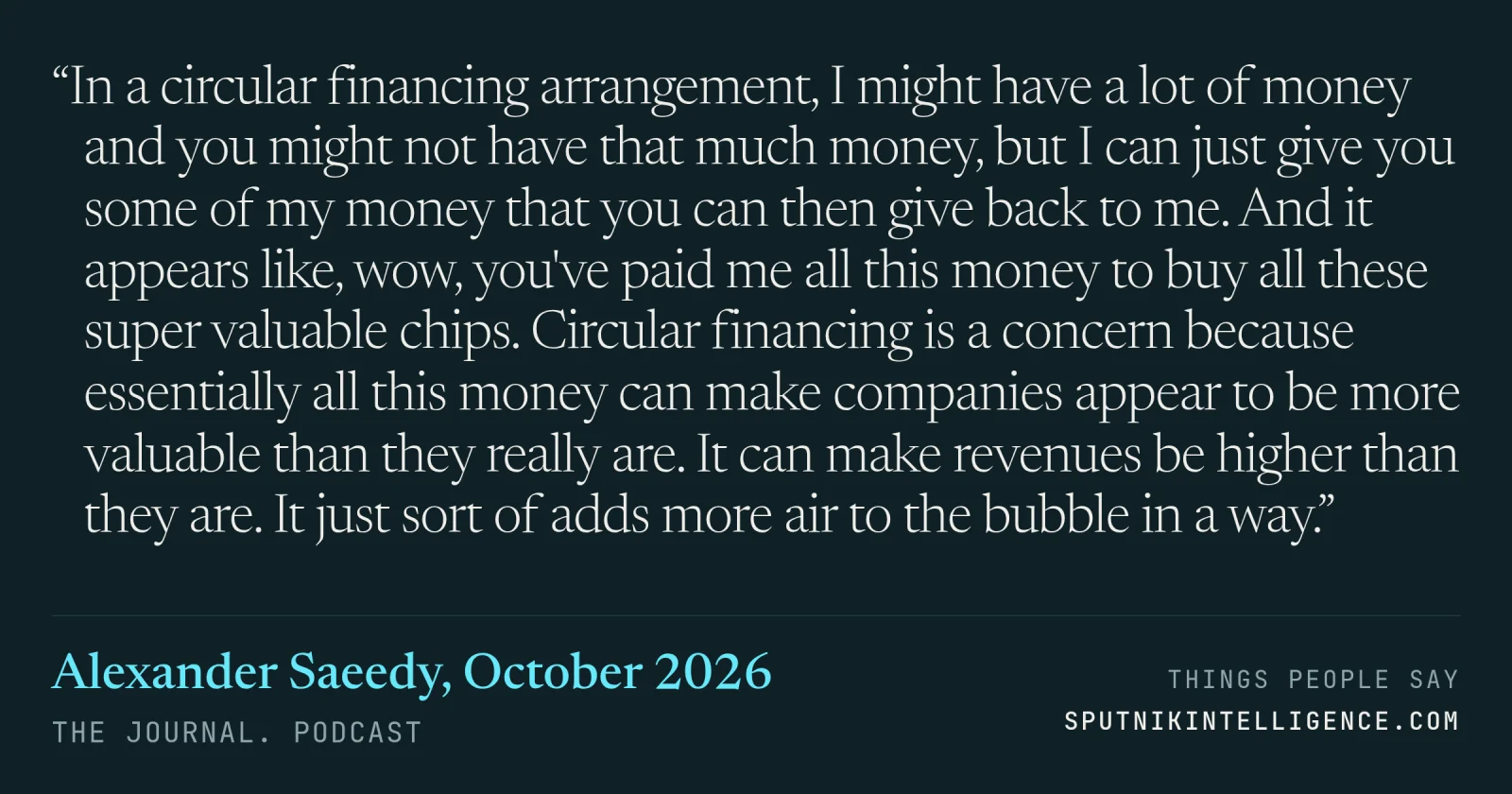
“In a circular financing arrangement, I might have a lot of money and you might not have that much money, but I can just give you some of my money that you can then give back to me. And it appears like, wow, you've paid me all this money to buy all these super valuable chips. Circular financing is a concern because essentially all this money can make companies appear to be more valuable than they really are. It can make revenues be higher than they are. It just sort of adds more air to the bubble in a way.” — Alexander Saeedy, The Journal.

Knutson had just said that people watching the AI industry call arrangements like this circular financing. Saeedy had described Broadcom lending Anthropic money that it can use to pay Broadcom back. Here he explains in plain terms why that pattern worries observers.

The Journal. · 2026-10-30 Permalink → Listen →
The Journal. Around 16:20 into the episode
Alexander Saeedy

Broadcom, in addition to all the things it's doing that we've described with the guarantee and the supplying, they're actually lending money to Anthropic that it can use to pay it back. So the level of interconnection between these companies is really Really fascinating.

Ryan Knutson

This is what people watching the AI industry call circular financing. All this money being handed back and forth between the same companies.

Alexander Saeedy

In a circular financing arrangement, I might have a lot of money and you might not have that much money, but I can just give you some of my money that you can then give back to me. And it appears like, wow, like, you know, you've paid me all this money to buy all these super valuable chips. Circular financing is a concern because essentially all this money can kind of make companies appear to be more valuable than they really are. It can make revenues, you know, be higher than they are. It just sort of like adds more air to the bubble in a way.

Ryan Knutson

And there's a level of interconnectedness so that if like the bubble does pop, everybody's sort of tied together. Well,

Alexander Saeedy

right. All these interconnections means if one party goes down, then like a lot of other parties could go down. And I'm not saying that's the case here, but from a risk management perspective, right, you should be conscious of what's going on here.

Ryan Knutson

What does it say about the state of the AI industry that financing like this is necessary?

Speaker names come from our own diarization. The position is estimated from where the line sits in the episode.