MM

Matt Mills

Things Matt Says on Podcasts

Where to Find Them

Matt Mills has been a guest on Tomorrow, Today .

Recently: “Who Is Responsible When AI Agents Make Decisions | Matt Mills x Shekhar Natarajan” on Tomorrow, Today (October 2026).

What They Said

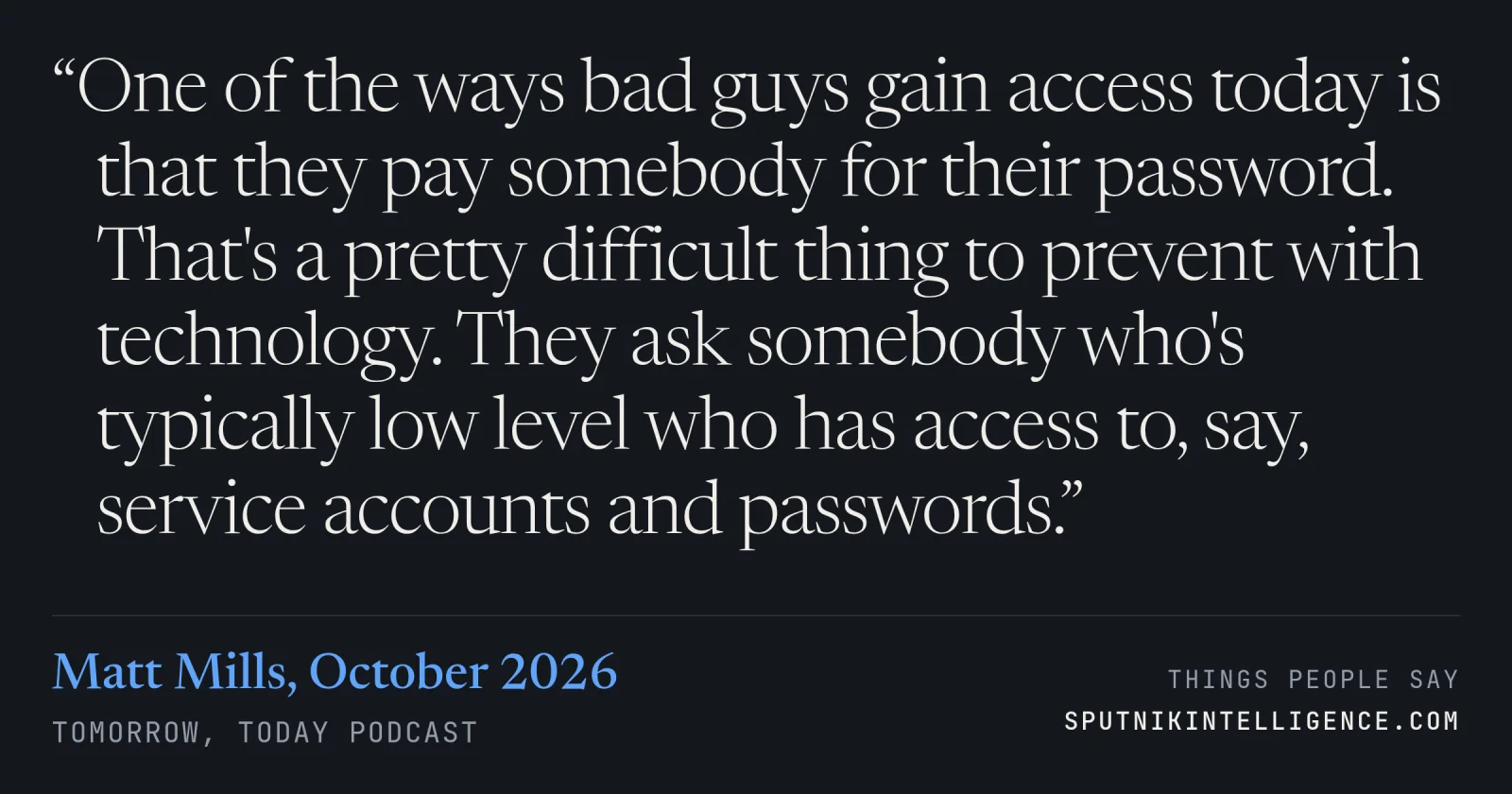
“One of the ways bad guys gain access today is that they pay somebody for their password. That's a pretty difficult thing to prevent with technology. They ask somebody who's typically low level who has access to, say, service accounts and passwords.” — Matt Mills, Tomorrow, Today

After saying most breaches come through stolen credentials, he describes one plain, human way attackers get in that technology struggles to stop.

Tomorrow, Today · 2026-10-31 Permalink → Listen →
Tomorrow, Today Around 10:22 into the episode
Matt Mills

…lot to it you have to make sure that you're using the technology you have it organized correctly you've got the right operational orchestration right but if you do that the answer is 100 yeah and and um we do that because number one our our our platform brings the non-humans and the humans together

Shekhar Natarajan

so we'll get to that in a minute so now help me understand i left my identity in the company yeah and you you forgot to turn off my identity so how does that identity get like hacked by someone when you have been denied the access when you left the company

Matt Mills

well if if you if you're turned off right and and your credentials are taken away then they then they won't but um it's funny right i mean one of the the ways people gain access today bad guys do right they pay somebody for their password right that's a pretty difficult thing to prevent um with technology and so you put things how do

Shekhar Natarajan

they ask for that

Matt Mills

i mean they ask somebody who's typically low level who has access to like say service accounts and passwords and they rival

Shekhar Natarajan

but is it not ethical is it not a crime to actually give away passports

Speaker names come from our own diarization. The position is estimated from where the line sits in the episode.
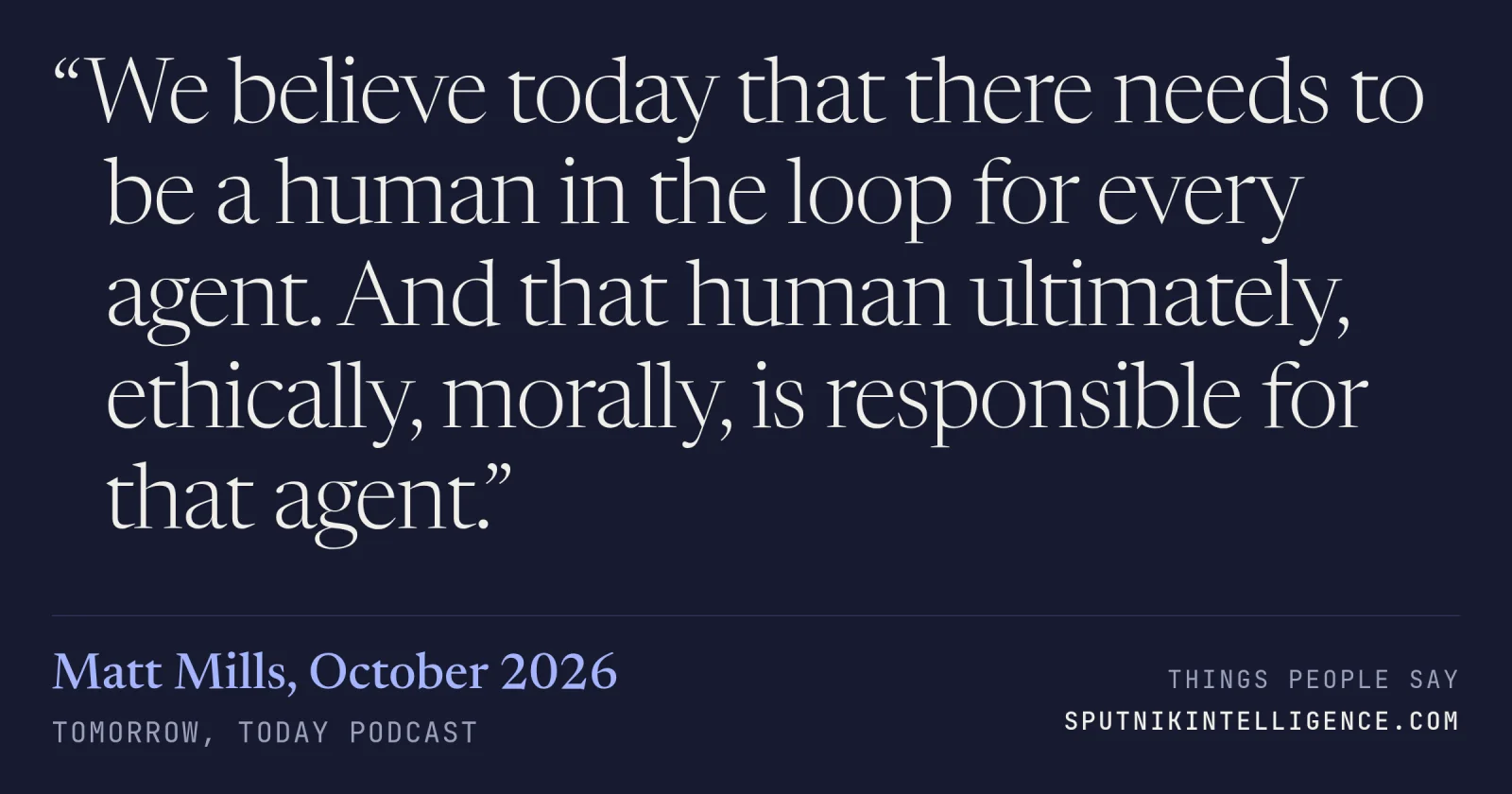
“We believe today that there needs to be a human in the loop for every agent. And that human ultimately, ethically, morally, is responsible for that agent.” — Matt Mills, Tomorrow, Today

Asked how identity can work for agents that behave probabilistically and can spawn other agents, he answers with a human-responsibility rule for every agent.

Tomorrow, Today · 2026-10-31 Permalink → Listen →
Tomorrow, Today Around 13:25 into the episode
Matt Mills

see we're we're not governing or or or um trying to control the quality of the output right what we're trying to do is making sure that um people have access to the right things in the right environment so so for instance um

Shekhar Natarajan

…he knows the output, he doesn't know like what the transformer technology really does. Sorry. So, how do you solve the identity problem of an agent which assumes the properties in a very probabilistic way? Yeah, and then agents can spawn agents, and so how do you manage and control all of those?

Matt Mills

Well, look, here's what I would tell you: we put things in place foundationally, and we believe today, yeah, today, um, that there needs to be a human in the loop for every agent, right? And that's that human ultimately, ethically, morally, is responsible for that agent, yeah, right? And so, my prediction-is

Shekhar Natarajan

it the authorizing person, or is it the model provider? Is it the guy who actually trained the model? Is it the guy who gave the knowledge to the model, or is it the guy who actually provisioned the agent? Who's responsible?

Matt Mills

Yeah, I think at the end of the day, the human that's responsible for that agent is ultimately responsible. Now, you're going to get into a bunch of things here like policy, right? There's a policy engine, there's a risk engine, there's an intent engine, right? All of these things are going to play…

Shekhar Natarajan

The behavior didn't come from the person.

Speaker names come from our own diarization. The position is estimated from where the line sits in the episode.
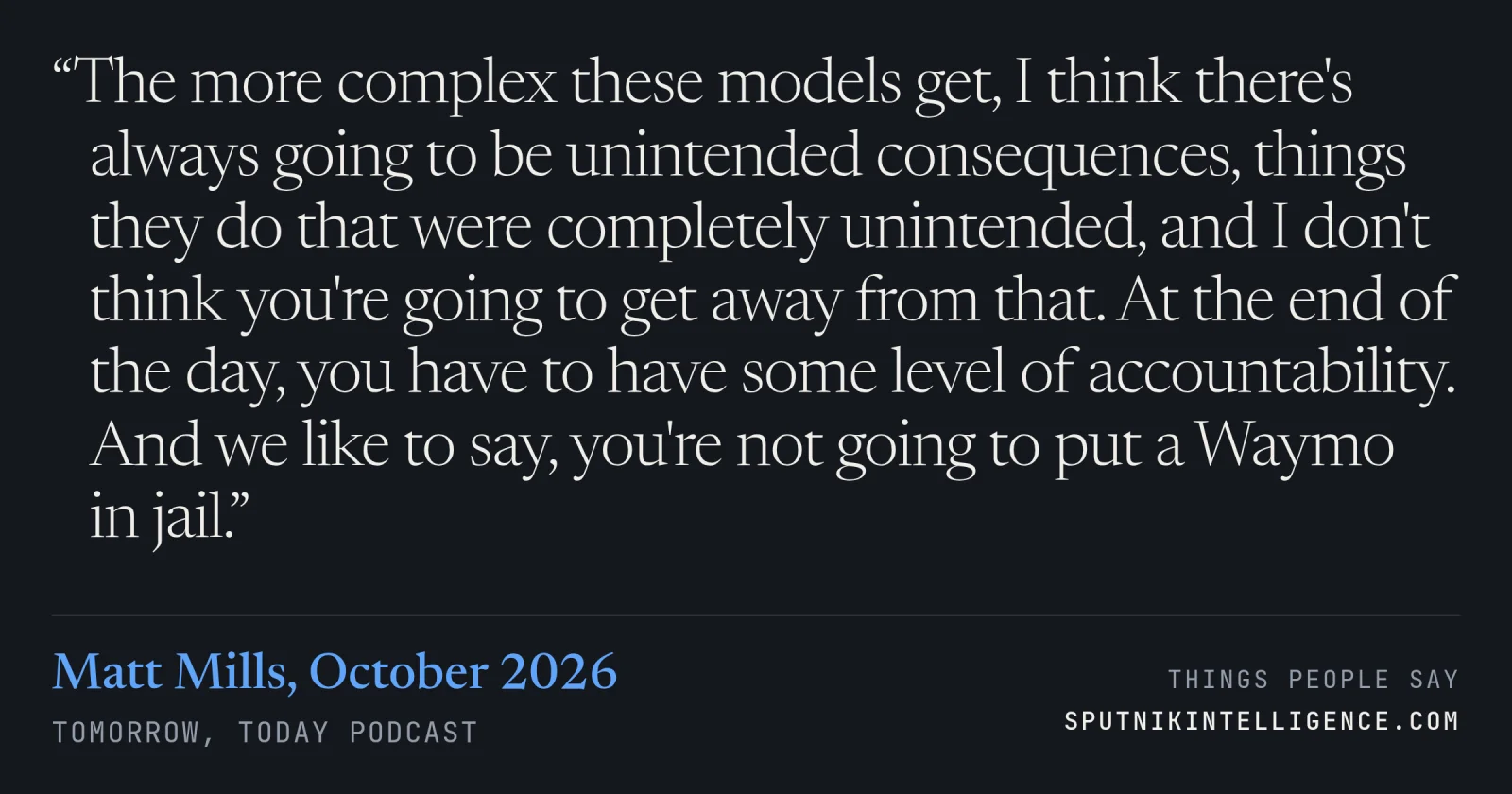
“The more complex these models get, I think there's always going to be unintended consequences, things they do that were completely unintended, and I don't think you're going to get away from that. At the end of the day, you have to have some level of accountability. And we like to say, you're not going to put a Waymo in jail.” — Matt Mills, Tomorrow, Today

Pressed on who is responsible when an AI agent does something its authorizing human never intended, the identity-governance executive argues accountability must still land on a person.

Tomorrow, Today · 2026-10-31 Permalink → Listen →
Tomorrow, Today Around 14:38 into the episode
Matt Mills

…things here like policy, right? There's a policy engine, there's a risk engine, there's an intent engine, right? All of these things are going to play into a risk analysis that you're going to get for these agents, right? Now, the author is the authorization still comes from the person, the human.

Shekhar Natarajan

The behavior didn't come from the person.

Matt Mills

The behavior, the more complex these models get. So, you talked about nested, right? I think there's always going to be these unintended consequences that come out of this on things that they do that were completely unintended. And I don't think you're going to get away from that. I think that the more and more complexities get, you're going to be dealing with that. And I think at the end of the day, you have to have some level of accountability. Yeah. Right. And, you know, we like to say, you know, you're not going to put a Waymo in jail.

Shekhar Natarajan

Yeah. Yeah. See, so, okay, that's where I was headed.

Matt Mills

Yeah.

Shekhar Natarajan

So you, you definitely cannot put Waymo in jail. Neither you can fire the algorithm which powers Uber, which discriminates drivers sometimes. Right? So let's get that right, right? So, so in the world of AI Agents is so crucial, but the consequences for that pan action doesn't seem to me like you…

Speaker names come from our own diarization. The position is estimated from where the line sits in the episode.