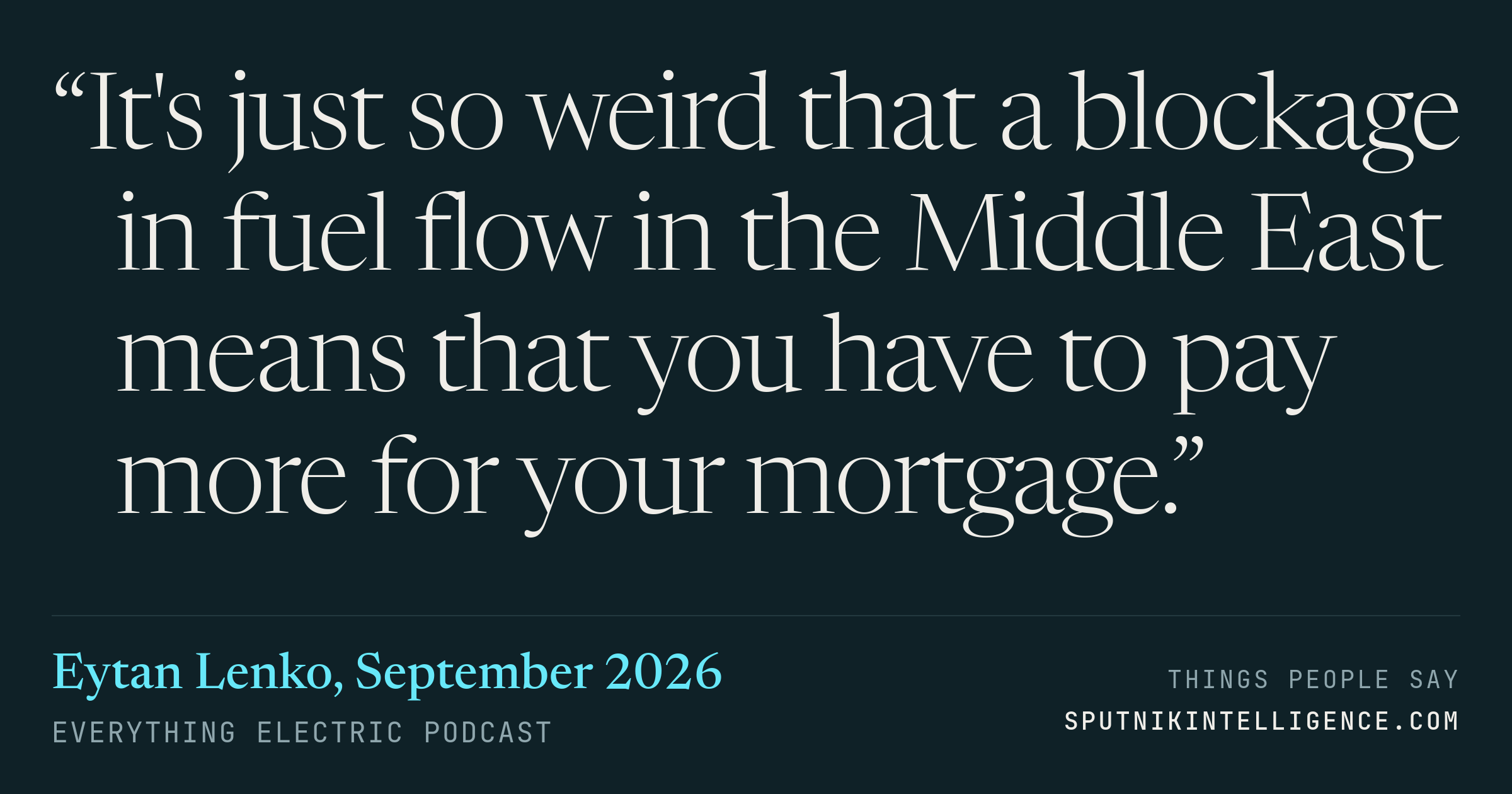
Lenko has just walked the chain link by link: fuel costs rise, inflation rises, the central bank raises rates, mortgages get more expensive, people stop spending. He is drawing on survey work showing that Australian support for individual clean-energy measures rose even as general support for climate action fell, because people answered on energy security and cost rather than on climate.
was the I mean that the biggest the most interesting thing that came through out of this study like you know this because we also just asked the generic what do you think about climate you know are we doing enough are we acting enough and actually support for doing more or what we're doing on climate dropped in this study but the the score for all of the individual solutions increased and the reasons were all of those sorts of things energy independence energy security Australia You know, having its own kind of things, things being cheaper. So, the message that is cutting through to people, like you say, is much more, what are my incentives? Why is this good for me? Than I'm doing, you know, all the people that bought an electric car because it's good for the planet have bought their electric car already. They were the 10% that were the early adopters. And now it's kind of the time for everyone else to come through, but they need a different reason. And, you know, for, you know, I don't want to say luckily, but you know, like the war in Iran and things like that have really done more to accelerate progress, at least on the consumer side, than any kind of incentive, you know, any policy.
It wasn't what anybody planned, was it? Not that there was necessarily a lot of conventional planning, but it's woken the world. I feel it's also one of those things where you have the shock of Russia and Ukraine, and that's a blip and it makes people think. But when the second one comes along and then the third one comes along, and then it's all of these, I mean, they are horrible events, but they really highlight the fact that stuff comes from somewhere. And we've just also,
it just means that you start thinking like, it's just so, it is weird the way that we've constructed our economies in some ways around the centrality of fossil fuels. So, like, you know, the cost of fuel goes up, then that drives the inflation number up. The government says we want to deal with inflation. So we're going to raise interest rates and make people's mortgages more expensive. Then people have to pay more for their mortgage. So they're not feeling, you know, they're not feeling as wealthy and that they stop spending on other stuff. It's just so weird that a blockage in fuel flow in the Middle East means that you have to pay more for your mortgage. Like, you know, like that's a, it's such a strange connection. But now people are starting to make it. You're like, oh, well, if we, you know, the solar panels that I have on my roof that almost every house in Australia has, I can plug my car in here, power it myself. You know, that there's never going to be any conflict in the world that interrupts the solar panels on my roof or the battery in my garage now. And I'll charge my car pretty much for free. One of the amazing things that's happened in Australia that just started actually is the government passed legislation that electricity, there's so much solar now in the middle of the day in Australia that prices often go negative. And so we actually need to create more demand in the middle of the day. And so we've legislated that every electricity retailer have to offer consumers a plan where their electricity is free between 11 a.m. and 2 p.m. every day. That's
national legislation.
Yes, for states that are locked in. So, you know, most states now have that. There's a few, a couple of smaller exceptions. But yeah, so I have free electricity here between 11 a.m. and 2 p.m. So if you have a battery,
you can just charge. So basically, you just, everybody just charges up their battery because everyone's going to get it. So that's that combines with the battery