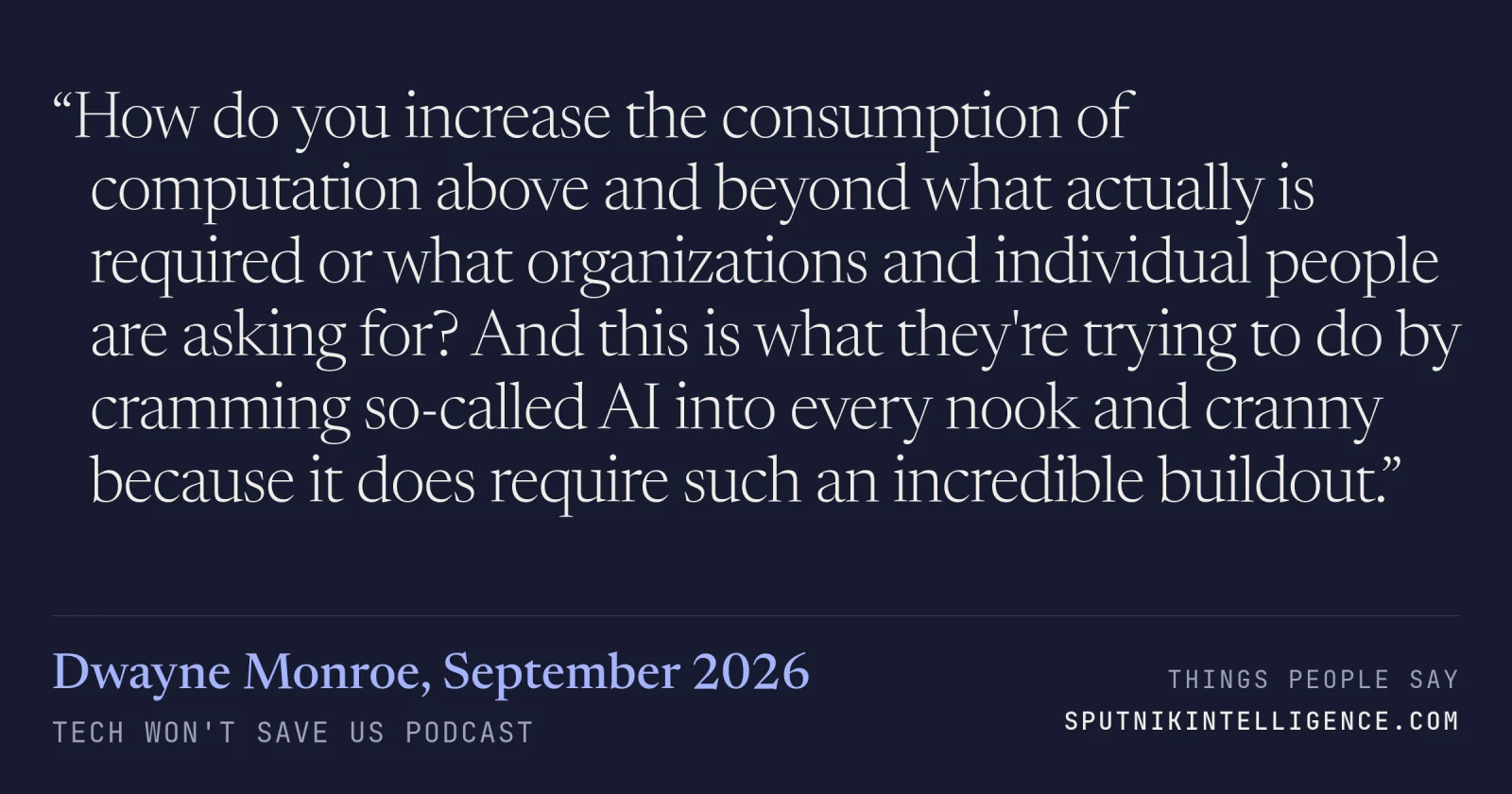
Monroe set this up by describing a hypothetical software business making good money with flat growth, and how unacceptable the market would find that. His answer to AI's ubiquity is a demand problem rather than a capability one: the buildout came first and the use cases are being manufactured to fill it. The episode around him was tracing how cloud infrastructure became the profit centre it is.
…for keep developing intangible assets for these companies ends up being a sort of like best alternative available. And in the end, why it's the best alternative available for them is that it enables them to keep on extracting value from those that participate in their global value chains.
…in the first half of 2024. These companies are serious, not just about expanding their businesses, but increasing the amount of computation our societies require, regardless of whether there are corresponding social benefits. At the end of the day, the bottom line comes before everything else.
Let's say you just made $10 billion a year by just providing nice software that people wanted, and you had modest growth or maybe no growth. Well, we know that the way our system functions, that would just be unacceptable. You'd be punished by the market and so forth and so on. How do you increase the consumption of computation above and beyond what actually is required or what organizations and individual people are asking for? And this is what they're trying to do by cramming so-called AI into every nook and cranny because it does require such an incredible buildout.
To close off this episode, let's go back to the Dahls, the city in Oregon that became the site of Google's first company-owned data center. Fast forward 15 years, and residents were starting to ask questions about how much they were really benefiting from the arrangement and the effects of all the…
Well, so if we go back to 2021, we got, you know, our readers out in the Dallas said, oh, Google is seeking a lot more water from the city, and they want a new water deal to help finance that. And I thought, well, we should understand that. So I called the water utility manager for the city, a…
As Google fought to keep its water use figure secret, it found itself facing a growing public relations nightmare and finally relented. When it shared its water use figures for the Dahls, people were shocked at what it showed. In just five years, Google's water use in the city had tripled. Its…