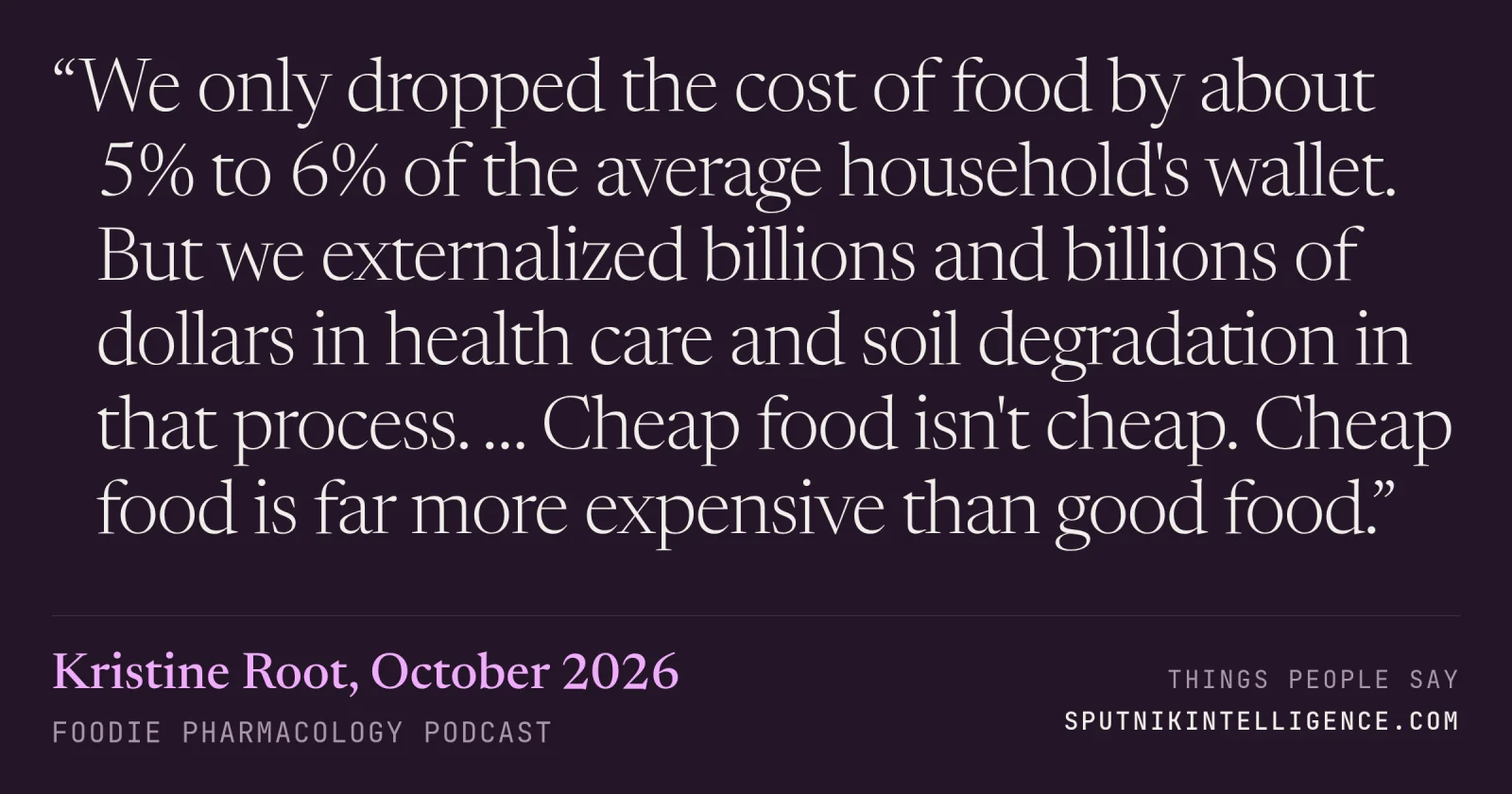
Asked what the title of her report, "The End of Cheap Food," means, Root says food went from roughly 16 to 18% of the average household budget in the 1960s to 10 to 11% two years ago. Her argument is that the savings were small next to the costs pushed outside the food system.
Or if we go back and
about the environmental piece too that we don't necessarily always see. Yeah.
Yeah. If we go back and we look at it, if we look, I believe it was back in the 60s, was the way we diced the data, and we looked at what people were spending out of their wallet, about 18% of the, you know, average household, 16% of their budget was going towards food. Two years ago, we had dropped that down to about 10 to 11%. Wow. So we only dropped the cost of food by about 5% to 6% of the average household's wallet. But we externalized billions and billions of dollars in health care and soil degradation in that process. The money is a disproportionately outsized increase in expenditures outside of the system. And so when I say the end of cheap food, we have to start truly looking at what the cost of food is. Food, cheap food isn't cheap. Cheap Food is far more expensive than good food. And so we need to stop thinking about food as an efficiency. And we need to start thinking about the cost of food and how it…
Yeah, that's great. Amazing. Well, foodies, we're going to have a copy of the link to the report, not only in the video version of the episode, but I'll also make sure and post it with the show notes and in Substack at Nature's Pharmacy. Thank you so much for coming on the show. It's really been…
If you can't tell, I'm really energized by it. It really excites me. And I appreciate that you're interested in the conversation and wanted to have it.
Amazing. Well, thank you, Christine. And thank you to your listeners for tuning in to this episode and others. We are in season eight of Foodie Pharmacology. You can find this and our other episodes at Pod Bean, foodiepharmacology at podbean.com. You can also find us on the Teach Ethnobotany…