Senior Editor at Lawfare covering the intelligence community and national security, and a former Assistant Special Agent in Charge with the FBI who spent most of his career countering the PRC's intelligence services. Before the FBI he was an attorney in private and public practice.
Interviews guests on The Lawfare Podcast, including Ben Macintyre on the Cold War spy Redwood and Eileen Guo on the "censorship-industrial complex," and joins the Rational Security panel.
The host asked who leaked the Huang story to the press, suggesting a US intelligence insider unhappy with inaction. Feinberg agrees that is probable, but adds two other possibilities: an allied service, or China itself releasing it once the asset had stopped being useful.
…And that's powerful knowledge for them. If they know that they still have another two years where the Commerce Department or the Justice Department can be dissuaded from, you know, furiously investigating potential violations of national security laws, that's really valuable for them to know.
Kate Klonick
…and failed to do something. So somebody within the administration or intelligence decided to take this to the reporters. That's a pretty significant that is in my, I am not even an expert in these things. And I'm like, oh, that's not, that's not great. So give us a little bit more nuanced analysis.
Speaker 3
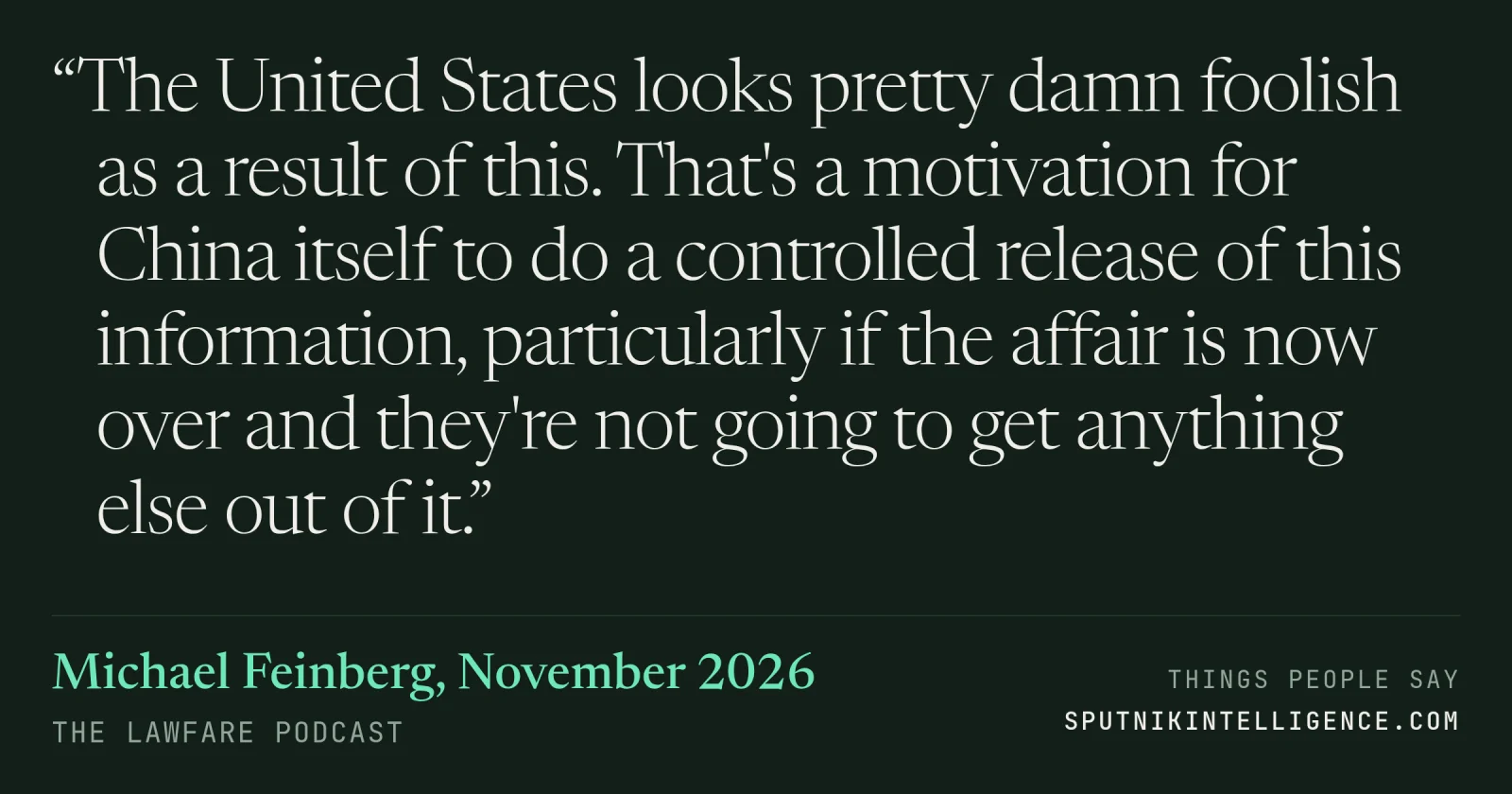
…famous one being the Five Eyes. And most of those nations have not descended into the circus sideshow of national security that the United States has been for the past two years. And as a result, there are other nations who also don't want China to become a preeminent hyperpower. They'd also have an incentive to leak this and stop it from happening. And there's one third possibility as well. The United States looks pretty damn foolish as a result of this. That's a motivation for China itself to do a controlled release of this information, particularly if the affair is now over and they're not going to get anything else out of it. So, you know, somebody clearly leaked it. That much is obvious. It was probably somebody from the United States, but there's always a possibility that it was a foreign national from a country-friendly Orfoe.
Kate Klonick
So I just kind of want to also put a timeline on the very, like, now we're talking about Trump's admiration for Jensen Huang, like, but that was not always the case. And in fact, around the same time that he was last seen with Alice Wang, the supposed honeypot that he has been linked to, Jensen…
Speaker 3
It's entirely possible. And if I were, you know, a newly made member of the majority in Congress conducting oversight hearings, this would probably be something into which I wanted to look. We don't know for certain. I mean, things we do know that would slightly mitigate against this scenario…
Speaker 2
Hey, folks, Ben Wittis here. And I want to tell you about a time long ago when my household was carrying some debt. It was student debt by current standards. It wasn't the biggest deal in the world, but it felt like a big deal. We didn't
Speaker names come from our own diarization. The position is estimated from where the line sits in the episode.
Asked whether the relationship or the Chinese intelligence recruitment came first, Feinberg says he leans toward the relationship starting on its own and the woman being recruited afterward. Engineering a honey trap in advance, he argues, is too unreliable to be worth the cost.
…just personalized AI for the way we work. That means less time on the work around the work and more time finding the stories worth talking about. Get AI tools for work. Upgrade to Google Workspace with Gemini at goo.gle slash workspace with Gemini. That's goo.gle slash workspace with Gemini.
Kate Klonick
…and she somehow found information in her dealings with him and took that to the Chinese. Lots of kind of crazy stuff, but let's start with like the idea of honey pots. And, you know, one of the things that I have always thought about with honey pots and honey traps is that they are traditionally.
Speaker 3
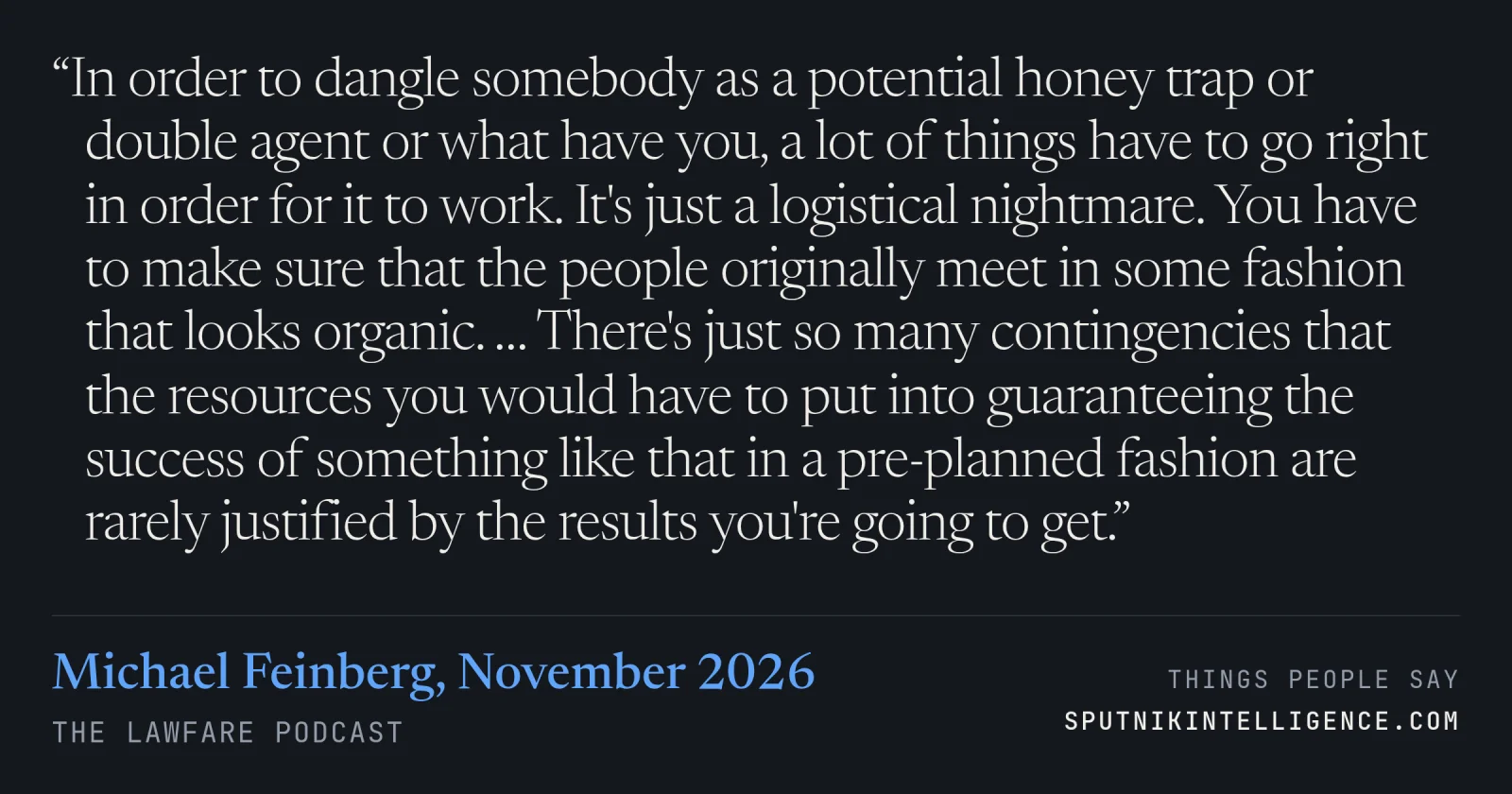
Yeah, my inclination is that it's the latter, that the relationship probably started first. The Chinese intelligence services became aware of it, and then they determined they could recruit her and leverage that relationship for their own benefits. And the reason is pretty simple. In order to dangle somebody as a potential honey trap or double agent or what have you, a lot of things have to go right in order for it to work. It's just a logistical nightmare. You have to make sure that the people originally meet in some fashion that looks organic. You have to bank on the fact that they're going to connect on a level that makes them want to meet again. You're going to have to bank on the fact that what might be a platonic relationship eventually becomes romantic. There's just so many contingencies that the resources you would have to put into guaranteeing the success of something like that in a pre-planned fashion are rarely justified by the results you're going to get.
Kate Klonick
No, that makes a ton of sense. And so I'm curious that if that's the case, you know, what was, if this, where has she gone? Like, what was, it looks like as recently as 2025, she was in contact with him. Do you think that he had any indication before or after that? Or do you think that there, I…
Speaker 3
So, all right, let's take those one by one. First of all, I would not make too much of the disappearance because there's three potential factors in play. First, everything that we know about this matter is functionally coming from two news sources. The New York Times has done some reporting, and…
Kate Klonick
Yeah, I think that that's, I think that that is, I mean, that's the ongoing implications of this are massive. But in the in the very, in the most immediate kind of part of this, it seems like MegaSpeed, this multi-billion dollar corporation, essentially was able to get $4.8 billion worth of…
Speaker names come from our own diarization. The position is estimated from where the line sits in the episode.
Asked how dangerous the Jensen Huang affair is to national security and to Nvidia, Feinberg, a former FBI counterintelligence agent, says the worry is not only company secrets. Huang is in regular contact with tech CEOs and political leaders, so what she learned about the people around him could be the real prize.
…bank on the fact that what might be a platonic relationship eventually becomes romantic. There's just so many contingencies that the resources you would have to put into guaranteeing the success of something like that in a pre-planned fashion are rarely justified by the results you're going to get.
Kate Klonick
…or what she told. It does just seem like Megaspeed used it to get her on export controls. It's not clear to me yet how bad that is. So I guess my main question is: how significant is this going to be? Like, how dangerous is this to national security? And how dangerous is this possibly to NVIDIA?
Speaker 3
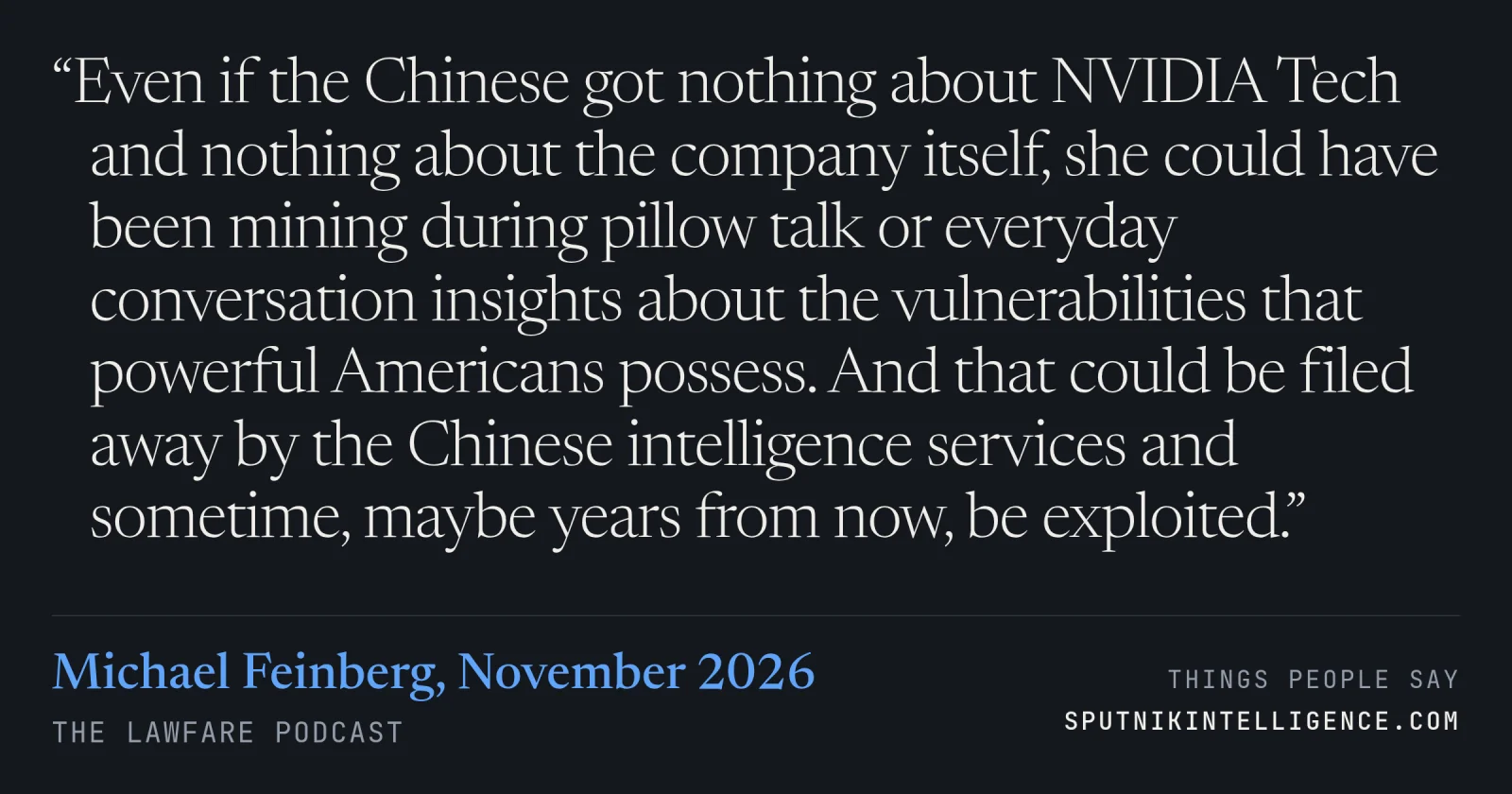
…and that is assessment data on people they know. Jensen Huang is a titan of industry who is in regular contact professionally and socially with pretty much every tech CEO in the world, I would imagine. Furthermore, President Trump has taken a liking to him, which means that he's also dealing with the highest levels of executive power in the United States, which is China's main rival. So even if the Chinese got nothing about NVIDIA Tech and nothing about the company itself, she could have been mining during pillow talk or everyday conversation insights about the vulnerabilities that powerful Americans possess. And that could be filed away by the Chinese intelligence services and sometime, maybe years from now, be exploited.
Kate Klonick
Yeah, I think that that's, I think that that is, I mean, that's the ongoing implications of this are massive. But in the in the very, in the most immediate kind of part of this, it seems like MegaSpeed, this multi-billion dollar corporation, essentially was able to get $4.8 billion worth of…
Speaker 3
So I want to push back against your final characterization a bit. We do know, or at least it's been alleged in the reporting, that the Department of Commerce was seriously looking at mega speed. But for some reason, largely due to NVIDIA's lobbying, it seems, the Commerce Department backed off of…
Kate Klonick
Yeah, so let's actually talk. I think that that is like the other, there's one story in which this is going to impact the AI industry, the AI race, the market, obviously. There's another story about the fact that the U.S. is a mark in such an obvious way. But then there's this other part of this…
Speaker names come from our own diarization. The position is estimated from where the line sits in the episode.