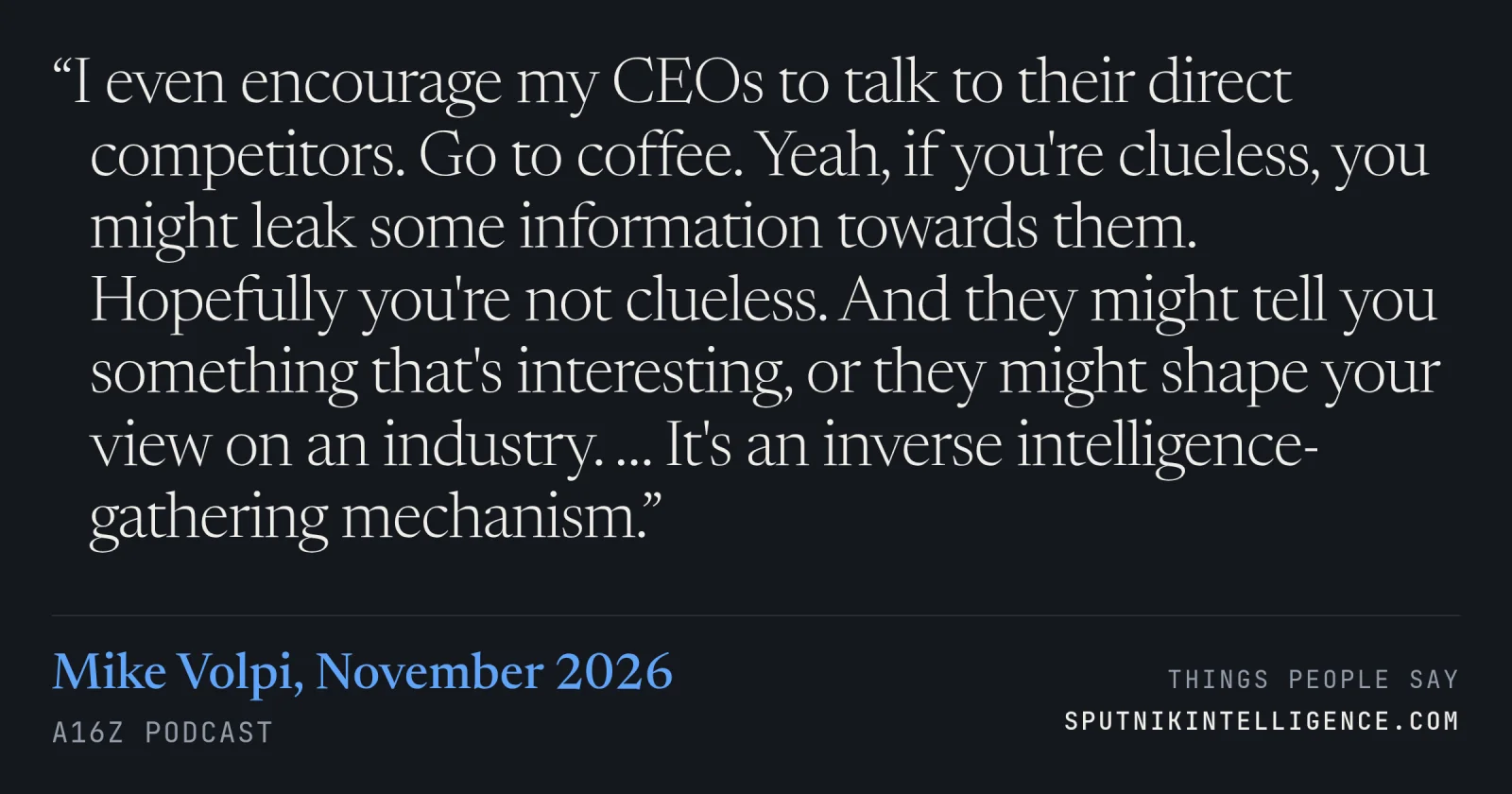
Asked how founders should think about being acquired, Volpi says startups should keep talking to big companies and rivals all the time, so they already know the right people when they want to sell.
No, well, obviously, you do as good a job as you can building a network and knowing what's going on. It's basically cataloging the inventory, is the way we used to think about it. But every company in the market is a potential acquisition. So you catalog them and where are they in their growth rate? What kind of founders they have? Who are the backers? What are their aspirations? Who are their customers? Just like be informed. And, you know, the business, the corporate development group had to do that, but I kind of considered it everybody's job at the company to be constantly informed about what's happening around them. So, and then essentially, we at the company, we would try to weave it at Cisco. We would try to weave in the inventory against a strategy statement that was there. For example, we're a router company, but there are going to be more switches than routers. Therefore, we need to have a switch. What are the switching companies that are available, right? Or optical networking is becoming important because of bandwidth, blah, blah, blah. What are the companies that are available? You often have the…
Guido Appenzeller
I think this is really good advice. I keep telling my portfolios the same thing. If you don't have the cell phone number of the CEOs of each of your competitors, that's a problem. There will be a day when you need it.
Mike Volpi
Absolutely.
Guido Appenzeller
So it's a network you need to build.
Speaker names come from our own diarization. The position is estimated from where the line sits in the episode.
Asked what changes in networking for AI, Volpi explains that internet networking was built around bursty, unpredictable traffic. AI clusters break that assumption, which he says opens room for cheaper network designs and threatens incumbent vendors.
…out the workload, and you would under-provision the device to connect more bandwidth because not everybody all communicates at the same time through the thing. And the outputs of that inbound are highly variable. Okay, that's the internet. That's the workloads that we live with. That was almost
Guido Appenzeller
dogma, right? For a long time. Okay,
Mike Volpi
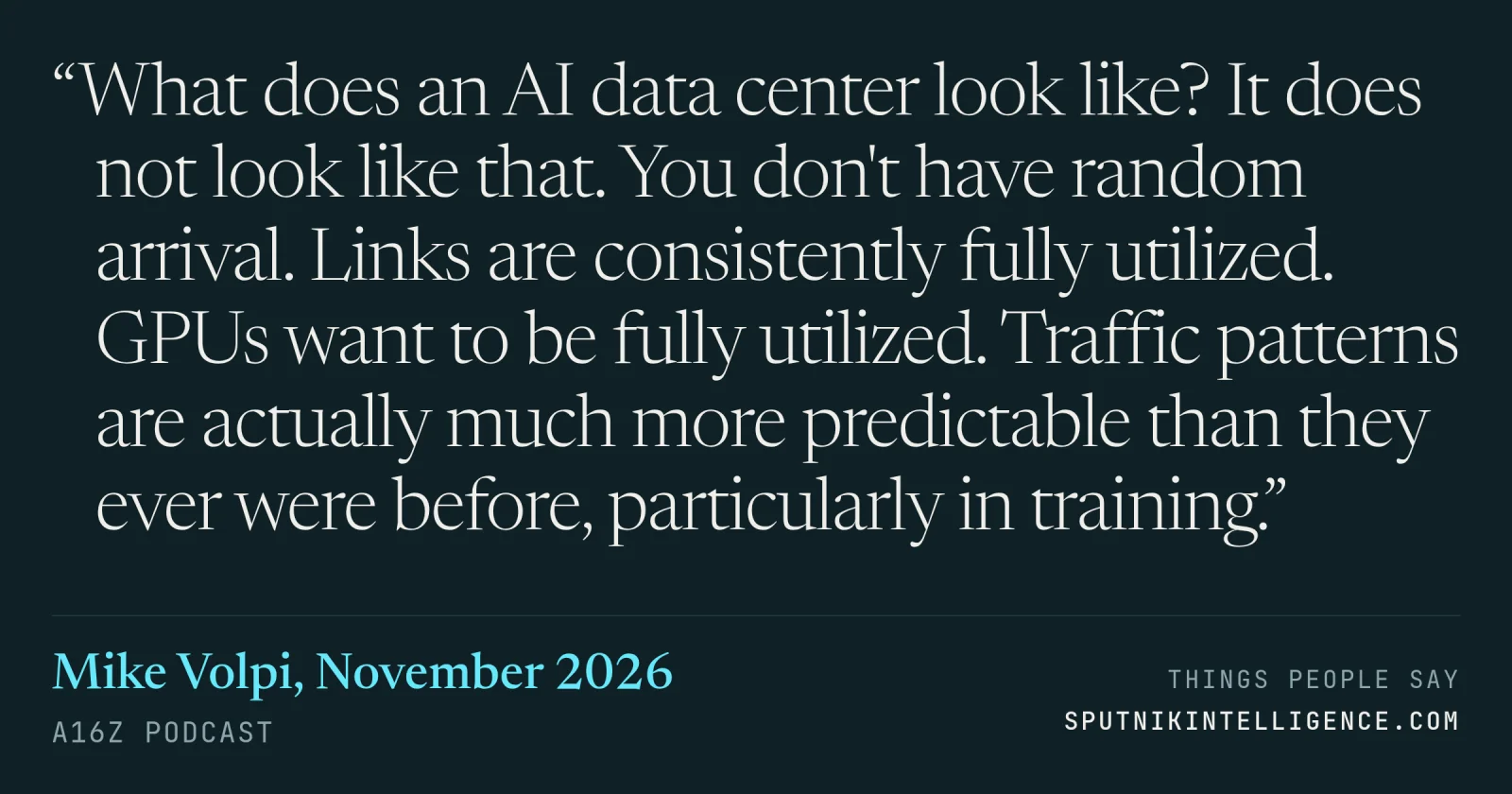
so fast forward today. What does an AI data center look like? It does not look like that. You don't have random arrival. Links are consistently fully utilized. GPUs want to be fully utilized. Traffic patterns are actually much more predictable than they ever were before, particularly in training. They're incredibly predictable. They're less predictable in inference, but you can see the traffic pattern, especially if you do good batching. I think of
Guido Appenzeller
it is still very predictable, right? Yeah, especially if you do big batching. Yeah, exactly. Like
Mike Volpi
you can definitely make it more predictable. So the fundamental tenet of the workload has changed. Yet, if you look at the dominant networking architecture today, which is the Broadcom, what's it not Trident? The Tomahawk. Tomahawk, which is the Dune acquisition that they did, is a StatMux packet…
Guido Appenzeller
So essentially, back to circuits, is what you're saying. Yeah.
Speaker names come from our own diarization. The position is estimated from where the line sits in the episode.
Asked how this cycle compares with the ones he has seen, Volpi says today's AI stack is so interlinked that a chatbot's quality depends on the optics supply chain behind chipmaking.
As you probably know, I've started a new venture fund called Anabi Capital. Technically speaking, I retired in 2023 and I was supposed to get a yacht. That didn't work out
Speaker 2
very well, did it?
Mike Volpi
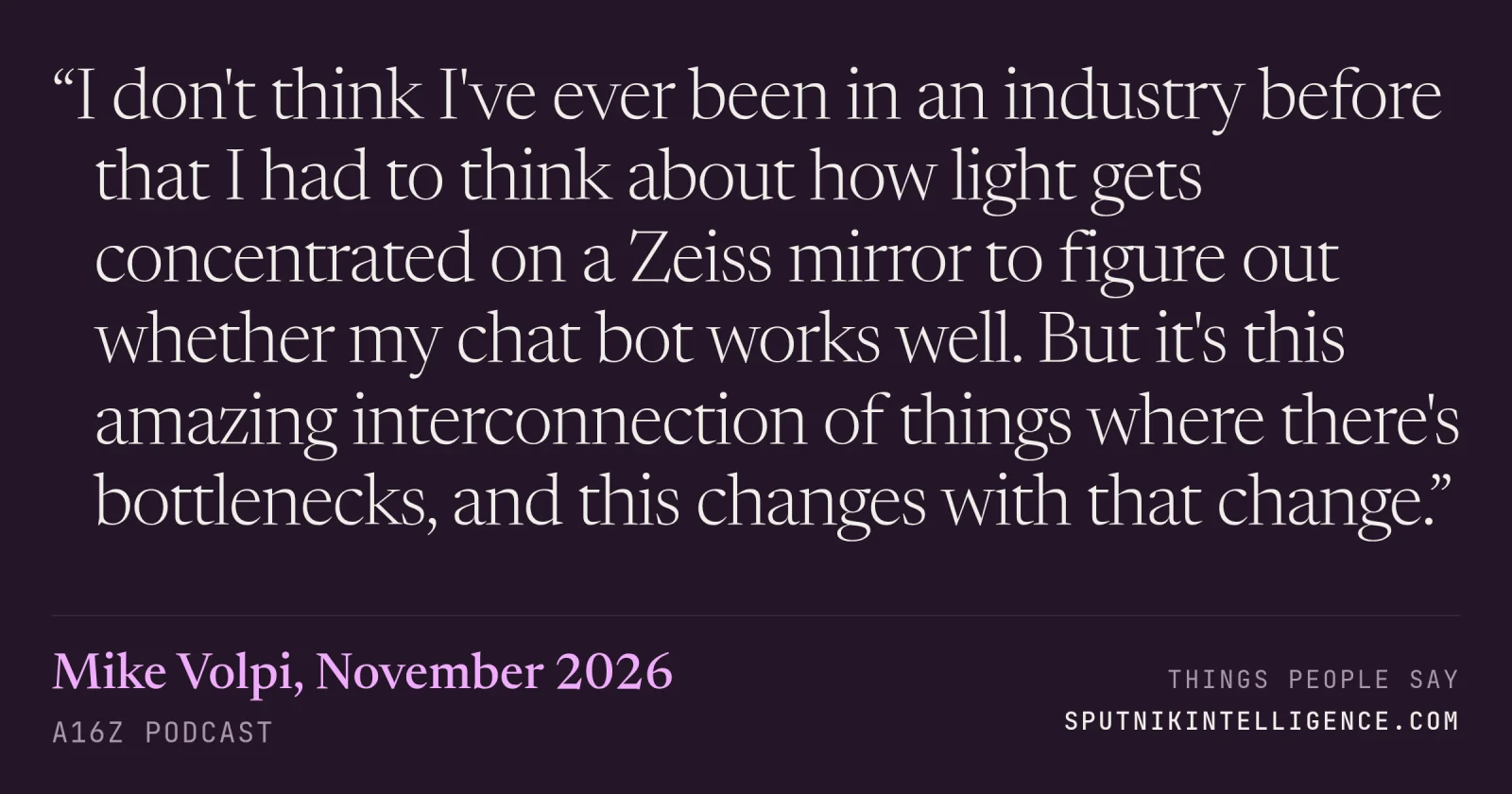
Why? I actually think this is the most fascinating time to be doing our job and to be in our industry. Not just because the change is big and we all know how transformative the change is, but because it requires more intellectual exertion to understand what next. It's like you don't have a crystal ball. It's not obvious what the next move is. And so you have to keep thinking and you have to think at a systems level. Like, I don't think I've ever been in an industry before that I had to think about how light gets concentrated on a Zeiss mirror to figure out whether my chat bot works well. But it's all, it's this amazing interconnection of things where there's bottlenecks and this changes and this changed with that change. So I find it just the most intellectually fascinating time. And because the end prize is so significant, by figuring out how these different Parts unlock. You can create a company here and a company there, and this one can become worth a trillion dollars, and this one can become 500 billion, and so on and so forth. And honestly, I did not…
Raghu Raghuram
This tops 99. Oh, yeah.
Guido Appenzeller
Easily.
Raghu Raghuram
Totally, totally agree. And we are all in the same business for very much the same reason. This has been a fascinating hour. Thank you so much. And we could be continuing this conversation endlessly, but perhaps we'll do it another time.
Speaker names come from our own diarization. The position is estimated from where the line sits in the episode.
Asked why Cisco stopped being the most valuable company in the world, Volpi, who ran its acquisitions, describes how double ordering hid real demand in 2000. It is the mechanism he sees as the risk in any AI hardware over-order.
…of orders. And then we were, of course, putting orders on all of our supply chain. And because the demand felt so robust, we were taking the financial risk on those orders. In other words, we were like, here's the money, keep the money and just give us this stuff as soon as possible. So possibly
Guido Appenzeller
go wrong with that.
Mike Volpi
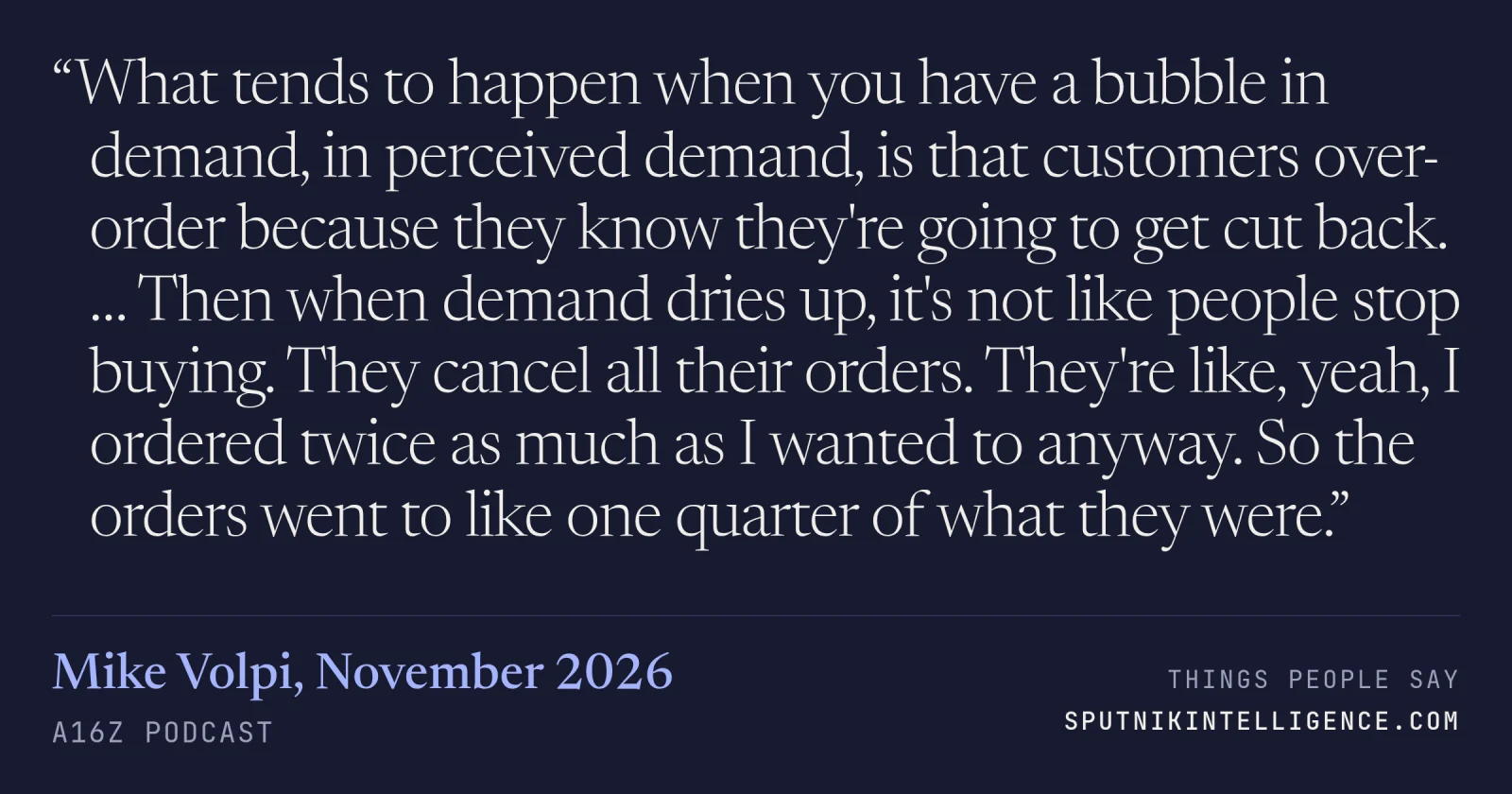
So then when demand dries up, it's not like people stop buying. They cancel all their orders. They're like, yeah, I ordered twice as much as I wanted to anyway. So I need half of half of that. So the orders went to like one quarter of what they were. And then A, you've taken the risk on the supply chain, and B, your demand falls through the roof. And so I think. I think we ended up in the December quarter. And this is kind of memorable because it happened in December quarter. So we are one month off. So November, December, January. And usually what tends to happen with businesses that are a month off, you know this, right? Like December's soft, and then the first week of January, you start seeing coming back. And then by the end of January, you've made it up. So we go through December, it's soft, and it's like, no big deal. December is always soft. And then week one, January, nothing happens. Week two, January, nothing happens. Week three, January, nothing happens.
Raghu Raghuram
Oh, shit. Oh, shit.
Mike Volpi
So the quarter came in. I don't know. Maybe we missed by 35, 40%. Wow.
Raghu Raghuram
Wow.
Speaker names come from our own diarization. The position is estimated from where the line sits in the episode.
On the demand side of AI capacity, Volpi says the near-infinite appetite will change shape as buyers route cheaper work to cheaper models. He expects this to show up before any change in chip supply.
…the infrastructure side, what's sort of the value chain of it. The first thing you would say is right now we live in a world where demand for AI capacity tokens, whatever, is near infinite and supply is incredibly constrained. So another way to put it is we all just live in Jensen's world.
Guido Appenzeller
He's king of the hill, there's no question.
Mike Volpi
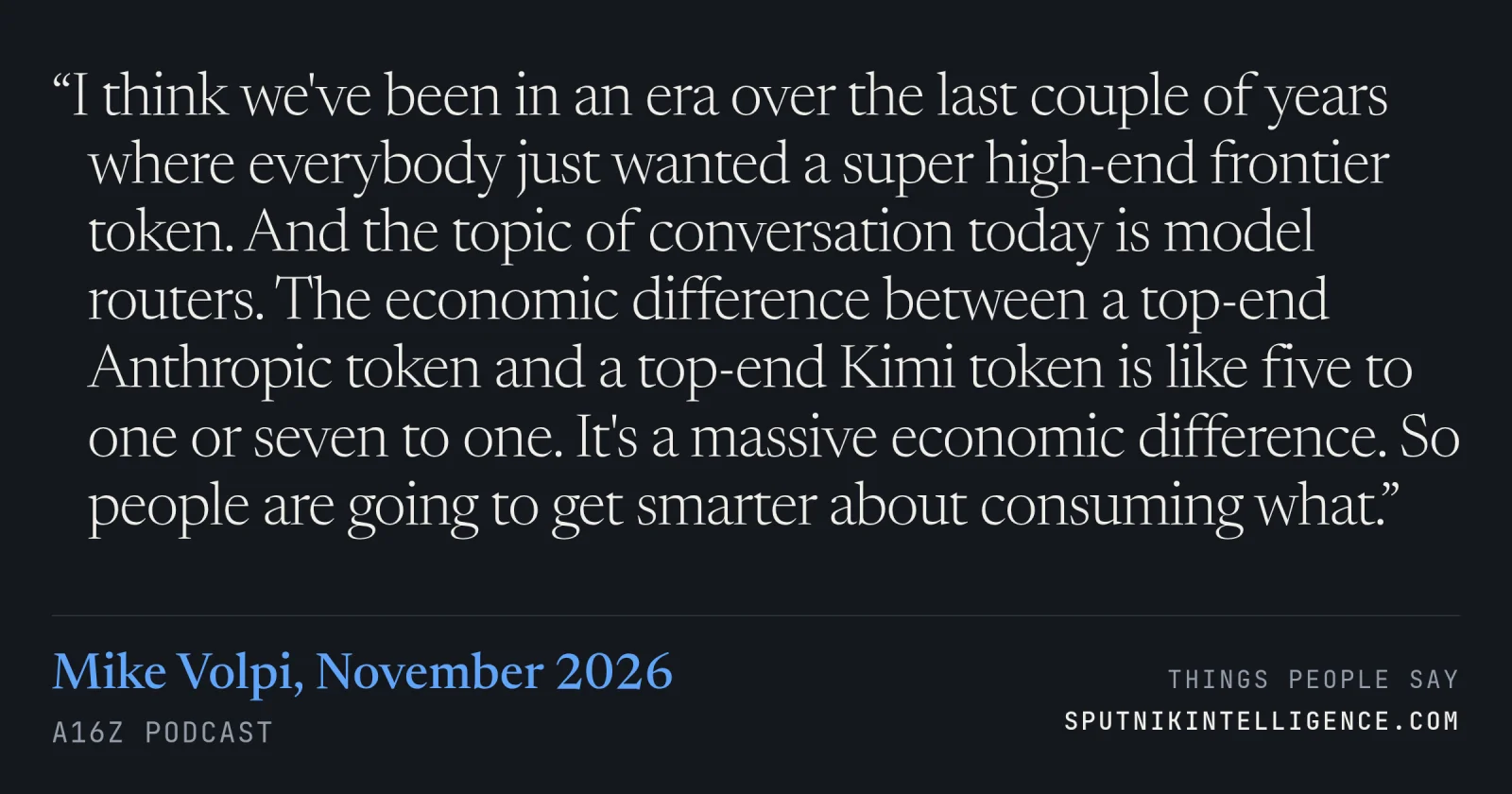
I think the shape of the industry will begin to change when either the characteristics of demand change or the characteristics of supply change. And I think my view is right now, the supply side, because so much of the limitation, well, there are some power limitations for sure, but the dominant limitation is silicon. And I would say that unless there's more fab capacity, that doesn't change, which means it's not likely to really change in the next two or three years, maybe five years out. You could imagine that there would be more fab capacity. You could put more wafers through the same machines or you can make more ASML machines and so forth. But that's probably a governing factor of our industry, which means we live in a reasonably scarce world. And those who have fab capacity are actually kind of kingmakers of the infrastructure universe. On the demand side, I do think that the world is going to get smarter about the type of tokens they consume. I think we've been in kind of an era over the last couple of years that everybody just wanted a super high-end frontier token. And I think the topic of conversation today is model routers and how do I move stuff to, you…
Guido Appenzeller
Yeah. I mean, it seems we're moving from a card as the minimum unit to a rack as the minimum unit, or even a few racks in some cases.
Mike Volpi
Yeah, I would say that's a media
Raghu Raghuram
part that they
Speaker names come from our own diarization. The position is estimated from where the line sits in the episode.
Volpi had said NVIDIA is trying to shape the industry by financing smaller cloud players, and his co-host defended it. This is Volpi's reply on why funding neo-clouds can't change the number of winners.
well, I think both of you make very valid points. The thing I would say, Guido, is that an industry wants to look a certain way because when it does, it creates maximum utility, maximum economic value. Why are there three hyperscalers? Because it's a business where scale matters.
Guido Appenzeller
Software.
Mike Volpi
It's a business where scale matters, and therefore the industry wants to concentrate. No matter how much you finance them, the little ones are always weaklings. So, and obviously, if you're in video, you don't like that. You don't want three customers. You want 50 customers. So, you fund them, but at some point, they're going to die. It just, because the industry, whenever it's a scale business, wants to consolidate. You know, we could fund 100 airlines in America, but in the end, you're going to have three. So, my point is not that it's a bad idea, it's just that it's futile.
Raghu Raghuram
Yeah.
Guido Appenzeller
So, so noble intentions, but
Mike Volpi
now to your point, it could be a very good return on. I don't know that they, I don't know if they actually care about the return on capital. They might. And if they get out at the right time,
Speaker names come from our own diarization. The position is estimated from where the line sits in the episode.
His co-host had noted that AI infrastructure is now about 2% of GDP, against a small fraction of a percent for the internet buildout. Volpi says the scale makes sense because the thing being built is worth more.
Yeah. Some of them better than others, but broadly, I expect that there will be an economic correction in the market, but the underlying assets will be quite useful for a long period of time.
Guido Appenzeller
Isn't that one other big difference from how it was back then, which is that everything is now much, much larger? I mean, back then, we were investing a small fraction of a percent in infrastructure for the internet. Today, we're investing 2% or so for GDP, right, in AI infrastructure.
Mike Volpi
Yeah. Well, it is much bigger, but it's an interesting concept, right? Because in the 100,000 feet abstraction, what is it that is being built, right? Back then, it was communication that was being built. Today, we're building intelligence. And the economic value of intelligence is probably higher than the economic value of communication.
Speaker 2
Probably. Yep.
Mike Volpi
Right. So I think it's unsurprising. I also think that, believe it or not, I mean, it's been nearly 30 years. The markets are more efficient now, right? Which is why so much more risk capital is willing to make its way into AI, which even back then was not able to. So that is, I'm actually more…
Guido Appenzeller
The role of IT has also massively increased, right? Back then, I mean, in the late 90s, PCs were somewhat common, but not ubiquitous. Today, so to speak, software has eaten the world. And it's sort of for any company out there, it's a very central part of what they do when distribution
Speaker names come from our own diarization. The position is estimated from where the line sits in the episode.
The discussion was about how long GPUs really last, which decides whether the debt financing the buildout is safe. Volpi argued that older chips are earning more today than when they were new. His host pushed back that debt investors have not accepted the longer life.
Oh, for sure. And not just any company, but 7 billion people have a supercomputer in their pocket. Exactly. So there's much more evenly spread consumption of the underlying benefit that's being produced.
Raghu Raghuram
…interest rates and the scale of capital causing people to say, hey, this is going to crowd out everything else and we may not even have enough capital. During the bandwidth build out and the internet build out, that was not the case, correct? There was no sudden increase in interest rates, was it?
Mike Volpi
…this asset that have a five-year life, partly because of AI itself, is a useful asset for quite a bit longer. And in that context, I mean, if you're in the business of financing an asset and that asset ends up having a much more longer useful life, then you're the beneficiary of that because your business models were constructed on a short. So in some sense, I actually think this, the fact an unintended consequence of AI being good at software is that the underlying asset life is getting longer, thereby helping it to be more financeable. And that's an interesting phenomenon that I didn't quite expect
Raghu Raghuram
when this thing got underway. Although the investors are not, the dead investors have not broadly accepted the extended life of a GPU. But your clouds clearly have to be.
Speaker 2
I'm not sure I have either. I mean, like right now, it seems what's mostly happening is that we have a massive scarcity of an asset. So even previous generations
Guido Appenzeller
are still worth a lot, right? If we ever get to a point where we have an abundance of GPUs, that might completely change. You might go back to those numbers. So I think
Speaker names come from our own diarization. The position is estimated from where the line sits in the episode.
Asked where the infrastructure gaps are for founders, Volpi described the industry as a pull between supply and demand. He says the main supply limit is silicon, so whoever has fab capacity is a kingmaker, and that is unlikely to change for two to five years.
…the infrastructure side, what's sort of the value chain of it. The first thing you would say is right now we live in a world where demand for AI capacity tokens, whatever, is near infinite and supply is incredibly constrained. So another way to put it is we all just live in Jensen's world.
Guido Appenzeller
He's king of the hill, there's no question.
Mike Volpi
I think the shape of the industry will begin to change when either the characteristics of demand change or the characteristics of supply change. And I think my view is right now, the supply side, because so much of the limitation, well, there are some power limitations for sure, but the dominant limitation is silicon. And I would say that unless there's more fab capacity, that doesn't change, which means it's not likely to really change in the next two or three years, maybe five years out. You could imagine that there would be more fab capacity. You could put more wafers through the same machines or you can make more ASML machines and so forth. But that's probably a governing factor of our industry, which means we live in a reasonably scarce world. And those who have fab capacity are actually kind of kingmakers of the infrastructure universe. On the demand side, I do think that the world is going to get smarter about the type of tokens they consume. I think we've been…
Guido Appenzeller
Yeah. I mean, it seems we're moving from a card as the minimum unit to a rack as the minimum unit, or even a few racks in some cases.
Mike Volpi
Yeah, I would say that's a media
Raghu Raghuram
part that they
Speaker names come from our own diarization. The position is estimated from where the line sits in the episode.
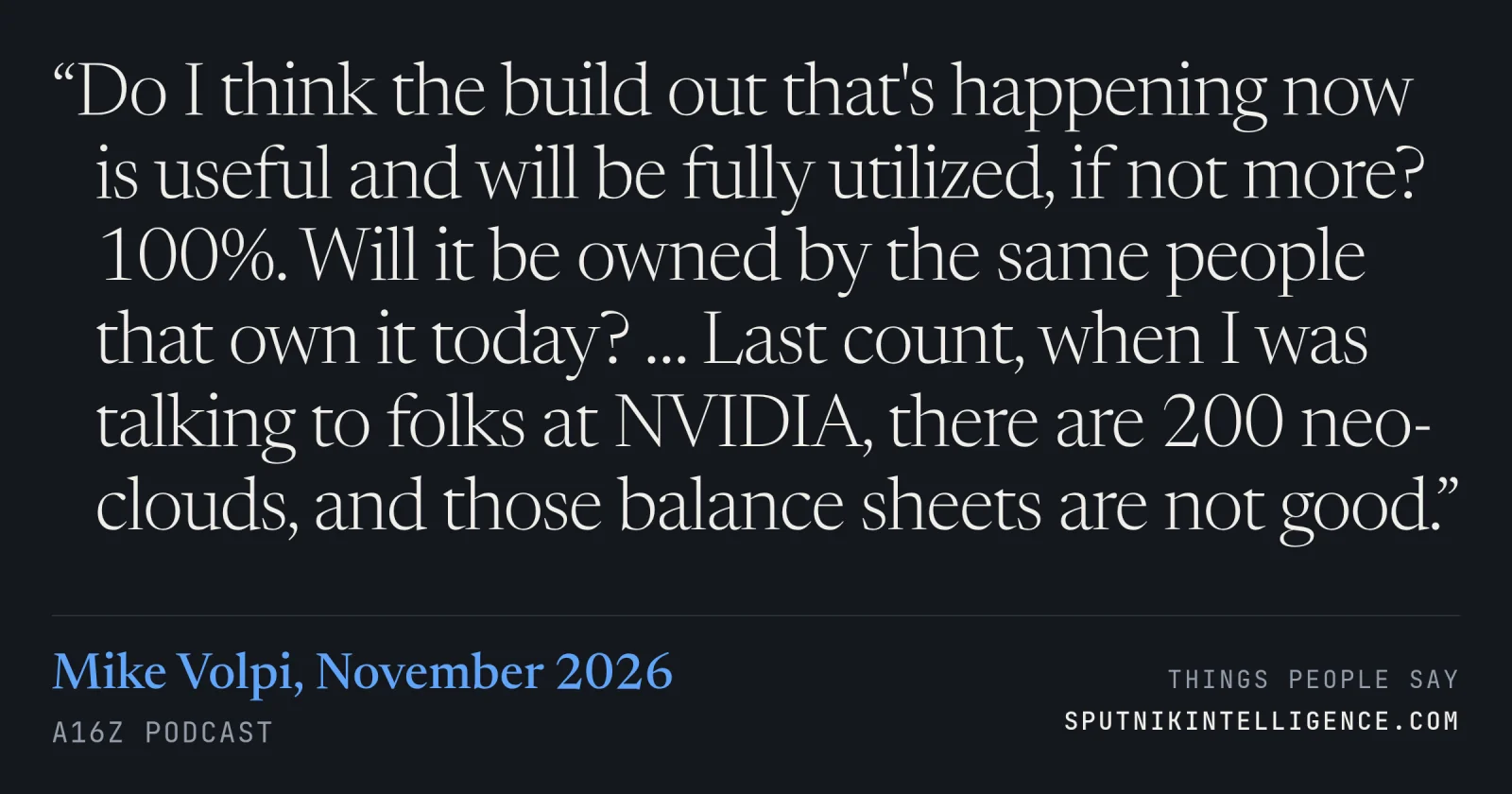
Asked how he reads the AI buildout against the late-90s fiber boom, Volpi said the fiber proved useful but ended up owned by someone else after the debt-laden builders went bankrupt. He expects the same split here: the compute will be used, but ownership will change after a correction.
…are not good enough. And then that ripples through the industry. And ultimately, the players that were most saddled with debt went bankrupt. Now, it's interesting to note that debt was buying assets, those fiber optic cables. And those assets actually turned out to be quite useful in the future.
Raghu Raghuram
Exactly.
Mike Volpi
Except they were operated by somebody else because the guys that went bankrupt didn't have them anymore. So the first thing to recognize is that the underlying assets that were built at the time was bandwidth, and I suspect this compute this time. It'll be useful. There's no question that it'll be useful. Whether it will be owned by the same companies or not is an interesting economic question. So that's a long-winded answer to say: do I think the build out that's happening now is useful and will be fully utilized, if not more, 100%. Will it be owned by the same people that own it today? A lot of interesting dependencies and a lot of things that, in fact, are outside of the control because they're macroeconomic and geopolitical and so forth. It's really outside of the control of the builders themselves. And in particular, when I talk about the builders, some of the balance sheets are pretty healthy, right? Last count, when I was talking to folks at NVIDIA, there are 200 neo-clouds, and those balance sheets are not good.
Raghu Raghuram
Yes.
Mike Volpi
So I'll predict that there will be some.
Raghu Raghuram
Of course.
Speaker names come from our own diarization. The position is estimated from where the line sits in the episode.