JL

Jure Leskovec

Things Jure Says on Podcasts

Where to Find Them

Jure Leskovec has been a guest on MLOps.community , Software Engineering Daily , The Data Exchange with Ben Lorica , The Future of Everything , Night Science , Software Engineering Radio - the podcast for professional software developers , Super Data Science: ML & AI Podcast with Jon Krohn and The TWIML AI Podcast .

Recently: “1047: NVIDIA Kumo: Foundation Models for Tabular Data, with Stanford Prof. Jure Leskovec” on Super Data Science: ML & AI Podcast with Jon Krohn (November 2026); “88 | How AI dreams up new science – with Jure Leskovec” on Night Science (August 2026); “Foundation Models for Structured Data” on Software Engineering Daily (June 2026); “SE Radio 724: Jure Leskovec on Relational Graph and Foundational Models” on Software Engineering Radio - the podcast for professional software developers (June 2026); “Relational Foundation Models for Enterprise Data with Jure Leskovec - #768” on The TWIML AI Podcast (May 2026); “The AI Revolution Finally Comes to Structured Data” on The Data Exchange with Ben Lorica (December 2025).

What They Said

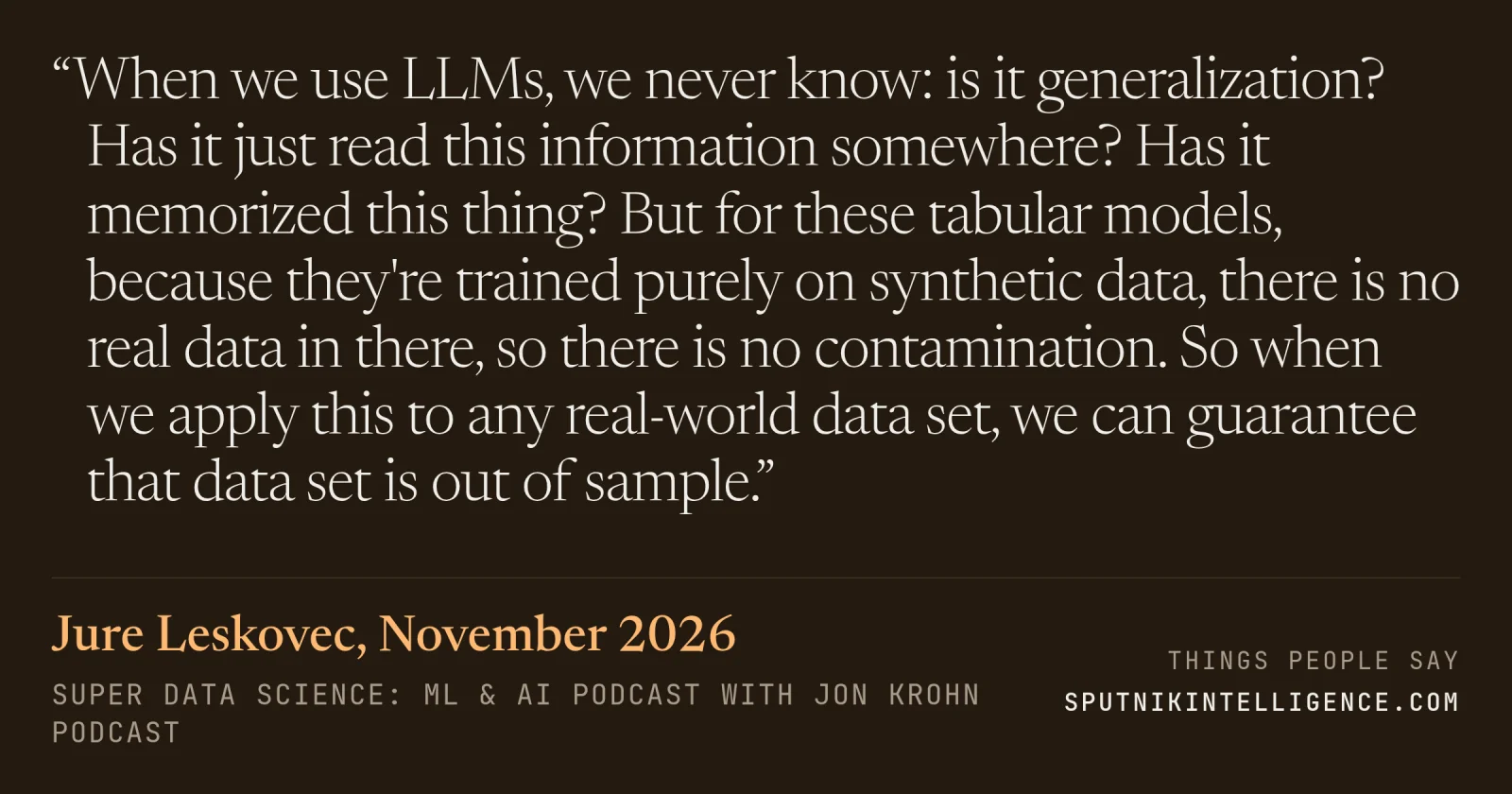
“When we use LLMs, we never know: is it generalization? Has it just read this information somewhere? Has it memorized this thing? But for these tabular models, because they're trained purely on synthetic data, there is no real data in there, so there is no contamination. So when we apply this to any real-world data set, we can guarantee that data set is out of sample.” — Jure Leskovec, Super Data Science: ML & AI Podcast with Jon Krohn

Jon Krohn asked how a model trained only on simulated tables can be trusted on real data. Leskovec says synthetic-only pretraining rules out the training-data leakage that clouds most LLM benchmark results.

Super Data Science: ML & AI Podcast with Jon Krohn · 2026-11-24 Permalink → Listen →
Super Data Science: ML & AI Podcast with Jon Krohn Around 17:22 into the episode
Jure Leskovec

…tables with different missingness structures, with different You know, heavy-tailed extreme value type distributions and so on. So, that flexibility turns out to be super useful because, yeah, as you said, we can generate more and more data. We can keep scaling up these models as much as we like.

Jon Krohn

…real-world data. So, like all these simulations, you can, you know, downstream, you can say, okay, I know that even though I only worked with simulated data throughout my training process, we know that it applies to the real world because when we test it on real-world data, it hits out of the park.

Jure Leskovec

That is an excellent point, right? One thing that is beneficial from having trained this with synthetic data is that prediction is all about generalization, right? We don't want, like, it doesn't matter, you know, kind of making decisions about the past is easy. Making decisions about the future is much harder, right? So, I think, and when we use LLMs, we never know: is it generalization? Has it just read this information somewhere? Has it memorized this thing? We never really trust it whether it's doing some real kind of inference or is it just kind of recalling from memory, right? But for this tabular models, because it's purely synthetic data trained, there is no real data in there, so there is no contamination. So, when we apply this to any real-world data set, we can guarantee that that real-world data set is out of sample, right? The model has never seen it in any training, has never seen those numbers, has never seen those specific patterns that actually occur in the real world. So, that's great because then our, let's say, accuracy estimates and so on, either from Kaggle competitions or things like that, are true and real, and they are really…

Jon Krohn

Something else that's interesting when comparing to, say, classical machine learning or classical AI approaches is that if we were to use, say, a simple logistic regression model or linear regression model to try to explain how some features in a table are predicting some label in a table, the way…

Jure Leskovec

That I think is a good point. And it's kind of the remarkable thing that happens here: that through this, you know, basically generating these random causal graphs, sampling, filling them with noise, getting the dependencies out, putting that into a big table, and then telling the neural network to…

Jon Krohn

It's very cool stuff. What a world we live in these days. I couldn't have imagined these kinds of things. You wouldn't know this about me because there's no reason why you would know anything about me, Yuri. But I did a PhD focused on machine learning and AI, finished that in 2012. And this kind of…

Speaker names come from our own diarization. The position is estimated from where the line sits in the episode.
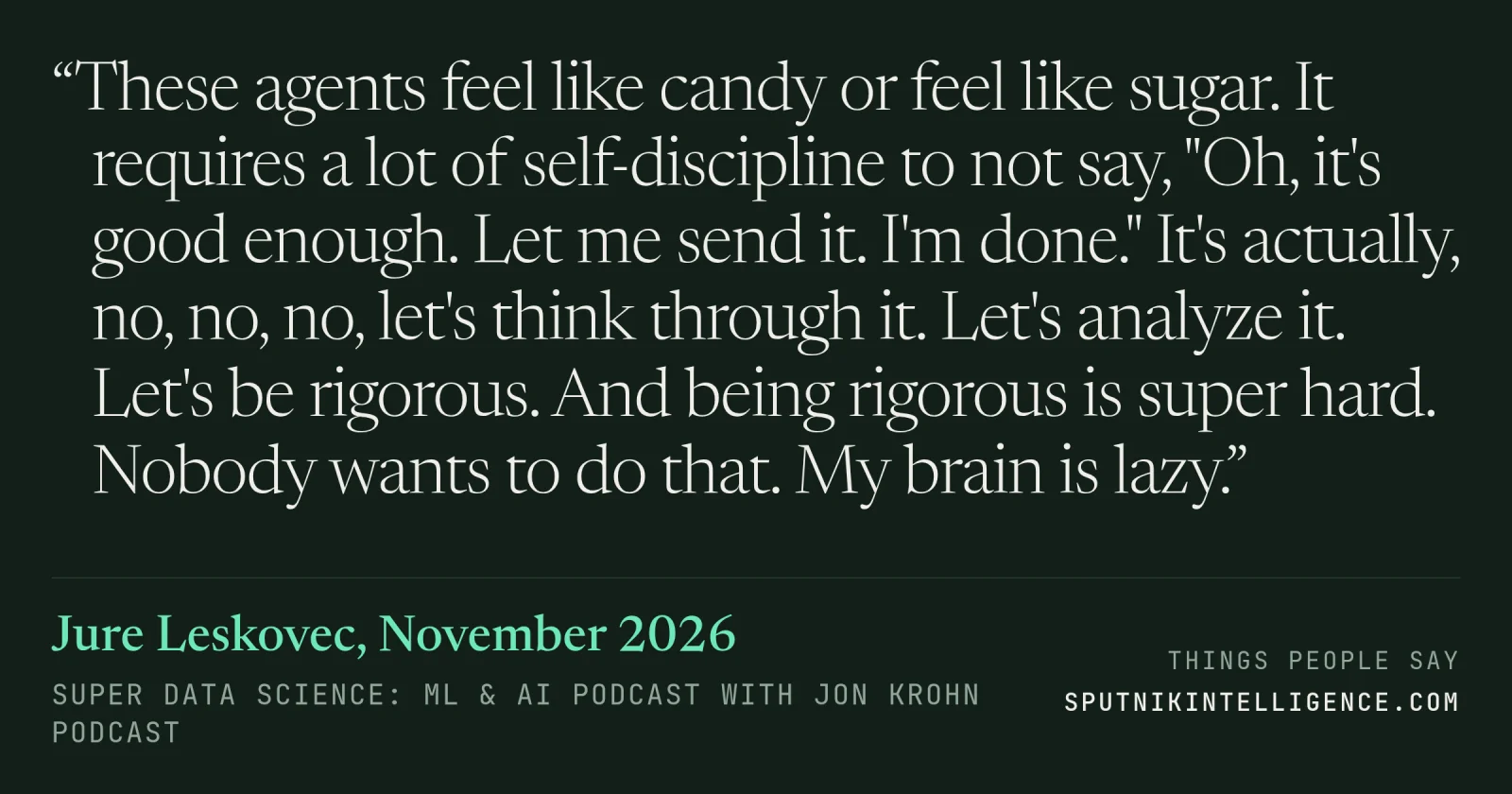
“These agents feel like candy or feel like sugar. It requires a lot of self-discipline to not say, "Oh, it's good enough. Let me send it. I'm done." It's actually, no, no, no, let's think through it. Let's analyze it. Let's be rigorous. And being rigorous is super hard. Nobody wants to do that. My brain is lazy.” — Jure Leskovec, Super Data Science: ML & AI Podcast with Jon Krohn

Continuing on human judgment, Leskovec describes the pull to accept agent output without checking it. He ties this to why his lab's biology agent is built to be transparent and easy to stop.

Super Data Science: ML & AI Podcast with Jon Krohn · 2026-11-24 Permalink → Listen →
Super Data Science: ML & AI Podcast with Jon Krohn Around 53:26 into the episode
Jure Leskovec

the value of human judgment is getting higher and higher. That ability to manage

Speaker 3

messiness, context, and being able to direct and judge the output of these agents, I think is very

Jure Leskovec

important. And that is very valuable. But, you know, in some sense, I feel like these agents feel like candy or feel like sugar. It requires a lot of self-discipline to not say, oh, it's good enough. Yes, let me send it. I'm done. It's actually, no, no, no, let's think through it. Let's analyze it. Let's be rigorous. And being rigorous and thinking, as you said, is like, it's super hard. Nobody wants to do that. My brains are lazy. I don't want them to think too much. So, I mean, I'm joking a bit, right? So that's why I think it's in some sense so important to validate, to bring in this, let's say, additional context. Think about the messiness. Think what are all the inputs, let's say, the agent needs to be able to do its work and then guide it, judge where it's going, stop it when it's going off track and so on. And if we connect now to Biomni, human scientists love it because it's not built to say, hey, I will replace you. It's built to say, I am here to be super transparent. You can stop me. You can talk to me. So now all of a sudden, science gets. more digitized it does not science does not…

Jon Krohn

hey hey this is your host john crone in addition to hosting this podcast did you know that i run an ai consulting firm called whycarrot yes that's the letter why and the deliciously crunchy veggie at ycarrot our team pairs decades of ml and software engineering experience with recognized expertise…

Speaker 3

yeah thank you thanks for saying this i think uh you know what's the most amazing to me is that when you basically i come to the students and i say hey look this will be hard um but it will be good learning experience right and the most amazing thing is when basically students say okay i'm willing…

Jure Leskovec

and everything publicly available and you know i encourage others to to to take to take my slides take my courses and build on them because you know it

Speaker names come from our own diarization. The position is estimated from where the line sits in the episode.
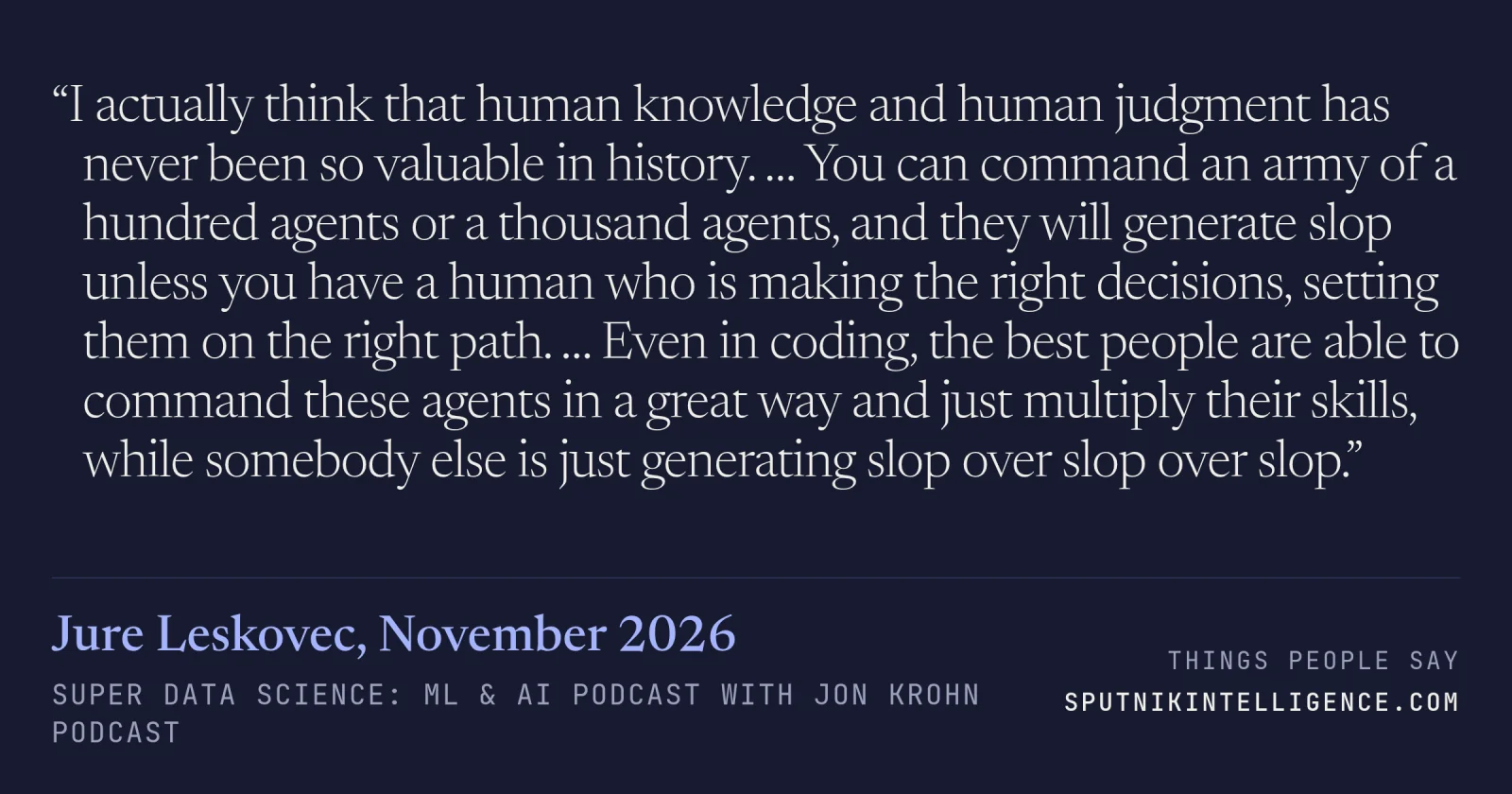
“I actually think that human knowledge and human judgment has never been so valuable in history. … You can command an army of a hundred agents or a thousand agents, and they will generate slop unless you have a human who is making the right decisions, setting them on the right path. … Even in coding, the best people are able to command these agents in a great way and just multiply their skills, while somebody else is just generating slop over slop over slop.” — Jure Leskovec, Super Data Science: ML & AI Podcast with Jon Krohn

Jon Krohn asked where practitioners can find solid ground if AI starts improving itself. Leskovec, a Stanford professor, says agents can loop on verifiable problems, but open-ended work still needs a human to judge what is right.

Super Data Science: ML & AI Podcast with Jon Krohn · 2026-11-24 Permalink → Listen →
Super Data Science: ML & AI Podcast with Jon Krohn Around 46:45 into the episode
Jure Leskovec

…senior PhD student in a sense of helping with some cloning design protocols or doing some single-cell data analysis or looking at some multi-omics data and so on. So it was huge boosts in productivity of human scientists because now you can just tell it what to do and it does it for you.

Jon Krohn

…the singularity, I guess. What do you make of all that? Where do you think we're going and how fast are we getting there? Where can we as practitioners find solid ground in this fast-moving environment to be confident that the skills we're investing in are still going to be relevant years from now?

Jure Leskovec

Yeah, that's a great question. And right, like I teach students here at Stanford. So this question is very important to me because I need to prepare my students for the future. My view is maybe this is kind of what I would say. I actually think that human knowledge and human judgment has never been so valuable in the history. And the reason for this is that humans have this unique ability to judge and to make decisions. And you can command an army of hundred agents or thousand agents, whatever it is, they will generate slop, right? Unless you have this human who is making the right decisions, setting them on the right path, and so on. And, you know, yes, maybe in some domains where the objective function is super clear and it's called a verifiable reward, I can always get the exact estimate how well did the agent solve the task. And then, of course, the agent can kind of keep iterating and looping. But if you think about this, Harder, more open-ended problems, it's not like that. You need that human judgment. You need that human component of identifying, okay, what is correct, what is incorrect, where do we want to go deeper, where did the agent steer off and so on. And I mean, even in coding, you know, in just writing code, we see that the…

Jon Krohn

I like that a lot. It makes a lot of sense to me with the intuition that I have. And something, if people listen to the show like every episode, they will have heard me say this before. But one of the things, one of the places that I find I provide a lot of value in this increasingly automated…

Speaker 3

I agree. I agree with you. I think in that respect, I think it's kind of like I said, I think

Jure Leskovec

the value of human judgment is getting higher and higher. That ability to manage

Speaker names come from our own diarization. The position is estimated from where the line sits in the episode.

Collections They Appear In