TB

Todd Bishop

Things Todd Says on Podcasts

Has covered Amazon for years, and on GeekWire questions the AI-training explanation for Amazon's book-scanning facility.

Where to Find Them

Todd Bishop hosts and writes GeekWire and hosts Positive Charge by GeekWire . They have also been a guest on Me, Myself, and AI , Acquired and Big Technology .

Recently: “Seattle and San Francisco: Big tech, political backlash and the AI boom” on GeekWire (October 2026); “Live show: Amazon, Meta and the fight over the future of AI; Plus, is Seattle still the place to build?” on GeekWire (September 2026); “AI meets real estate, with Zillow's engineering SVP Toby Roberts” on GeekWire (September 2026); “From plant nuggets to bug kibble: Inside the alternative protein revolution” on Positive Charge by GeekWire (September 2026); “Study warns Seattle over-relies on Big Tech; Seattle Times v. Microsoft; Apple's iPhone Duo echoes the past” on GeekWire (September 2026); “NBA's Ballmer crackdown echoes Microsoft antitrust, SF vs. Seattle housing, and a Seahawks tech twist” on GeekWire (September 2026).

What They Said

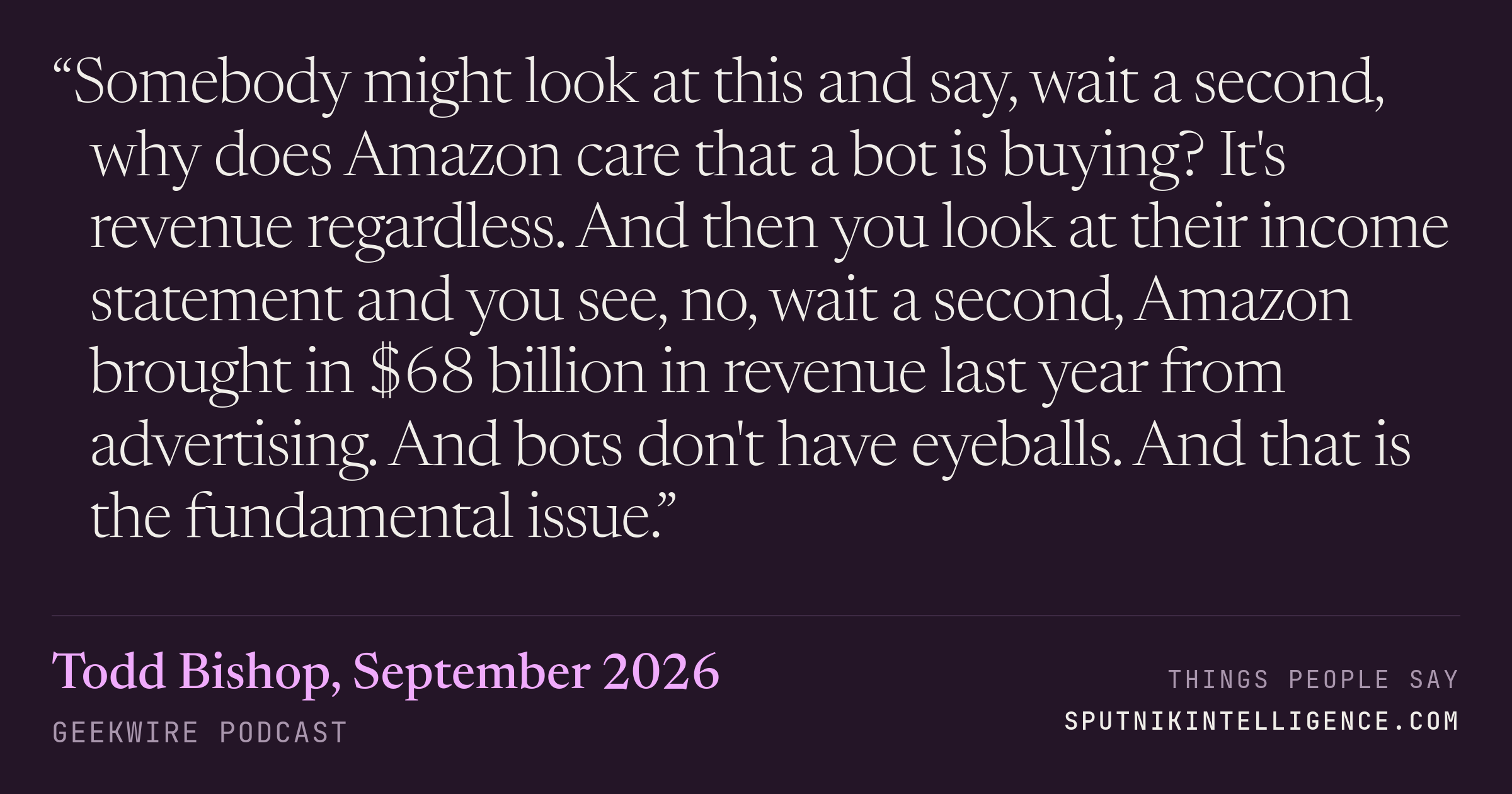
“Somebody might look at this and say, wait a second, why does Amazon care that a bot is buying? It's revenue regardless. And then you look at their income statement and you see, no, wait a second, Amazon brought in $68 billion in revenue last year from advertising. And bots don't have eyeballs. And that is the fundamental issue.” — Todd Bishop, GeekWire

At a GeekWire live show, Bishop had been shopping through Meta's agent Muse, which Amazon is blocking, and had just read out what Muse itself said when he told it about the block. His answer for why Amazon cares is the ad business, and he adds that Amazon is trying to turn Alexa into the same kind of consumer chatbot.

GeekWire · 2026-09-26 Permalink → Listen →
GeekWire Around 11:19 into the episode
Todd Bishop

But then I explained to Muse what was going on. And I said we were going to be talking about Muse on the podcast. And I said, what would you want me to say? What would be your message about yourself and this situation? And Muse said, the one thing I would want said about me, I'm not blocked because I did something shady. I'm blocked because two giants haven't agreed on the rules yet. And the customer is the one stuck in the middle. I was like, whoa. Yeah, kind of profound in an almost human way. That really struck me. Yeah. Creepy or inspiring, John.

Speaker 2

Yeah, I guess it's both because it's right on the mark. You see power shifting so radically in the tech ecosystem right now where a company like Amazon, Meta on top in the cloud era, and now playing a little bit of defense here, it seems, as it relates to meta. And I just think that's pretty interesting how the tables have turned.

Todd Bishop

Now, somebody might look at this and say, wait a second, why does Amazon care that a bot is buying it? I mean, it's a purchase for Amazon, Meta. It's revenue regardless. And then you look at their income statement and their financials and you see, no, wait a second, Amazon brought in $68 billion in revenue last year from advertising. And bots don't have eyeballs. And that is the fundamental issue. I will say the more I used Muse myself, I realized the other wrinkle in this. And that is you really see in this application a very consumer. friendly version of what all of us are using at work. It is like chatting with Messenger. In fact, there are times when Muse will just give you a thumbs up, much like a friend would who wants you to stop chatting at them. You know, like this is very much a consumer-friendly experience. And what does Amazon have that they're trying to turn into their own consumer-friendly AI chatbot? Alexa. Amazon's big initiative right now with Alexa is taking it from the speakers on your counter to the chatbot on your phone. This is Panos Panay, the former Microsoft executive. This is a big thing that he's doing. So I think there's all sorts of interesting battle lines here.

Speaker 2

So Todd, aren't you a little nervous about running e-commerce purchases through Meta?

Todd Bishop

I am so much the wrong person to ask that. I was chatting with some of our guests before the show and they were talking about. Because you'll try anything. I am pretty much the ideal guinea pig for any kind of risky. I probably shouldn't say this on the podcast. I'm going to turn myself into it. What's your safe word?

Speaker 2

Tell us your safe word.

Speaker names from our own diarization · position estimated from where the line sits in the episode
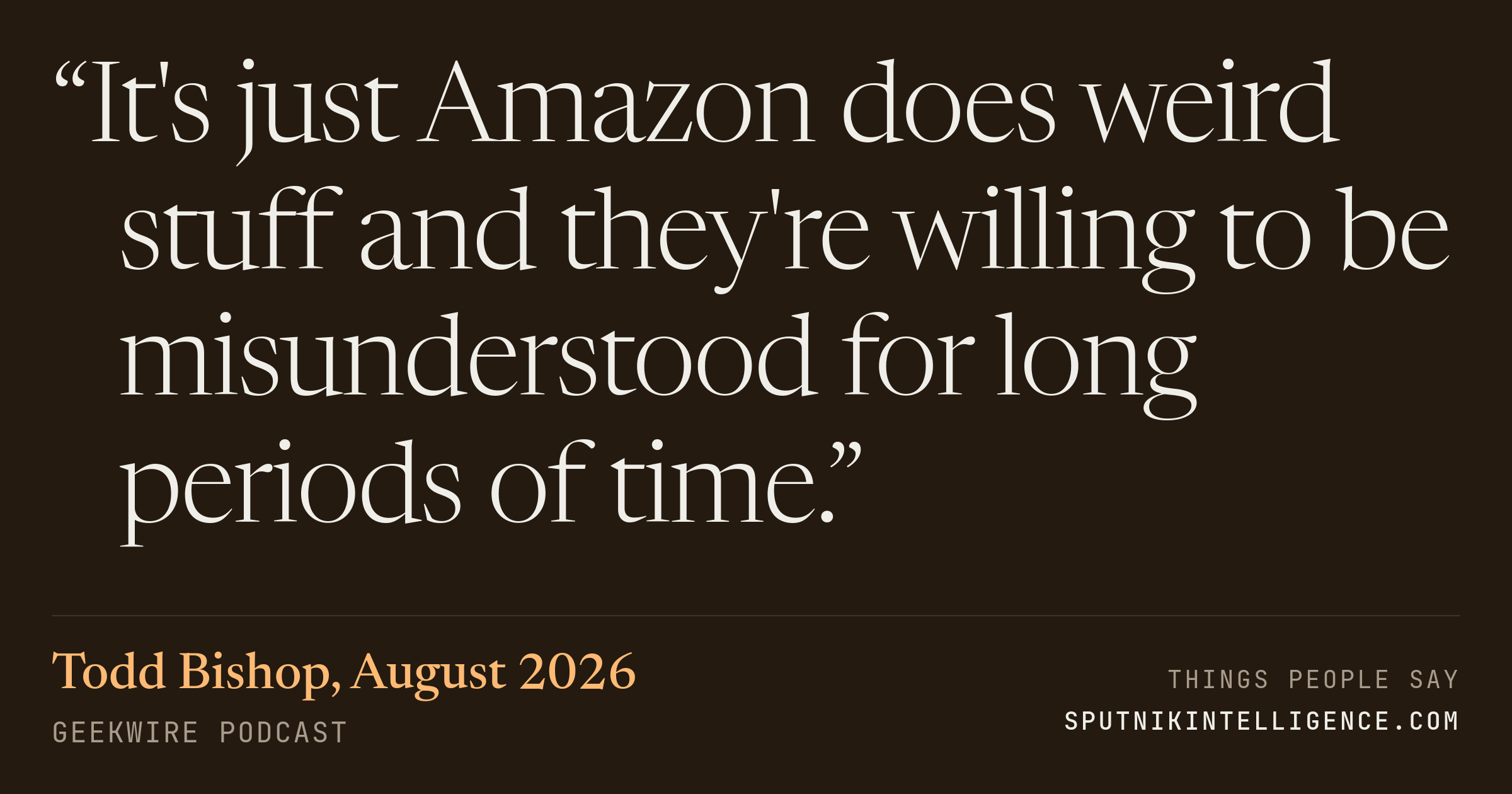
“It's just Amazon does weird stuff and they're willing to be misunderstood for long periods of time.” — Todd Bishop, GeekWire

Bishop and his co-host were discussing a report that Amazon is cutting apart and scanning books at a facility, which most coverage read as AI training data. Bishop says he is less convinced than most, and offers this as the lesson from years of covering the company: the obvious explanation is often not the real one, and Amazon does not mind the confusion. His co-host pushes back that the evidence does point at AI.

GeekWire · 2026-08-22 Permalink → Listen →
GeekWire Around 23:45 into the episode
Todd Bishop

So initially, he was confused because this center is primarily known as like a print-on-demand place. So, like, why would you have rare books at a print-on-demand, you know, Kindle direct publishing kind of place? But he realized from employee forums that there's a separate facility inside this building on the north end where they scan books, they cut them apart first, and then they scan them. And now, Amazon didn't deny this in its statements, but Amazon also was not forthcoming about the reasons that they're scanning these books. The assumption based on all sorts of clues, including the fact that some of the employees scan the ISBN codes, the barcodes, it seems like they're logging these books in some ways. And it fits the pattern of an AI company trying to systematically work through every known book that they can. And so the assumption is that it's training some kind of AI model. Of course, Amazon is partnered closely with Anthropic, which has gotten in hot water over this practice. That said, one of the safe harbors in the ruling that the judge came out with in that case was: hey, if you're destroying the book in the process of scanning it, it's actually okay because you're not going to reuse it. Sort of this weird legal technicality, which is kind of perverse, especially to book lovers. At any rate, fascinating story, and I loved it for the reporting technique that was put into it.

John Cook

So, what do you think is really going on?

Todd Bishop

I think it's probably AI. I'm less convinced of that than most other people. And I will tell you, I don't think 404 media definitively proved that it's for AI. And yet, their headline and their lead and a lot of their language, it felt like some of the reporters' hedging in the story was lost and it just got translated, oh yeah, this is an AI book scanning operation. Having covered Amazon for as long as we have, I think one of the lessons that we've taken away is it may be for something completely different than anybody ever expects that is not obvious. It's just Amazon does weird stuff and they're willing to be misunderstood for long periods of time. I think it could be something completely different. What do you think?

John Cook

The evidence certainly would indicate AI purposes and training. So I would see why they would maybe make that leap. But yeah, you're right. We don't know. I think the end result is we're not 100% sure here, but certainly interesting the lengths that these companies are going to just to capture the planet's data.

Todd Bishop

Yes. Yes. This whole technique, I did some research, and there's a precedent here in a Seattle nonprofit called the Basel Action Network. They started planting GPS trackers long before AirTags in old printers and monitors back in 2014. And they were tracing where e-waste actually goes. And they found that so much of this was basically exported and not truly recycled in the ways that the companies that took them in promised. And so it was kind of some investigative watchdog reporting by this nonprofit in a much similar way, but they had to like team up with MIT on cellular trackers that needed a data plan. And it wasn't exactly the AirTag era.

John Cook

And it's getting easier and easier to do this sort of tracking. I mean, you think about even like the watermarking technology within AI that you're now able to track, you know, AI systems. Yeah, I think it's fascinating how companies are tracking data now.

Speaker names from our own diarization · position estimated from where the line sits in the episode

Collections They Appear In