AG

Alan Greene

Things Alan Says on Podcasts

Where to Find Them

Alan Greene has been a guest on The People's Pharmacy (8 times) .

Recently: “Show 1496: Can You Trust AI with Your Family’s Health?” on The People's Pharmacy (November 2026); “Show 1398: Protecting Children from the Perils of Plastic” on The People's Pharmacy (September 2024); “Show 1352: Home Tests, Tech and Tools to Improve Your Health” on The People's Pharmacy (August 2023); “Show 1208: Keeping Kids Healthy in the Age of Coronavirus” on The People's Pharmacy (April 2020); “Show 1129: Is Complementary Medicine Good for Children?” on The People's Pharmacy (July 2018); “Show 1052: The Challenge of Antibiotic-Resistant Superbugs” on The People's Pharmacy (September 2016).

What They Said

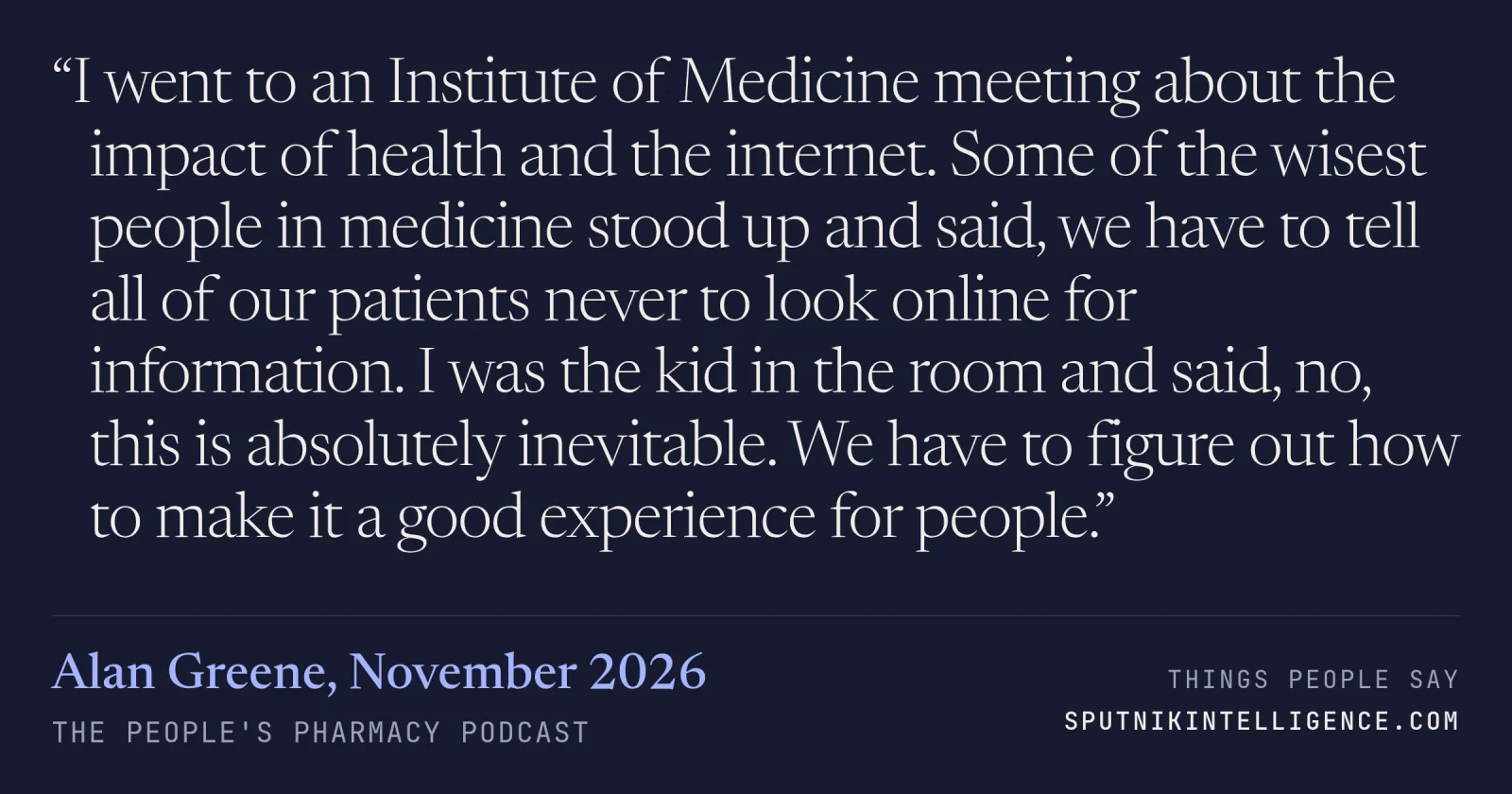
“I went to an Institute of Medicine meeting about the impact of health and the internet. Some of the wisest people in medicine stood up and said, we have to tell all of our patients never to look online for information. I was the kid in the room and said, no, this is absolutely inevitable. We have to figure out how to make it a good experience for people.” — Alan Greene, The People's Pharmacy

A host noted that some doctors still tell patients "just don't Google." Greene recalls the same reflex in the mid-1990s about the early web, and uses it to frame how clinicians should treat AI now.

The People's Pharmacy · 2026-11-20 Permalink → Listen →
The People's Pharmacy Around 08:19 into the episode
Alan Greene

…so that now most people will look something up before they ever talk to their doctor. It's widely available. There's all kinds of information. And the needs now are more how to make sense of it, how to tie it to your own personal information, and really how to integrate that into all of your care.

Terry Graedon

…and then sort of following all the leads and what possible terrible thing you might have. A few doctors, maybe a lot of doctors, I'm not sure, tell their patients, well, just don't Google. That's not a realistic recommendation. So how can people get information without getting misinformation?

Alan Greene

Yeah, that's an excellent question. I remember way back in 1996, went to an Institute of Medicine meeting about the impact of health and the internet. And some of the wisest people in medicine stood up and said, we have to tell all of our patients never to look online for information, which I was like the kid in the room and said, no, this is absolutely inevitable. This is where things are headed. We have to figure out how to make it a good experience for people. And so there's a number of things we can do. We can point people towards sites that are credible and not there to create panic and click views. We can help teach people that the human body is an amazing thing and that kids' bodies are particularly resilient overall and tend to do very well if we take away things that get in the way of their health and just support them. And that the primary stance is one of security and peace and how do we help them grow. And then find a way to reality check whatever it is you find. Now,

Joe Graedon

there was a time when there were certain websites that were considered reliable. So you could go to the Mayo Can You could go to the Cleveland Can You could go to government websites. And everybody was like, yeah, that's fine. You know, if they're reputable, you can sort of trust them. And of…

Alan Greene

And really, since 2022, I mean, AI has been around for a long time, but since 2022, it's really taken center stage. And now if you type a message into a search engine, there's a good chance it'll be an AI synthesis that you get. And rather than going to any website, website traffic's going way down…

Joe Graedon

usually right at the

Speaker names come from our own diarization. The position is estimated from where the line sits in the episode.
“A generation ago, the problem was you couldn't get enough health information. And now it's the opposite. You can get too much. Many people come to me confused because they heard something from an influencer who says it's terrible to ever use sunscreen, and a dermatologist who said you have to always use sunscreen when you walk out the door.” — Alan Greene, The People's Pharmacy

Asked how he helps patients make sense of a firehose of conflicting health advice. Greene says the valuable work now is sitting down with people and putting each claim in perspective.

The People's Pharmacy · 2026-11-20 Permalink → Listen →
The People's Pharmacy Around 18:29 into the episode
Terry Graedon

Our guest expert is Dr. Alan Greene, a pediatrician at Crescendo MD in Portola Valley, California. He launched DrGreen.com, the pioneer physician website in 1995. Dr.Green.ai followed in 2022.

Joe Graedon

…vast array of information, this incredible overdosing of, you know, do this, don't do that, or, oh, there's a new headline out today, or I went to this other doctor and now I'm really confused. How do I put it all together? Because it does seem sometimes like you're drinking out of a fire hose.

Alan Greene

Right. So a generation ago, the problem was you couldn't get enough health information. And now it's the opposite. You can get too much. And many people come to me confused because they heard something from an influencer who says this is terrible to ever use sunscreen and a dermatologist who said you have to always use sunscreen when you walk out the door and all these different opinions that they get. And what's one of the most valuable things we can do together is sit down and sort of evaluate, put all of it in perspective. That there are elements of truth generally across the board, but taken to extremes where the actual statement's not true. And how do we, why do they come that way? And what can you do?

Terry Graedon

Dr. Green, one area that you almost certainly have to deal with as a pediatrician has become unexpectedly controversial over the last six or eight years, and that is vaccination. How do you deal with the fact that vaccines have become so polarized in our current society?

Alan Greene

Yeah, that's a tough thing that I like to go through individually with the families I work with. The idea of exposing children to a tiny amount of the threats that are likely to be big for their bodies so that their own immune system can recognize them in advance and be able to fight against them…

Terry Graedon

you said an AI study. So

Speaker names come from our own diarization. The position is estimated from where the line sits in the episode.
“There was some thought that the medically developed AIs would be better than the general AIs, but they don't seem to be. And which general AI is the best varies every few months… When Wikipedia came out, there was a separate one called Metapedia where only physicians did the editing. I thought, this is going to be so much better. It was not. Wikipedia was more accurate coming from everybody.” — Alan Greene, The People's Pharmacy

Asked where he sends parents for reliable AI help, Greene says purpose-built medical AI hasn't beaten the general chatbots. He compares it to a physician-only wiki losing out to Wikipedia.

The People's Pharmacy · 2026-11-20 Permalink → Listen →
The People's Pharmacy Around 51:07 into the episode
Alan Greene

Right.

Speaker 4

Do you have any places that you'd like to send parents for more information that will enhance that communication?

Alan Greene

I'm not sure exactly to that. I think there was some thought that the medically developed AIs would be better than the general AIs, but they don't seem to be. And which general AI is the best varies every few months. So we'll talk about that. A long time ago, when Wikipedia came out, people thought this is really good, but wouldn't it be cool if there were a separate Wikipedia called Metapedia, which was launched, and they had only physicians do the editing? And I thought, this is going to be so much better. It was not. Wikipedia was more accurate coming from everybody. And basically, AI is drawing from the wisdom of all humanity. That's where it's coming from, is everything that people have written and done over the last bit.

Terry Graedon

That's gone up onto the internet, and AI has read it all and incorporated it.

Alan Greene

Right.

Speaker 4

I'm curious if you could share with us what other tools that parents can use in sort of monitoring their children's health. Are there any things that you either send them home with or you recommend that will enable them to be more active and providing you with information that can be helpful…

Speaker names come from our own diarization. The position is estimated from where the line sits in the episode.
“The errors do concern me, that people will trust false information. But I think more deeply, I'm concerned about passivity. That people could use it as a crutch and get a quick answer without thinking about it, or without taking actions that get their bodies aligned with the way that biology works, just going for quick fixes.” — Alan Greene, The People's Pharmacy

Asked what worries him most about patients using AI, Greene says it isn't hallucination. His bigger worry is people handing their thinking and their health habits over to a chatbot.

The People's Pharmacy · 2026-11-20 Permalink → Listen →
The People's Pharmacy Around 43:44 into the episode
Alan Greene

…value. Always fact-check it elsewhere with somebody else. And then today we were at a meeting of some of the founders of the Society for Participatory Medicine together. And this marvelous idea, think of AI. Use AI as a sparring partner, somebody to test each other back and forth, not as a crutch.

Terry Graedon

I'm wondering what worries you most about patients using AI.

Alan Greene

The errors do concern me that people will trust false information. But I think more deeply, I'm concerned about passivity. That people could use it as a crutch and use it to get a quick answer without thinking about it or without taking actions that get their bodies aligned with the way that biology works, just going for quick fixes. Just like being outdoors is normal for humans, we want to get everything we can for our kids and ourselves, what we is normal for humans, figure out how our biology works best.

Speaker 4

I often wonder if this Massive amount of information that keeps coming in can sort of enhance this idea of the helicopter pilot that, you know, parents are hovering over their children, worrying about their children, overly concerned because everything they do, they're questioning on AI to say, is…

Alan Greene

Yeah, I absolutely do see that. People who come in very anxious and largely amplified by their AI searches. One of the things I try to get people to understand is that before a baby is born, they are doing some of the most complex, difficult, rapid, amazing development that ever happens in life. At…

Terry Graedon

Right.

Speaker names come from our own diarization. The position is estimated from where the line sits in the episode.
“I tell people that AI is a great place to start a search, but it's not a great place to end one. Start a journey into learning something, but don't take it at face value. Always fact-check it elsewhere with somebody else… Use AI as a sparring partner, somebody to test each other back and forth, not as a crutch.” — Alan Greene, The People's Pharmacy

A host noted that AI answers can be both marvelous and wrong. Greene, a pediatrician who runs an AI health site, says the error rate on health questions is still significant, and gives his rule for using it.

The People's Pharmacy · 2026-11-20 Permalink → Listen →
The People's Pharmacy Around 43:07 into the episode
Alan Greene

…source now. Even the ones who go to search engines like they always did, it's that little AI summary at the top they're reading rather than going to the original source. And the answers are often marvelous, but they're often wrong, too. Even I get fooled by them from time to time. I was skeptical.

Terry Graedon

They could be both marvelous and wrong at the same time.

Alan Greene

And confident and marvelous and wrong. And there are different studies looking at what the error rate is, but it's still significant. And on health, you don't want to make those mistakes. So I tell people to be skeptical or fact-check everything somewhere else. But I tell people that AI is a great place to start a search, but it's not a great place to end one, to start a journey into learning something, but don't take it at face value. Always fact-check it elsewhere with somebody else. And then today we were at a meeting of some of the founders of the Society for Participatory Medicine together. And this marvelous idea, think of AI. Use AI as a sparring partner, somebody to test each other back and forth, not as a crutch.

Terry Graedon

I'm wondering what worries you most about patients using AI.

Alan Greene

The errors do concern me that people will trust false information. But I think more deeply, I'm concerned about passivity. That people could use it as a crutch and use it to get a quick answer without thinking about it or without taking actions that get their bodies aligned with the way that…

Speaker 4

I often wonder if this Massive amount of information that keeps coming in can sort of enhance this idea of the helicopter pilot that, you know, parents are hovering over their children, worrying about their children, overly concerned because everything they do, they're questioning on AI to say, is…

Speaker names come from our own diarization. The position is estimated from where the line sits in the episode.

Collections They Appear In