
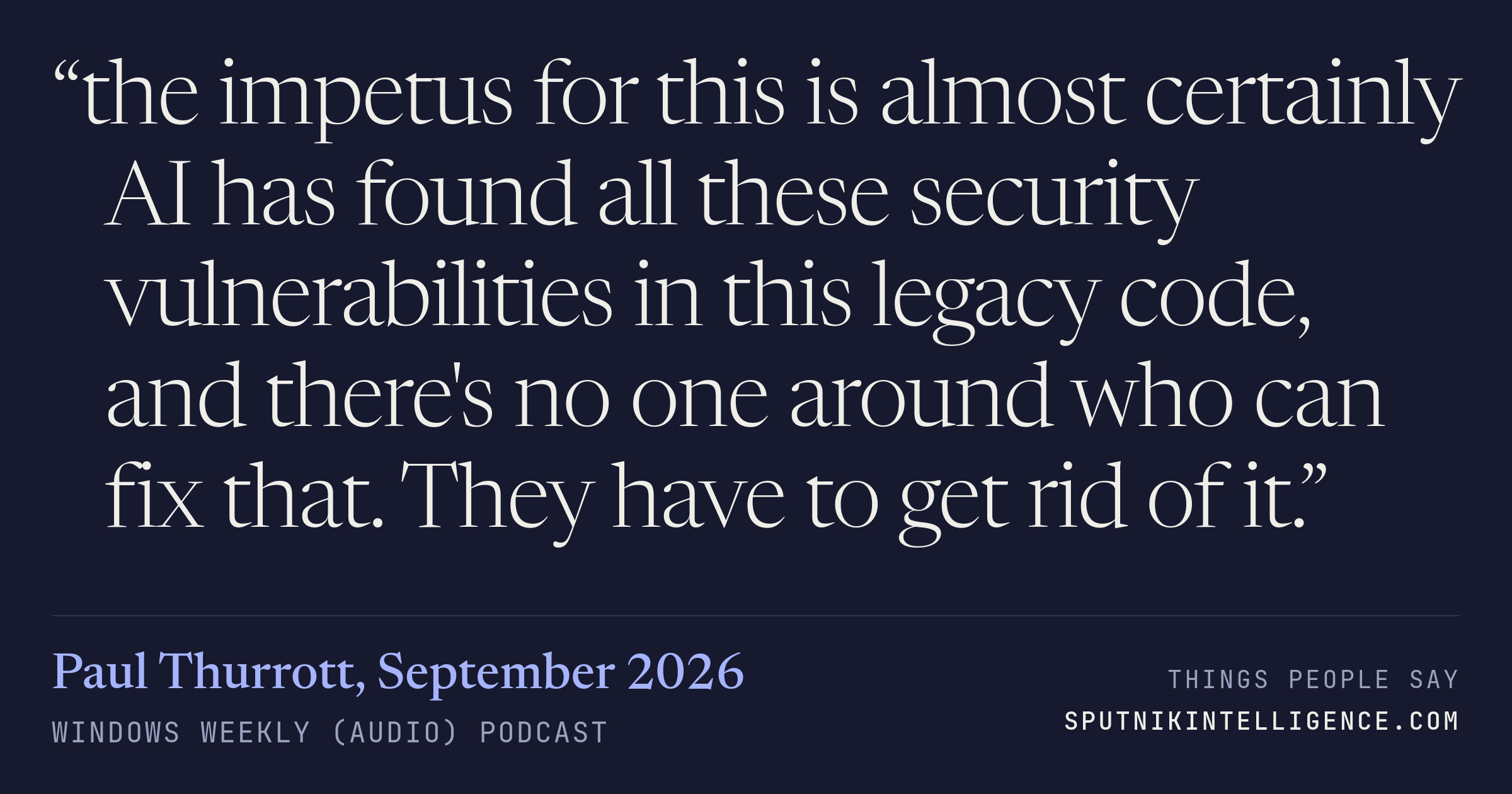
Thurrott had been describing Windows as an archaeological dig of interlinked code from different eras, with the developers who wrote each layer long gone. Microsoft's push to move old interfaces onto WinUI had struck him as pointless housekeeping until he landed on this explanation. He flags it as his own theory, then says twice that he thinks it is literally why.
know. Over many years, too. It's really, it's rough. But here's the thing. Like, there's so much legacy. So I make this, I joke about it in a way. It's really not funny anymore because of all the AI kind of security stuff. But, you know, Windows as this archaeological dig of different eras of technology that are just interlined. Generations of
developers.
Yep. But the thing is, like, you know, so you hear it, like, Microsoft's like, okay, we're going to update all these legacy UIs. We're going to use WinUI, which is the most modern stack. I'm not saying it's great, but whatever. It's the modern stack. And you're like, yay, whatever. They're fixing this thing. That really bothered me. But honestly, the impetus for this is almost certainly AI has found all these security vulnerabilities in this legacy code, and there's no one around who can fix that. They have to get rid of it. And I think that might be why. I think that literally might be why. And you know what? Great. Tell me the
downside. This is all good.
Yeah. If you went to talk to any kind of normal mainstream version, you know, person who uses Windows and you're like, hey, has it ever occurred to you that like this hackers would be able to break into like a printer driver and do something horrible to a computer? They'd be like, what are you talking about? That's crazy. You're like, well, yeah, as it turns out, this is actually a serious problem. And now we're fixing it or we're trying to fix it. But that's not unique to printer drivers or whatever, the printer subsystem. It's all over Windows. And that's the thing. So it's like, ha ha ha, we have like a, you know, archaeological dig of all these different strata of technologies over many decades. But you know what? Now that's a freaking huge security problem. We have to fix it. So yay, they're fixing it, I guess.
Awesome.