Lyon is explaining why he ended up building his own infrastructure around the world rather than renting it. He says the next layer of the same problem is the carriers and interconnects beyond your own cage.
Well, if it's free, there's nothing free. And if you're not paying for it, you are the product. You're being eaten alive. You know, the United States has pretty cool laws. We can use them to protect people. And so DocsNet's US-based, but we also have a Swiss company that handles all of European operations. So there's separation between the operations between the two regions. We're doing other regions like that too. So it's, you know, corporate governance actually matters in these types of situations. But like, you know, I just don't feel comfortable with my data going to a company that doesn't talk about who owns it, why they exist other than privacy. You know, we made a very, very conscious decision that we're very open about what we're doing, who's involved, why the decisions have been made those ways. And it's also kind of to drive community too. But yeah, there are creepy VPNs out there. Oh,
yeah. I mean, and you know, and it's not just, I mean, it's funny because we like to talk about nation states. We like to talk about intelligence agencies, right? Like CIA, NSA, these are all super cool. But in reality, like the risks are a lot more low level than that, right? Like, and, you know, for some of these, there were instances at the beginning of sort of the crypto, the initial cryptocurrency waves where people's accounts were getting drained and they were using some of these servers. Services that were in other countries. And it turns out that, like, you know, in some of these countries, you have the meshing together of the intelligent state apparatus and organized crime. Right. And so you see where these things start to bleed into each other.
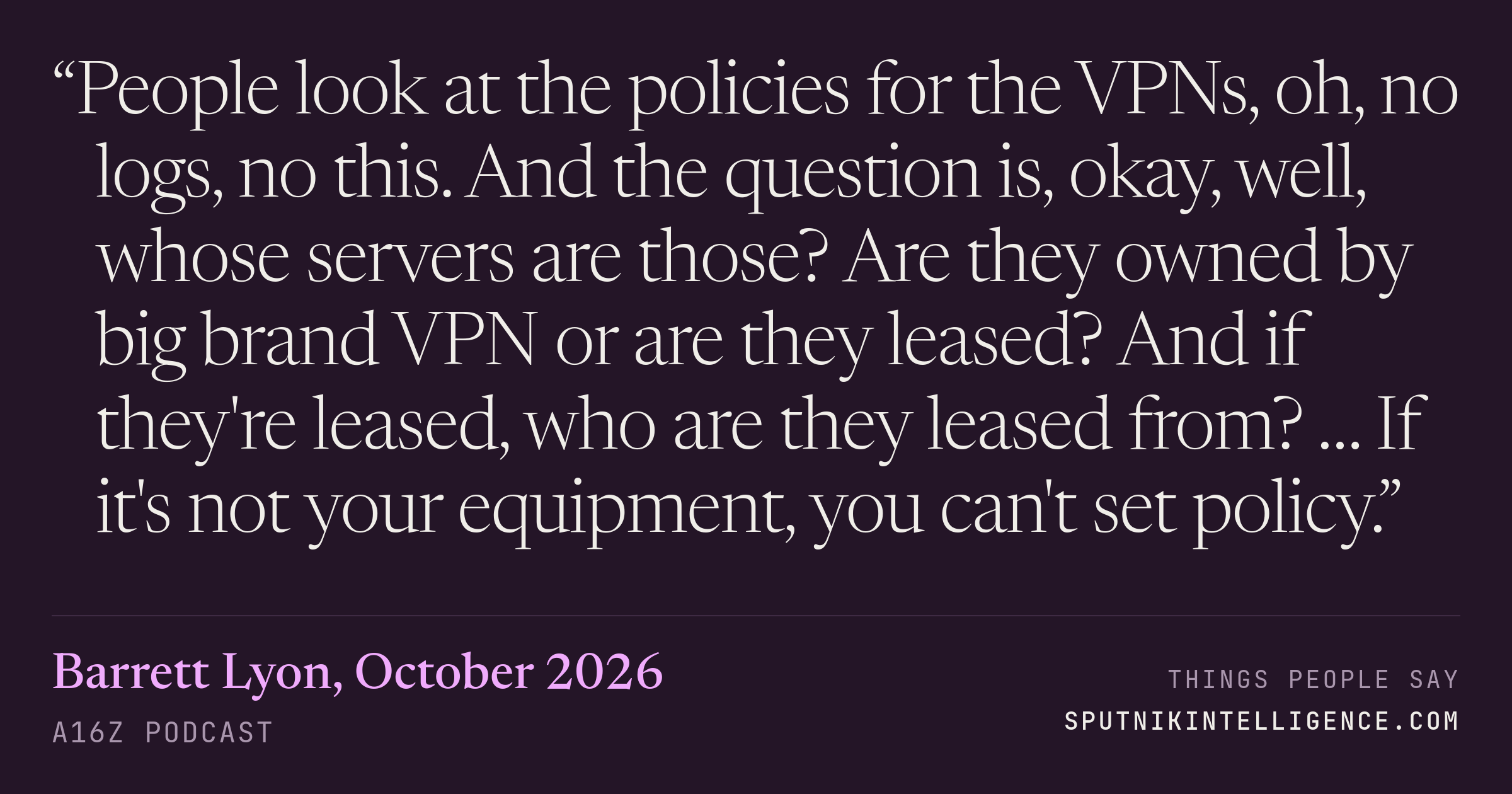
Yeah. I mean, and then people look at the policies for the VPNs, oh, no logs, no this. And the question is, like, okay, well, whose servers are those? Yeah. Are they owned by big brand VPN or are they leased? And if they're leased, who are they leased from? And what are those people doing with the data? And what are their policies? But there's that whole underbelly. And learning about that has been difficult because I personally was not up to building infrastructure all over the world as rapidly as I could. But I ended up realizing that that was, you know, if it's not your equipment, you can't set policy. It's just, you can't. And then the next layer of policy is the carriers and interconnect beyond your cage or whatever it is. So it's been an incredible amount of work to work around, you know, the bare metal as a service kind of creepy underbelly.
And this is like one big difference with, I think, a lot of folks, right? Is that you own the full stack from like software to wire?
Yeah, software to wire and even all the AI components that run routing and things like that are all on our bare, on our metal. Well,
and I think that was that was one of the funny things. I think when we originally started talking about this was you were you were incredibly distrusting of large inference and AI providers. Yeah. And you've built your own AI stack.