After counting 225 "region-pair years" of opportunity under a 2011 federal planning rule, Palken was asked how many inter-regional power lines it produced. The host guessed more than zero; Palken says none.
…lays out as inter-regional coordination, where the regions are meant to coordinate their needs with each other and find transmission solutions that meet them. Do you want to guess how many inter-regional transmission lines have been planned and built as a result in those 225 region pair years?
Is it meaningfully larger than zero?
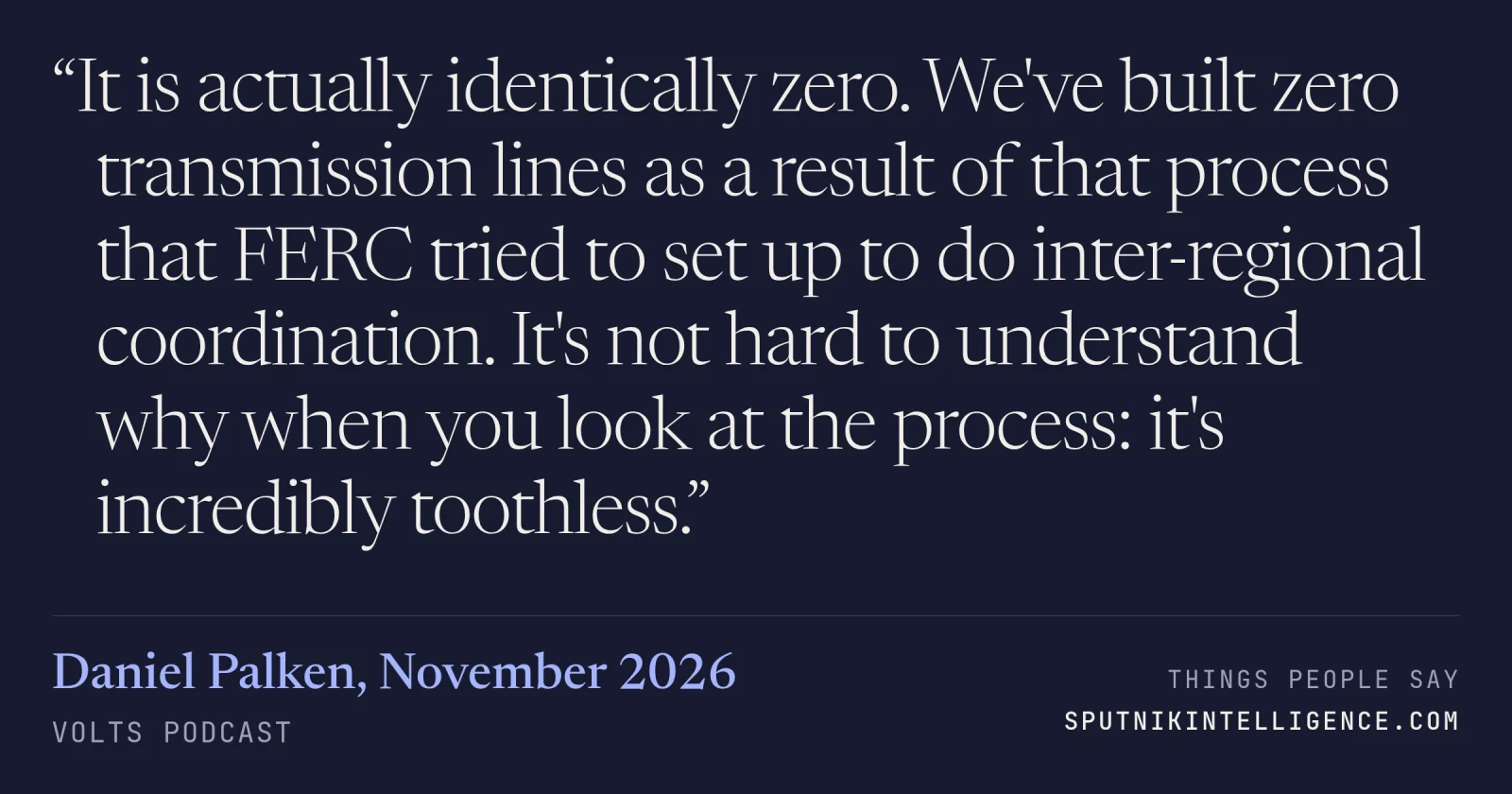
It is actually identically zero. We've built zero transmission lines as a result of that process that FERC tried to set up to do inter-regional coordination. It's not hard to understand why when you look at the process, it's incredibly toothless. What this bill does as a remedy to that is it writes a actually quite, I guess, toothsome, would be like a version with teeth of an inter-regional planning rule that requires all these regions to get together with their neighbors on a periodic basis and go through a planning exercise subject to a bunch of known best practices, which have kind of been emblematic of the regional planning processes in regions where that has worked in the last several years and identify needs that can be met with transmission, identify transmission solutions to meet them, and then select those solutions if they're meeting a set of affordability and reliability metrics that are essentially set forth in the bill, which there's very good reason to believe there's so much pent up need on the grid that we would…
But what if they don't? You know what I mean? What if they don't? Is there a forcing mechanism?
There is. And this is the part that carries over from the EPRA bill is kind of the one-two punch of these two priorities. The first is this, I'm not going to call it top-down because it's really middle-out. It's driven by the regions, but this middle-out policy of having the regions get together…
It eases congestion in your area, thereby lowering prices in your area, which in a sane world would be a good thing, but not always from the utilities perspective. And that's the end of the free preview. If you'd like to hear more, become a paid subscriber at volts.wtf. Thank you.