MC

Matt Carey

Things Matt Says on Podcasts

Where to Find Them

Matt Carey writes The Cloudflare Blog . They have also been a guest on Scaling DevTools (2 times) , MLOps.community and The Changelog .

Recently: “Multi-Cloud LLM Routing and Context-Aware Coding Agents” on MLOps.community (November 2026); “The next generation of MCP” on The Cloudflare Blog (August 2026); “Your agent needs a computer, not a container — introducing @cloudflare/computer” on The Cloudflare Blog (August 2026); “Cloudflare devs @ AI Engineers Europe (Sunil Pai, Matt Carey & Thomas Ankcorn)” on Scaling DevTools (May 2026); “MCP on Code Mode (Interview)” on The Changelog (May 2026); “Running Events with Matt Carey from AI Demo Days” on Scaling DevTools (October 2025).

What They Said

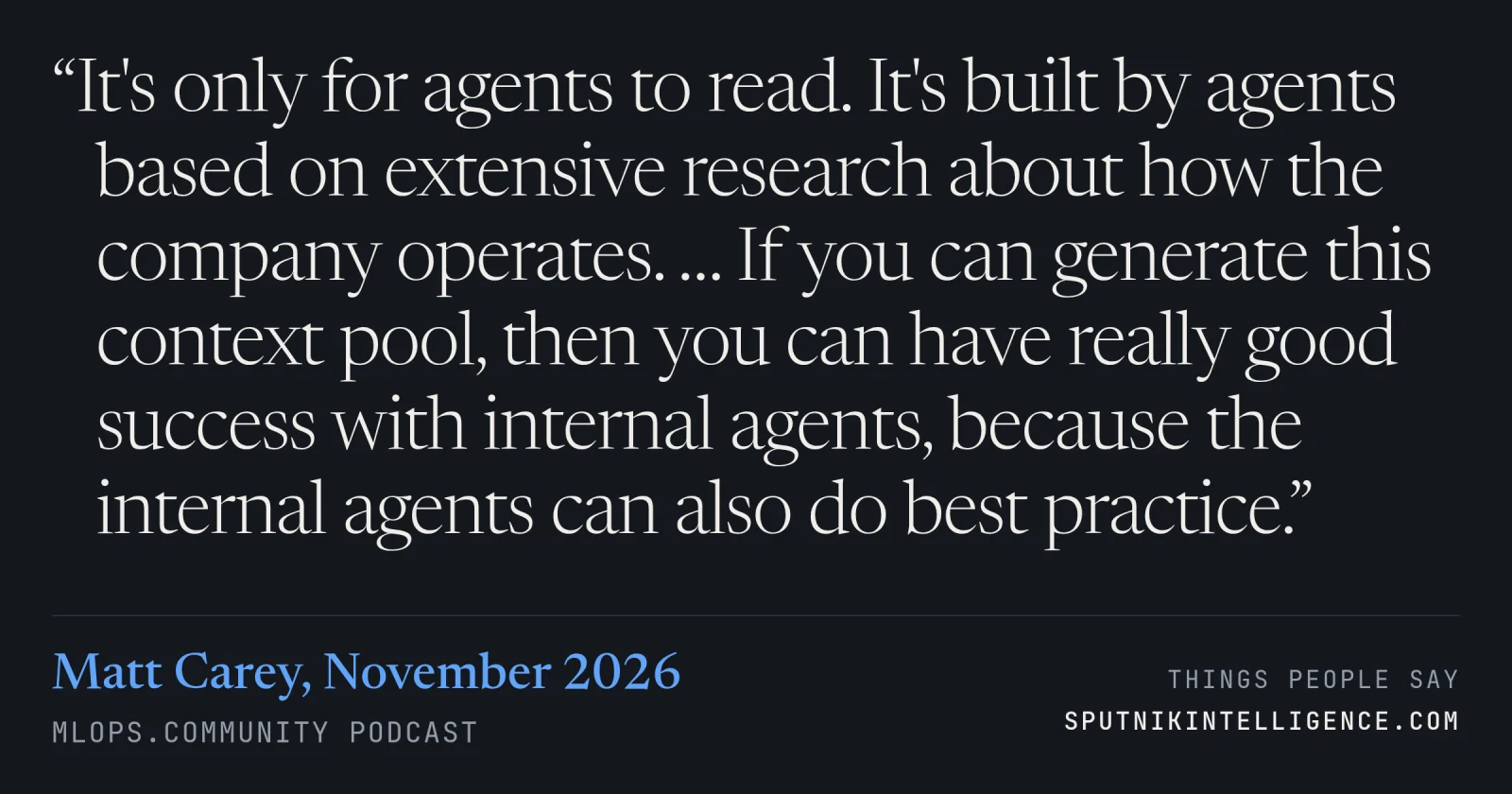
“It's only for agents to read. It's built by agents based on extensive research about how the company operates. … If you can generate this context pool, then you can have really good success with internal agents, because the internal agents can also do best practice.” — Matt Carey, MLOps.community

Asked whether Cloudflare's internal engineering codex is meant for humans or agents, Carey says it is written only for agents, so every coding agent in the company follows the same practices.

MLOps.community · 2026-11-16 Permalink → Listen →
MLOps.community Around 12:04 into the episode
Matt Carey

…have similar versions to this. Like, I know the very famous ones are the Airbnb style guide for code, right? Like, people used to write JavaScript in the Airbnb style guide. Now, I think you can build whole applications with the Cloudflare codec. So, that's how we're trying to think about it.

Demetrios Brinkmann

Is it primarily for humans to read or for agents to read? Yeah,

Matt Carey

it's only for agents to read. So, it's built by agents based on extensive research about how the company operates. And we're trying to write down how the company operates and trying to be aligned across the whole company. Cloudflare is 4,500 people, I think, and trying to be aligned about everyone's coding agents should know how the company works and how the company operates, where to go for different things. Yeah, it's a massive task. But if you can do that and you can generate this codex, codex is such a loaded word now. But if you can generate this context pool, then you can have really good success with internal agents because the internal agents can also do best practice.

Demetrios Brinkmann

Yeah, one thing that I find super difficult is just knowing how well my stuff's performing versus like what it should be at, or what is the top end of this performance. And so, like, evaling it and going through, and even just something as simple as documentation and the agent's ability to…

Matt Carey

Yeah.

Demetrios Brinkmann

Because it's a human, all right, like I want to write the best I can. I want to make sure that these docs are well written, but you're not like having to go and then like say, can we eval these docs? Right?
Speaker names come from our own diarization. The position is estimated from where the line sits in the episode.
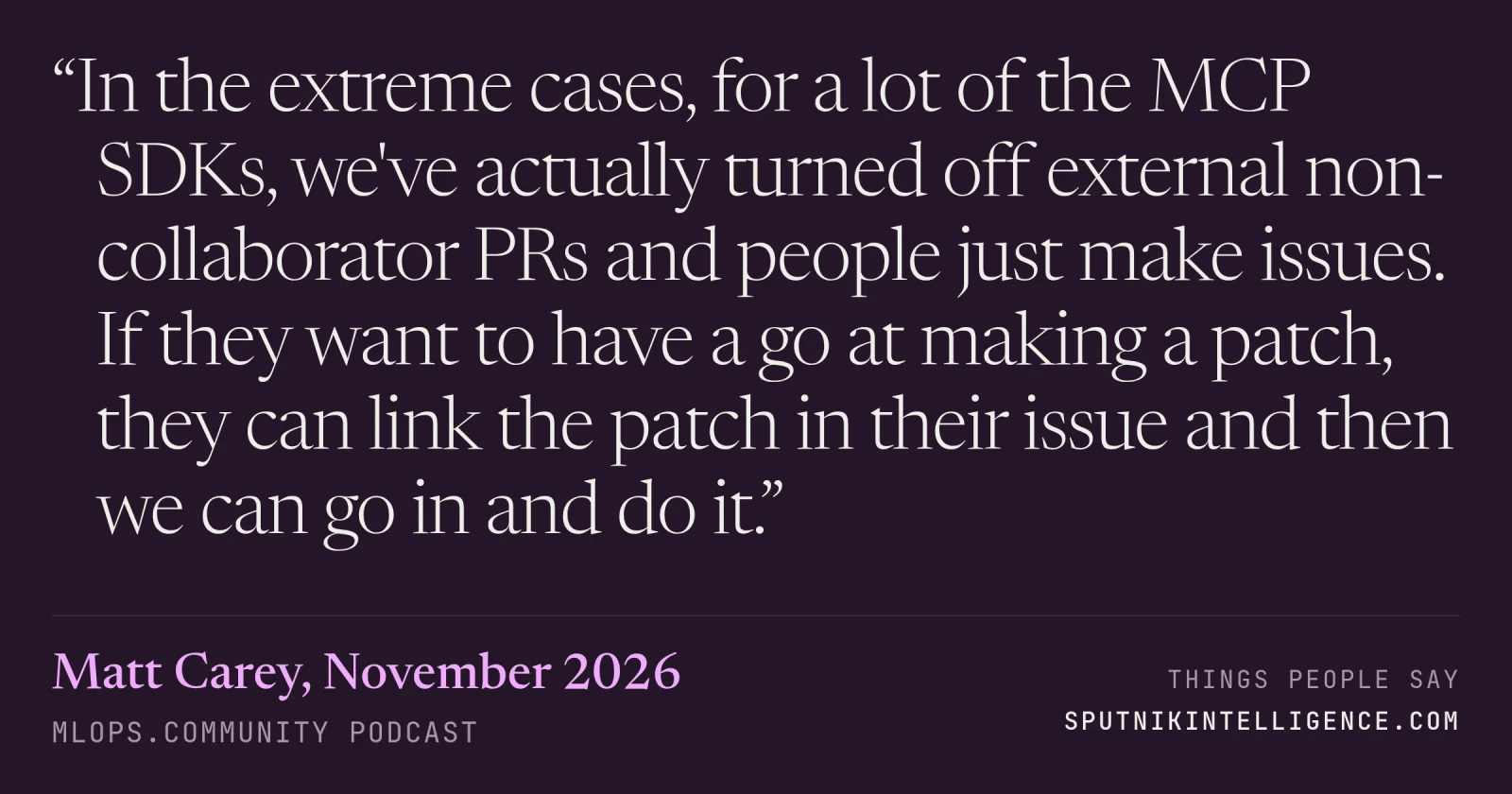
“In the extreme cases, for a lot of the MCP SDKs, we've actually turned off external non-collaborator PRs and people just make issues. If they want to have a go at making a patch, they can link the patch in their issue and then we can go in and do it.” — Matt Carey, MLOps.community

The hosts were discussing how open-source maintainers cope with a flood of AI-generated pull requests. Carey says some teams he works with have stopped accepting outside PRs entirely.

MLOps.community · 2026-11-16 Permalink → Listen →
MLOps.community Around 17:00 into the episode
Matt Carey

…Because up until now, I think open source repos have really had this like deluge of people. I want to make a contribution. I'm going to throw my agent at this potential problem and see what it comes up with. I'm going to scan the repo and find these security vulnerabilities, which potentially

Demetrios Brinkmann

…I get a lot of PRs for superpowers. And a lot of times it's very low quality because obviously, yeah. But he built out ways to just automatically sift through the low quality ones. And then the ones that should get the humans time get bubbled to the top by having like some very firm rules. Yeah,

Matt Carey

I think everyone is doing this. Like in the extreme cases for a lot of the MCP SDKs, I can't speak for all of them, but we've actually turned off external non-collaborator PRs and people just make issues and they can, if they want to have a go at making a patch, they can link the patch in their issue and then we can go in and do it. I think there's this like whole, there's this whole thing about how can you reduce that maintainer burden and how can how can you actually automate each of the points but have some type of human review and like whatever people are comfortable with. Dude,

Demetrios Brinkmann

because PRs are cheap, man. Well, very cheap. Yeah,

Matt Carey

it depends on your model, but yeah, potentially they're cheap. But also a lot of the time, I think open source maintainers have a very like strong idea of where they want the project to go. And so them knowing about issues is very useful, but then actually the implementation has to fit with the…

Demetrios Brinkmann

You don't got to get out there. Yeah, you got

Speaker names come from our own diarization. The position is estimated from where the line sits in the episode.

Collections They Appear In