AB

Art Berman

Things Art Says on Podcasts

Where to Find Them

Art Berman has been a guest on The Great Simplification with Nate Hagens (2 times) , Macro Voices (2 times) , Wealthion - Be Financially Resilient (2 times) , Planet: Critical , Palisades Gold Radio , Geopolitics & Empire and Reality Studies .

Recently: “A World-Changing Event: We're Not Going Back to January 2026 with Art Berman” on The Great Simplification with Nate Hagens (October 2026); “Oil Near $100: China’s Demand Story Doesn’t Add Up | Art Berman” on Wealthion - Be Financially Resilient (September 2026); “Art Berman: The Global Energy Order Is Breaking” on Wealthion - Be Financially Resilient (August 2026); “Art Berman: Iran, Oil, & Energy Signal vs Noise in a Fragmenting World” on Geopolitics & Empire (June 2026); “Art Berman: Art Berman: Coming Oil Shock ‘Worst Thing’ in Modern History, Shortages Inevitable” on Palisades Gold Radio (May 2026); “A World On the Precipice: The Last Oil Tanker From the Strait of Hormuz has Arrived – Now What? with Art Berman” on The Great Simplification with Nate Hagens (May 2026).

What They Said

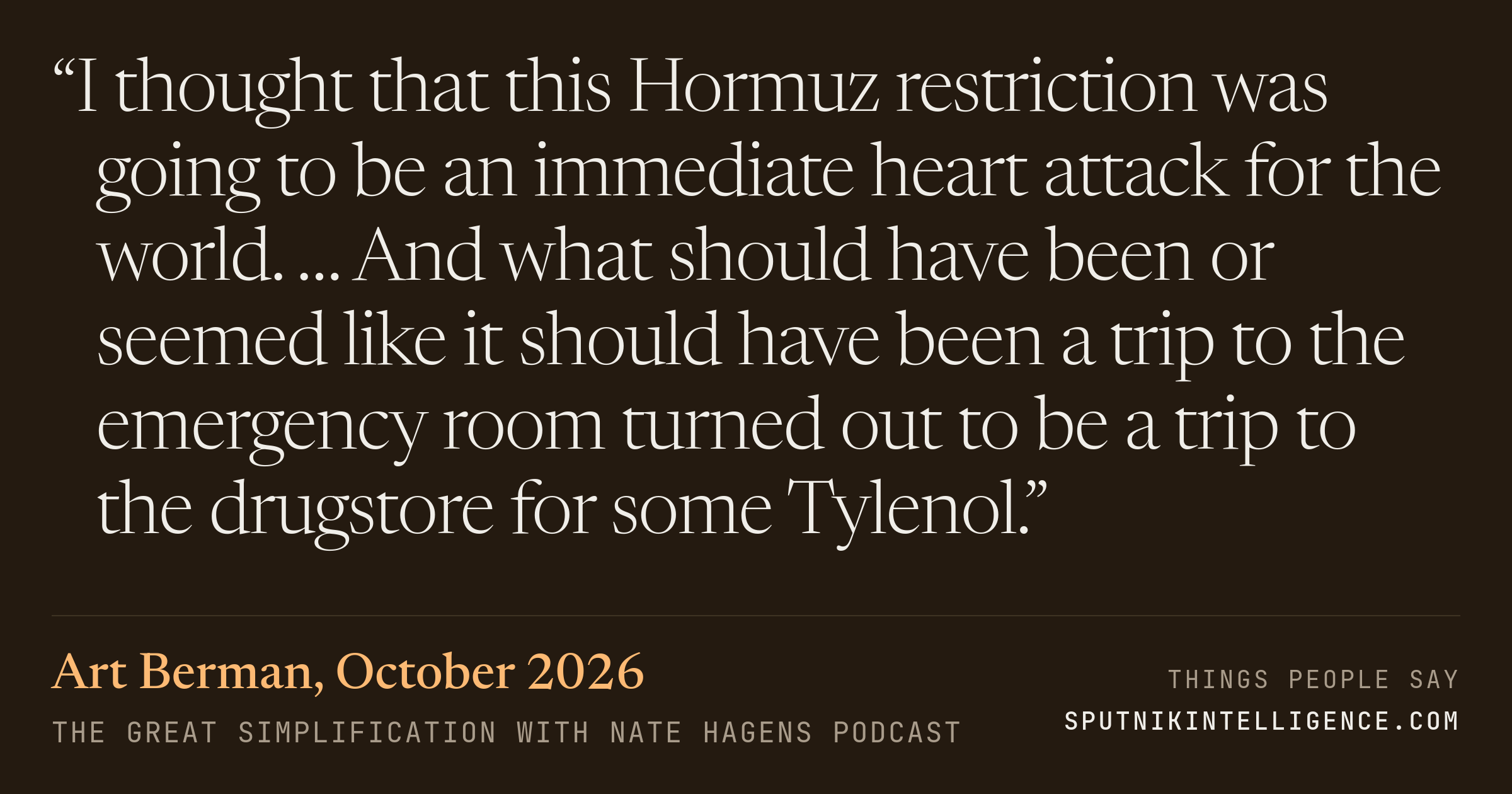
“I thought that this Hormuz restriction was going to be an immediate heart attack for the world. … And what should have been or seemed like it should have been a trip to the emergency room turned out to be a trip to the drugstore for some Tylenol.” — Art Berman, The Great Simplification with Nate Hagens

Berman was admitting what he and other oil analysts got wrong about the restriction of the Strait of Hormuz. By his account the world lost about 10 million barrels a day and not the 20 million feared, thanks to bypass pipelines, strategic reserves and a drop in Chinese crude imports. The host's next question was whether the trip to the emergency room is still to come.

The Great Simplification with Nate Hagens · 2026-10-07 Permalink → Listen →
The Great Simplification with Nate Hagens Around 07:39 into the episode
Speaker 1

So that is among the core questions and a difficult one. And the simple answer is, as you alluded, first of all, it depends on where you are. But you and I are both in the United States. And so let's just talk about that for a moment. And here in the United States, my life has not changed very noticeably as far as the things that are available to me. Now, the price of some things is higher. But I mean, it's not like the bottom has fallen out. And so why is that? And part of the answer is that the United States has a tremendous endowment of all natural resources, but particularly oil and natural gas and coal. So we are in a much better place than, say, the parts of the world that are hurting, which are predominantly Asia and parts of Africa that essentially have no indigenous energy resources of their own.

Speaker 2

And Europe as well. I would include Europe in that list.

Speaker 1

Fair enough. Europe used to have a fair amount of energy resources and they've pretty much blown through them. I think the second part, though, is just how remarkably and impressively adaptable the energy system has shown itself to be. It surprised me, Nate. I mean, when we talked about Iran a couple of months ago, you're right, I got the diesel prices and some of the product prices right. But there were some things that I didn't get right. And I thought that this Hormuz restriction was going to be an immediate heart attack for the world. Most of the analysts that I respect were pretty much in the same boat. So we were all wrong to some extent. And what we were wrong about is just how amazingly cleverly the system adapted and adjusted. And so instead of losing 20 million barrels a day, we ended up only losing maybe 10 million barrels a day because there were all sorts of clever things. There were bypass pipelines. There were strategic petroleum reserves that we could draw on. And then there is this mystery of China deciding to stop importing 4.5 million barrels of crude oil a day. So all of those things just kind of stacked up. And what should have been or seemed like it should have been, you know, a trip to the emergency room turned out to be a trip to the drugstore for some Tylenol.

Speaker 2

Is the trip to the emergency room on the horizon?

Speaker 1

We're getting the car warmed up right now, I think, Nate.

Speaker 2

Okay. I want to cover two things. First of all, you mentioned the strategic petroleum reserve. I mean, there's different ones in different countries. Let's talk about the United States. My understanding is we're at 40, 50-year lows, and there's not so much more lower we can go before those caverns start to not be able to function. Can you give us an overview of that situation?
Speaker names from our own diarization · position estimated from where the line sits in the episode
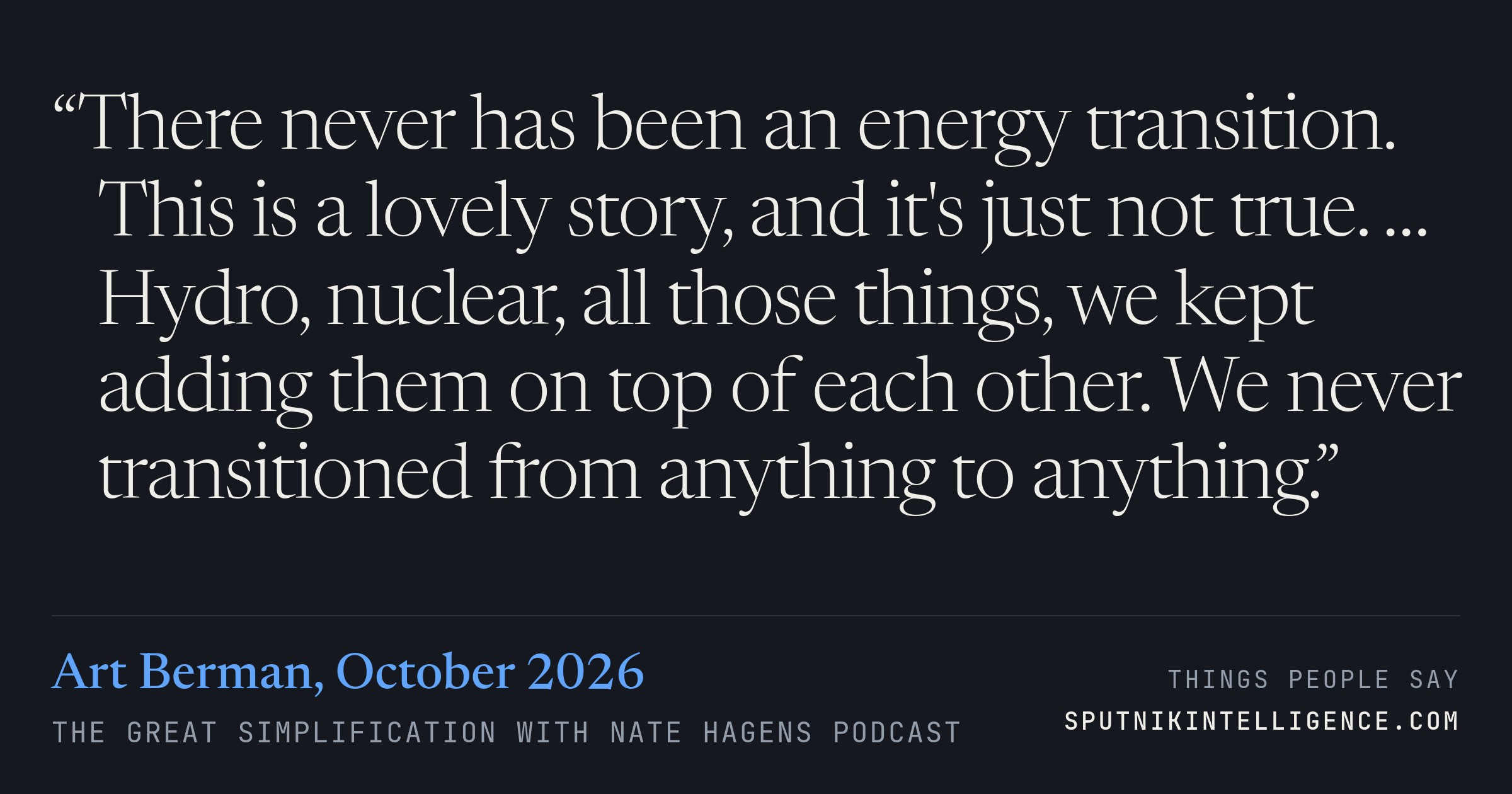
“There never has been an energy transition. This is a lovely story, and it's just not true. … Hydro, nuclear, all those things, we kept adding them on top of each other. We never transitioned from anything to anything.” — Art Berman, The Great Simplification with Nate Hagens

Nate Hagens asked whether the oil shock from the Iran war would speed up or slow down the energy transition. Berman's answer is that biomass, coal, oil and gas were each layered on top of the last and none has ever declined, so investors betting on substitution are betting on something with no historical precedent. He adds that this doesn't mean it can't be done, only that the odds are low in the near term.

The Great Simplification with Nate Hagens · 2026-10-07 Permalink → Listen →
The Great Simplification with Nate Hagens Around 38:17 into the episode
Speaker 1

Oh, we could absolutely run an economy, but not an economy that would support 8.2 billion people. It'd be a very different civilization, and in many ways, I think a better one. It's just that, you know, you don't get from here to there in a single step. I mean, you're talking about a long transition.

Speaker 2

So let me ask you this. We had an energy shock in the 70s, and society responded to that. We had nuclear build outs and efficiency standards, and they found oil in the North Sea. And today's options, the way things are going, are faster electrification, a return to coal. Have you seen China's 2027 expected gigawatt expansion of coal? It's massive. What else? Resource nationalism, stockpiling, and different countries are doing different things. So what do you think this 2026 Iran war energy shock could be setting in motion? And does the shock speed up or slow down the so-called energy transition story?

Speaker 1

Well, first of all, let me just say there never has been an energy transition. This is a lovely story, and it's just not true. I mean, what has existed, and I'm talking about, you know, since 10,000 years ago, have been energy additions. And so early man used human and livestock muscle, wood and other biomass. Okay, the amount of biomass that is used today is pretty much the same as it was in 1800. We don't have good records back before then. So we never stopped using biomass. We simply layered on coal on top of it. But as a world, we have, at the very least, over the last 20 or 30 years, we've actually, we've kept our coal consumption flat or increased it slightly. So biomass, we never decreased it. Coal, we never decreased it. Then we got oil and we added that on top and that's never decreased. Natural gas came later. That's never decreased. Hydro, nuclear, all those things, we kept adding them on top of each other. We never transitioned from anything to anything. I'm not bringing this up because it's a semantic problem. It's that the entire mindset that our investment world is in is one of substitution. We're going to substitute renewables or EVs or whatever for our current system. And yet there's no historical precedent for ever doing that. That doesn't mean that you can't do it. It just means that the probability is quite low. And certainly the probability is low in the near term.

Speaker 2

What's this going to change?

Speaker 1

I mean, everything has changed. We just don't know it yet. And so what I think is most probable is that we'll see a run-up in prices, which we're seeing right now. We're going to see demand destruction. It'll vary from place to place, depending on the capacity of that location to get its supply chains and deal with the financial fallout. And at some point, we're going to see a version of what happened after the first oil shocks, which was, in that case, a decade and a half of essentially global recession and depression. That's why we had low oil prices. And as I've said, this is not going to play like that movie did, because the scale of our economy and the complexity of our economy today is so much greater than it was in 1980.

Speaker 2

What about U.S. shale? What's happened since February? What did U.S. shale do in response to this crisis? What didn't it do? And what does that imply about shale for the next five years?

Speaker names from our own diarization · position estimated from where the line sits in the episode

Collections They Appear In