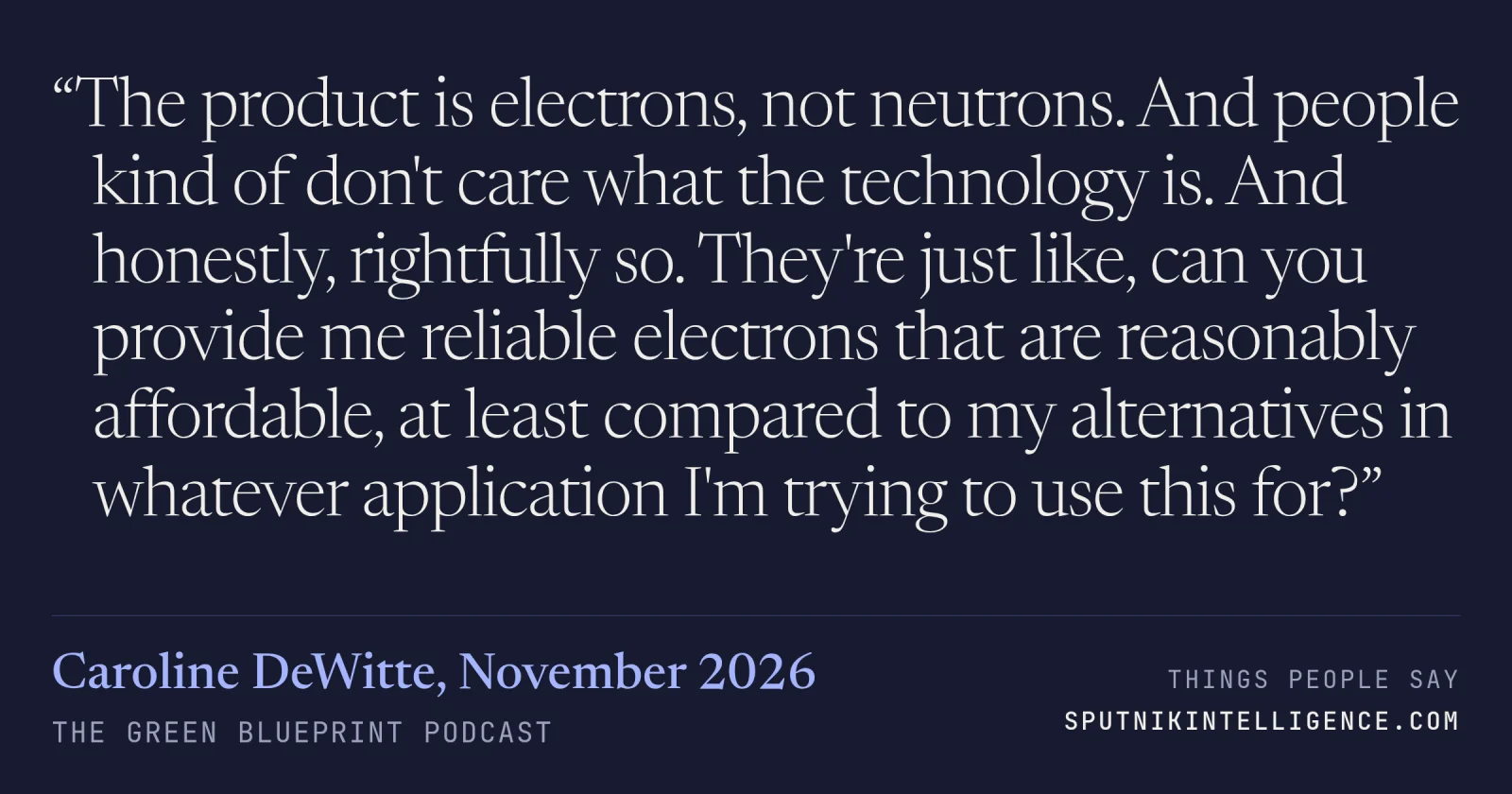
Asked how Oklo landed on building, owning and operating its own reactors instead of selling designs, DeWitte explains that utilities are risk averse and customers care about power, not reactor technology. It is the core of the company's business-model pitch.
…have that in hand for kind of the regulatory process and proving that we believe that this will behave as we think it will. So you can, you know, benchmark computer codes that then can do other predictive behavior. But just having that actual experimental data on the exact same field type is key.
…the reactors that you're working on. So can you say a bit about how you came to that decision? I think there's a little bit of a mix across the nuclear startups around like, are you selling a reactor technology? What exactly is your business model? So how did you all land on that as your approach?
…for the first one or two. And it's probably got to be something that's a little turnkey. And what we started landing on as far as like what we thought we could do on venture, what I call venture scale funding is like really small reactors as proof points. And we'd need to own and operate it ourselves in order to kind of have the product. In other words, I've used this a few times before, but the product is electrons, not neutrons. And people kind of don't care what the technology is. And honestly, rightfully so. They're just like, can you provide me reliable electrons that are reasonably affordable, at least compared to my alternatives in whatever application I'm trying to use this for? So I think we realized that early on we had some interesting conversations with utilities that seemed like they were ready to like move forward or wanted to maybe do the operating part of, and we do the design part and they'd buy a reactor from us. But ultimately, like we didn't see that as consistently to make that basically our whole business model, we really just realized. But the other thing…
definitely more to say on fuel. I want to ask you one more question about your customers. One of the things, I don't know why I always remember this, but there was a study maybe 10 years ago that the Canadian government did. And one of the things that they noted is that, you know, a place where…
Oh, yeah. Yeah. Yeah. So that's like, I'll try to be like succinct. You got a lot in there. So like, yeah, we did evolve over the years. And partly that was just due to differing access to capital as we went along. So, you know, like our first, you know, our Series A was so small. And then, and we…
Totally. Well, and so this is the multi-billion dollar question is like, can we build nuclear reactors and which ones will we build to meet this moment? But to get there, among the things that we have to figure out is the regulatory pathway. And this is one of those moments in the conversation…