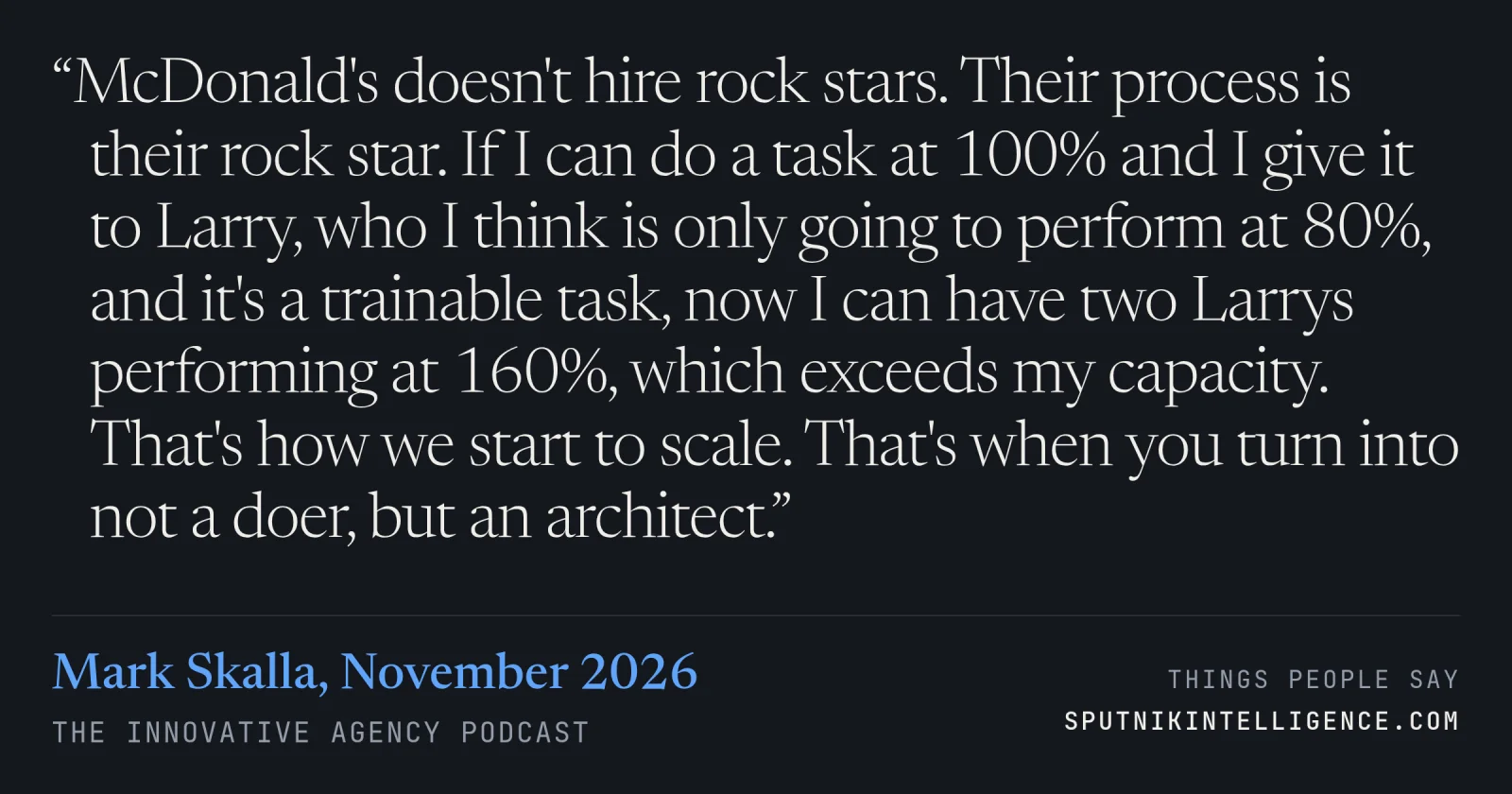
Asked how founders can delegate decisions, Mark says founders' decisions follow patterns they could teach, and uses a simple capacity calculation to show why a trainable process beats relying on talent.
…haven't spent five hours of my week doing A, B, and C, and I can see that these other people are managing it. Now I have five hours to do better critical thinking. How do I expand my business? How do I expand my product offerings? How can I grow revenue or profit, whatever it is, or size or, yeah.
…architecture is absent. And that is why we are so scared to delegate decision-making. We maybe were past the pain point of actually getting the work off our desks, but we're still being come to by our team members for decision-making. So talk a little bit about that framework, if you don't mind.
Sure. I'm going to try and remember specifically what I wrote about in that one, but I'm just going to walk our dead bones.
This is why it's fun to be the interviewer, not the interviewee.
Yeah. So here's what I remember paraphrase. This is not going to be exactly like my own book because it's been a while since I wrote it. When we're trying to offload those decision-making processes, it initially starts off as a task. You're absolutely right. We're not giving somebody the autonomy…
No, you didn't actually. But I'm also intrigued by the way you sort of segregate the different types of decisions and which ones require owner input. Or which ones just require owner knowledge or which ones just require a quick check? Or could you talk a little bit about that? Because you did, you…