BK

Brian Kernighan

Things Brian Says on Podcasts

Where to Find Them

Brian Kernighan has been a guest on Lex Fridman Podcast , CoRecursive: Coding Stories , The Changelog , The Peterman Post , The Developing Dev , CppCast and The Peterman Pod .

Recently: “Brian Kernighan: Inside Bell Labs, The Best Programmer, Why C Won” on The Developing Dev (October 2026); “Brian Kernighan: Inside Bell Labs, The Best Programmer, Why C Won” on The Peterman Post (October 2026); “Brian Kernighan: Inside Bell Labs, The Best Programmer, Why C Won” on The Peterman Pod (October 2026); “Wisdom from 50+ years in software (Interview)” on The Changelog (March 2022); “Unix and C History” on CppCast (February 2022); “Story: The Birth of Unix with Brian Kernighan” on CoRecursive: Coding Stories (November 2020).

What They Said

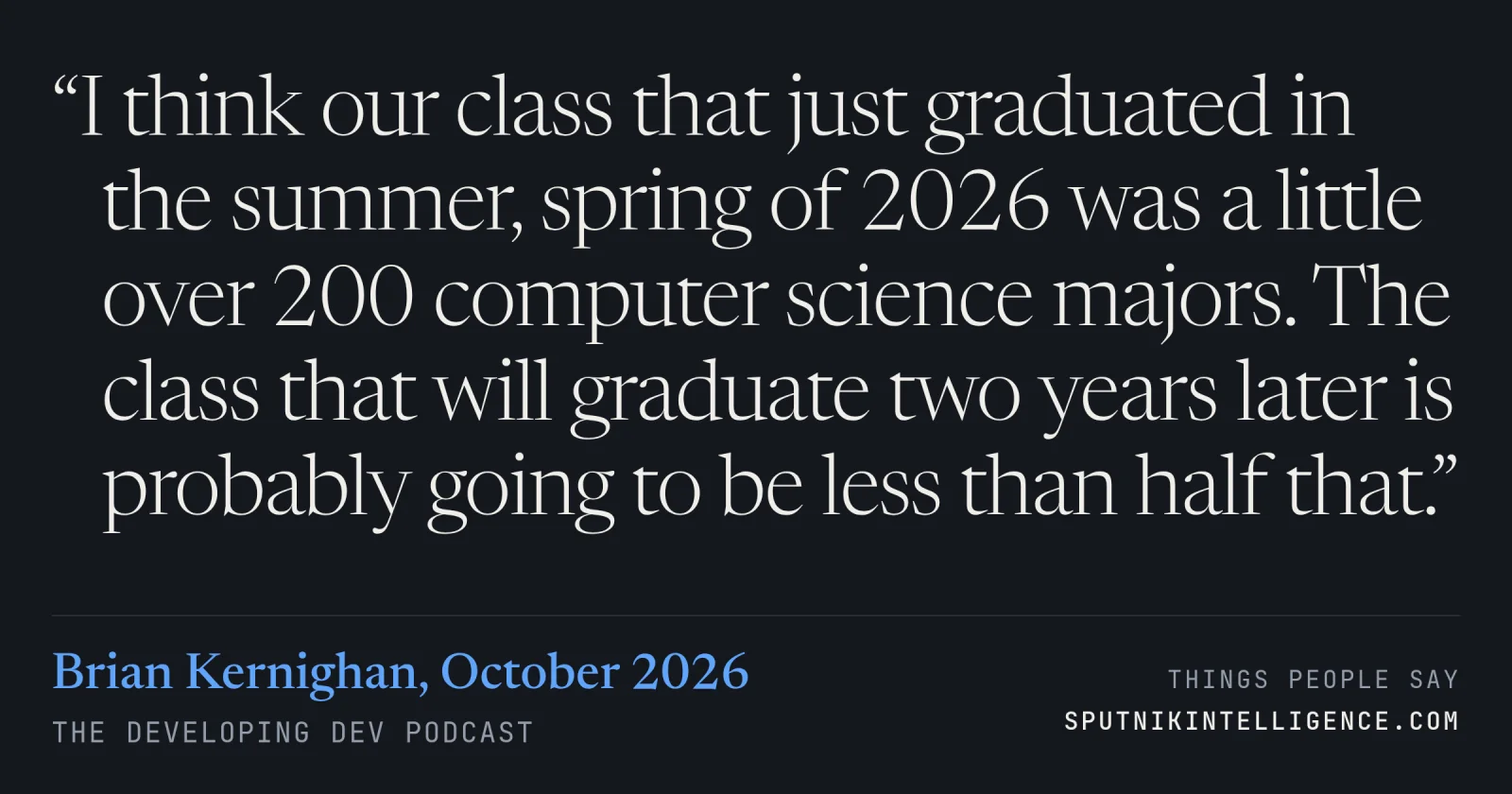
“I think our class that just graduated in the summer, spring of 2026 was a little over 200 computer science majors. The class that will graduate two years later is probably going to be less than half that.” — Brian Kernighan, The Developing Dev

Kernighan on falling computer science enrollment at Princeton. He says students are moving to electrical, mechanical and aerospace engineering, which feel more concrete and less likely to be replaced by language models, and that they may be overreacting.

The Developing Dev · 2026-10-26 Permalink → Listen →
The Developing Dev
Brian Kernighan

…majors than we did a few years ago. And that means classes are smaller. Not entirely because many of those people just went to other departments, but they're still taking our courses, but they're somewhat smaller. And that means that there's more contact with the students. And I think that's good.

Ryan Peterman

What percent down would you say?

Brian Kernighan

Our numbers are, I don't know where they're representing. I think they're more extreme for some unknown reason, but I think our class that just graduated in the summer, spring of 2026 was a little over 200 computer science majors. The class that will graduate two years later is probably going to be less than half that.

Ryan Peterman

Less than half. Yeah.

Brian Kernighan

Maybe even down to a third. We don't know because there's a staggered way in which majors appear, but I would guess that if it was 200, it'll be sort of 80-ish, 90-pure guesswork, quite a bit more. Those people have gone in here to electrical and computer engineering and mechanical and aerospace…

Ryan Peterman

So the total number of students that go to Princeton is roughly constant. Oh, it's totally constant. But the proportion that goes to the computer in

Speaker names come from our own diarization. The position is estimated from where the line sits in the episode.
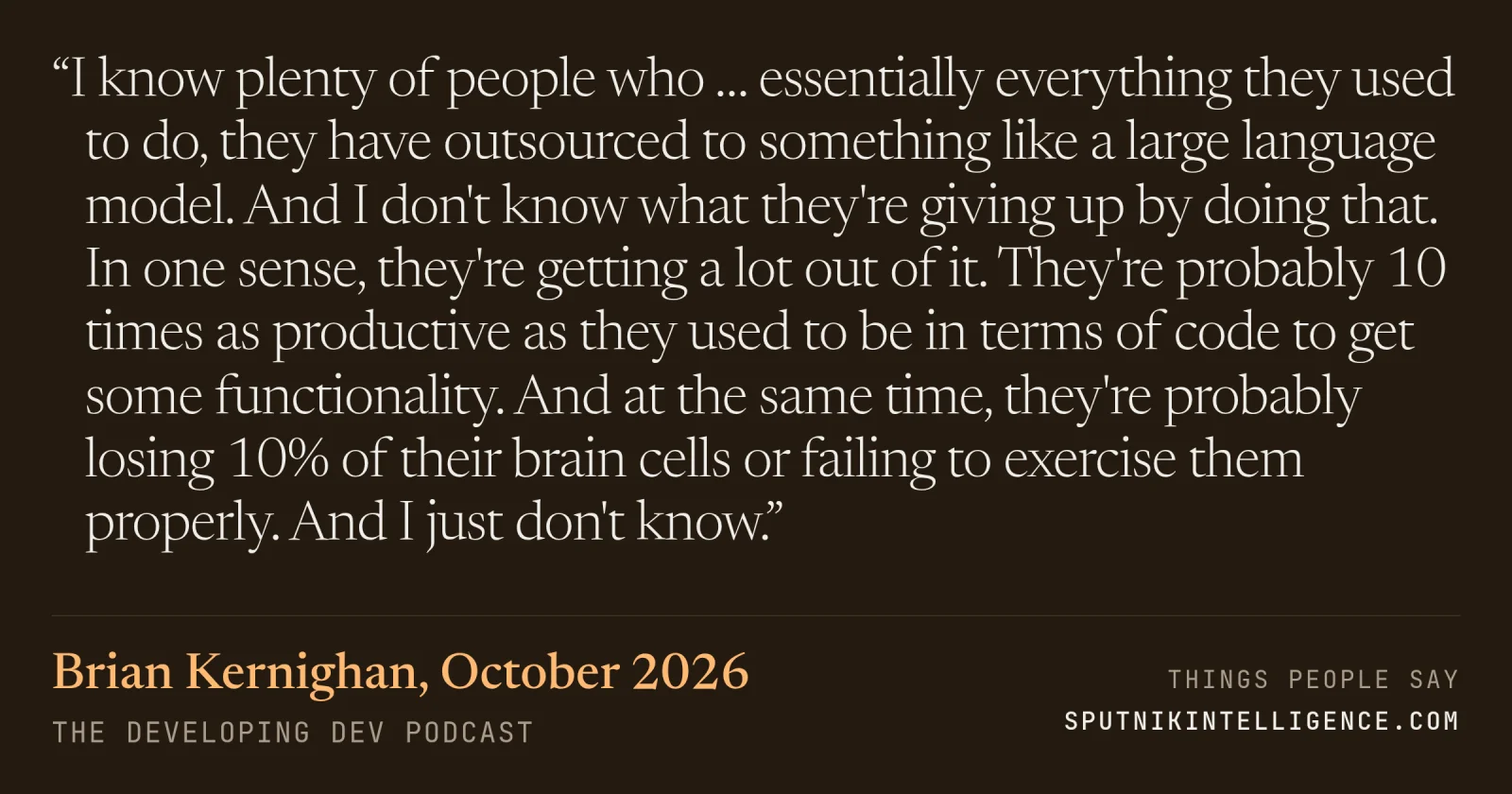
“I know plenty of people who … essentially everything they used to do, they have outsourced to something like a large language model. And I don't know what they're giving up by doing that. In one sense, they're getting a lot out of it. They're probably 10 times as productive as they used to be in terms of code to get some functionality. And at the same time, they're probably losing 10% of their brain cells or failing to exercise them properly. And I just don't know.” — Brian Kernighan, The Developing Dev

Kernighan, the Princeton professor and Unix pioneer, on programmers who now hand nearly all their work to AI. He says whatever anyone says about this today will probably be wrong in a month, and that faculty don't know what to teach students worried their jobs won't exist.

The Developing Dev · 2026-10-26 Permalink → Listen →
The Developing Dev
Brian Kernighan

…query? Because I'm not an SQL expert. And if we already knew the answer, we wouldn't need it. And so I'm wrestling with that. And my observation is 90% of the time it generates a perfectly fine query and 10% of the time it doesn't gives you a totally wrong answer. And I don't know which is which.

Ryan Peterman

It sounds like what you're saying is you need some domain expertise. Otherwise, you can't be the judge of if it's.

Brian Kernighan

…by yourself. So you need something AI again. To help you with generating the test, but then you need something to evaluate whether the tests were properly generated. And there's this infinite regress of, you know, check the checker, who checked the checker kind of thing. Now, I'm oversimplifying, and I'm not a high-powered user. And I know plenty of people who, as you described, are, you know, essentially everything they used to do, they have outsourced to something like a large language model. And I don't know what they're giving up by doing that. In one sense, they're getting a lot out of it. They're probably 10 times as productive as they used to be in terms of code to get some functionality. And at the same time, they're probably losing 10% of their brain cells or failing to exercise them properly. And I just don't know. It's early, and things, whatever we say today in a week or a month, will not probably be correct anymore. The place where this shows up, right around here at least, is kids worrying about what's going to happen when I get out of here. I wanted to be a software engineer. Does that job still exist? And the answer is maybe, but it's different than it would have been two or three years ago. And by…

Ryan Peterman

In the world you described, which is today's world, the models are not perfect. There's a lot of subtleties where they get things wrong. But in a world where they are perfect and they're kind of doing everything, what just like out of curiosity, what happens to a computer science major?

Brian Kernighan

Well, I mean, first, you have a premise there, which is that these things will become perfect. And I suspect they won't become perfect, although they may become a lot better than they are right now. So there's probably still going to be a need for somebody to assess their perfection. I think the…

Ryan Peterman

When C came out, were people mourning assembly language?

Speaker names come from our own diarization. The position is estimated from where the line sits in the episode.
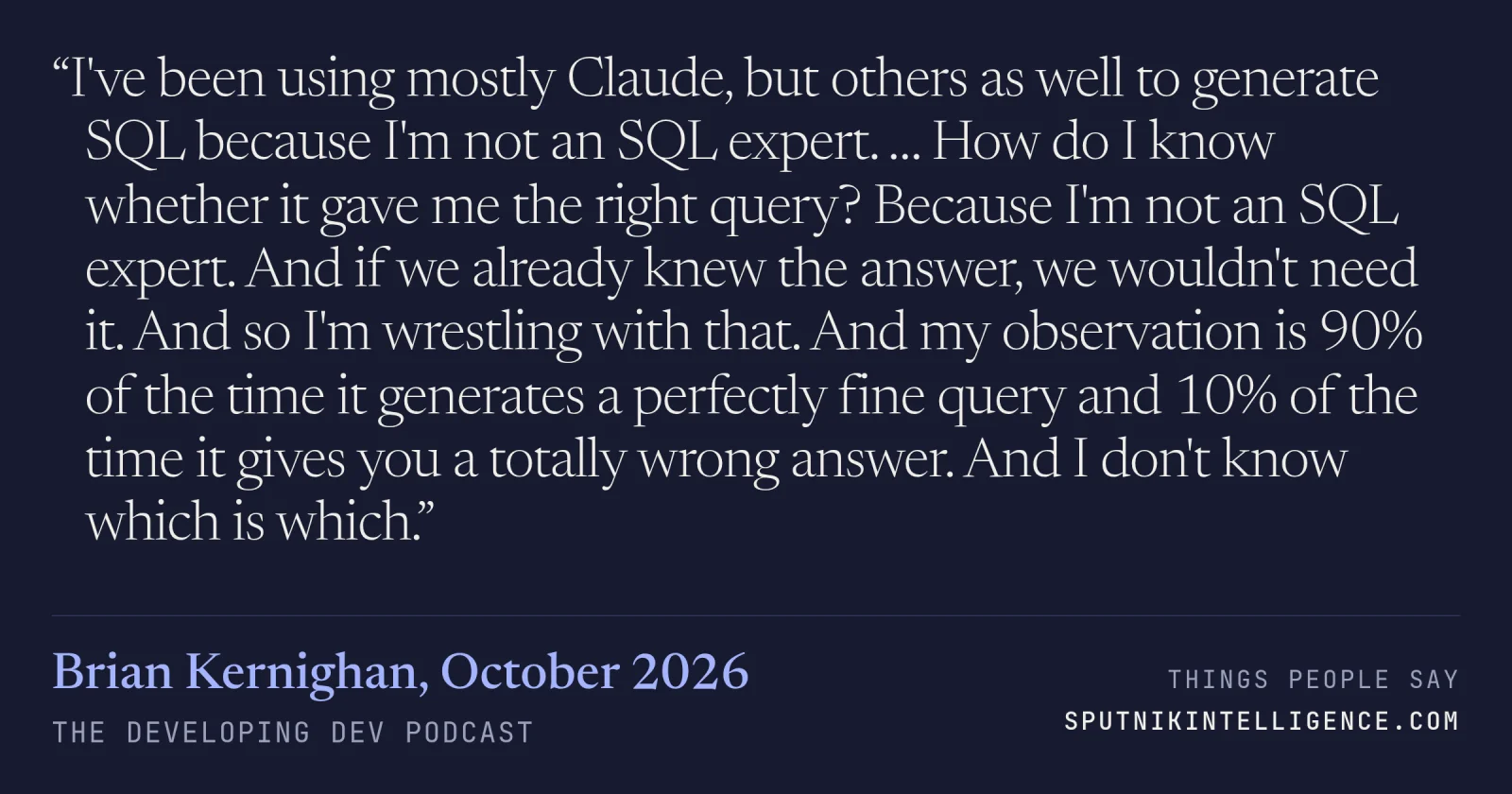
“I've been using mostly Claude, but others as well to generate SQL because I'm not an SQL expert. … How do I know whether it gave me the right query? Because I'm not an SQL expert. And if we already knew the answer, we wouldn't need it. And so I'm wrestling with that. And my observation is 90% of the time it generates a perfectly fine query and 10% of the time it gives you a totally wrong answer. And I don't know which is which.” — Brian Kernighan, The Developing Dev

Asked how it feels to watch hand-written code become obsolete, Kernighan describes generating SQL from plain-English questions for a colleague who isn't a programmer. The problem is checking the output: you need domain expertise, and then a way to check the checker.

The Developing Dev · 2026-10-26 Permalink → Listen →
The Developing Dev
Brian Kernighan

…Large language models explain this. What's that mean? What's the future going to be? And so that paradigm shift, I think, is really, really, really uncertain. And we are very much in the middle of it. And everybody knows about it. So anyway, now I've given you the synopsis of the book. Go by it.

Ryan Peterman

…sad for them to see these things become obsolete, like typing things out and stuff. I was curious, in your career in computing, there must have been points where something became obsolete, maybe like the punch cards or I don't know, something like that. And I guess, how did you feel at that time?

Brian Kernighan

…to generate it for you? I don't think so. I don't think that at all. And even once the program is generated for you, you still have to see whether it works and whether it's the most effective way to do what you want. And is it really doing what you want or should you have wanted something different and all of those sorts of things? And that's in an environment where you know what you're doing. I've been using mostly Claude, but others as well to generate SQL because I'm not an SQL expert. And I have a colleague over at the Institute for Advanced Studies who has a database. She's not a programmer at all, but she wants to query her database effectively. So I need something to generate SQL from natural language queries. So I want to say, give me all of the whatever's that have this property and get the large language model to generate the SQL and then run it through the database.…

Ryan Peterman

It sounds like what you're saying is you need some domain expertise. Otherwise, you can't be the judge of if it's.

Brian Kernighan

You need domain expertise. Probably it's the same domain expertise you always needed. You need ways of validating what you do because you can't be sufficiently expert that you can test a big program all by yourself. So you need something AI again. To help you with generating the test, but then you…

Ryan Peterman

In the world you described, which is today's world, the models are not perfect. There's a lot of subtleties where they get things wrong. But in a world where they are perfect and they're kind of doing everything, what just like out of curiosity, what happens to a computer science major?

Speaker names come from our own diarization. The position is estimated from where the line sits in the episode.

Collections They Appear In