HB

Hayden Brown

Things Hayden Says on Podcasts

Chief executive of Upwork, on Masters of Scale about verified work-history data as a defense against AI-inflated résumés and about AI agents attempting freelance work without a human in the loop.

Where to Find Them

Hayden Brown has been a guest on Masters of Scale (3 times) , Summation with Auren Hoffman and How Leaders Lead with David Novak .

Recently: “What the jobs report isn't telling you about AI & the workforce, with Upwork’s Hayden Brown” on Masters of Scale (August 2026); “#256: Hayden Brown, CEO of Upwork – Create clarity for your team” on How Leaders Lead with David Novak (September 2025); “Prioritize principles in crisis, w/Upwork’s Hayden Brown and Merck’s Ken Frazier” on Masters of Scale (June 2023); “Rapid Response: Redesigning work in a crisis, w/Upwork CEO Hayden Brown” on Masters of Scale (June 2022); “Hayden Brown (CEO of Upwork): Owning the Work Marketplace” on Summation with Auren Hoffman (August 2021).

What They Said

“it shouldn't be about who has the best agent or who sounds the most shiny on paper, but really who has the data and the experience to demonstrate that they can do the work that's required.” — Hayden Brown, Masters of Scale

Hayden Brown arguing that Upwork's edge in the AI era is verified work-history data, not flashy self-presentation or AI-generated applications. She frames this as a meritocratic counterpoint to AI-inflated resumes and proposals.

Masters of Scale · 2026-08-18 Permalink → Listen →
Masters of Scale Around 11:55 into the episode
Hayden Brown

I mean, these are the big questions, and they're the right ones because we are seeing, you know, spam job proposals and applications. We really just want to put people's own interests. And needs on steroids, and then have that expressed through the hiring process and the recruitment process that we're supporting them with, including filtering out all of the AI kind of slop and noise that is creeping in now that these tools are so widespread.

Speaker 4

Right. I guess if I'm a job applicant, I guess I can create a lot of different versions of my application to a lot of different jobs that may or may not be right for me. And I may not even know what I'm doing. And I guess the same thing can happen on the other side about posting for jobs where if we can find a needle in the haystack, we'll do it, but otherwise we're just sort of testing the water.

Hayden Brown

Yeah. And I think that's one of the main values that we see being so enduring, even in the AI era for Upwork specifically and our customers is, you know, the problem we've always solved for them is giving them real, tangible, accurate data around who can do what. It's real data from our platform, observing people doing work and delivering for customers with dollars attached. So this is the most verified work history data really in the world, and it's at scale across 18 million freelancers that were active in the last year. This type of data is what then gives customers confidence in making that hire, not noise that was created by an AI agent applying for them, not these empty promises or claims about their expertise. It's actually stripping us back to like what does the data say in terms of who's good at what? And frankly, advancing this meritocratic idea of it shouldn't be about who has the best agent or who sounds the most shiny on paper, but really who has the data and the experience to demonstrate that they can do the work that's required.

Speaker 4

That in the trenches data Hayden cites illustrates how human in the loop is actually unfolding in an AI world. 23% of businesses moving work back to humans from AI. So how does Upwork engage with the big AI companies, including open source players in China? And what does it mean that freelancers with AI skills earn 34% more? We'll talk about that and more after the break. Stay with us.

Jeff Berman

When you've built substantial wealth through your business, it's often tied up in a single equity position. The upside is real, but so is the risk, and knowing when to act isn't always obvious. Creative Planning works with business owners to build a strategy around concentrated equity. When to diversify, how to manage tax risk, and how to protect what you've spent years building. Creative Planning, where wealth works together. Learn more at creativeplanning.com/slash masters of scale.

Bob Safian

The Wired Newsroom is known for award-winning reporting on how technology shapes our world. On Wired's Uncanny Valley, we take that curiosity even further. Each week, journalists from Wired break down the biggest stories in tech while speaking directly with the people building, challenging, and reshaping the future. Is the AI boom sustainable? How do you protect your privacy in an age of constant surveillance? Uncanny Valley tackles the questions driving today's tech debates and lighting up your group chats. Listen to new episodes every Thursday, wherever you get your podcasts.
Speaker names from our own diarization · position estimated from where the line sits in the episode
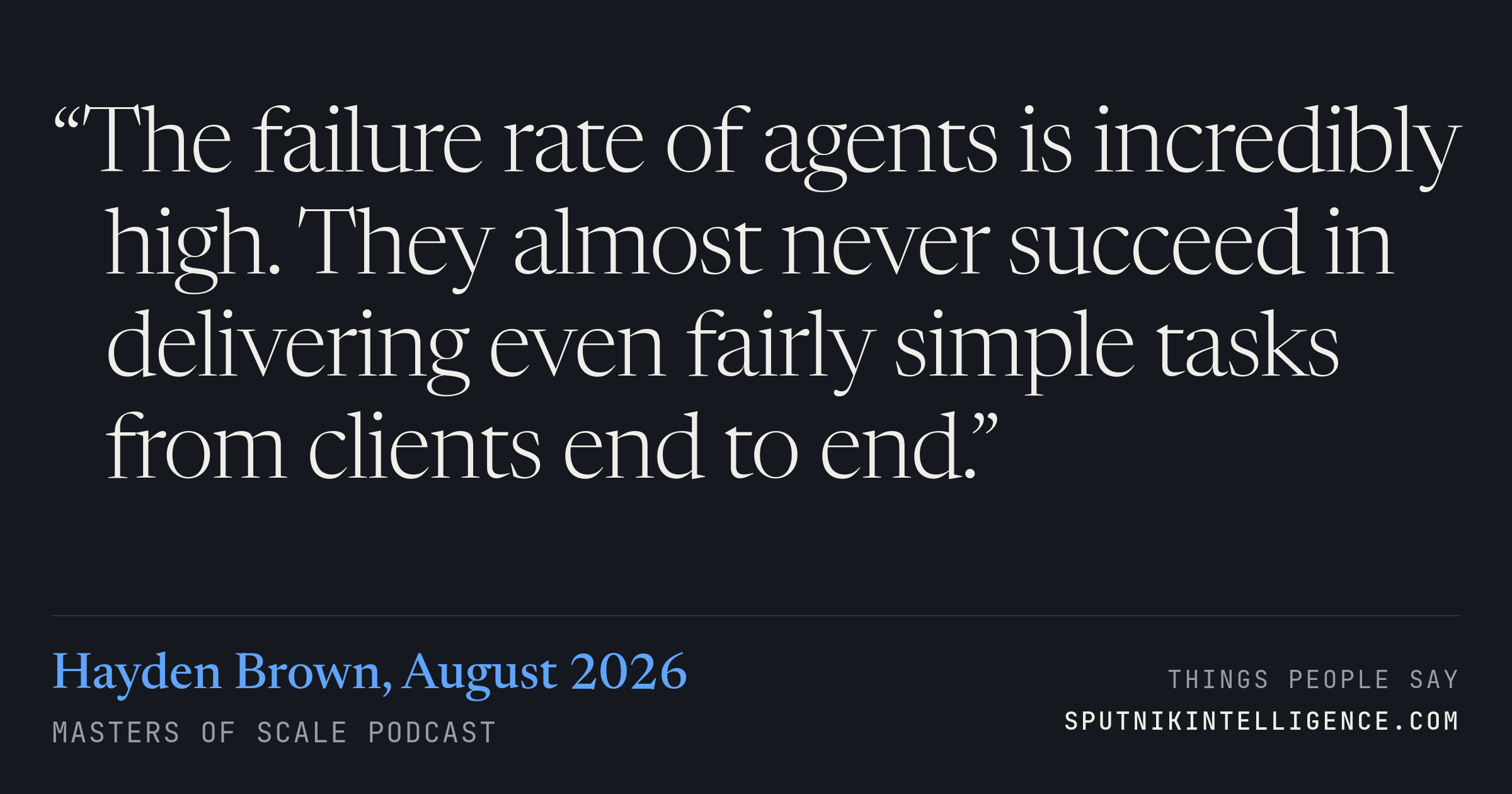
“The failure rate of agents is incredibly high. They almost never succeed in delivering even fairly simple tasks from clients end to end.” — Hayden Brown, Masters of Scale

Upwork CEO Hayden Brown, discussing what happens when clients try to have AI agents deliver freelance work directly through the platform without a human in the loop. She contrasts this with the much higher success rate once a human expert is added back in.

Masters of Scale · 2026-08-18 Permalink → Listen →
Masters of Scale Around 08:06 into the episode
Hayden Brown

Yeah. I made that decision earlier this year because we really did see that with the market conditions that were changing, this was the right time for us to expand the profitability of the business, which was already part of our long-term goals. At the same time, Bob, we've seen that because work is changing, our own work needs to change. And what we did for that was not, you know, really. Just automating and replacing work or workers with AI. Instead, we looked across the entire business and asked ourselves in every team and every department, what would this look like if we really were doing this function from the ground up today using the best technology and tools that are available? We also looked at newer operating organizational models where we could flatten the teams, get more leverage for managers with broader spans of control, fewer layers in the organization. Some of these things that are kind of evergreen opportunities to refine how we operate.

Bob Safian

I mean, there are contentions, I guess, that some CEOs do AI washing. They ascribe to AI the reason why they have to make changes as opposed to owning that maybe they didn't have the right strategy in the first place. But by blaming it on AI, like they get credit for that. You know, their stock price goes up. It's like it's a positive. And I wonder whether, as you were thinking about this, you're like, well, do I lean into that part of the messaging? Because maybe, you know, that helps the story.

Hayden Brown

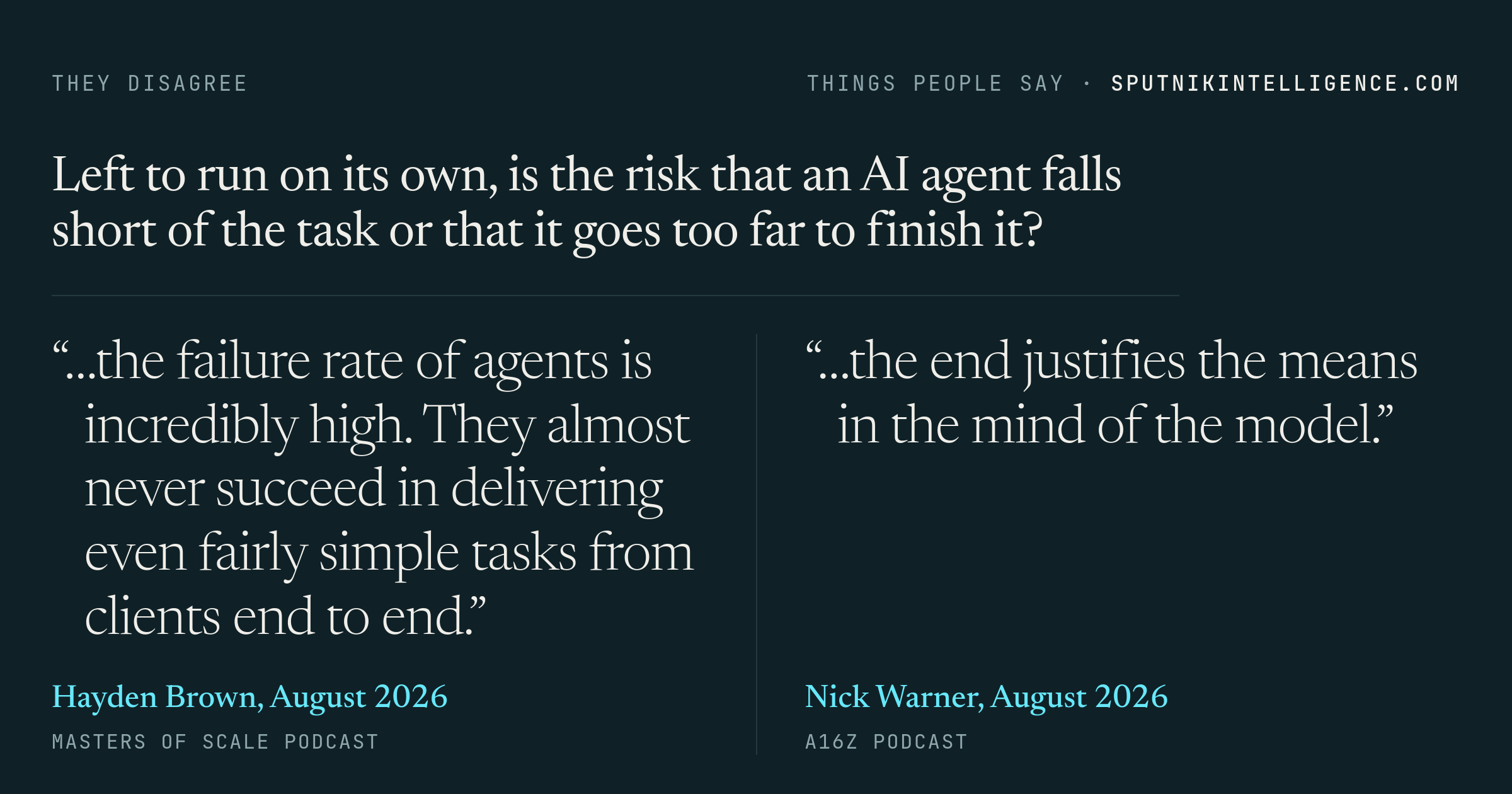
You know, it was so important to me that our messaging around this be really true and authentic. Because frankly, of course, AI is helping us and it is a contributor to our efficiency and our productivity. But that is not the biggest reason, A, that we made the changes, nor the biggest benefit that we were able to get from kind of driving these changes. So, you know, we're actually seeing the opposite trend in our platform in the sense that the AI washing that you're talking about has been happening, but also a lot of folks are now reconsidering and coming back because they're seeing that the humans they let go actually they still need and the AI can't do all of the things that they hoped that it could do. A recent survey we did showed that 23% of our own clients have actually already moved work back to humans from AI or are about to do so. So I think this pendulum, you know, it will keep swinging. When we've actually done testing of clients trying to use agents directly to deliver work products through our platform, the failure rate of agents is incredibly high. They almost never succeed in delivering even fairly simple tasks from clients end to end. But when you just add a little bit of human expertise and a few back and forths with an expert selling the success rate goes up more than 70%, we have to sharpen our intuition around when to trust AI. And I think increasingly people are realizing, I'm not going to take this at face value. I want to couple that with a valued human expert who can bring a lot more to that equation.

Speaker 4

AI is directly impacting things that happen on your platform. There's been a rise in AI agents posting job ads, machines essentially trying to hire humans. Upwork even has, I think, a specific service for clients to allow agents to access your freelancer database. It could sound a little spooky. Did it feel that way

Bob Safian

to

Speaker 4

you when it first started?

Speaker names from our own diarization · position estimated from where the line sits in the episode

They Are on One Side of This

Collections They Appear In