Asked how agents connect to continual learning, Herring describes an idea from a recent open-weight model paper that his team is building on: turning an agent's daily work and failures into training environments overnight.
…really strong talent density in terms of the, you know, there's eight of us and we can train a really good model given there. It's so wild. Time and resources. That's so wild. So we've been sort of biding our time and making sure we can do it right. And so definitely more to come on that soon. How
does it go to the continual learning? Like explain that now where you're at with all of it. I'm
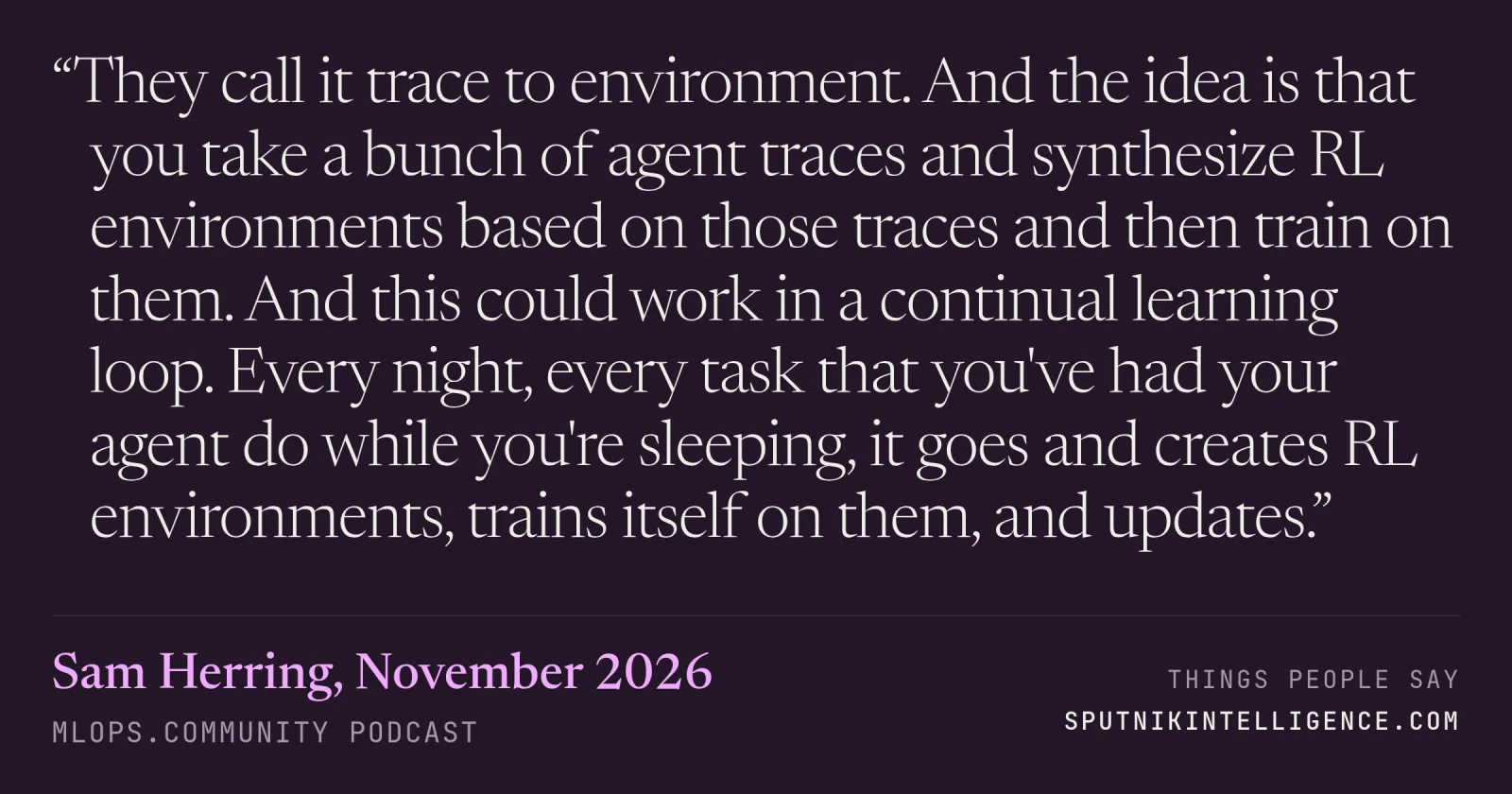
glad you asked. I'm glad you asked. So Xiaomi, the latest model is Mimo v2.6 Pro. In that paper, they talk about this brilliant thing that has come out lately and is sort of obvious when you think more about it, but still the idea struck me. They call it trace to environment. And the idea is that you take a bunch of agent traces and synthesize RL environments based on those traces and then train on them. And this could work in a continual learning loop. Like every night, every task that you've had your agent do while you're sleeping, it goes and creates RL environments, trains itself on them and updates. Or you could do, you know, amassing tens of thousands of different traces on data sources that you have. Why not just spin
up a bunch? Yeah,
if you have a lot of data of Hermes agent uses, what we do first is what's called failure analysis. So we go through and find the exact points where the agent makes a mistake. Then we cluster those by the mistake type. And once you have a bunch of different piles of, oh, the agent, you know…
those or is that all all automated pipelines also awesome yes and so again that helps with the recursiveness and yeah huge okay that