CH

Cat Hicks

Things Cat Says on Podcasts

Where to Find Them

Cat Hicks has been a guest on Thoughtworks Technology Podcast , O11ycast and Hanselminutes with Scott Hanselman .

Recently: “On the psychology of software teams (w. Cat Hicks)” on Thoughtworks Technology Podcast (November 2026); “Ep. #85, AI/LLM in Software Teams: What’s Working and What’s Next with Dr. Cat Hicks” on O11ycast (August 2025); “Psychology of Software Teams with Dr. Cat Hicks” on Hanselminutes with Scott Hanselman (February 2025).

What They Said

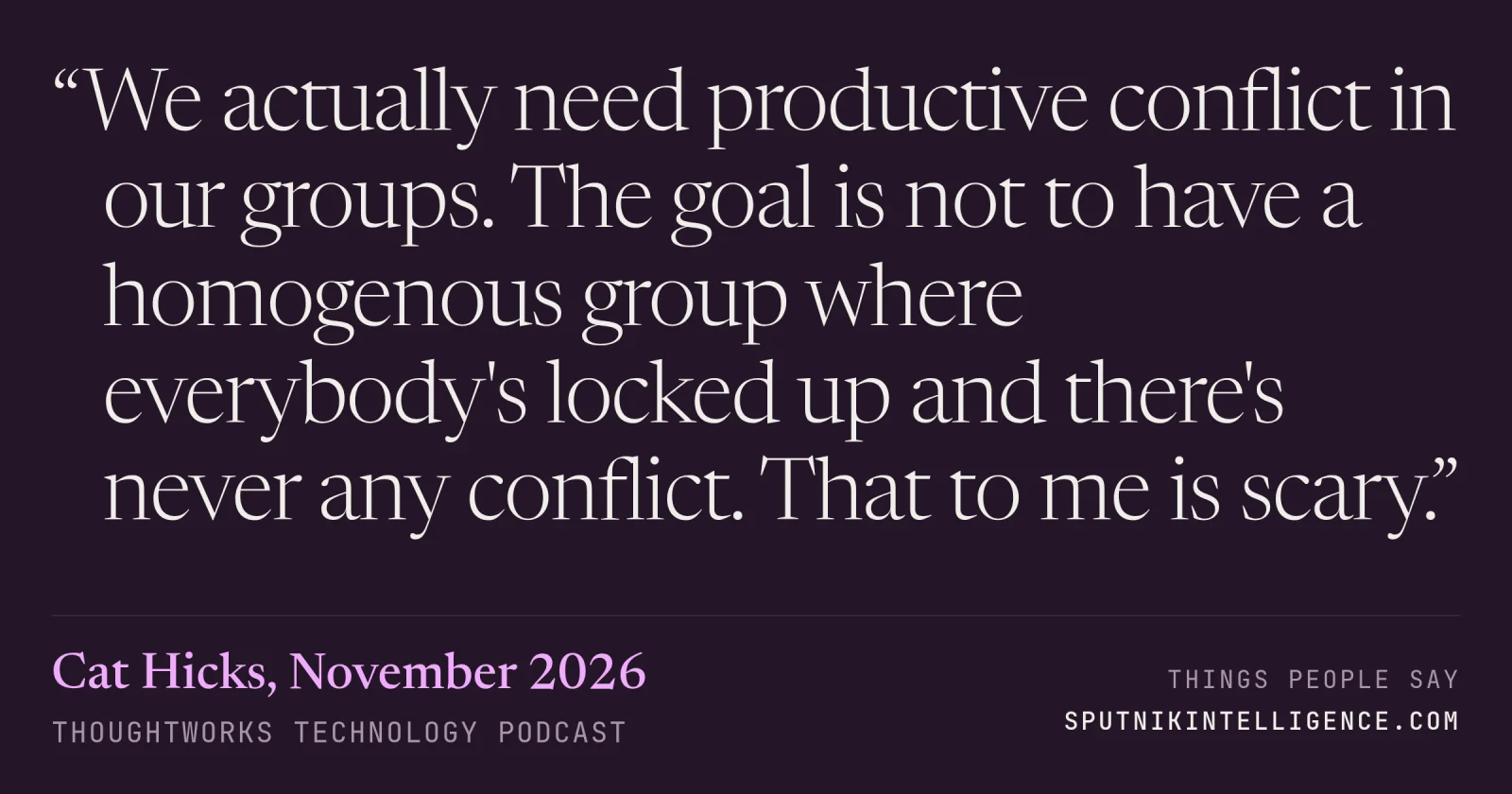
“We actually need productive conflict in our groups. The goal is not to have a homogenous group where everybody's locked up and there's never any conflict. That to me is scary.” — Cat Hicks, Thoughtworks Technology Podcast

A host described two colleagues whose friction, one enthusiastic and one weary, produced good work. She calls it productive conflict and says its absence is a warning sign.

Thoughtworks Technology Podcast · 2026-11-25 Permalink → Listen →
Thoughtworks Technology Podcast Around 21:15 into the episode
Caer Sanders

Yeah.

Andrew Harmel-Law

…in 1987, right? Eckhard probably wasn't born in 1987. But that, that thing, that friction, and I hadn't noticed in my delivery manager, I was like, watch that, like, see that happening. When you see this happening, this is a good thing. So interesting when you see it happen. And we need that. We

Cat Hicks

call it in psychology. We call this like productive conflict. We actually need productive conflict in our groups. Like the goal is not to have a homogenous group where everybody's unlocked up and there's never any conflict. I mean, that to me is a scary, I'm like, what is going on that everybody's so conformist, you know, when I see that in an org. So how can I think some now?

Andrew Harmel-Law

Maybe to pick up where you're going, hopefully. How do we, because like you said, you can say these things, but how if we want to promote the fact that those are valuable skills and like, so disagreeing isn't going to get you in trouble or like say, well, that person's hard to work with. Yeah. How…

Cat Hicks

Especially now in AI when maybe

Andrew Harmel-Law

we're not looking at code, but we are thinking about code together collaboratively. Yes. That's a big deal. So.

Speaker names come from our own diarization. The position is estimated from where the line sits in the episode.
“We have evidence at scale that those explanations are not true. Those lone geniuses do not really predict good outcomes for organizations. And functional groups that are kind to each other, this is not just a nice to have. It genuinely leads to more breakthroughs and innovation.” — Cat Hicks, Thoughtworks Technology Podcast

Asked about the myth of the brilliant lone developer, she says the research doesn't support tolerating a brilliant jerk, and that information flows better when people feel safe.

Thoughtworks Technology Podcast · 2026-11-25 Permalink → Listen →
Thoughtworks Technology Podcast Around 04:33 into the episode
Cat Hicks

…strategy, right, that I know folks like Andrew Harmel-Law thought about, where you see this bill coming due, right? So yeah, I'm trying to unpack the basic parts of our cognitive science and social structures that lead us into those short-term strategies and then also give us paths out.

Andrew Harmel-Law

…this in a lot of ways. Do you want to kind of like expand that a little bit just to, because you, you do some really interesting stuff with your description of that. And then you go into the science and why this might have occurred and maybe it stuck and maybe stick. It resonated hard with me. So.

Cat Hicks

Thank you. Thank you. And if I'm missing something, like jump in and be like, oh, but remember you said this. And yeah, like, don't, don't, no fear. Yeah, because these are big concepts. So I love imagery for this. And my wife drew a really beautiful picture of all these little brains in jars for the book, actually, if you saw it. And I started using, yeah, I started using this metaphor to try to capture like, you know, when we as human beings like look around at the world, we carry around like these sort of suites that of beliefs, feelings, you know, experiences, and kind of what the ideas that are cognitively accessible to us. We call these mental models, right? So just like you have mental models of software, you have mental models of the team and their expectations, you also have these kind of mental models like, what does it mean to be a good software engineer? What does software success come from, you know, where does it come from? What is technical problem solving? And we can measure this with people. And I have in my research actually measured how much…

Caer Sanders

you know that's actually a great segue because one of my next comments is around you know brittle you named three traps in the book around brittle productivity the lone genius which we've all probably encountered at some point and then chilly climates and i think of chili climates especially…

Cat Hicks

by the way that that connection between math and programming apt is very yes very low evidence for it oh i love this so much yeah yeah you can use sorry i'm totally seguing off of this is amazing i just want you to know when you think about your own cognition okay you have many many different…

Caer Sanders

so much yeah well it is funny because you know calculus was so easy for me but algebra was horrific and so it kind of echoes that but anyway

Speaker names come from our own diarization. The position is estimated from where the line sits in the episode.
“None of these things mean you like everybody you work with. You can have very strong trust in people that you honestly wouldn't necessarily go get drinks with after work. It's not all the warm and fuzzy feelings. These are strategic cognitive judgments you are making about the probability of different things happening.” — Cat Hicks, Thoughtworks Technology Podcast

Explaining how learning culture and belonging affect whether people speak up, she stresses that trust at work is a calculation about risk, not friendship.

Thoughtworks Technology Podcast · 2026-11-25 Permalink → Listen →
Thoughtworks Technology Podcast Around 18:12 into the episode
Cat Hicks

…over time. Your point of view matters. And so I'm not surprised that we see this strong, strong outcome where those people feel like they belong more. And I want to make another point here because people often feel this. Like none of these things mean you like everybody you work with. Okay. This

Andrew Harmel-Law

was a good bit of it. Okay.

Cat Hicks

This is really important. Yeah. And I mean, probably you will feel better about them. But I mean, it's nicer if everybody gets on, right? It's nicer. You'll feel safer in certain ways. But like you can have very strong trust in people that you honestly wouldn't necessarily go get drinks with after work. Or, you know, you can actually, it's not all the warm and fuzzy feelings. These are kind of like strategic cognitive judgments you are making about the probability of different things happening. And we want to set you up to, you know, in the moment where you're kind of wondering if you should think more deeply about some little bit of friction that you noticed in the code, right? I mean, we, we all probably, you all, you, you two probably have these memories of like some moment where like someone chased that feeling of friction and it uncovered, it unraveled this whole thing that would have been this huge problem, right? Like these are brilliant moments of human problem solving. And they are more likely to happen when we are kind of giving people all of their cognitive energy back for their problem…

Andrew Harmel-Law

no, I think a little bit like I mean, again, you've got a phrase which kind of I think sums some of this up. And like maybe we can talk about this a little bit in a minute as well. But like you say, more bands, less rock stars. And I was like, yeah, that was another big one. And just to the kind of…

Caer Sanders

Yeah.

Andrew Harmel-Law

You don't remember what it was like in 1987, right? Eckhard probably wasn't born in 1987. But that, that thing, that friction, and I hadn't noticed in my delivery manager, I was like, watch that, like, see that happening. When you see this happening, this is a good thing. So interesting when you…

Speaker names come from our own diarization. The position is estimated from where the line sits in the episode.
“In the Claude skill, I have the agent quiz you about the structure of what it generated. You don't have to have written all the lines of code yourself in order to benefit from this. … You can get these learning benefits from just 10 or 15 minutes out of your hour. So agentic code for 45 minutes and learning-opportunities work for 15.” — Cat Hicks, Thoughtworks Technology Podcast

Asked what research excites her most, she described a Claude skill she built that interrupts agentic coding with short learning exercises, so developers keep understanding code they didn't write.

Thoughtworks Technology Podcast · 2026-11-25 Permalink → Listen →
Thoughtworks Technology Podcast Around 27:19 into the episode
Cat Hicks

…the people in your org. Okay. All the people in your org. It's not easy to do. It's not easy to design a survey that works. It's not, but I think that like that step of hearing, collecting the developer voices, an unbelievable amount of obvious low-hanging fruit will emerge the moment you do that.

Caer Sanders

Amazing. As we come closer to the end of our time here, what is the thing you're researching right now that you're most excited about looking ahead in the next six to 12 months?

Cat Hicks

You know, I'm really, really excited about learning comprehension, expertise building, and skill building in the Agentic era. And I might, maybe I'm the only person in the world who's excited about it and thinks there's like actually a really interesting path here. But, you know, I, you may be familiar with this project that I did where I built a CLOD skill called learning opportunities. And I made this skill because I wanted to create these just-in-time learning opportunities that actually like interrupted the agentic output. So again, moving from productivity to problem solving, this is an example of it. And I had worked for a long time. We didn't get into this, but before software, I worked as a learning scientist. I've worked with large-scale online learners. I've worked with kids. I've worked with big, big scale efficacy data in the United States. And so I've always been really fascinated by how do we help people turn on like their problem-solving muscles. So in the Cloud skill, I have the agent quiz you about the structure of what it generated. And you don't have to have written all the lines of code yourself…

Caer Sanders

That is so exciting. I had to go try that because I did not know about that stuff at all.

Andrew Harmel-Law

Me neither.

Cat Hicks

Oh, yeah, yeah. You'll enjoy it. You'll like it a lot. I mean, let me know if you like it.

Speaker names come from our own diarization. The position is estimated from where the line sits in the episode.
“Single advice to a leader listening to this: get out of the way. Stop talking. You need to hear from your developers. … It's like the single biggest change you can make: you as a technical leader have an amazing resource at your fingertips, which is all the people in your org. … An unbelievable amount of obvious low-hanging fruit will emerge the moment you do that.” — Cat Hicks, Thoughtworks Technology Podcast

A host cited her finding that 88% of managers value visibility of technologists' work but only 24% of technologists feel their work is visible, and asked for one piece of advice to close the gap.

Thoughtworks Technology Podcast · 2026-11-25 Permalink → Listen →
Thoughtworks Technology Podcast Around 25:48 into the episode
Cat Hicks

…have like a sense that there is actually a place where we can acknowledge if a project was really hard? Imperfect? You know, do you have that sense of history as an org? And they've, I've seen some really interesting like conflict get eased by just giving people the space to even like express that.

Caer Sanders

…of the work are different than the people who are experiencing the costs of it. Like there's a big disconnect. And so what would your single biggest advice be to leaders and also to these individual contributors to bridge that gap and close those loops so that they are converging on a happy medium?

Cat Hicks

Oh, gosh. Single advice to a leader listening to this: get out of the way. Stop talking. You need to hear from your developers. And I don't know where it's going to go. Okay. This is like a big, you know, lots and lots of things might need to happen, but, but stop talking. If there's one thing I could like inject into engineered orgs right now, it's like a project or initiative or space in some way to just gather up the perspectives of those people. Because what that data point came from, it's and it was, it's just so…

Caer Sanders

Amazing. As we come closer to the end of our time here, what is the thing you're researching right now that you're most excited about looking ahead in the next six to 12 months?

Cat Hicks

You know, I'm really, really excited about learning comprehension, expertise building, and skill building in the Agentic era. And I might, maybe I'm the only person in the world who's excited about it and thinks there's like actually a really interesting path here. But, you know, I, you may be…

Caer Sanders

That is so exciting. I had to go try that because I did not know about that stuff at all.

Speaker names come from our own diarization. The position is estimated from where the line sits in the episode.
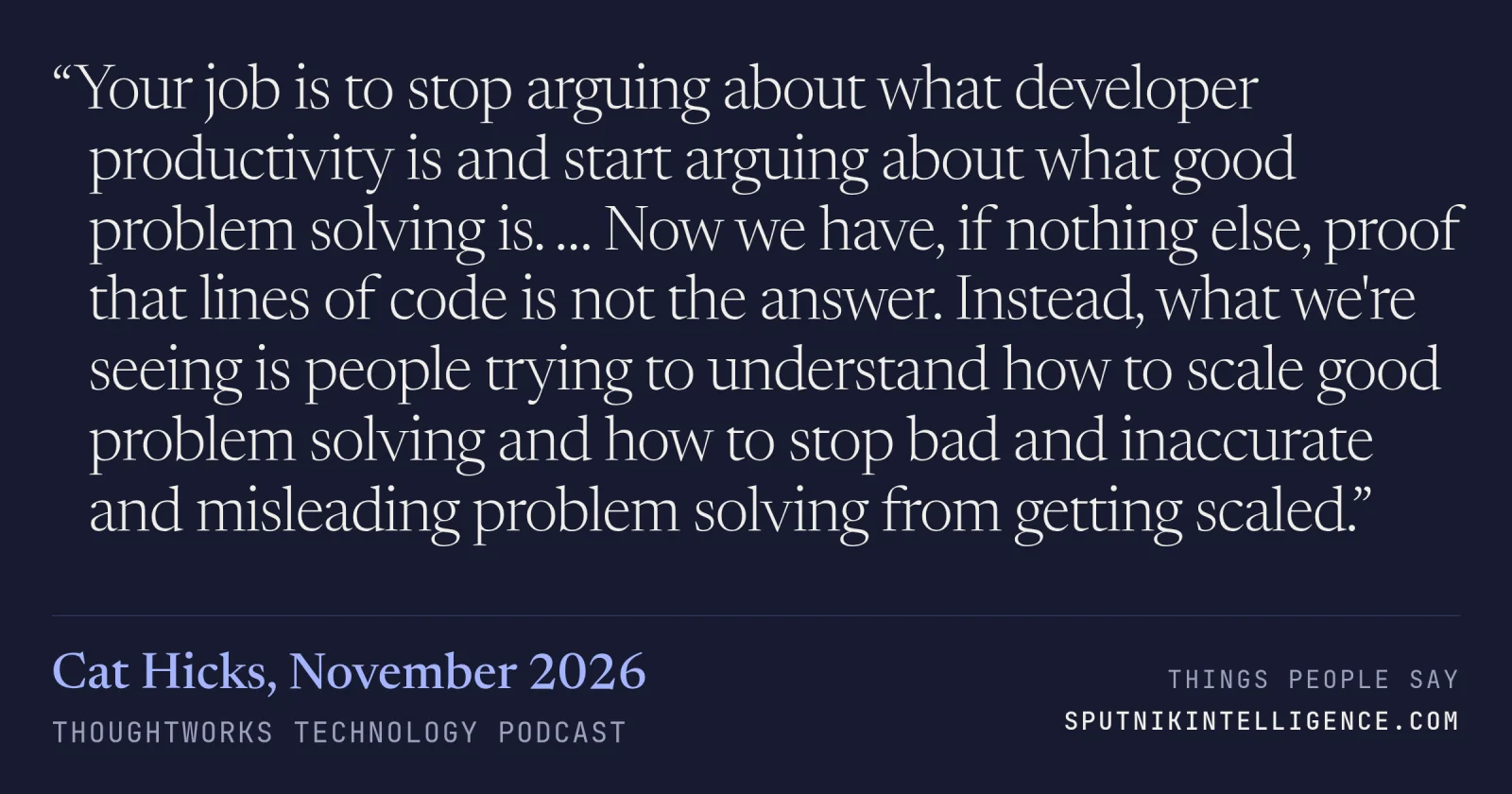
“Your job is to stop arguing about what developer productivity is and start arguing about what good problem solving is. … Now we have, if nothing else, proof that lines of code is not the answer. Instead, what we're seeing is people trying to understand how to scale good problem solving and how to stop bad and inaccurate and misleading problem solving from getting scaled.” — Cat Hicks, Thoughtworks Technology Podcast

Asked how a problem-solving culture looks now that AI agents can produce output at volume, the psychologist says AI has proved that output metrics were never the point.

Thoughtworks Technology Podcast · 2026-11-25 Permalink → Listen →
Thoughtworks Technology Podcast Around 10:37 into the episode
Cat Hicks

…leadership really does. And I do work with leadership teams on this sometimes to say this climate problem is actually my responsibility, probably a lot more directly than many of the niche technical conversations that I'm constantly like bike shedding on. Um, so that's my pitch for that one. Yeah,

Andrew Harmel-Law

…that those things can all be like super, super the problems are where we spend more of our time now, right? And trying to make point L L Ms in the right direction. Yeah, you kind of described that a little bit and just kind of give because it was it blew my mind when I read that. It's so good. It's

Cat Hicks

thank you. Yeah, I think that I mean, I use this a couple ways because I talk about understanding the difference between orientation. Into being oriented toward demonstrating performance versus investing in mastery and that we kind of need both. But I also think there's a phrase I really like, and I say this all the time to teams I work with. Your job is to stop arguing about what developer productivity is and start arguing about what good problem solving is. So switch from productivity to problem solving. We all know we want productivity. We all know that that's an outcome that we want. But what you need to focus on is how you create that outcome. So let's get into the weeds of it is kind of what I argue in the book. And I think that it's so interesting with AI because now we have, if nothing else, proof that lines of code is not the answer. And…

Caer Sanders

They really are.

Cat Hicks

Yeah.

Caer Sanders

And like, playing with the marketing. What have you seen?

Speaker names come from our own diarization. The position is estimated from where the line sits in the episode.

Collections They Appear In