DK

David Krakauer

Things David Says on Podcasts

Where to Find Them

David Krakauer writes COMPLEXITY and writes StarTalk Radio . They have also been a guest on Brain Inspired (3 times) , Machine Learning Street Talk , The Generalist and Humans On The Loop: Wisdom for an Age of Magical Technologies .

Recently: “What Is Intelligence? With David Krakauer” on StarTalk Radio (October 2026); “What Is Intelligence? With David Krakauer” on StarTalk Radio (October 2026); “Can Humans Stay Smart in the Age of AI? (David Krakauer, President of the Santa Fe Institute)” on The Generalist (September 2025); “Emergence Explained with David Krakauer” on StarTalk Radio (August 2025); “Emergence Explained with David Krakauer” on StarTalk Radio (August 2025); “Large Language Models and Emergence: A Complex Systems Perspective (Prof. David C. Krakauer)” on Machine Learning Street Talk (July 2025).

What They Said

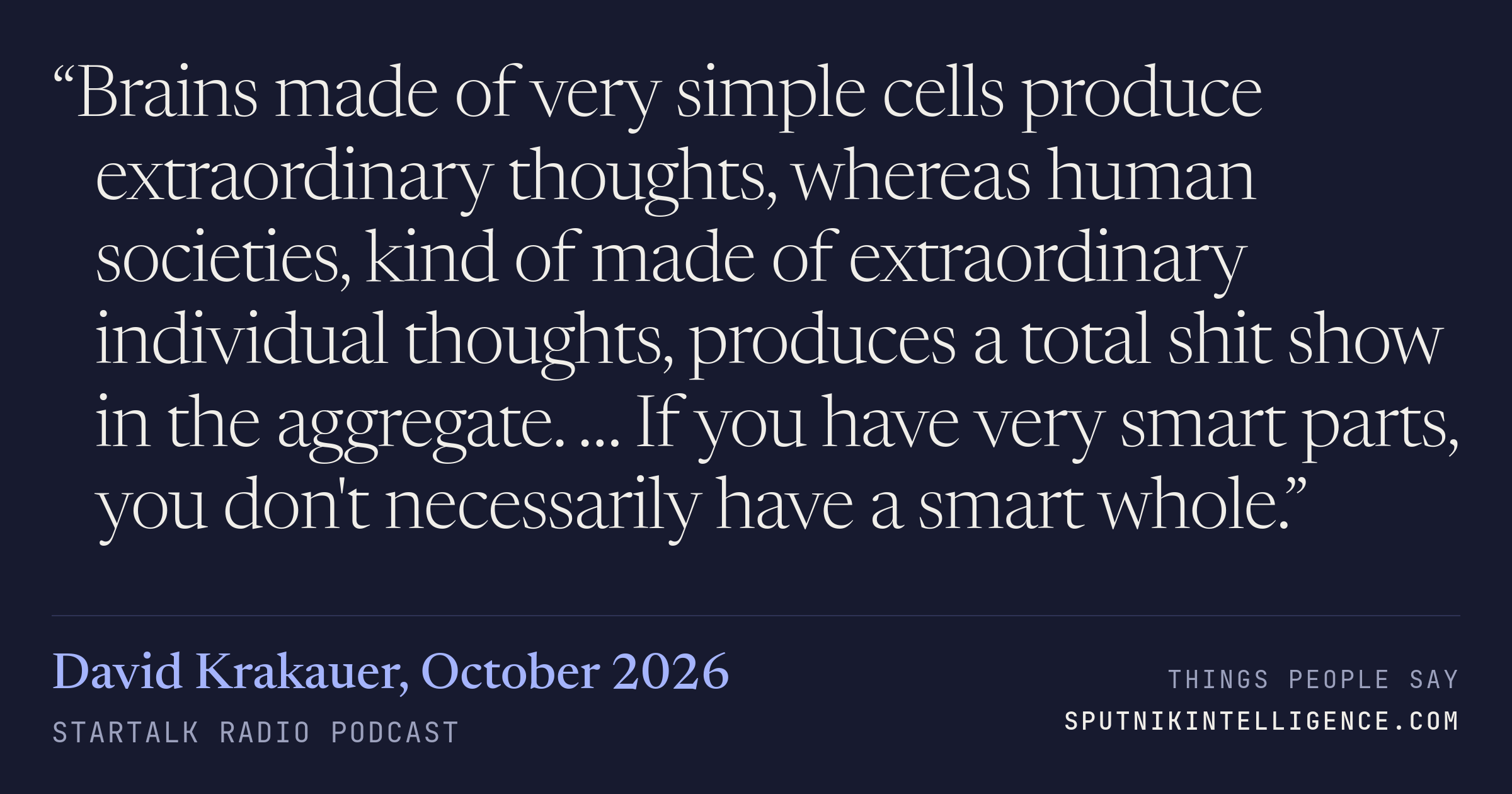
“Brains made of very simple cells produce extraordinary thoughts, whereas human societies, kind of made of extraordinary individual thoughts, produces a total shit show in the aggregate. … If you have very smart parts, you don't necessarily have a smart whole.” — David Krakauer, StarTalk Radio

The conversation is on collective behaviour, with a host bringing up schools of fish that change direction all at once. Krakauer points to what he finds surprising about the relationship between parts and wholes.

StarTalk Radio · 2026-10-02 Permalink → Listen →
StarTalk Radio Around 08:31 into the episode
Neil deGrasse Tyson

I mean, this is emergent things like flocking of birds, I guess.

Chuck Nice

Or, yeah, or when you see fish change all directions all at once. Yeah. Even though I don't even know if that's like electrochemical or not, but who knows?

David Krakauer

No, but there's an interesting thing that happens here that's surprising, right? Which is that brains made of very simple cells produce extraordinary thoughts, whereas human societies, kind of made of extraordinary individual thoughts, produces a total shit show in the aggregate. So there's an interesting relationship between parts and wholes. If you have very smart parts, you don't necessarily have a smart whole.

Neil deGrasse Tyson

That's true. Because there's nothing less intelligent than a mob of people with pitchforks and tiki torches.

Chuck Nice

True.

Neil deGrasse Tyson

It seems to be inverse correlated with the number of people who are part of the mob.
Speaker names from our own diarization · position estimated from where the line sits in the episode
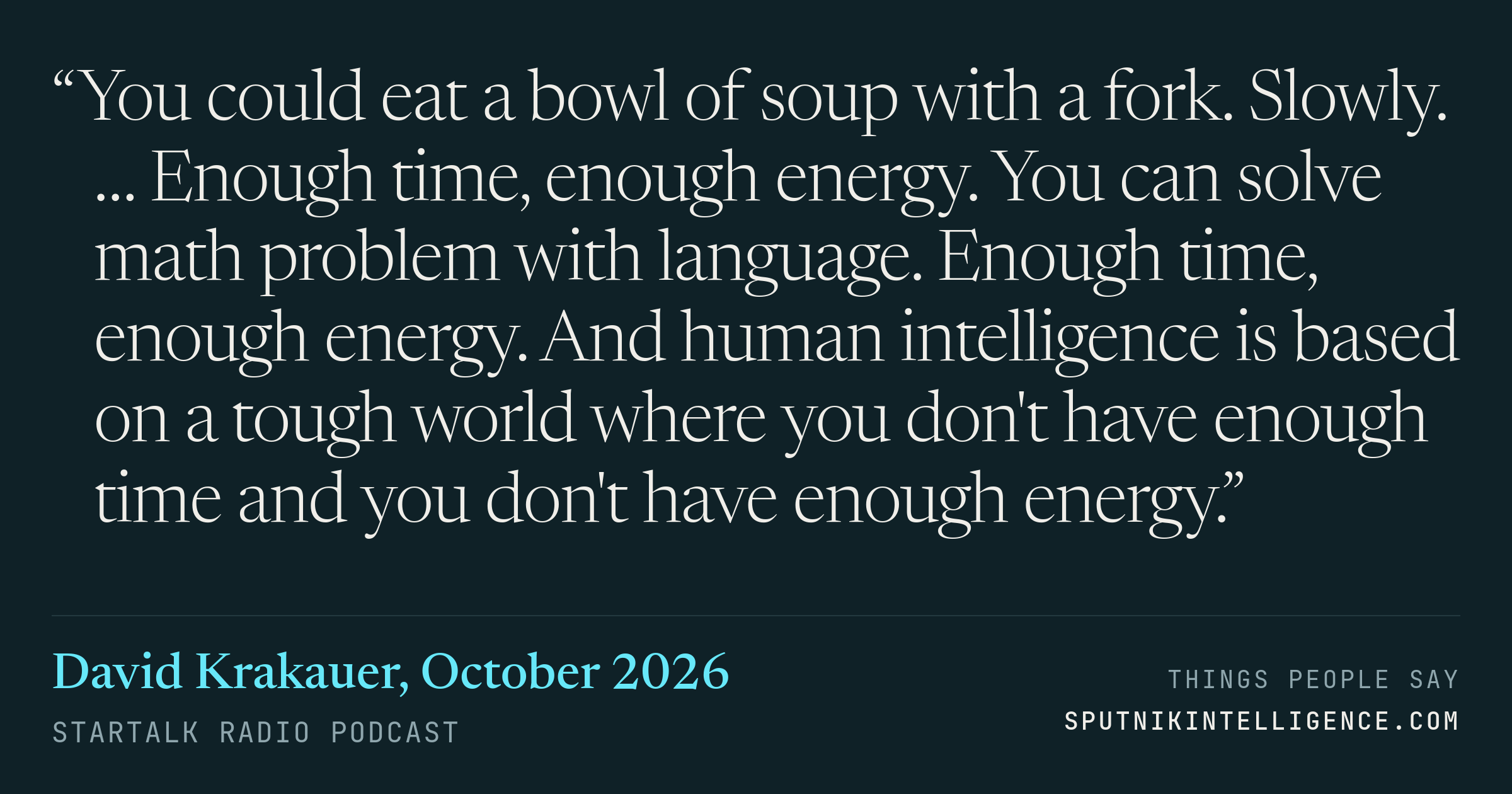
“You could eat a bowl of soup with a fork. Slowly. … Enough time, enough energy. You can solve math problem with language. Enough time, enough energy. And human intelligence is based on a tough world where you don't have enough time and you don't have enough energy.” — David Krakauer, StarTalk Radio

Krakauer has just described a language model solving a long-standing fluid dynamics problem at a cost he puts in the tens of millions of dollars. His point is that a purely linguistic system can solve almost anything, but very inefficiently, which is why humans invented other languages for problems.

StarTalk Radio · 2026-10-02 Permalink → Listen →
StarTalk Radio Around 33:41 into the episode
David Krakauer

so we were talking about the recent thing in the last week that everyone's talking about, which is LLM solving a mathematics problem that the singularities of the Navier-Stokes equations, this kind of stuff, right? This dynamics of fluids. And there was this long-lasting, you know, an outstanding question with a prize behind it about some properties of these equations, which is do they blow up and so on? Do they have singularities in them? And so out comes an LLM recently, and at considerable expense, I mean, tens of millions of dollars, thousands of agents, it finds a solution. But it's doing it by being fed text, not geometry. It doesn't have a visual apparatus. So what does that mean that we can solve math problems by only being trained on language? And that's what we were talking about. And I think what we've discovered, the interesting thing about purely linguistic intelligence, if you like, an LLM, is that you can solve almost any problem with it, but you solve it very inefficiently.

Chuck Nice

Right. And then you gave the example of eating soup, which I thought was brilliant.

David Krakauer

Well, yeah, you could eat a bowl of soup with a fork. Slowly. You could. Slowly. There you go. Enough time, enough energy. You can solve math problem with language. Enough time, enough energy. And human intelligence is based on a tough world where you don't have enough time and you don't have enough energy. That's why we invented all these other languages to solve problems. It's a very important distinction. Plus,

Neil deGrasse Tyson

we have a billion years testing ground to make it happen efficiently.

David Krakauer

Exactly.

Neil deGrasse Tyson

Because if we only got smart doing LLMs, we would have burnt our energy load hundreds of thousands of years ago. And we would have never gotten to where we are. Yeah,

Speaker names from our own diarization · position estimated from where the line sits in the episode

Collections They Appear In