DS

David Silver

Things David Says on Podcasts

Where to Find Them

David Silver has been a guest on Training Data .

Recently: “David Silver and Lasse Espeholt of Ineffable Intelligence: A Superlearner for the Age of Experience” on Training Data (October 2026).

What They Said

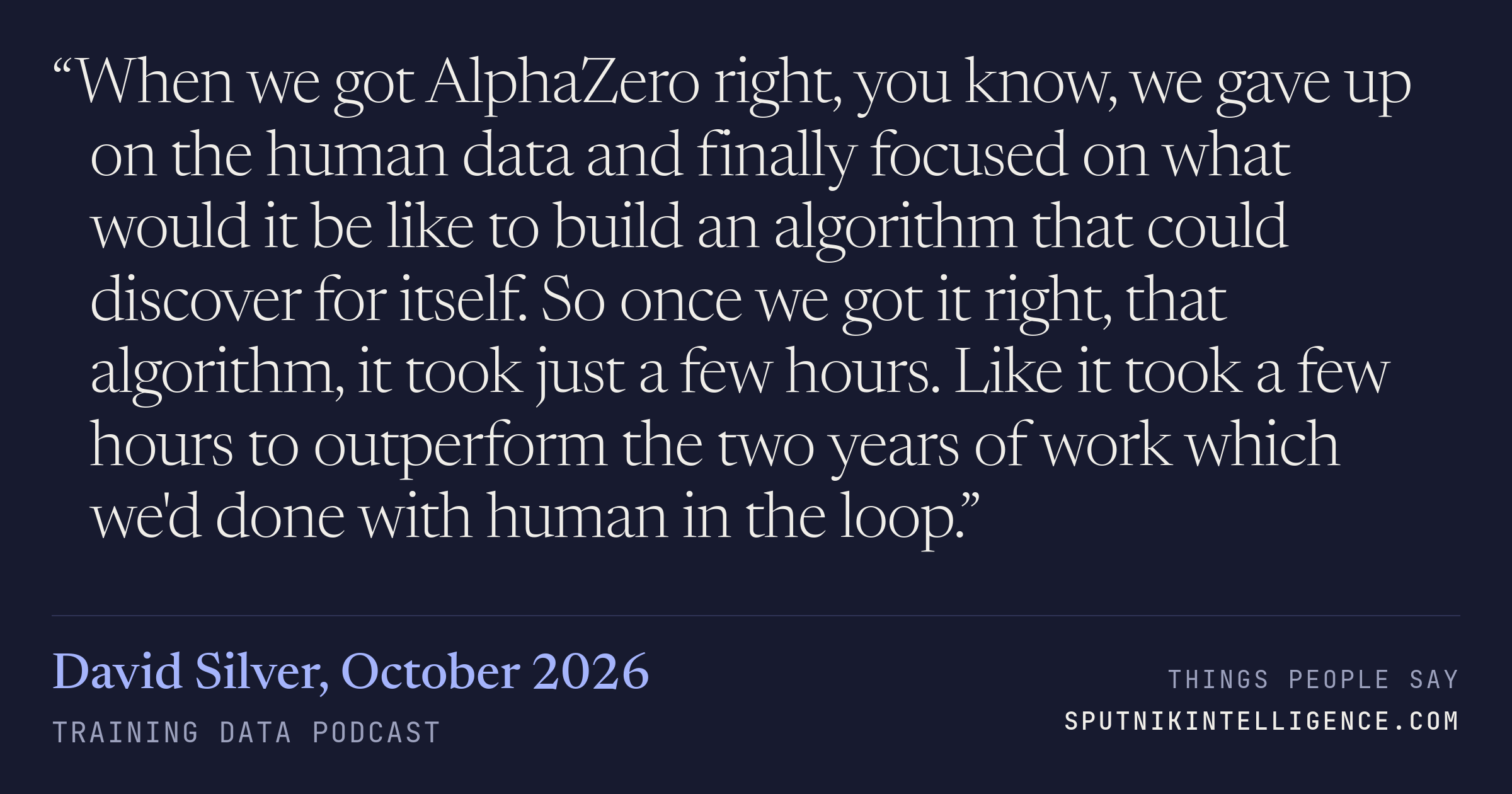
“When we got AlphaZero right, you know, we gave up on the human data and finally focused on what would it be like to build an algorithm that could discover for itself. So once we got it right, that algorithm, it took just a few hours. Like it took a few hours to outperform the two years of work which we'd done with human in the loop.” — David Silver, Training Data

Silver explains why his new lab is betting against human data. AlphaGo took two years of human-in-the-loop work, much like the LLM approach. AlphaZero, which learned without human games, beat it within hours. He says today's LLM companies are building learning systems with thousands of people in the loop.

Training Data · 2026-10-13 Permalink → Listen →
Training Data Around 27:03 into the episode
David Silver

…the four humors or there'll be all kinds of strange beliefs that would be embedded in there and be very hard to kind of remove because they're so fundamental to the kind of language and the processes of thinking that humans have used. So I do think that going beyond this is a really important goal.

Sonya Huang

…with AlphaGo and then Alpha Zero, AlphaGo Zero is maybe the best example that anyone can point to of what happens when you remove human priors. Maybe if you take us back to AlphaGo and then AlphaZero, was it surprising to you that removing human priors would result in even smarter intelligence?

David Silver

I wasn't sure, honestly. So I remember I always like to do things in research where I think you ask research questions which are like on a knife edge where it's like 50-50. I think it's not very interesting to do research where you already know the answer and you're like 95% certain this thing's going to work. It's kind of like boring, honestly, to do those things. So, you know, I think research, good research is about asking questions where you're really not sure what the answer is in advance. And in this case, I was about 50-50 and I thought that maybe there was a good chance that it might, but I wasn't confident and it was very exciting to see it. I should say, you asked about human priors. So we are making a bet, quite ineffable. And the bet we're making is that we can go further by giving up on the priors that everyone's relying on today, like the human data, like the whole internet of knowledge that everyone else is building their systems upon. That's an important choice. And so we should probably talk about why we're doing that. And I think the reason for me, of course, it's a short-term sacrifice. We give up…

Sonya Huang

That's very profound. As far as I know, there are humans at ineffable, and some of you are creating environments or crucibles. What does it look like to actually try and make sure that human priors aren't kind of leaking into what you're doing?

Lasse Espeholt

Yeah, well, so when we design like environments and like rewards functions and so on, obviously there's a human bias in there. But we don't want to, as Dave was also mentioning earlier, we don't want to bias it towards building a machine based on the von Neumann architecture or something like this.…

David Silver

So I totally agree with this. I would also say that we're not religious about this. It's not like a religion that you can't have any human prior anywhere. It's more like a pragmatic position that until we give up on relying on the trillion item data sets of human knowledge, that we're not going to…
Speaker names from our own diarization · position estimated from where the line sits in the episode
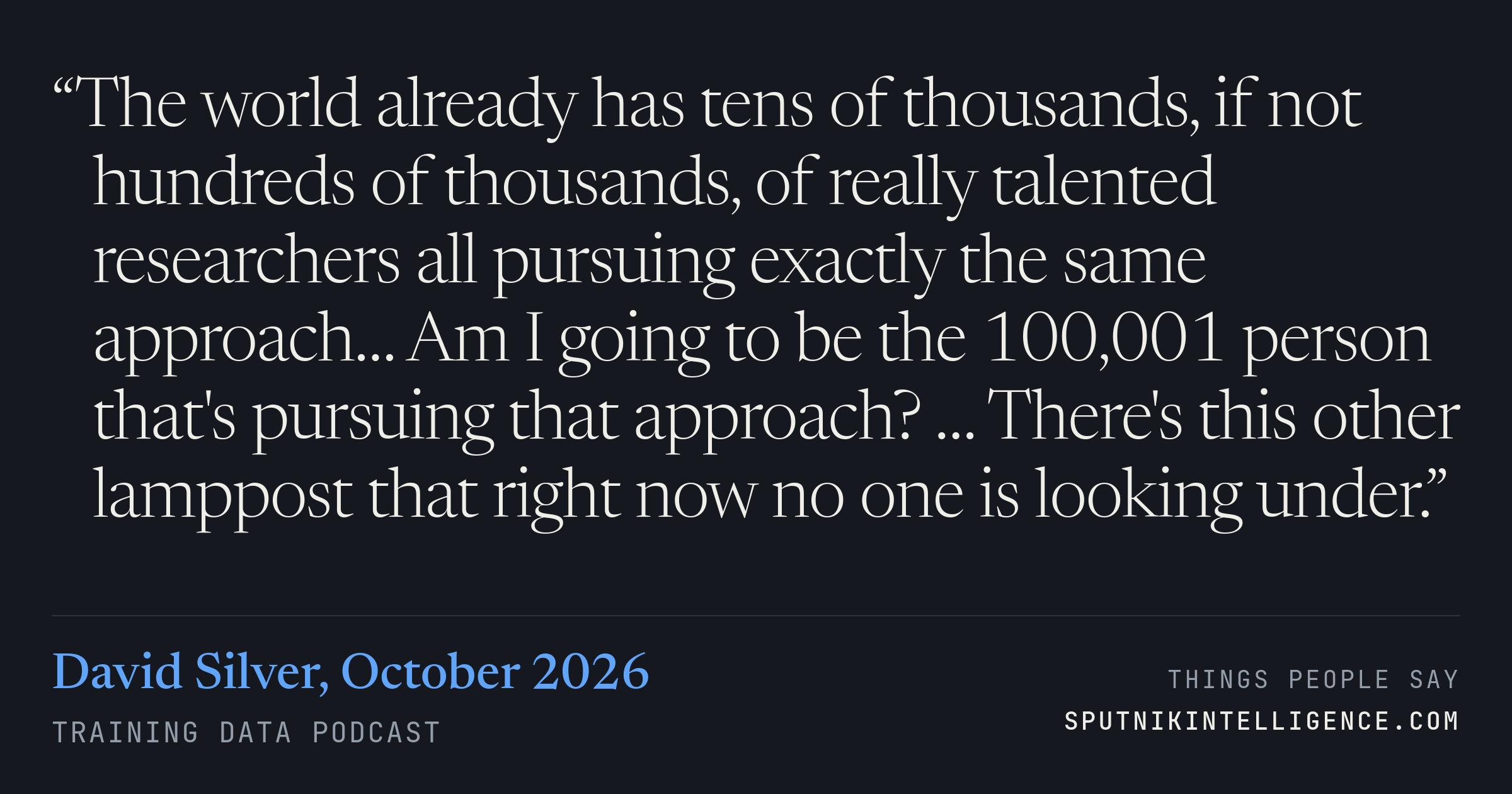
“The world already has tens of thousands, if not hundreds of thousands, of really talented researchers all pursuing exactly the same approach… Am I going to be the 100,001 person that's pursuing that approach? … There's this other lamppost that right now no one is looking under.” — David Silver, Training Data

Asked why he left DeepMind to start a new lab instead of running the work there, Silver says his path to superintelligence doesn't go through LLM products. The crowd, he says, is all doubling down on pre-training and post-training LLMs.

Training Data · 2026-10-13 Permalink → Listen →
Training Data Around 03:06 into the episode
David Silver

…the right scale, that a lot of things which seem like incredibly hard or like they might be very slow, that once you've kind of experienced enough data, that after that, the things that were slow can become very fast. I think that's a lesson that wasn't obvious to me in advance until it happened.

Sonya Huang

Okay, we're going to come back to that later. You could have run this program inside DeepMind, where, you know, could have probably had more access to compute than just about anybody. You decided the right thing to do was to start a new lab. Why did you do that?

David Silver

…I realized that I felt that so passionately that this deserved to be more than just the corner of an organization that's focused on LLM-based products and deserved to be represented by an elite AI lab that really just gives this approach its all and represents it 100%. And once I realized that, it felt very natural to create this company. I suppose another way to look at it is that. You know, the world already has tens of thousands, if not hundreds of thousands, of really talented researchers all pursuing exactly the same approach, like really just kind of doubling down on LLMs with pre-training, post-training, you know, coding and that kind of LLM path. Am I going to be the 100,001 person that's like pursuing that approach? Is that the most effective use of my time and my energy? And in the end, I realized that there's this other lamppost that right now no one is looking under, and where if I actually put my effort…

Sonya Huang

company name that couldn't go to waste.

David Silver

That's right. You're going to say where

Sonya Huang

the mind's called ineffable.

Speaker names from our own diarization · position estimated from where the line sits in the episode

Collections They Appear In