
Johar argues that modern institutions and finance were built on an unusually predictable period of climate, energy supply and demographics, which is now ending. He tells capital allocators that projections modelling these as separate, linear systems miss how they now feed back on each other.
…on the macro level, moving and moving outside those zones of predictability at the climatic sense. But also, we're now fundamentally moving outside the predictability in terms of our demographics, our energy supply. All of this infrastructure is now winding into a period of systemic volatility.
So, our entire financial system, our institutions, our expectations, our prices, our incentives were based on an unbelievably stable period of history, both ecologically, because we have more energy every single year. That's been stable as well. And demographics. And demographics as well.
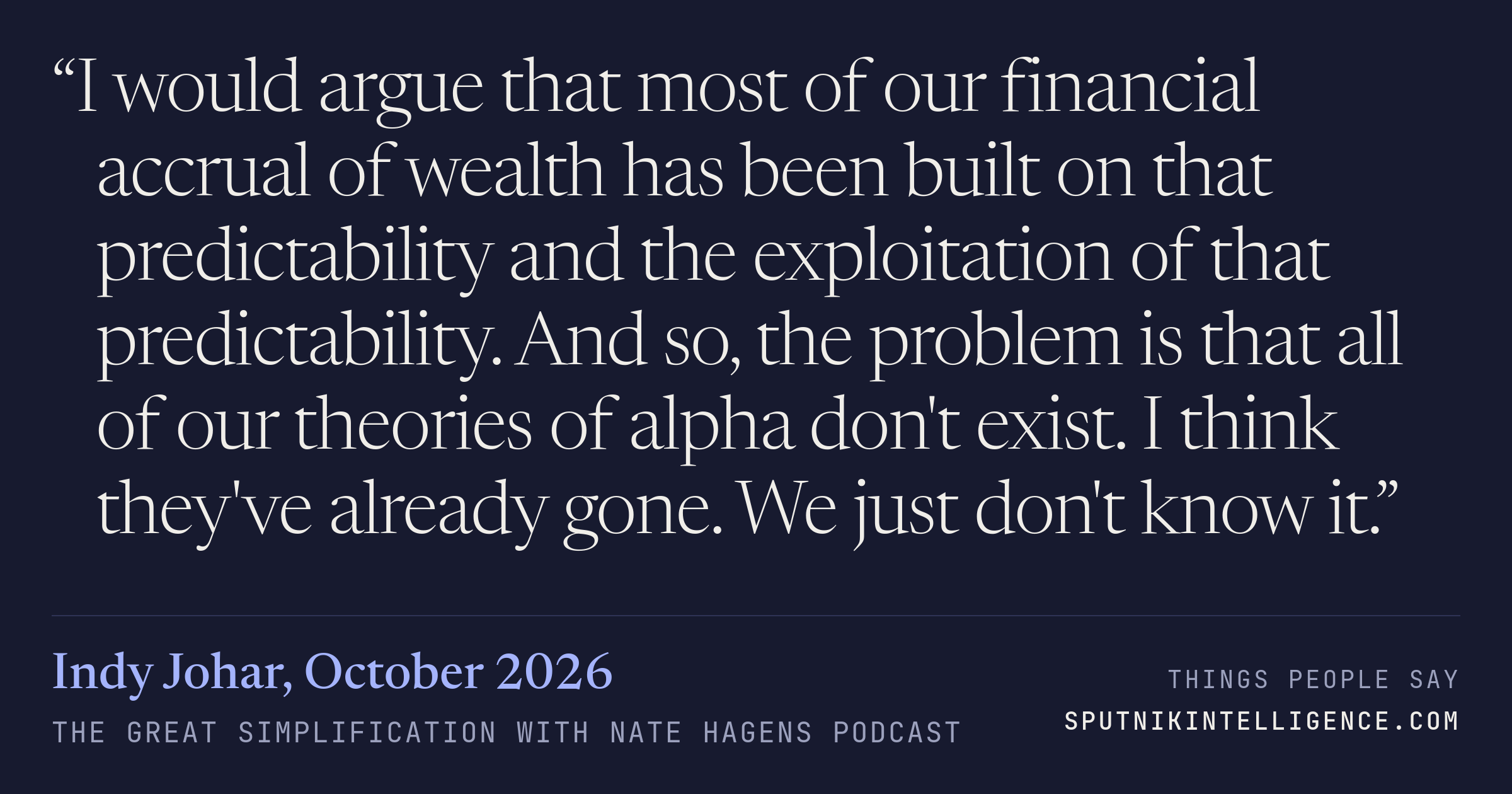
I would argue that most of our financial accrual of wealth has been built on that predictability and the exploitation of that predictability. And so, the problem is that all of our theories of alpha don't exist. I think they've already gone. We just don't know it. And so, when I sit in rooms and people talk about product replacements, replacing one thing with another, and I'm like, well, what I don't yet understand is if we have a major labor cognition collapse, we don't necessarily have the value of the labor distribution in the economy. So, the demand collapses simultaneously very quickly, and violence kicks off. So, all these predictions of copper and…
How many are seeing it or even suspecting it?
Privately, individuals are. I think the challenges, and this is where I think family officers have a strategic advantage because they're unencumbered capital. Coded capital, I think, is the is unfortunately in the worst. Well, I don't know what that means. Um, funds, pre-structured funds, funds…
Let me double-click on something you said before. You mentioned alpha. And I think there's two aspects of that that I'm curious about. One is to a planet that is only recently becoming self-aware, what is the alpha that we should be measuring? That's one question. And second, the narrow boundary…