DS

David Stubbs

Things David Says on Podcasts

Where to Find Them

David Stubbs has been a guest on Bloomberg Surveillance (4 times) , Schwab Network (2 times) and How I Invest with David Weisburd .

Recently: “E459: David Stubbs on AI's Portfolio Risk, the Rise of Private Markets, and the Psychology of Wealth” on How I Invest with David Weisburd (November 2026); “AI’s Core Players Could Outlast the Semiconductor Selloff” on Schwab Network (October 2026); “Oil Surges on Fears of Prolonged War” on Bloomberg Surveillance (April 2026); “The Next Step of AI Investing is Downstream & in Private Markets” on Schwab Network (September 2025); “Surveillance: Equity Risk with Stubbs” on Bloomberg Surveillance (September 2022); “Surveillance: Retail Sales Miss With Gapen” on Bloomberg Surveillance (August 2021).

What They Said

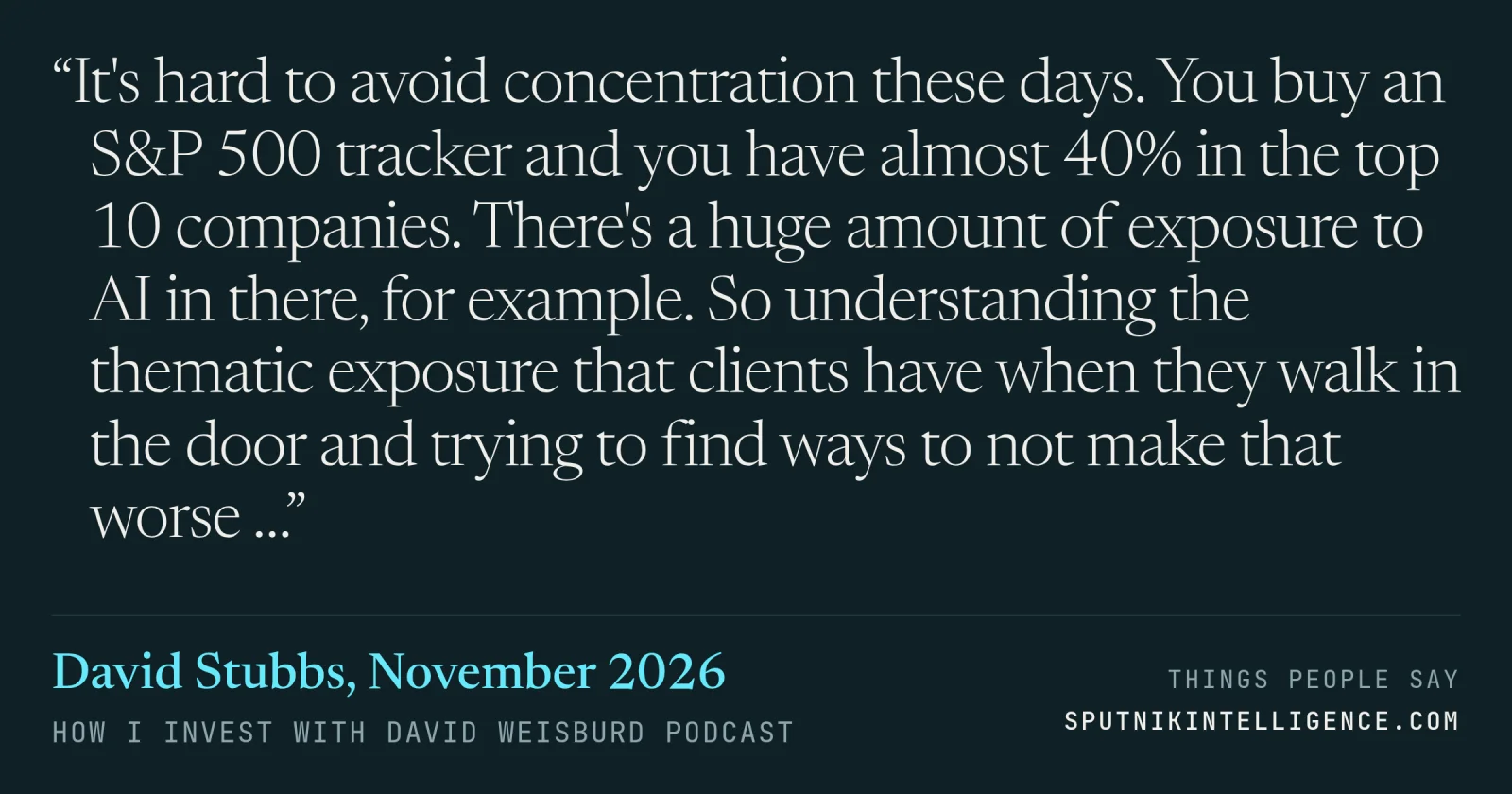
“It's hard to avoid concentration these days. You buy an S&P 500 tracker and you have almost 40% in the top 10 companies. There's a huge amount of exposure to AI in there, for example. So understanding the thematic exposure that clients have when they walk in the door and trying to find ways to not make that worse …” — David Stubbs, How I Invest with David Weisburd

Asked how to build a resilient portfolio today, Stubbs points to the concentration hidden in plain index funds, which now amount to a large bet on AI.

How I Invest with David Weisburd · 2026-11-23 Permalink → Listen →
How I Invest with David Weisburd Around 08:25 into the episode
David Stubbs

…tight labor market. That could be a cause as well. And the U.S. still has significant structural forces like the aging society pushing up healthcare costs, for example. So a few less data centers is not going to fix all the inflation issues, but on the margin, it pushes more towards deflation.

David Weisburd

And you're chief investment strategist for an $11 billion plus RIA. So you have to come up with how to build portfolios for investors, given all these market externalities. How do you build a portfolio to be resilient today?

David Stubbs

The big question is, how do you try to control volatility in the equity market? Traditionally, that's been the role of fixed income. The 60-40 portfolio was based on the premise that if equities had a bad day, the bond market might have a good day. And for a long time, the 2000s and 2010s, that was the case most of the time. Since then, it's been the opposite. Often the bond market having a bad day disturbs the equity market and they both fall together. The correlation went from negative to positive. That's been a very challenging environment. We've tried to add resilience into portfolios by doing a few things. Firstly, adding in alternative asset classes, everything from hedge funds to private markets. Also utilizing active strategies in fixed income, which we believe should provide a different type of return stream. Even if plain vanilla fixed income is having a bad day, bad week, bad month, that you pay out for some active management there. There's some evidence that active management is more persistent in fixed income and therefore maybe worth the fee. So that's a couple of ways. And I think…

David Weisburd

I want to get back to diversification because it's one of these questions that you ask the most sophisticated investors and they spend 30 minutes explaining whether they're diversified or not. But first, you mentioned about this correlation between stocks and bonds. My understanding was that in…

David Stubbs

Well, 2022 was the clearest and most durable example, right? You had a multi-month decline in the equity market, the same time as a multi-month increase in bond yields. And the supply constraints that are unique at the time were a key part of that. Coming out of COVID, Russia-Ukraine, absolutely…

David Weisburd

So another one, when people talk about the correlation between assets, they're talking about historical.
Speaker names come from our own diarization. The position is estimated from where the line sits in the episode.
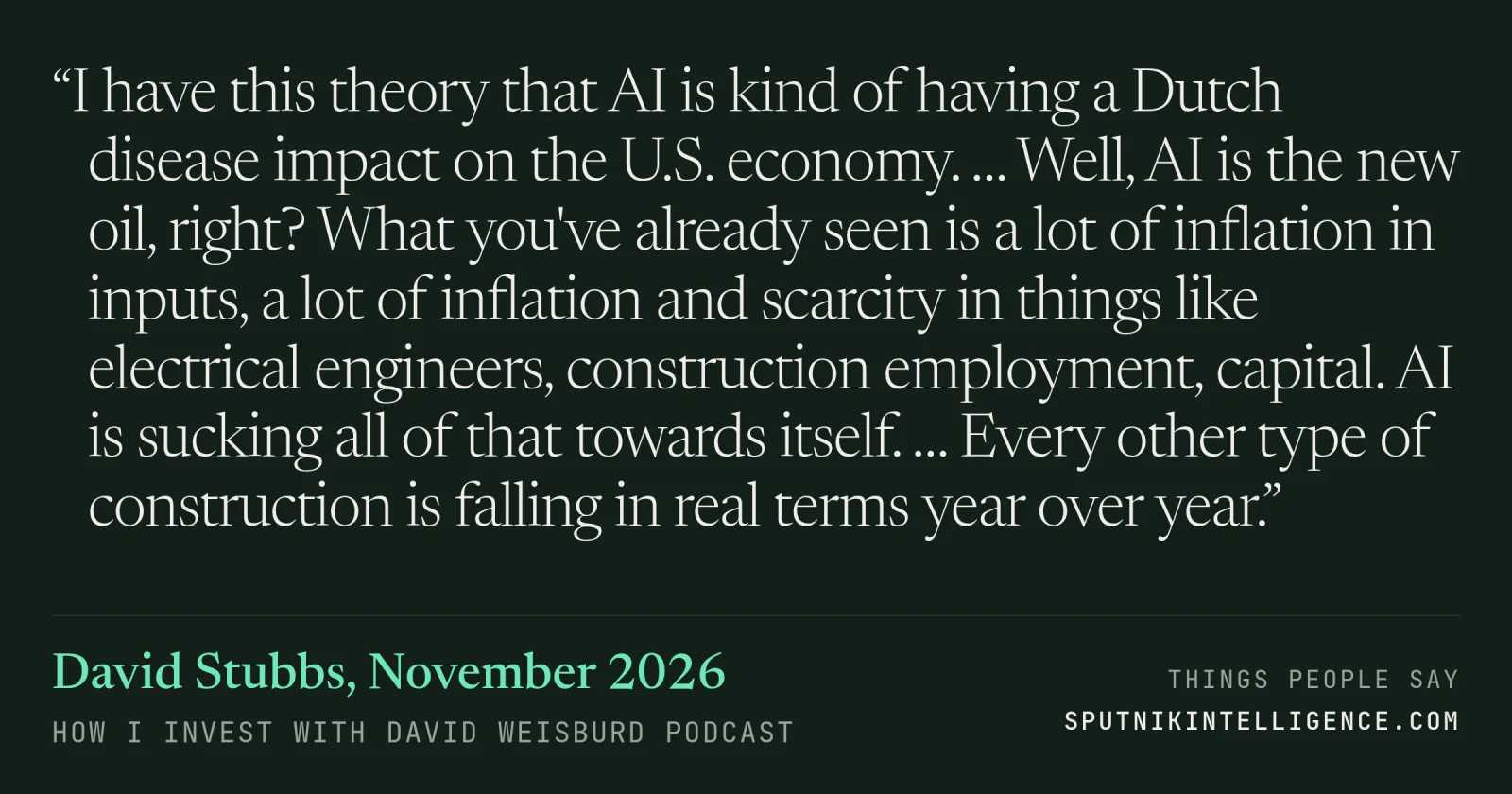
“I have this theory that AI is kind of having a Dutch disease impact on the U.S. economy. … Well, AI is the new oil, right? What you've already seen is a lot of inflation in inputs, a lot of inflation and scarcity in things like electrical engineers, construction employment, capital. AI is sucking all of that towards itself. … Every other type of construction is falling in real terms year over year.” — David Stubbs, How I Invest with David Weisburd

Asked to explain Dutch disease, where a resource boom raises costs and hurts the rest of an economy, David Stubbs applies it to the AI data center buildout. He points to construction data showing data centers and energy booming while other building shrinks.

How I Invest with David Weisburd · 2026-11-23 Permalink → Listen →
How I Invest with David Weisburd Around 06:01 into the episode
Speaker 3

This episode is presented by Juniper Square, the operations partner for private markets.

David Weisburd

Tell me about the Dutch disease.

David Stubbs

I have this theory that AI is kind of having a Dutch disease impact on the U.S. economy. So what is Dutch disease, otherwise known as the natural resource curse? Well, it's a well-known principle in economics and economic history. Let's say you're a country, you discover oil. What happens? We have a boom in the oil. That's a good thing. But there are some negative consequences. Firstly, the boom in the oil sector will push up costs for things, for labor, for materials, and that will…

David Weisburd

And this also has an effect on inflation as well.

David Stubbs

Exactly. Over the horizon, you could say that calming down some of this construction activity in the data center space may help with inflation. I think that's more. Which will bring down rates. Yes, will eventually bring down rates. We obviously saw the reaction on election day or the day after…

David Weisburd

And you're chief investment strategist for an $11 billion plus RIA. So you have to come up with how to build portfolios for investors, given all these market externalities. How do you build a portfolio to be resilient today?

Speaker names come from our own diarization. The position is estimated from where the line sits in the episode.

Collections They Appear In