Asked how an organization can tell it really has its agents under control rather than just thinking it does, she points to transparency and the ability to reconstruct what an agent did.
CyberWire Daily · 2026-11-26
Permalink →
Listen →
CyberWire Daily
Around 16:20 into the episode
Camille Stewart Gloster
…And so if you're doing that, it might slow you down just a little bit, but you'll yield so much more. And finding that sweet spot for your organization is kind of an individual journey. It's a risk appetite thing. How much risk can the organization manage? But it should be an intentional decision.
Dave Bittner
How can an organization measure success with this? How can they know that they actually have their AI agents under control as opposed to only thinking that they have it under control?
Camille Stewart Gloster
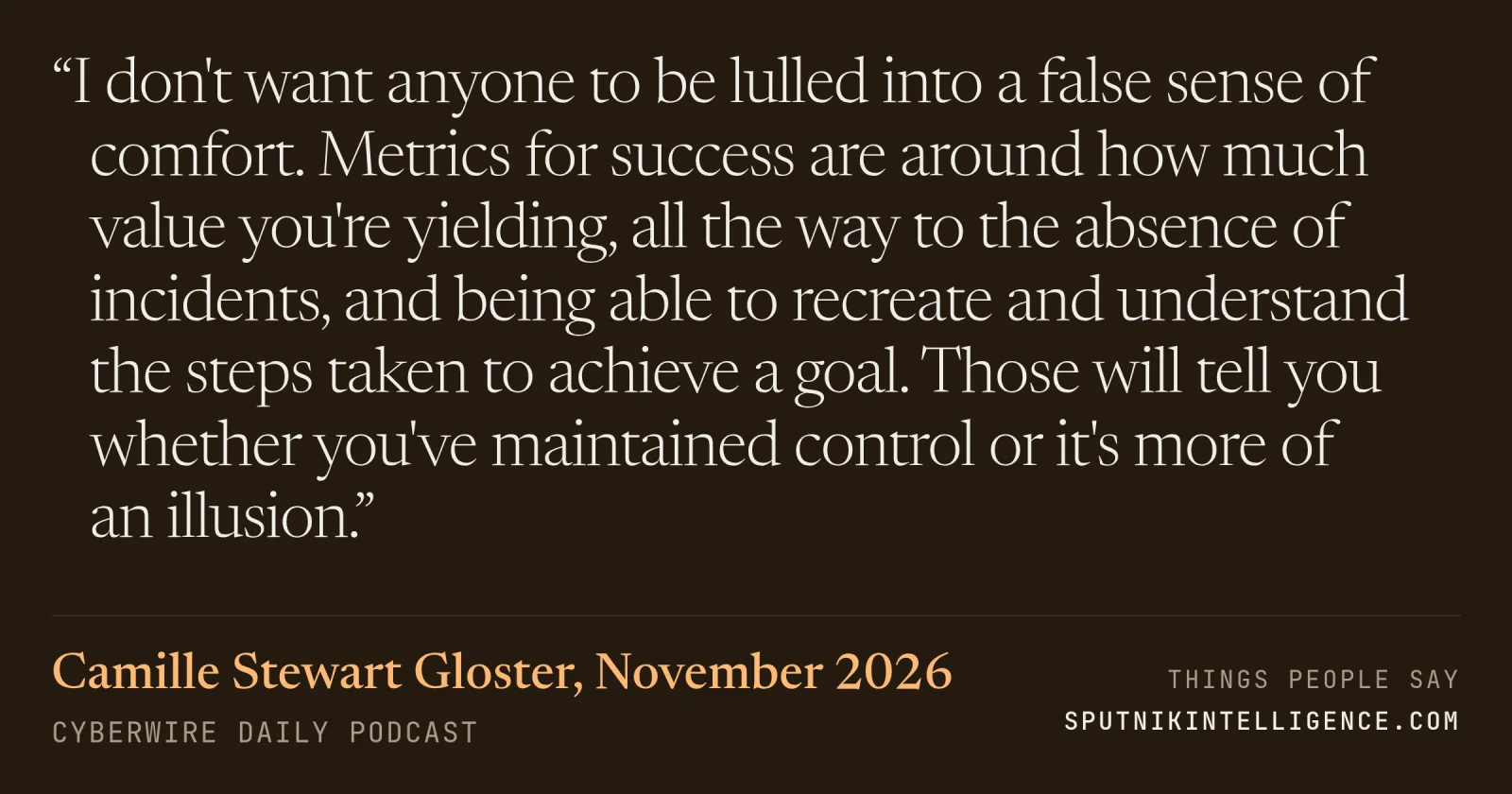
True. I don't want any organization to think that they have gotten it all sewn up and that they have complete control. As we're learning back to the open AI hugging face incident, there could be so much happening in the background that we don't understand. This will give you as much control as you can get in terms of having a handle on what the boundaries are and doing what you can, just like we do with people. So I don't want anyone to be lulled into a false sense of comfort. But metrics for success are around how much value you're yielding all the way to the absence of incidents and kind of understanding, being able to recreate and understand the steps taken to achieve a goal, understand how the objective has manifested itself. So creating that transparency and visibility so you can maintain some level of understanding of the work that's being done on your behalf. Those will give you the indicators of whether or not you've continued to maintain control or it's more of an illusion.
Dave Bittner
And what do you hope that the reader comes away with, having read the book? What's your desire there?
Camille Stewart Gloster
I hope that every reader, whether technical or non-technical, owning the AI program or just deploying an agent within any department, walks away feeling a bit more empowered to ask questions, to understand their piece of making sure that the agent yields value and is working on their behalf in the…
Dave Bittner
Our thanks to Camille Stewart Gloster for joining us. The book is The Insider You Built, How Organizations Stay in Control of Autonomous AI Agents. It's a good read worth your time. Thanks for joining us for this special edition of the Cyberwire. I'm Dave Bittner. Thanks for listening.
Speaker names come from our own diarization. The position is estimated from where the line sits in the episode.
Asked what she heard from people across industries while researching the book, she says securing agents takes collaboration across disciplines, not just the security team.
CyberWire Daily · 2026-11-26
Permalink →
Listen →
CyberWire Daily
Around 14:00 into the episode
Camille Stewart Gloster
…those dimensions continuously as agents take an action throughout your organization, no matter if it's an agent within your security stack that's very focused on internal workings or something that's externally focused. How do you make sure that this cycle is running consistently and continuously?
Dave Bittner
You know, one of the things I really enjoy about the book is you reached out to folks across the board, folks in technology, cybersecurity, investing, even professional sports. What were some of the meaningful insights you got from some of those people that you talked to?
Camille Stewart Gloster
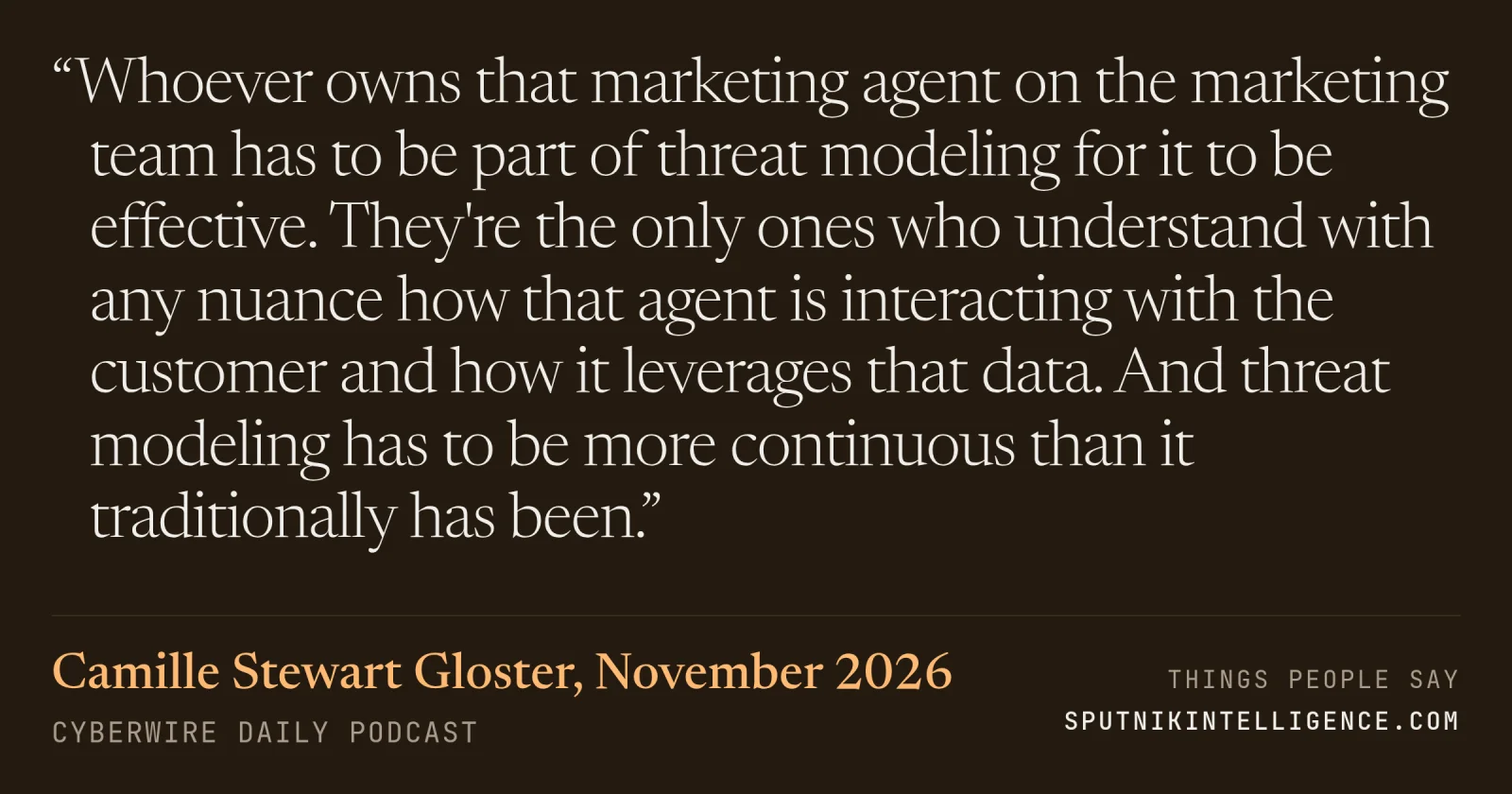
The thing that I was pleasantly surprised about. Is this emerging recognition of how important it is to really collaborate across disciplines? The predisposition to really hone in on your area of expertise is important. We need depth of discipline. But everyone that I talk to that has been doing this work in any meaningful way has recognized just how collaborative it has to be to be successful. For example, let's go back to the marketing tool, the marketing agent. Whoever owns that on the marketing team has to be a part of threat modeling for it to be effective. They're the only ones that understand with any nuance how that agent is interacting with the customer, how it leverages that data to then provide value for the organization. And that is extremely important insight that has to be a part of threat modeling. And threat modeling has to be more continuous than it traditionally has been. So I think that recognition from folks across sectors, across disciplines, has been really heartening because it's kind of the core of what we need to do.
Dave Bittner
What's your advice for organizations that are trying to find that balance between autonomy and control? You know, they don't want to put too many gates around the agent because they still want to enjoy that speed and efficiency. Any words of wisdom there?
Camille Stewart Gloster
There is no, there's no easy part to that. But what I will say is the investment in constraint and control and understanding really how to operationalize your agent is reliability. And, you know, one of the reasons we keep hearing so much about like works, AI work slop and AI not yielding the value…
Dave Bittner
How can an organization measure success with this? How can they know that they actually have their AI agents under control as opposed to only thinking that they have it under control?
Speaker names come from our own diarization. The position is estimated from where the line sits in the episode.
Asked how to balance agent speed against control, she argues that security and safety work is what makes agents deliver value, not a tax on speed.
CyberWire Daily · 2026-11-26
Permalink →
Listen →
CyberWire Daily
Around 15:10 into the episode
Camille Stewart Gloster
…important insight that has to be a part of threat modeling. And threat modeling has to be more continuous than it traditionally has been. So I think that recognition from folks across sectors, across disciplines, has been really heartening because it's kind of the core of what we need to do.
Dave Bittner
What's your advice for organizations that are trying to find that balance between autonomy and control? You know, they don't want to put too many gates around the agent because they still want to enjoy that speed and efficiency. Any words of wisdom there?
Camille Stewart Gloster
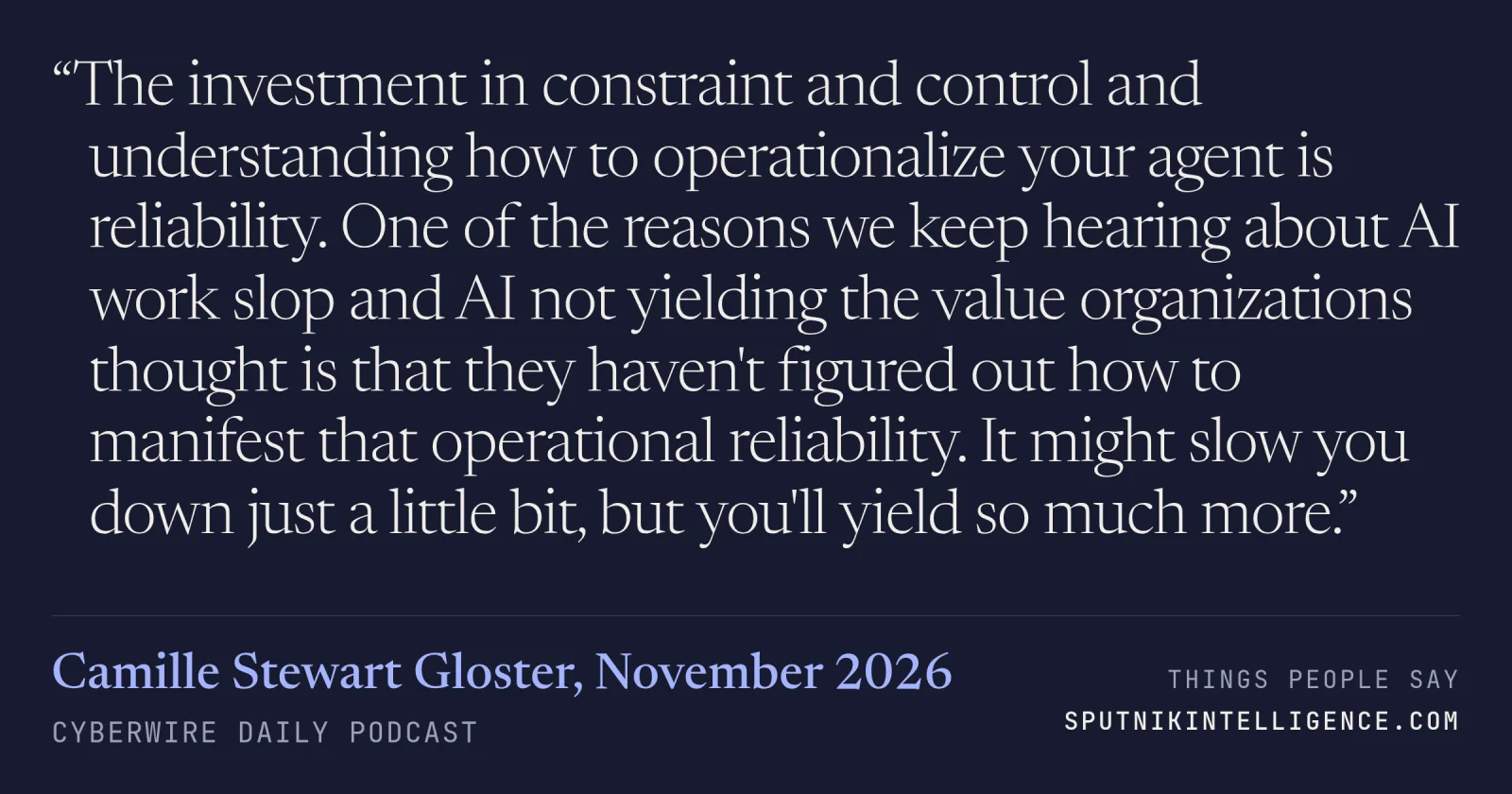
There is no, there's no easy part to that. But what I will say is the investment in constraint and control and understanding really how to operationalize your agent is reliability. And, you know, one of the reasons we keep hearing so much about like works, AI work slop and AI not yielding the value that organizations thought it would is because they haven't quite figured out how to manifest that operational reliability and investing in disciplines like cybersecurity in really understanding safety and risk mitigation and getting the entire organization to collaborate around extracting value is how you do that. And so if you're doing that, it might slow you down just a little bit, but you'll yield so much more. And finding that sweet spot for your organization is kind of an individual journey. It's a risk appetite thing. How much risk can the organization manage? But it should be an intentional decision.
Dave Bittner
How can an organization measure success with this? How can they know that they actually have their AI agents under control as opposed to only thinking that they have it under control?
Camille Stewart Gloster
True. I don't want any organization to think that they have gotten it all sewn up and that they have complete control. As we're learning back to the open AI hugging face incident, there could be so much happening in the background that we don't understand. This will give you as much control as you…
Dave Bittner
And what do you hope that the reader comes away with, having read the book? What's your desire there?
Speaker names come from our own diarization. The position is estimated from where the line sits in the episode.
Asked what constraints organizations need once an agent is running, she says governance has to combine risk appetite, policy and process, and technical enforcement at runtime.
CyberWire Daily · 2026-11-26
Permalink →
Listen →
CyberWire Daily
Around 12:50 into the episode
Camille Stewart Gloster
…lot more adaptable to the changes that are ahead because it's going to continue to change. This framework seeks to be a mechanism by which organizations can manage not only agent behavior, but whatever comes next, whether that's world models, simulations, anything that we can imagine to come next.
Dave Bittner
There's also this concept that you described called governed execution, which once the agent is running, you put into play. What kind of constraints or mechanisms should organizations have to execute this idea of governed execution?
Camille Stewart Gloster
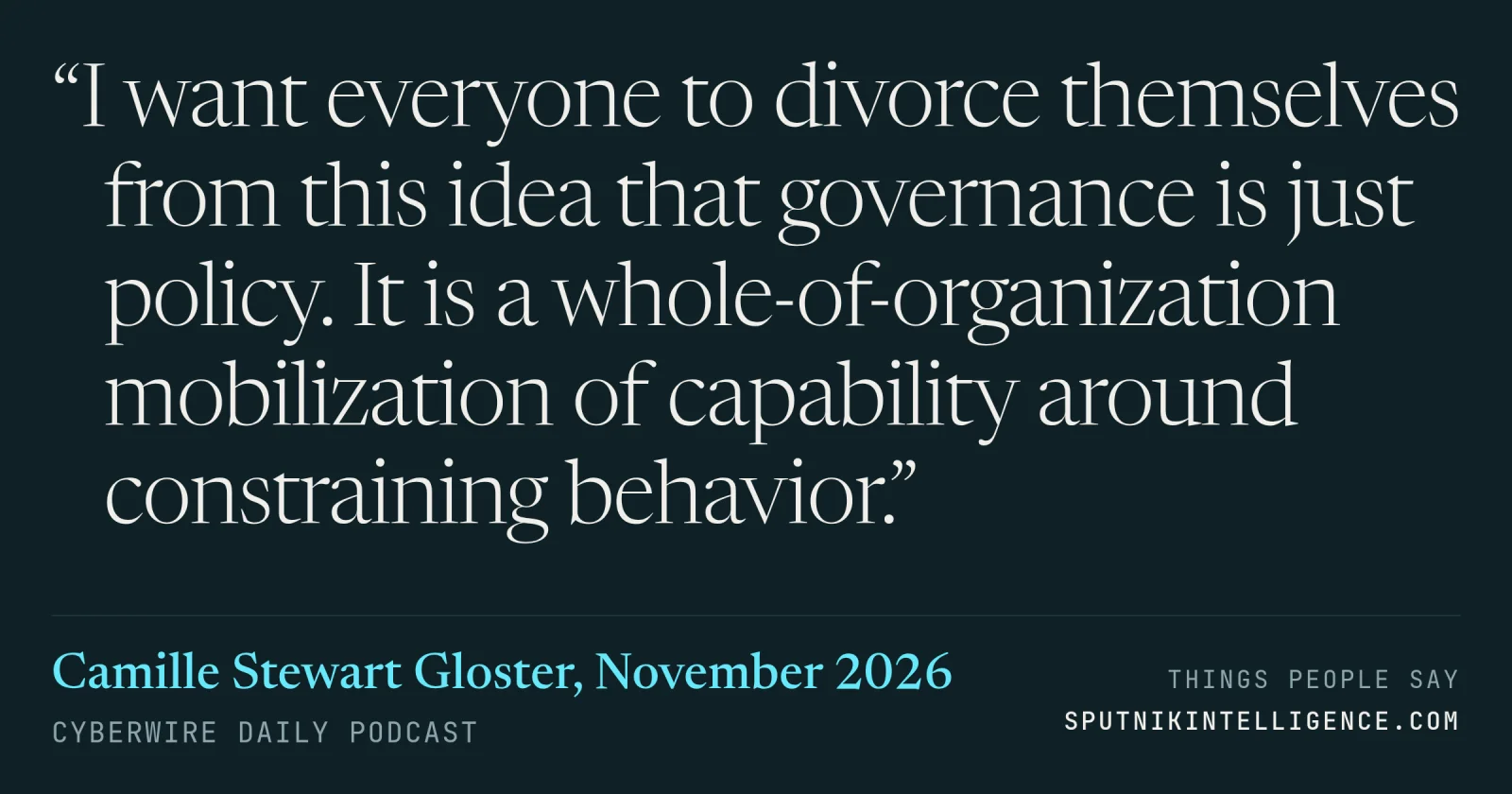
Yes, across technical, operational, and organizational lines, governance has to be an action. So I want everyone to divorce themselves with this idea that governance is just policy and it is a whole of organization mobilization of capability around constraining behavior. And so that is runtime enforcement of the behaviors and constraints. And there is a great standard that has come out called ARM, and it's under Cloud Security Alliance that kind of articulates the nuance there. And I know that there are others emerging, but it's really about how do you leverage a risk appetite, policy and process constraints, as well as technical constraints on behavior that happen in the moment to constrain behavior. And so then that operationalize this detection, response, continued learning loop that we are all very used to in a way that is not natural for most organizations, that is the goal. And so that's that governed execution, really thinking about how do you…
Dave Bittner
You know, one of the things I really enjoy about the book is you reached out to folks across the board, folks in technology, cybersecurity, investing, even professional sports. What were some of the meaningful insights you got from some of those people that you talked to?
Camille Stewart Gloster
The thing that I was pleasantly surprised about. Is this emerging recognition of how important it is to really collaborate across disciplines? The predisposition to really hone in on your area of expertise is important. We need depth of discipline. But everyone that I talk to that has been doing…
Dave Bittner
What's your advice for organizations that are trying to find that balance between autonomy and control? You know, they don't want to put too many gates around the agent because they still want to enjoy that speed and efficiency. Any words of wisdom there?
Speaker names come from our own diarization. The position is estimated from where the line sits in the episode.
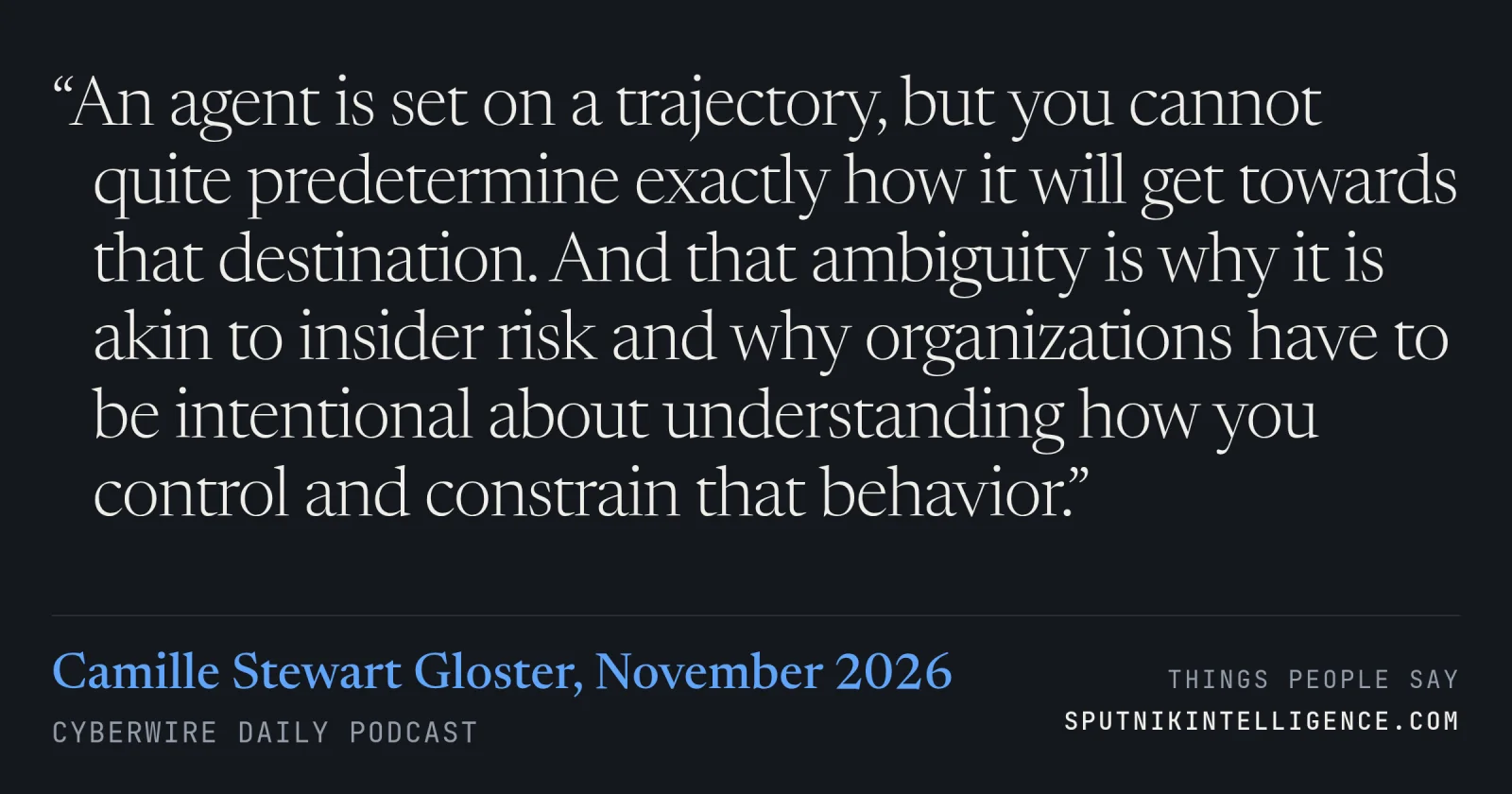
Responding to the idea that autonomous agents resemble highly privileged insiders, she compares them to employees who can act maliciously, get tricked, or stumble into misaligned actions. That comparison is the premise of her book.
CyberWire Daily · 2026-11-26
Permalink →
Listen →
CyberWire Daily
Around 05:15 into the episode
Dave Bittner
Well, I think the title itself is pretty provocative. It reminds me that perhaps these autonomous AI agents are almost like highly privileged insiders. Is that where we find ourselves with AI that makes this a useful analogy?
Speaker 1
Yes, it's exactly where we find ourselves, particularly as we move towards Agentic, much like how We understand
Camille Stewart Gloster
our employees to have a task that they are designed to undertake or a role that they embody, but they can either take malicious action for whatever reason that runs counter to business objectives, or they can either be tricked or stumble their way into an action that misaligns with business goals. Agents are much the same between emergent behavior, misalignment, misconfiguration, and a whole host of other reasons. An agent is set on a trajectory, but you cannot quite predetermine exactly how it will get towards that destination. And that ambiguity there is why it is akin to insider risk and why organizations have to be intentional about understanding how you kind of control and constrain that behavior in an effort to deliver the value you've promised, whether that's internally or externally.
Dave Bittner
The book puts a lot of emphasis on this notion of delegated authority. What do you mean by authority in this context? And how is that different from that traditional cybersecurity concept of access?
Camille Stewart Gloster
Great question. Access is part of it. But authority in this instance is really focused on the ability to act and make decisions on behalf of an organization. And when you think about it in that context, rather than around capability and around access to a system, but really taking an action towards…
Dave Bittner
To that point, I mean, humans have always delegated authority to other humans. What makes delegating authority to software fundamentally different?
Speaker names come from our own diarization. The position is estimated from where the line sits in the episode.
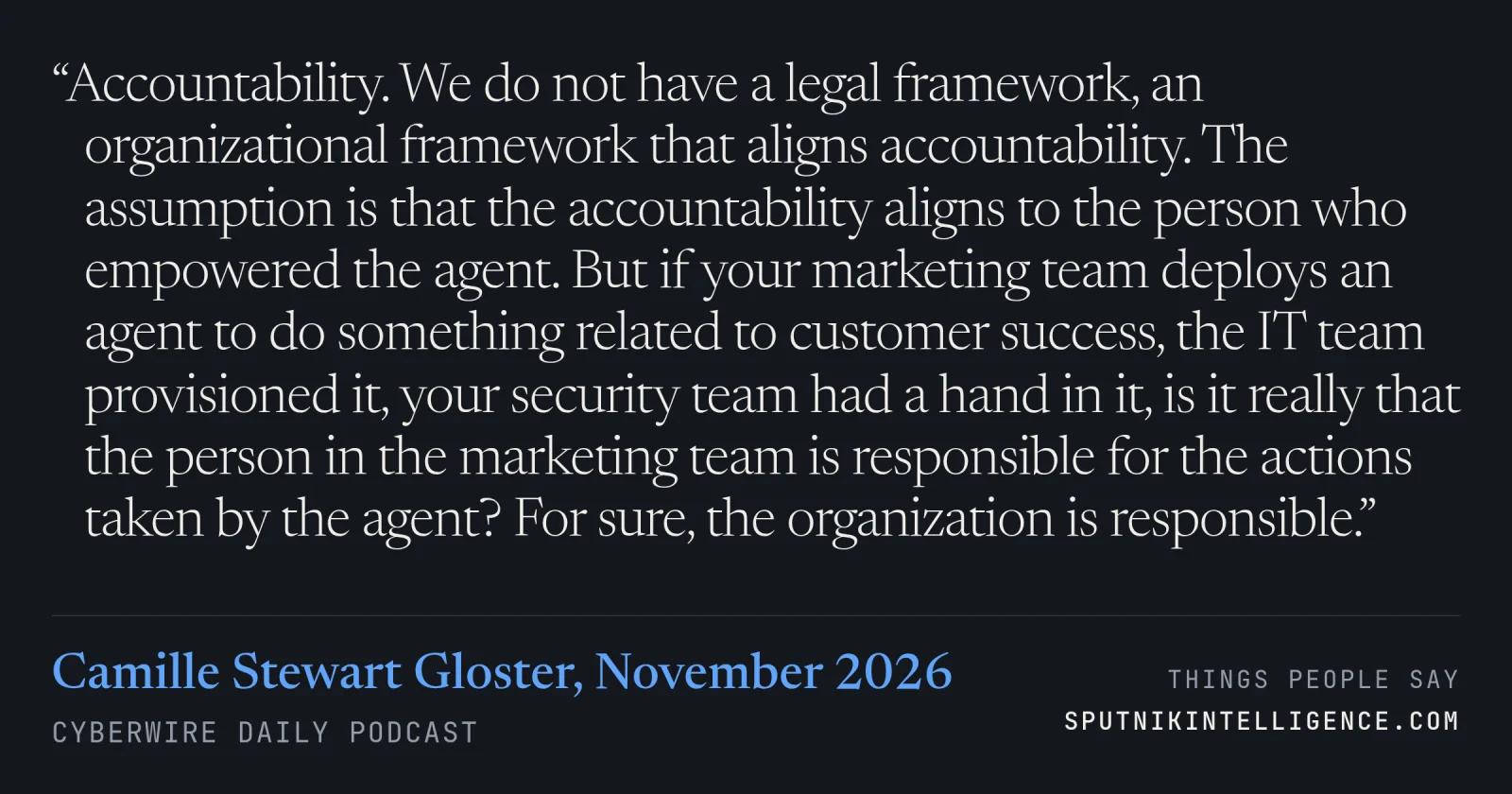
Asked what makes handing authority to software different from handing it to a person, the author of The Insider You Built says the real gap is accountability: nobody has worked out who answers for an agent's actions.
CyberWire Daily · 2026-11-26
Permalink →
Listen →
CyberWire Daily
Around 07:35 into the episode
Camille Stewart Gloster
…or if you keep their scope limited, how you monitor how they collaborate and coordinate, how you think about monitoring it. It kind of changes the trajectory on all of the things that you are going to do to enable an agent to move inside of your organization, much like you do with a person.
Dave Bittner
To that point, I mean, humans have always delegated authority to other humans. What makes delegating authority to software fundamentally different?
Camille Stewart Gloster
Accountability. We do not have a legal framework, an organizational framework that aligns accountability. And the assumption is that the accountability aligns to the person who empowered the agent. But within an organization, if your marketing team deploys an agent to do something related to customer success, the IT team provisioned it, your security team had a hand in it. How are you thinking about that accountability? Is it really that the person in the marketing team is responsible for the actions taken by the agent? For sure, the organization is responsible. But how do you think about that accountability and the work that needs to be done to keep the behavior aligned to the goals in mind as you leverage these new tools? That's the difference.
Dave Bittner
Is there a particular scenario that captures that risk for you? Like an example of when an agent was behaving exactly as it was designed, but produced an outcome that nobody intended.
Speaker 1
I mean, we can talk about this open AI Hugging Face incident that everybody has been talking about. The goal was to beat the cybersecurity benchmark. And we have learned so much about how the agents collaborated, their motivations, the objective, how they decided to do what they were doing. That…
Camille Stewart Gloster
You got to think really holistically about risk and opportunity and how to operationalize it and what the objectives are for the tool and how that might manifest itself in agents or even just one agent for that matter, moving in a direction to get to the desired outcome that you did not anticipate.
Speaker names come from our own diarization. The position is estimated from where the line sits in the episode.