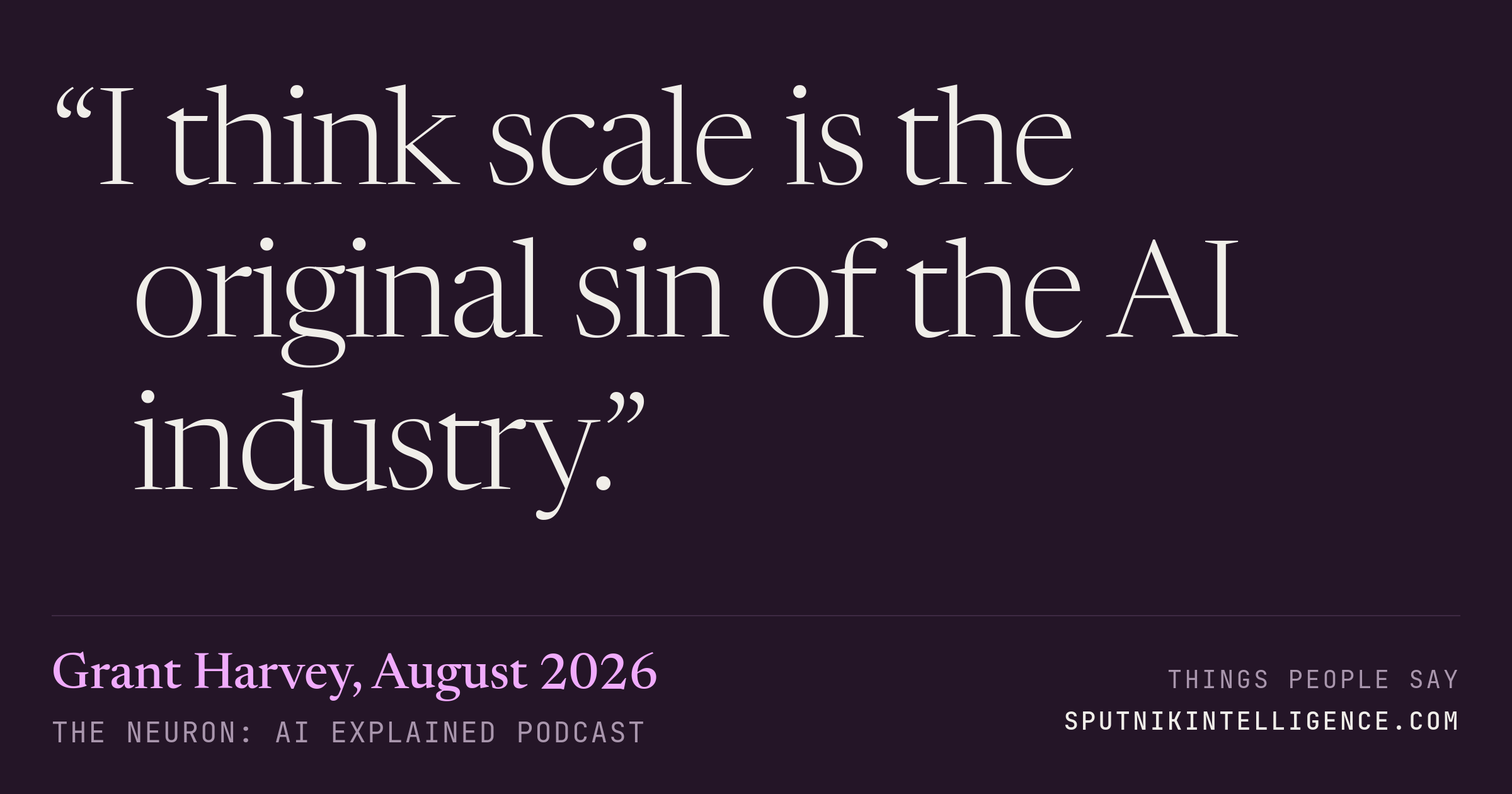
The co-hosts had been arguing about local opposition to data centres, with Corey Noles comparing it to prisons: everybody wants more of them, nobody wants one near their house. Harvey uses that to turn away from the siting fight toward the assumption underneath it, that bigger is always better. He goes on to argue you have to scale down to scale up, fixing the architecture so more comes out of the hardware already built.
physical manifestation, I agree. But I also think that there's a lot of people who like ChatGPT and like using it and don't want a data center in their backyard. That's fair too. This is based on Sun's reporting. Everybody wants more
prisons, but nobody wants it to be near them.
This all comes full circle to my whole point where it's like we need to stop thinking about scale. I think scale is the original sin of the AI industry. And it's why we're burning billions and billions of dollars on this. It's why we're building so many data centers so quickly, getting ahead of ourselves to some degree, but then also being behind because you see what scale brings. But like at a certain point, you need to scale down in order to scale up. Because think about how much more you can do if you fix the architecture to be much more efficient, to be much more memory efficient, to be able to work. Like you get so much more capacity out of what you've already built. And not only that, if you can make it so that everyone's computer can run these things, then people will have access to it locally. But that's exactly what's happening already,
I would say. Like now, an H100 runs these new, more efficient models that have continued to get better and better and better. And H100 runs GPT. I think this statement goes back to 5.4. I want to say it runs GPT 5.4 faster and better than it ran 3.5.
I believe it. Which is getting more out
of those. My problem is I don't think the idea that U.S. companies are going to just take a break and hand over the global lead in the AI race is a thing that is realistic. Like, I get the idea. I don't disagree with it as a