
James Ball

Things James Says on Podcasts

Tech, policy, politics. Political editor @ The New World, Fellow @ Demos, newsletter @ techtris, PhD researcher @ UCL Laws. Latest book: The Other Pandemic – How QAnon Contaminated The World.

Where to Find Them

James Ball hosts and writes The New World , writes Techtris and writes Transformer . They have also been a guest on Smashing Security (6 times) .

Recently: “Live: What I saw at the Russell Brand trial” on The New World (November 2026); “Touching Grass: The Midterms: Woke 3.0 vs Anakinposting” on The New World (November 2026); “The Midterms: Woke 3.0 vs Anakinposting” on The New World (November 2026); “Live: I watched Trump’s midterm meltdown with MAGA” on The New World (November 2026); “Touching Grass: Millennial optimism, and are we in 1984?” on The New World (November 2026); “Millennial optimism, and are we in 1984?” on The New World (November 2026).

What They Said

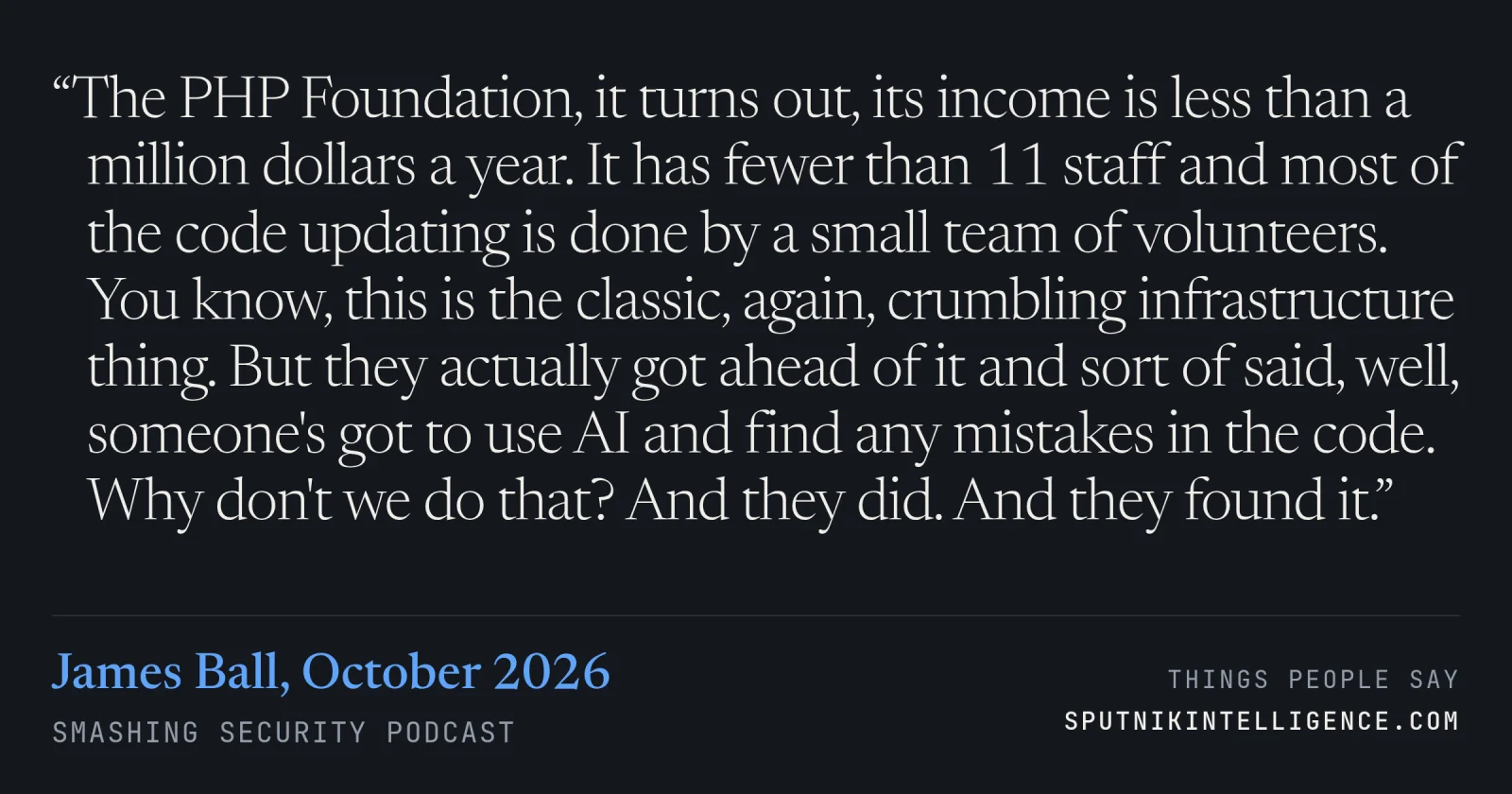
“The PHP Foundation, it turns out, its income is less than a million dollars a year. It has fewer than 11 staff and most of the code updating is done by a small team of volunteers. You know, this is the classic, again, crumbling infrastructure thing. But they actually got ahead of it and sort of said, well, someone's got to use AI and find any mistakes in the code. Why don't we do that? And they did. And they found it.” — James Ball, Smashing Security

Asked how the PHP flaw was discovered, James explains that the PHP Foundation sought help from an AI lab to audit its old code, and researchers found the hole. The line shows how small the team is behind software that much of the web runs on.

Smashing Security · 2026-10-29 Permalink → Listen →
Smashing Security Around 45:28 into the episode
James Ball

it's quite a nice language to use, isn't it? It's quite natural language. It's quite. Easy to write. I enjoy it. Like people tend to like PHP who use it.

Graham Cluley

But even if you were running the latest version of PHP, it was vulnerable to this huge security hole. But what was interesting was how this security hole was discovered and how it became front page news.

James Ball

…available. And the problem with PHP is it's loads of stuff you wouldn't think about. Like your router has a little admin page for its settings. Your printer will have a little PHP-powered admin page, et cetera. So people will remember the obvious stuff. And that's what they'll have been fixing the last 24 hours. There's got to be so much little hidden layer infrastructure stuff running it. The PHP Foundation, it turns out, its income is less than a million dollars a year. It has fewer than 11 staff and most of the code updating is done by a small team of volunteers. You know, this is the classic, again, crumbling infrastructure thing. But they actually got ahead of it and sort of said, well, someone's got to use AI and find any mistakes in the code. Why don't we do that? And they did. And they found it. So that's good. Yes. And then essentially they worked to patch it. And as I understand it, over the last week or so, they've been trying to notify particularly critical infrastructure people. And they were planning on putting it out, I think, on the 22nd. But by the 20th, it was obvious that word had got out and that attackers were starting to use it. And so they disclosed it slightly earlier…

Graham Cluley

And maybe someone who was inside the kimono, as it were, of knowledge of like, we've got this issue, guys, which we're trying to fix. And we only really want to make it public once we know we're ahead of it and that some critical parts of the internet have already been updated and protected.…

James Ball

mean, I work for a university. All of our course materials and our timetables got taken down. And so we had emails from IT going, still go to your classes, still do your classes, but you can't look up where they are and you can't get the teaching material that's on the intranet. So it was a tricky…

Graham Cluley

different levels of importance. There were government websites, there was your university, and there was my local chess club, all impacted to one extent or another with this PHP issue. And on top of the TLS issue, you do begin to think, oh, my goodness, there are so many vulnerable, flaky parts of…
Speaker names come from our own diarization. The position is estimated from where the line sits in the episode.
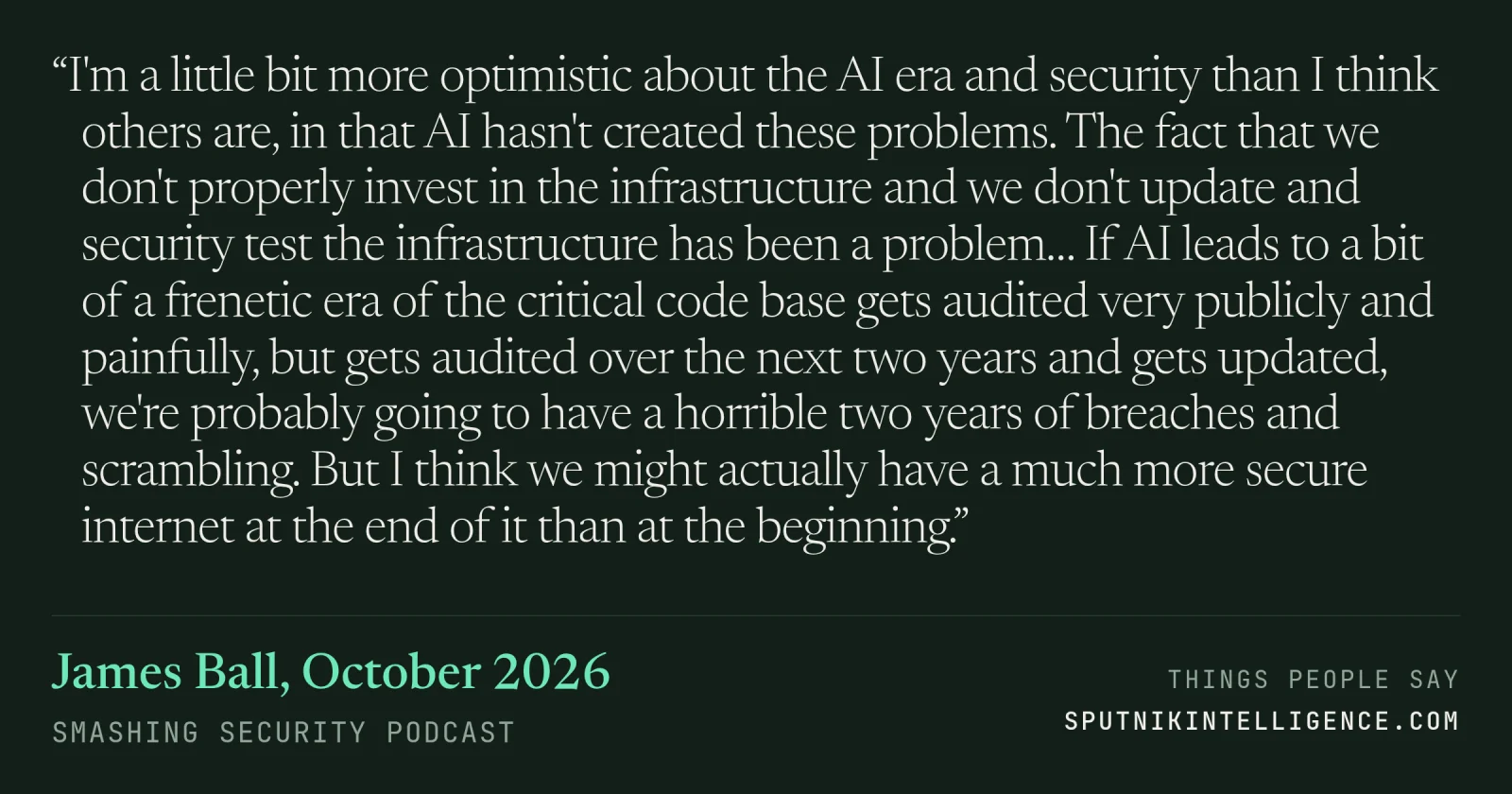
“I'm a little bit more optimistic about the AI era and security than I think others are, in that AI hasn't created these problems. The fact that we don't properly invest in the infrastructure and we don't update and security test the infrastructure has been a problem… If AI leads to a bit of a frenetic era of the critical code base gets audited very publicly and painfully, but gets audited over the next two years and gets updated, we're probably going to have a horrible two years of breaches and scrambling. But I think we might actually have a much more secure internet at the end of it than at the beginning.” — James Ball, Smashing Security

The hosts had just discussed a serious PHP vulnerability found with help from an AI model, and a set of absurdly short TLS keys found in browser infrastructure. Asked whether AI makes security worse overall, James argues the real weakness is neglected infrastructure, and AI audits could force it to be fixed.

Smashing Security · 2026-10-29 Permalink → Listen →
Smashing Security Around 46:50 into the episode
James Ball

…work for a university. All of our course materials and our timetables got taken down. And so we had emails from IT going, still go to your classes, still do your classes, but you can't look up where they are and you can't get the teaching material that's on the intranet. So it was a tricky day. So

Graham Cluley

…issue, you do begin to think, oh, my goodness, there are so many vulnerable, flaky parts of the internet, which we are so reliant on. You make the really good point. The PHP Foundation, a bunch of volunteers who are basically keeping these things up and running, which we are all so dependent on.

James Ball

So I'm a little bit more optimistic about the AI era and security than I think others are, in that AI hasn't created these problems. The fact that we don't properly invest in the infrastructure and we don't update and security test the infrastructure has been a problem. And the fact that often when spy agencies discover these vulnerabilities, even though they have responsibility for cybersecurity, they often don't disclose them because they'd rather exploit them. Like our Dutch friends, we've often had vulnerabilities that have existed for, say, a decade that either hasn't been found or has been found and exploited in secret. And if AI leads to a bit of a…

Graham Cluley

I think what you're really saying is that we've got another two years at least of great stories to report on for smashing security. But after that, once AI has fixed our world, then we'll really be scrabbling around. That's what you're saying. Earlier this year. Oh, here we go. Inside the walls of…

Speaker 2

agents doing a code review, Graham. It's not the Manhattan Project.

Graham Cluley

And when the sun came up on that incident, the finest engineering minds on the planet sat in a room and asked themselves one question.

Speaker names come from our own diarization. The position is estimated from where the line sits in the episode.

Collections They Appear In