
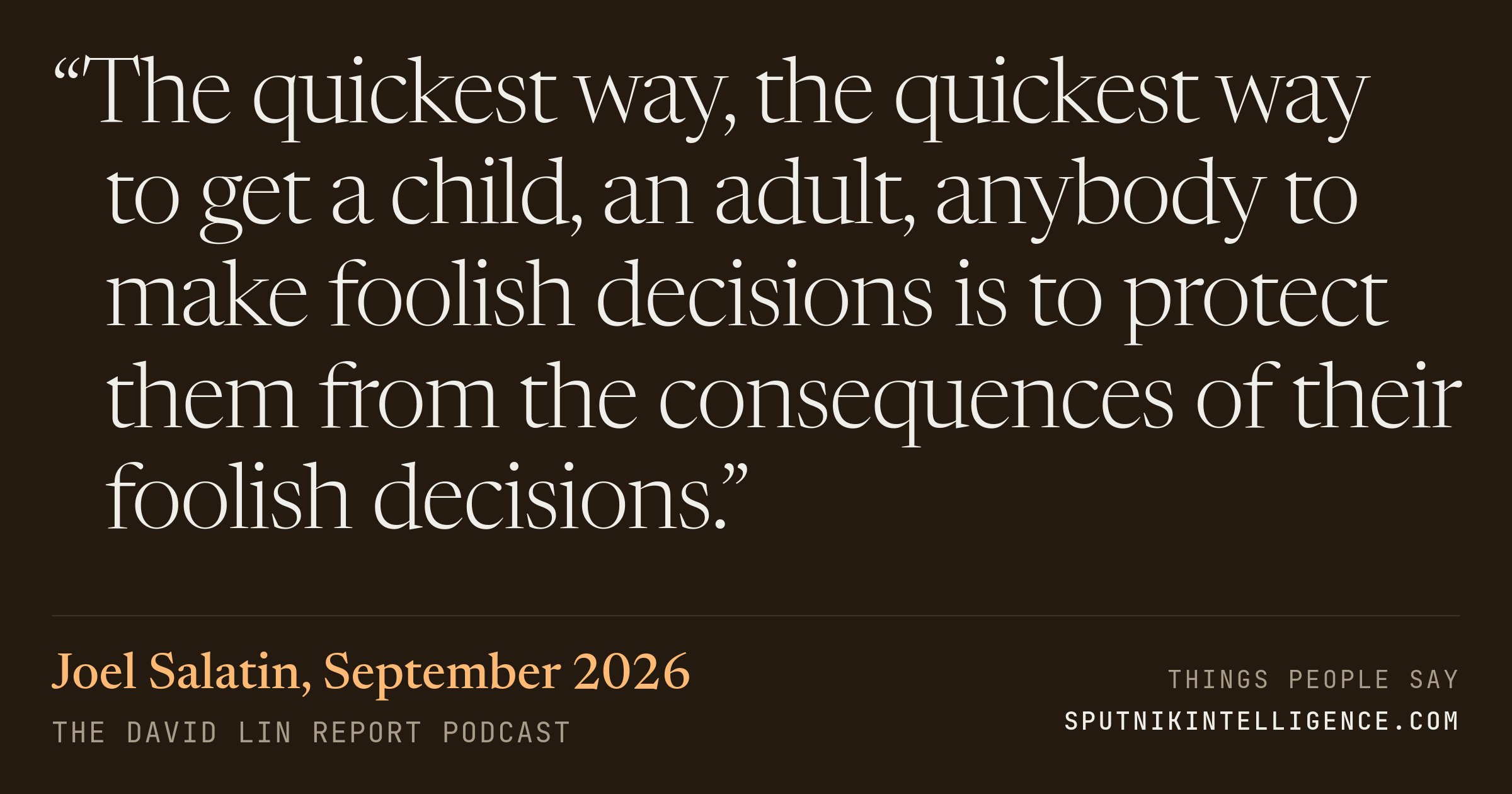
David Lin asked what Congress should do for farmers squeezed by rising diesel and fertilizer costs, and whether it should subsidize them. Salatin's answer is to phase out subsidies entirely, on the grounds that the safety net is exactly what lets bad decisions survive. Pressed on a supply shock, he argues there is enough idle land in the country that nobody would go hungry.
…of the century. Is farming fundamentally mechanical or biological? And so, those of us who take my approach say that farming is fun and food is fundamentally biological, it's not mechanical. Do we use machines? Yes, we do, but it is fundamentally a biological system, not a mechanical system.
…about the people that rely on fertilizers and diesel. And they ask you, hey, should we subsidize some farmers? So, that's a two-part question. What should be done for the farmers? What should the farmers do to survive this crisis? And should the government step in? How would you answer this?
Well, I am not a government program guy. So, my answer to the whole program is to gradually, you know, I mean, I would love to just eliminate it tomorrow, but all subsidies. The problem with the subsidies is that they provide such a safety net to farmers that farmers can make silly decisions and not suffer the consequences. The quickest way, the quickest way to get a child, an adult, anybody to make foolish decisions is to protect them from the consequences of their foolish decisions. And so, here we have these farmers growing corn we don't need, soybeans we don't need. The world doesn't want them. I mean, China has, China, which has taken half of America's soybean crop, they have a 2030 target to eliminate imports, to become crop self-sufficient, basically. And so, the obvious trajectory is these markets are going to collapse. And subsidies just continue kicking the can down…
I guess. The counter-argument is the risk of, let's say, if there's a geopolitical shock, let's say some war in the Middle East, and input prices go up, farmers don't have enough time to adapt to these shocks, and a lot of them do go out of business, and we have a food deficit. How close are we to…
America has 35 million acres of lawn, 35 million acres of lawn, and 36 million acres housing and feeding recreational horses. That's 71 million acres. That's enough to feed the entire country without a farm. We've got plenty of land, plenty of resources. The truth is that we are producing many…
If I were in Congress, I'd also ask a farmer about current trends in food prices. Let me just show you a few statistics here. The FAO World Food Price Index published by the United Nations, the FFPI price index averaged 131 points in July 2026. That's up 0.7 points from its June level. Compared to…