

WD

William Donahue

Things William Says on Podcasts

Where to Find Them

William Donahue has been a guest on Hermitix .

Recently: “The Life and Work of Elias Canetti with William Donahue” on Hermitix (November 2026).

What They Said

“He's a misanthropic humanist, right? That should strike us as an oxymoron. … He knows his culture, this distant culture in time and place, but it does nothing for him. It doesn't open him. … He makes a library a wall against reality, not something that opens it up.” — William Donahue, Hermitix

On Peter Kien, the scholar in Canetti's novel Auto-da-Fé who bricks up his windows to make room for bookshelves. The character is a picture of learning used as a fortress against the world.

Hermitix · 2026-11-25 Permalink → Listen →
Hermitix Around 35:28 into the episode
William Donahue

except you're being too nice about it. He doesn't just say send him away. He says, you know, basically, if you're like, excuse me, fuck off. You know, I'm not having anything to do with you, kid. I have no time for you. You can come back when I have time, but I never have time. Yeah, he never

James Dutton

has time. He always says.

William Donahue

Well, yeah, the so-called marriage. So he's a misanthropic humanist, right? That should strike us as an oxymoron, right? Humanism, the humanities, the liberal arts, obviously meant to open our hearts, open our horizon, expand our horizons, have us empathize with other cultures and other peoples. And here this is a guy who knows kind of the other in a way that is supposed to be astounding, sinology. So think of Austria, but he knows his culture, this distant culture in time and place, and et cetera, but it does nothing for him. It doesn't open him. As you described it earlier, he kind of entombs himself in this fortress. He makes a library a wall against reality, not something that opens it up. And the story of poor Franz Metzger is the same thing. The kid isn't going to be taught. He's going to be swatted away. Get the hell out of here, kid. And

James Dutton

yeah, what's really intriguing about that is the books that tend to have this stories that tend to plots that tend to have their character who's walled in, they tend to have someone who's because of this or of this or due to this walling in, their own inner fantasy develops in a more of a…

William Donahue

That's nice. Yeah, I like what you're saying because I think that is true. In other novels, there is kind of a hydraulic relationship. You know, if he closes himself down in one way, he opens himself in another. And in fact, there is a famous quote where he says that's the duty of a scholar to…

James Dutton

perhaps this is a place to just draw. I could ask you for the for if there is has been seen in the scholarship, like what the historical context is around this, because my understanding is that this Auto De Fey originally was planned by Connetti to be, I guess, maybe not the first, but like one of…

Speaker names come from our own diarization. The position is estimated from where the line sits in the episode.
“As great as he was, he was also a self-promoter and a liar. So he didn't write those novels. And it's not clear that he ever actually really meant to. … He was constantly suggesting this because he was desperate for attention and he wanted to let publishers and others know that he's a serious poet.” — William Donahue, Hermitix

Asked about Elias Canetti's reported plan for a cycle of eight novels. The Canetti scholar says the writer's papers show no other novel and that he inflated the project to look more important.

Hermitix · 2026-11-25 Permalink → Listen →
Hermitix Around 39:18 into the episode
William Donahue

…oh, he did. Yeah, yeah. He said it hurt him because he was a book lover, after all. So I want us to be careful not to take this one, you know, parodied character as symbolic of the humanities entirely or of scholarship entirely. It's a very particular take on it that I think he's regretting. Well,

James Dutton

…with technology, maybe a political obsessive, or et cetera, et cetera. So we got the book obsessive. So is there something within, I mean, maybe it's the Academy, as you just said, to do with this obsessiveness that Connetti was seeing, which is really the historical context for Ordo De Fey.

William Donahue

So, yeah, I think we have to now, with retrospect, liberate ourselves from some of Kennetti's own stories. As great as he was, he was also a self-promoter and a liar. So he didn't write those novels. And it's not clear that he ever actually really meant to. It was a bit of self-aggrandizing. He said he was going to base it on the series of Balzac's famous series. I think there's a half-truth there. I mean, yes, I think he's trying to contextualize his book and also give himself a little bit more luster. So I don't think that that's a helpful road necessarily. We know now from the Nachlas, from the papers, the posthumous papers, that there is no other novel there. But he was constantly suggesting this because he was desperate for attention and he wanted to let publishers and others know that he's a serious poet. I'm glad

James Dutton

I'm here with an experienced Kennedy scholar because I feel like the amateur, you're walking alongside. Me watching me trip up every single time. No, I mean the nice way. Kennedy's game game playing.

William Donahue

It's a real well, he is game playing, but in ways that I think are often very fun. There were some darker things that we could talk about that really hurt me. You know, when he wrote his book on Kafka, he wrote two essays that were put together in a small book on Kafka. He wrote a book that was…

James Dutton

Kafka Kafka did also say burn everything, you know, at the end.

Speaker names come from our own diarization. The position is estimated from where the line sits in the episode.
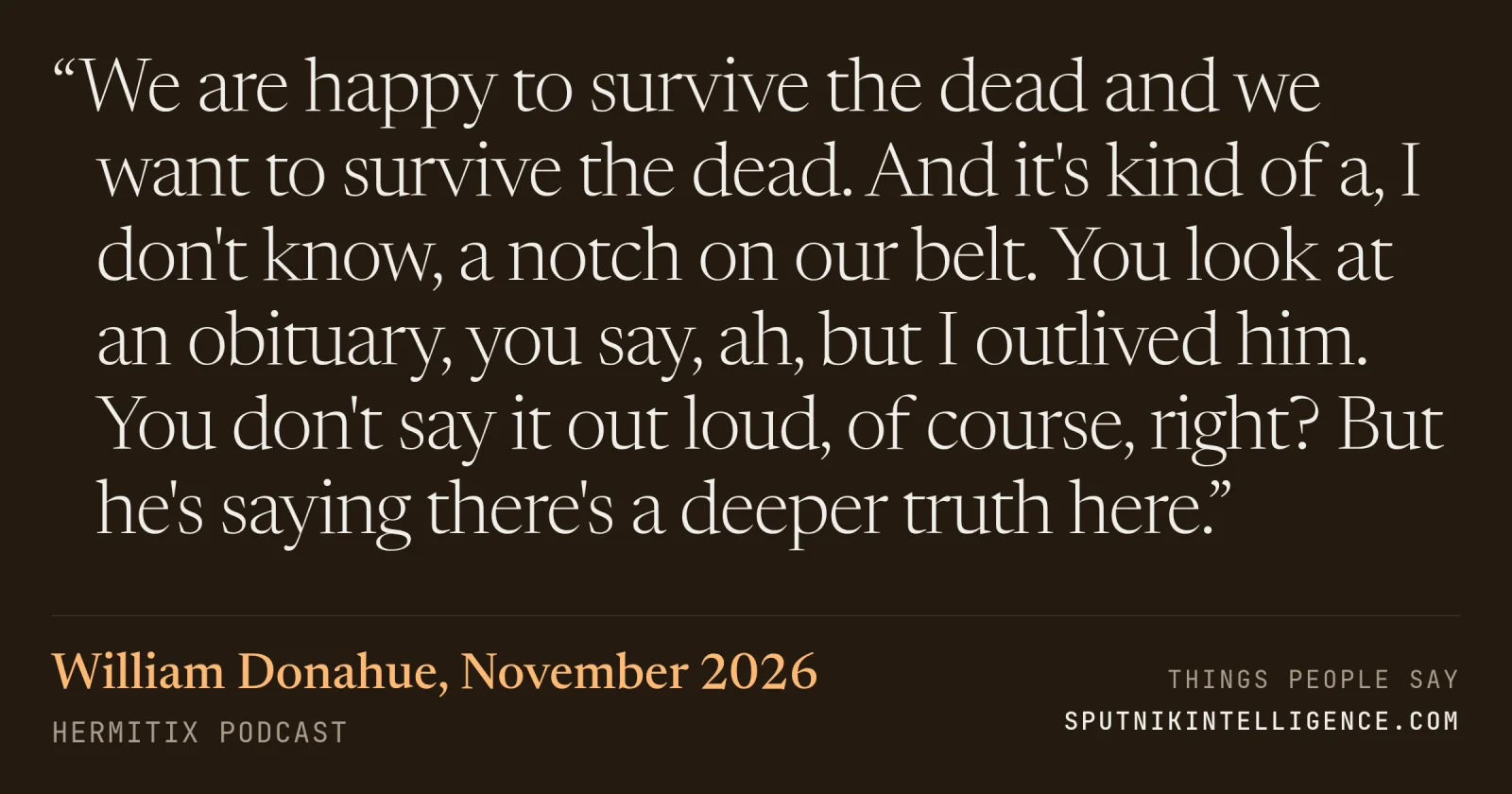
“We are happy to survive the dead and we want to survive the dead. And it's kind of a, I don't know, a notch on our belt. You look at an obituary, you say, ah, but I outlived him. You don't say it out loud, of course, right? But he's saying there's a deeper truth here.” — William Donahue, Hermitix

Explaining Elias Canetti's claim in Crowds and Power that surviving others is a form of power. He calls it a deliberately uncomfortable idea that Canetti insisted on.

Hermitix · 2026-11-25 Permalink → Listen →
Hermitix Around 12:28 into the episode
William Donahue

…of his papers the nachlas in the zura public library is uh his the many sources he gathered and the work that he tried to uh that he did complete to continue the second volume of crowds and power so both things are there open-endedness uh the the unfulfilled quest but also uh really clear outlines

James Dutton

…he lives this life of books and and the word and language um and yet there's these kind of key events throughout his life that sort of are the grammar to it and yet historical context and being amidst context is everything to him so how would you kind of introduce him as this yeah yeah yeah i

William Donahue

will do my best i will track uh so when he won the nobel prize in 1981 he was introduced or referred to on the bbc as a bulgarian jew um and uh uh h g adler the famous adler um when he heard that from his daughter-in-law he said if kennetti is a bulgarian jew i'm the queen of sheba uh you know but the thing is kennetti was a bulgarian jew it's just that maybe those weren't the two most obvious descriptors true but maybe not as helpful uh as we would want them to be so he's born uh in the ottoman empire in 1905 uh in rochuk a small town um and his family moves at a young age he's moves to manchester his father kind of rebels against the family business and sets up a business in manchester england he dies at a young age i think he's 31 it's a foundational moment for kennetti uh to lose his father's his father

Speaker 3

canal he's 11 i think right

William Donahue

uh about eight i think oh yeah right yeah he he learns to read english from his father the first language that he reads is english so already it's difficult is he german is he english he's going to publish later in german uh but english was always dear to him and he would say uh in um this book…

James Dutton

Not at all. I mean, and so much of this seems to go back to an event in 1927. Yes. This burning of the Justis Palace in Vienna. Yeah, the

Speaker names come from our own diarization. The position is estimated from where the line sits in the episode.

Collections They Appear In