She describes her farming family's first meeting with a renewable developer's team. It sets up why she later helped form a landowner collective to negotiate.
…to us is that my husband was actually in the shearing shed and a proponent literally walked into the shearing shed in the middle of shearing and said, oh, hey, do you want to host wind turbines? Look, something a little more formal. And all the shearers were in there going, telling to go away.
Sarah Nolet
More shearing. Sorry. So just to get the terminology right. So proponent, that refers to someone who actually works for the company or are they actually a middleman? Sorry. Yeah, explain who that is for anyone else.
Tracey Lefroy
So the proponent to us is the person who first approaches you with regard to potentially being a host of renewable energy infrastructure. Now, keeping in mind that that proponent is not necessarily who builds and manages and maintains that infrastructure in the end. But what struck me first was the asymmetry in the approach in terms of, you know, you've got your landowner or your farmer and you've got the proponent. So the proponent comes, I think for us, there were three people who came at first. This was a team who had done this dozens of times. They'd approached multiple families over multiple years, over multiple projects. We'd never done this. So that gap in knowledge and experience and even in project literacy, that was real and it was huge. And you start feeling a little bit like you're on the back foot. So yeah, the start of that journey is quite confronting.
Sarah Nolet
What, do you remember what they were wearing when they walked into that shearing shed? Like, were they dressed appropriately to come on farm?
Tracey Lefroy
Do you know what? They really were. Jeans, boots, shirt. Now that we've got to know them quite well over the last year or two, you know, that they are very real people, which I really appreciated. I think sometimes that when a proponent comes on who's a bit too slick, I think that can perhaps…
Sarah Nolet
Absolutely. I mean, in other businesses, you know, I'm sitting at my desk most of the day. And if someone wants to talk to me about something, they're scheduling a meeting. And so then I know that I'm transitioning from this context. And so it always strikes me about agriculture where the line…
Speaker names come from our own diarization. The position is estimated from where the line sits in the episode.
Asked where climate fits into the conversation, she says she does not lead with climate when talking to neighbours who may disagree about it; she starts from shared practical benefits.
…And I've just been really fortunate in that the Energy Charter have provided that framework and the architecture for me to be able to provide these services to landowners. And the proponents that I've worked with have all kind of gone, huh? Well, that's a really cool idea and have embraced it. I'm
Sarah Nolet
…One of the reasons for renewable energy is both energy sovereignty, but also from an emissions perspective. Are there ecological benefits? Do you guys, as the landowner hosting a project, get any kind of either environmental benefits or tell me about where does climate in this conversation?
Tracey Lefroy
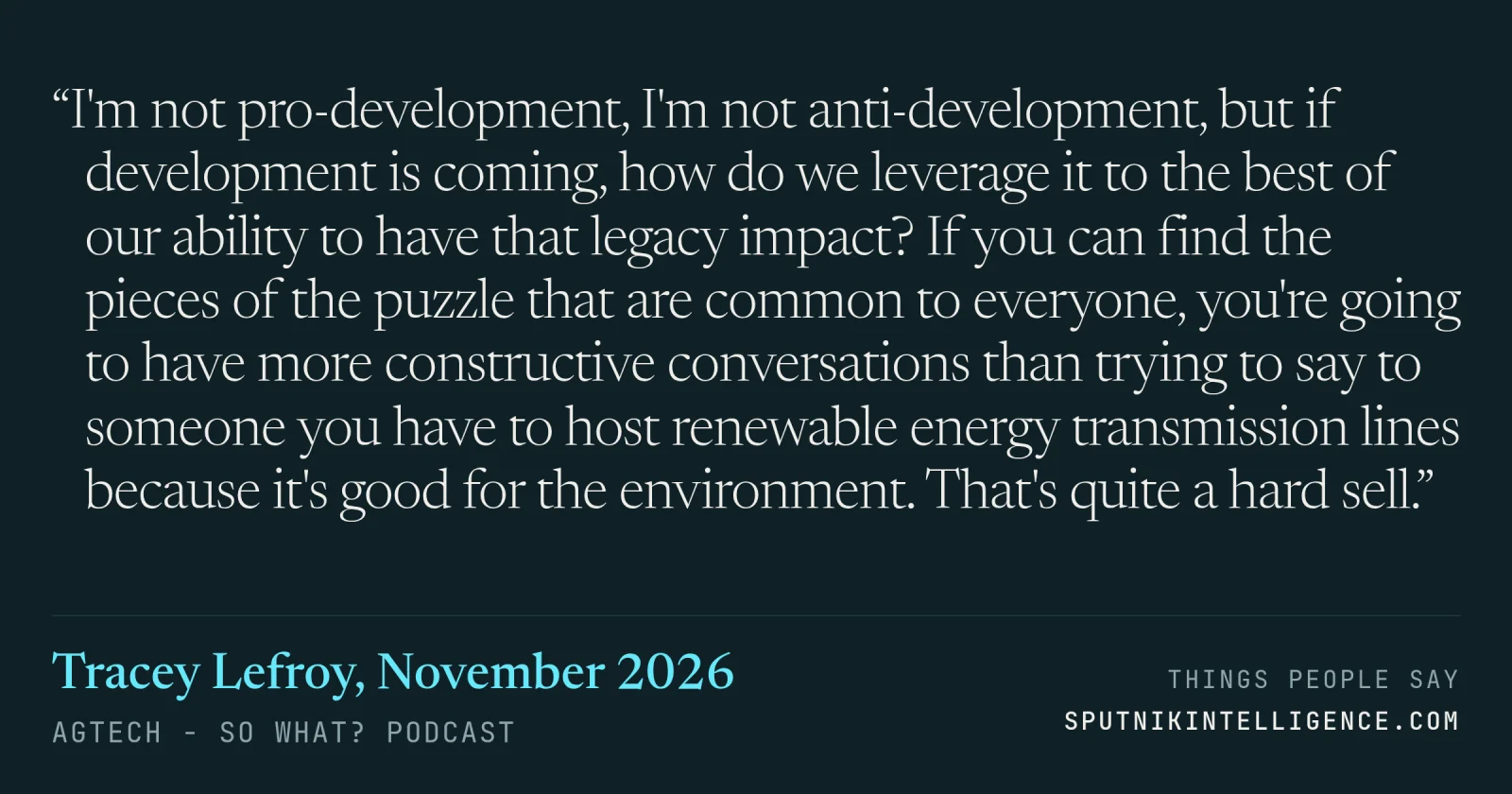
Yeah, really good question. And it's one I pushed pretty hard on and didn't get very far trying to figure out if there was some way that the landowner hosting renewable energy infrastructure or renewable energy production could get some green credits or some AQs or something. But they all go with the electrons. I mean, there is the opportunity to do some offset work. But I feel like, again, this is one of those pieces of the puzzle that needs a little bit more investigation. So I would really like to see if there is the opportunity to, and I don't have a proper word for it, but to share those green benefits, because there is obviously an impost on your business. And yes, you are being paid a rent or a construction fee or an operation fee, but you are hosting renewable energy production. So how can you get some green license out of that, I guess? And does it come from potentially opportunities for other economic? diversification so as we spoke about with the production of nitrogenous fertilizers or does it power i don't know a biodiesel plant um other thing that i think is quite important to note is i've always when having conversations with landowners or communities or neighbors is i'm not pro-development…
Sarah Nolet
when you cast your eyes forward it seems like the energy conversation isn't going anywhere the renewable conversation hopefully isn't going anywhere for australia i mean data centers and more energy requirements i'm curious what are some of the five 10 15 20 years out what's on your mind as…
Tracey Lefroy
so i think data centers are in the press a lot at the moment particularly with the federal government opening their office for ai but with regard to that i think it's again a space that's moving really quickly so when we first started talking about data centers two years ago their requirement for…
Sarah Nolet
huge thanks to tracy for so generously diving into the details about her experiences setting up renewable energy projects on farms the first thing that piqued my interest about tracy story was her instinctive response to bring neighboring landowners together to approach the negotiation as a…
Speaker names come from our own diarization. The position is estimated from where the line sits in the episode.
Asked about opportunities over the next five to twenty years given AI and data centre demand, she sees regional Western Australia as a natural home for data centres and frames them as a way to rebuild towns that have shrunk. It lands in a week of heavy AI infrastructure spending news.
…you have to host renewable energy transmission lines because it's good for the environment i think that that's quite a hard sell and you almost create that animism type concept because you can't see what's in it for me which is a little bit of a selfish comment but it's an understandable one
Sarah Nolet
…the energy conversation isn't going anywhere the renewable conversation hopefully isn't going anywhere for australia i mean data centers and more energy requirements i'm curious what are some of the five 10 15 20 years out what's on your mind as potential opportunities or challenges coming there
Tracey Lefroy
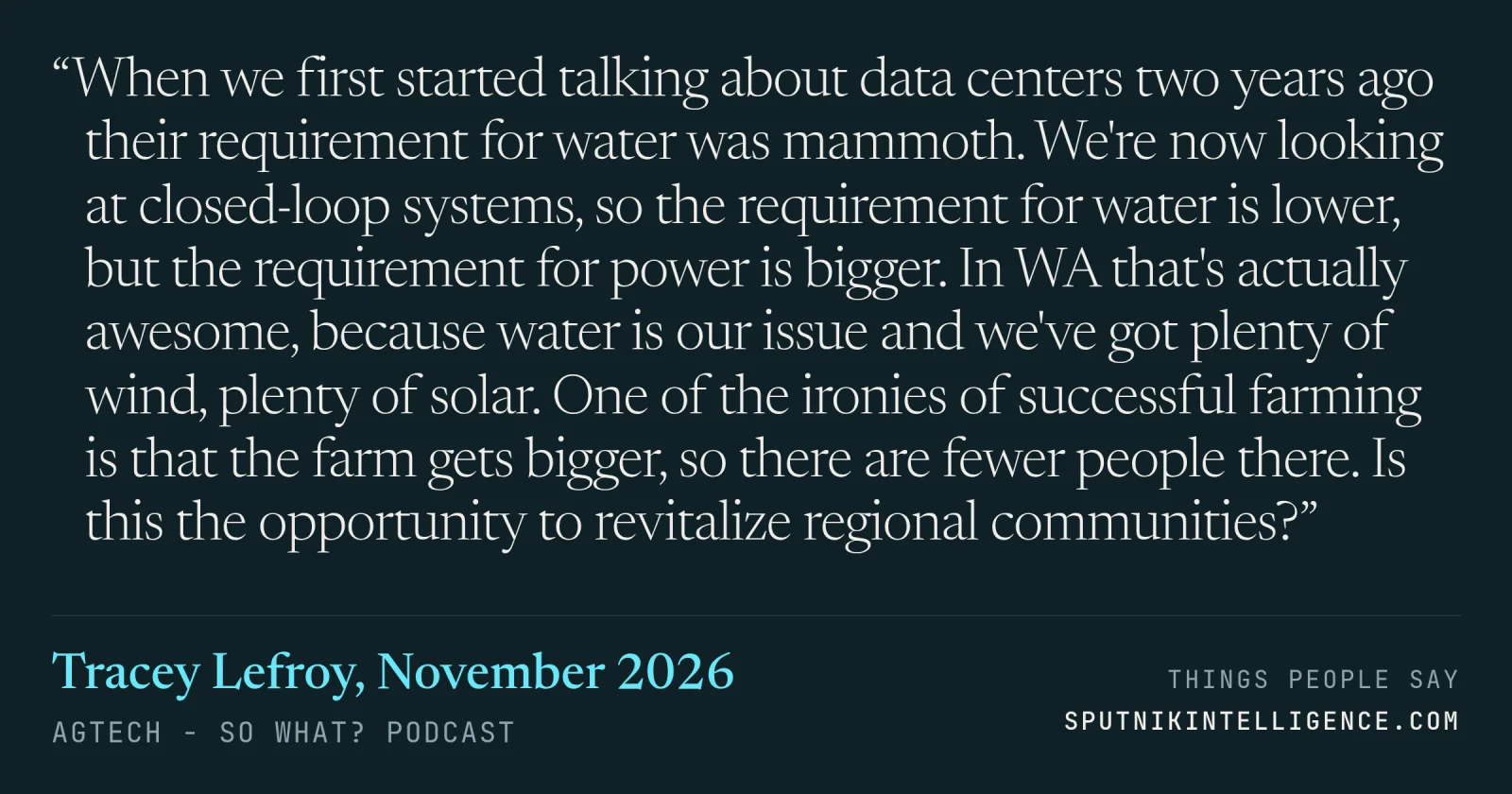
so i think data centers are in the press a lot at the moment particularly with the federal government opening their office for ai but with regard to that i think it's again a space that's moving really quickly so when we first started talking about data centers two years ago their requirement for water was mammoth we're now looking at data centers that are more a closed-loop system so the requirement for water is lower but as a function of being a closed loop system the requirement for power is bigger wa that's actually awesome because water is our issue we've got plenty of wind plenty of solar so we can create the energy if the technology is getting to the point where the water requirement is lower i actually think that that's awesome so in terms of opportunity for regional areas i love the concept that we're decentralizing our industry and you know data centers in regional areas i think it really makes sense i think it would be phenomenal we have a lot of land we have a lot of wind we have a lot of sun we don't have a lot of water but what can we do about technology solves for that one of the ironies of successful farming is that the farm gets bigger so there's less people there so your regional community is diminished is this the opportunity to revitalize regional…
Sarah Nolet
huge thanks to tracy for so generously diving into the details about her experiences setting up renewable energy projects on farms the first thing that piqued my interest about tracy story was her instinctive response to bring neighboring landowners together to approach the negotiation as a…
Speaker names come from our own diarization. The position is estimated from where the line sits in the episode.
After listing the risks of hosting energy projects, she turns to an opportunity: cheap local renewable power could underpin domestic fertiliser production.
…a red flag because why do I need to keep this a secret obviously there are elements that are commercial incompetence and certainly our landowner collective has been really aware of the commerciality of what we're doing but within the 10 of us we are really comfortable to share that information
Sarah Nolet
interesting let's talk about that commerciality a little bit tell me about some of the risks you were managing for and the benefits that you see from an economic perspective and maybe otherwise
Tracey Lefroy
yeah okay look there's a lot of risks and they can be risks from concern around water runoff around lay down pads through to concerns around decommissioning in 35 years so that's where it becomes really difficult because it's kind of like that being in the shearing shed and trying to think of a 35-year business deal at the same time the risks go from very operational very production focused very land-based issues all the way through to so in 35 years if the next owner is here or my children or my children's children are farming is what's the end of life of this project look like what's my decommissioning security how do i ensure that i know that i'm not actually setting up for a horrible mess at the end of 35 years so that that's and that's the landowners that i'm working with at the minute who are just so wonderful to work with so i'm doing a separate project altogether as an independent consultant and they're the very questions that they are asking you know they're saying what happens if in 15 years even the project goes broke who is then responsible for the decommissioning cost what happens if because i've got a…
Sarah Nolet
fascinating and i should say that you mentioned being an independent consultant so you've been through and are going through this in your own farm with the landowner collective but then because of this experience you've also been asked to help others it's great because your experience ranges across…
Tracey Lefroy
first off you have what they call an exclusivity agreement whereby you agree to exclude only have a conversation with this one proponent. So dating your friend and that's normally about five years. Then next you move into your option to lease and then a lease agreement. Six or seven megawatts seems…
Sarah Nolet
For anyone not familiar. So nameplate
Speaker names come from our own diarization. The position is estimated from where the line sits in the episode.
Asked about community dynamics when construction crews arrive in small towns, she gives concrete ways for projects to leave something behind, from reusable camp infrastructure to buying groceries locally.
…basically. It is a passive income and it's fantastic. And I think it's a really wonderful way of perhaps increasing the resilience of our farming businesses, particularly at the minute when input costs are just so enormous. It's a bit of a buffer against those, but it needs to be managed wisely.
Sarah Nolet
…putting the local mechanic out of business or just talk a little bit about those kind of community dynamics. And maybe that applies less in WA just given the kind of like size and scale of towns. Like I imagine it's more like per community, but not town because of how you guys are set up.
Tracey Lefroy
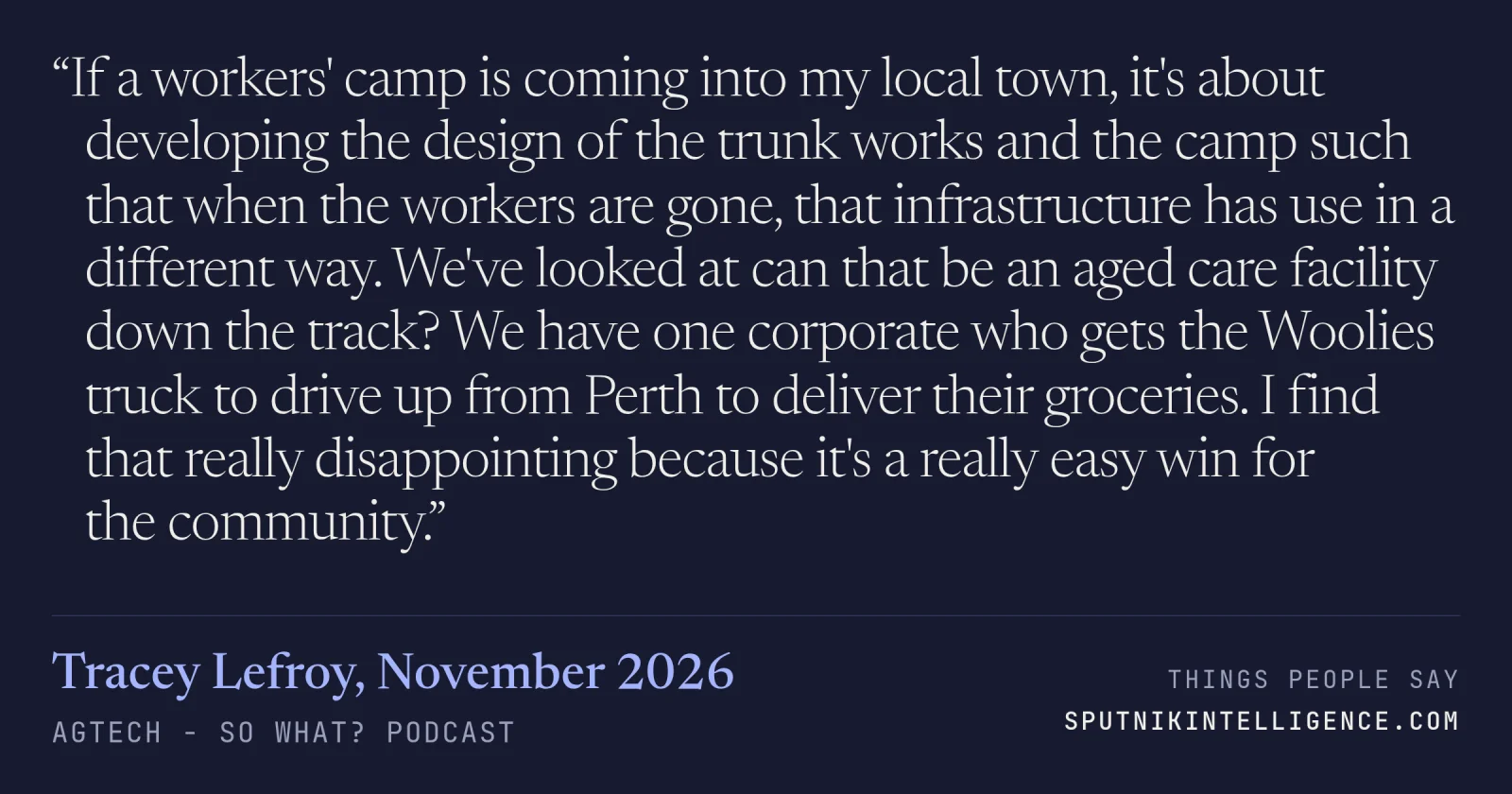
Oh, I could go on about this for hours. So it's really complex. So obviously during the construction phase, there are a lot more staff or workers needed than during the operational phase. So it's kind of this get in your community for a couple of years and then a release. And it's about making sure that during that hit period, that whatever housing or we call them trunk works. So your water, your sewage, your power, those sorts of infrastructure. It's about if we've got a workers' camp, I'll give an example. If a workers' camp is coming in to my local town of Mora and they need to then have the trunkworks in place, it's about developing the design of those trunkworks and the design of that workers camp such that when the workers are gone, that infrastructure has use in a different way. So for us, we've looked at can that be an aged care facility down the track? So aged care or aging in place in regional areas is absolutely what people are chasing, but we don't necessarily have the capacity for that. Guess it's about making sure that when renewable energy proponents are doing those construction projects, how do we leverage what they're already going to be doing so that it has a legacy impact for the regional community…
Sarah Nolet
Those are really tangible examples, like the aged care facility and the upskilling. And I like that it's both, there's some quantitative stuff there, like the income increases, but there's some qualitative stuff there too, like the training and that kind of piece. It seems like we've been through…
Tracey Lefroy
Sometimes I feel really optimistic. They're going to nail this. And then other times I feel less optimistic. But for me, it's about the governance systems. Have we specifically designed these governance systems to allow for good? Have we designed them such that we can capture this opportunity? An…
Sarah Nolet
Governance is one of those terms where I do feel like people think it's boring and yet it's so important. I keep going back to this question, I guess, of the frustration I hear from landowners and from regional communities about some of these projects and how they've gone and how the communities…
Speaker names come from our own diarization. The position is estimated from where the line sits in the episode.
Going through the commercial terms farmers should check before signing a renewables hosting deal, she flags land rating and tax treatment as costs that are easy to miss.
…this turbine, for example, can generate seven megawatts of power. However, sometimes it may even be turned off such that it's only generating two megawatts of power. That's irrelevant to the landowner. Land only gets paid on what its potential. Interesting. You know, nameplate capacity is.
Sarah Nolet
Presumably because the landowner isn't making that decision to turn it on or off, it's the company and you've still incurred the cost of having the project there.
Tracey Lefroy
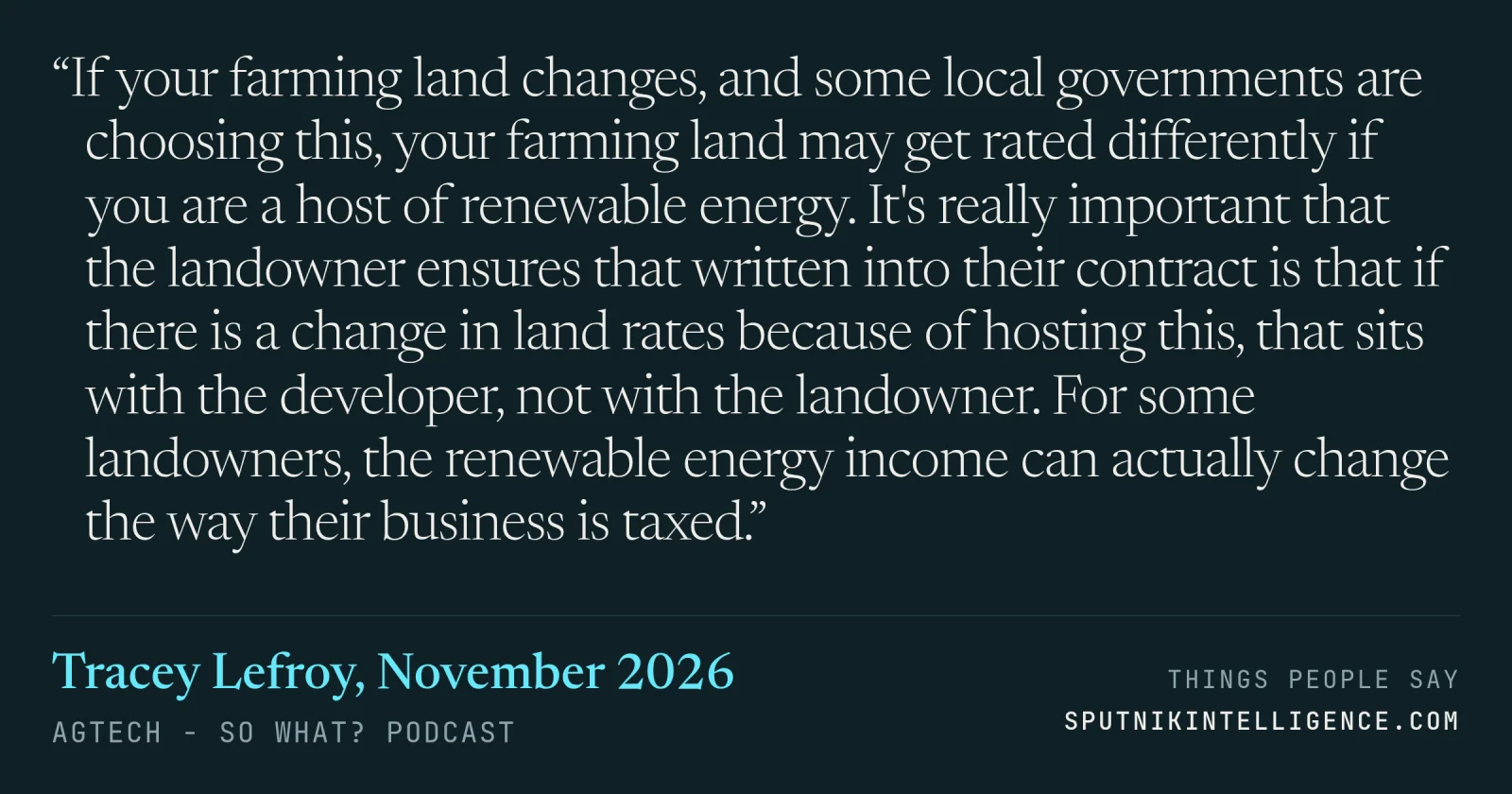
Other things that get written into your contract, which are super important, are things like rate differentials. So if your farming land changes, and some local governments are choosing this, your farming land may get rated differently if you are a host of renewable energy. And it's really important that the landowner ensures that written into their contracts is the fact that if there is a change in land rates because of hosting this, that that actually sits with the developer or the proponent, not with the landowner. Something for growers or landowners to be really aware of is that for some landowners, the renewable energy income can actually change the way that their business is taxed. So you've obviously got your primary production concessions for tax ratings. And depending on how you structure your business, that can be changed when you've got this income coming through. And that's something that we speak to the landowners about really extensively at the start is before you've signed anything, have a really good think about how you need to structure your business to accept this income in a way that minimizes its impact on your primary production. I do know that National Farmers Federation are doing some work on this. It's certainly…
Sarah Nolet
Yeah, it makes sense. That kind of community impact is one that I'm really interested in as well. That there's, you know, I've heard things like a big challenge has been when projects are going up in regional areas that the labor force actually do the installation. Like, is that taking away from…
Tracey Lefroy
Oh, I could go on about this for hours. So it's really complex. So obviously during the construction phase, there are a lot more staff or workers needed than during the operational phase. So it's kind of this get in your community for a couple of years and then a release. And it's about making sure…
Sarah Nolet
Those are really tangible examples, like the aged care facility and the upskilling. And I like that it's both, there's some quantitative stuff there, like the income increases, but there's some qualitative stuff there too, like the training and that kind of piece. It seems like we've been through…
Speaker names come from our own diarization. The position is estimated from where the line sits in the episode.
Walking through how host payments for wind turbines work, in dollars per megawatt per year, she explains nameplate capacity. The point is that landowners carry the footprint whether or not the company runs the asset.
…that's the bit when you actually go, oh, this isn't as bad as I thought it was going to be. So you're normally looking at about 2% to 3% footprint of the total farm area and you are getting paid dollars per megawatt again. And that's always on nameplate capacity, not on generation of electricity.
Sarah Nolet
For anyone not familiar. So nameplate
Tracey Lefroy
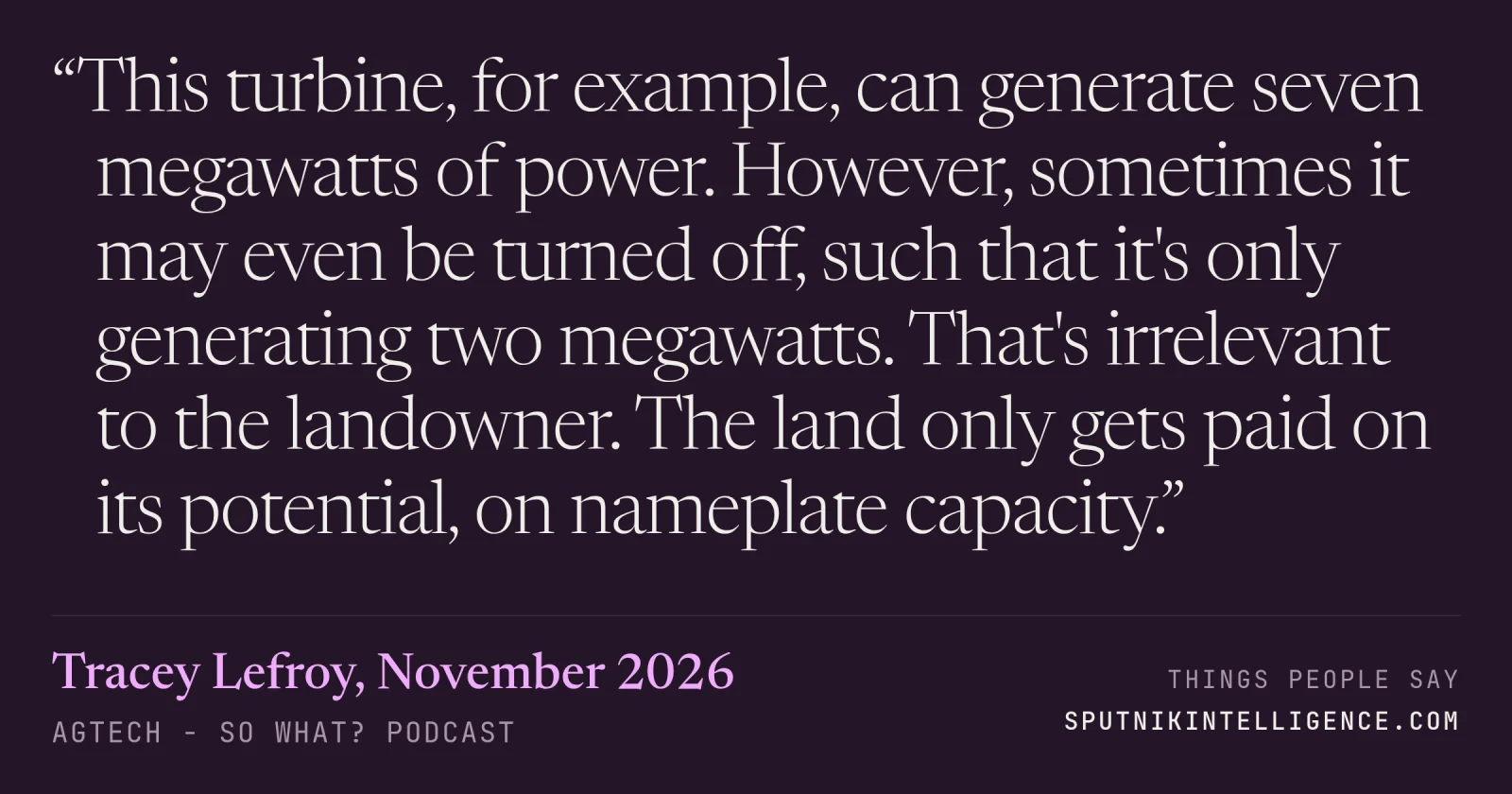
capacity is basically this turbine, for example, can generate seven megawatts of power. However, sometimes it may even be turned off such that it's only generating two megawatts of power. That's irrelevant to the landowner. Land only gets paid on what its potential. Interesting. You know, nameplate capacity is.
Sarah Nolet
Presumably because the landowner isn't making that decision to turn it on or off, it's the company and you've still incurred the cost of having the project there.
Tracey Lefroy
Other things that get written into your contract, which are super important, are things like rate differentials. So if your farming land changes, and some local governments are choosing this, your farming land may get rated differently if you are a host of renewable energy. And it's really…
Sarah Nolet
Yeah, it makes sense. That kind of community impact is one that I'm really interested in as well. That there's, you know, I've heard things like a big challenge has been when projects are going up in regional areas that the labor force actually do the installation. Like, is that taking away from…
Speaker names come from our own diarization. The position is estimated from where the line sits in the episode.
Asked whether developers resisted dealing with a landowner collective. She explains why negotiating as a group made sense: individual deals with different terms had been breeding distrust between neighbours.
…to have that legally and formally structured. And kudos to our proponents for embracing that concept. And I think that our proponents allowing us to work together actually created trust between not only within our landowner collective, but also between the landowner collective and the proponent.
Sarah Nolet
You would imagine like from a first principal's perspective that that's way more efficient for them too, that they're negotiating with one counterparty, but maybe there was resistance to it, or at least it wasn't the paradigm normally. Like, how did they take it? It
Tracey Lefroy
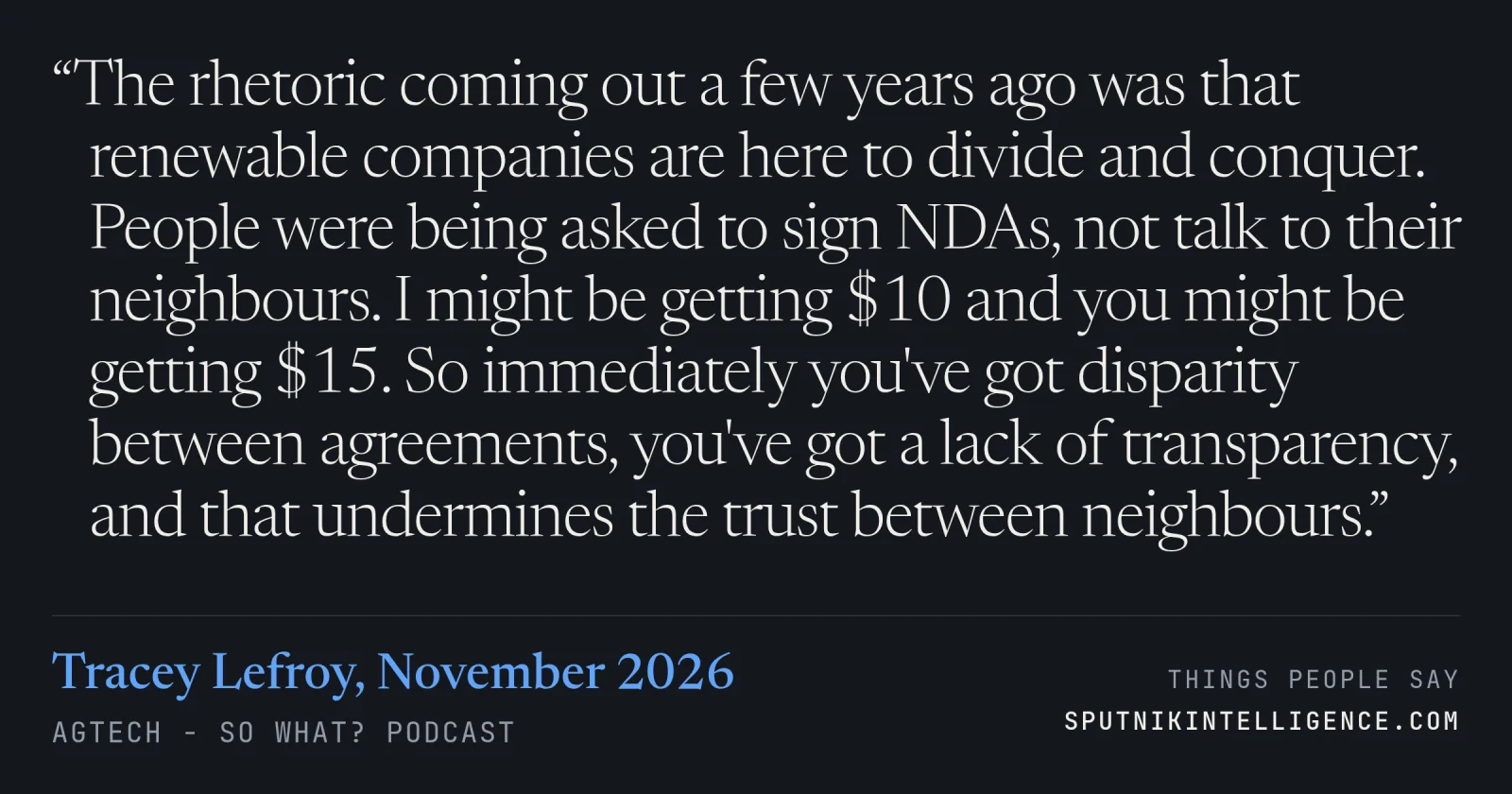
certainly wasn't the existing paradigm. And I think the other part, Sarah, is that the rhetoric coming out a few years ago was all about renewable companies are here to divide and conquer. So there was kind of this perception that people were being asked to sign NDAs, not seek to their neighbours, and that they perhaps sign up to things that were different from their neighbors. So I might be getting $10 and you might be getting $15. So immediately you've got disparity between agreements. You've got a lack of transparency. And that undermines the trust between neighbours. So to my mind, it makes complete sense, you know, in that surely working together smooths out those barriers. And as well, it means if I've got a question about something, I'm pretty darn sure most of my neighbors have got the same question because ultimately we are all farmers. Certainly these agreements are being done in a pre-competitive phase. It's not like me getting a turbine stops someone else from getting a turbine. Well, that's
Sarah Nolet
what I was wondering because the proponent was what was the driver for that kind of lock up the conversation, you know, NDA, single party. Like I could imagine a bunch of well-intentioned things. like oh these are people's private land and we want it to be respected and so it's a private…
Tracey Lefroy
so i think in a funny way there was almost and it's not been our experience at all but there was like this wild west approach where there was land speculation so slightly less ethical developers perhaps were trying to secure bundles of land that they would package up and then potentially sell off…
Sarah Nolet
interesting let's talk about that commerciality a little bit tell me about some of the risks you were managing for and the benefits that you see from an economic perspective and maybe otherwise
Speaker names come from our own diarization. The position is estimated from where the line sits in the episode.
Asked why renewable developers pushed landowners into NDAs. She explains the speculative land-banking behind it and makes the case for neighbours sharing information.
…a question about something, I'm pretty darn sure most of my neighbors have got the same question because ultimately we are all farmers. Certainly these agreements are being done in a pre-competitive phase. It's not like me getting a turbine stops someone else from getting a turbine. Well, that's
Sarah Nolet
…to be respected and so it's a private conversation we don't want to tell other people or it's like a land grab kind of thing like well i've got this farm and like is it competitive on their part that they're trying to sort of grab the area i'm just interested in the drivers from their perspective
Tracey Lefroy
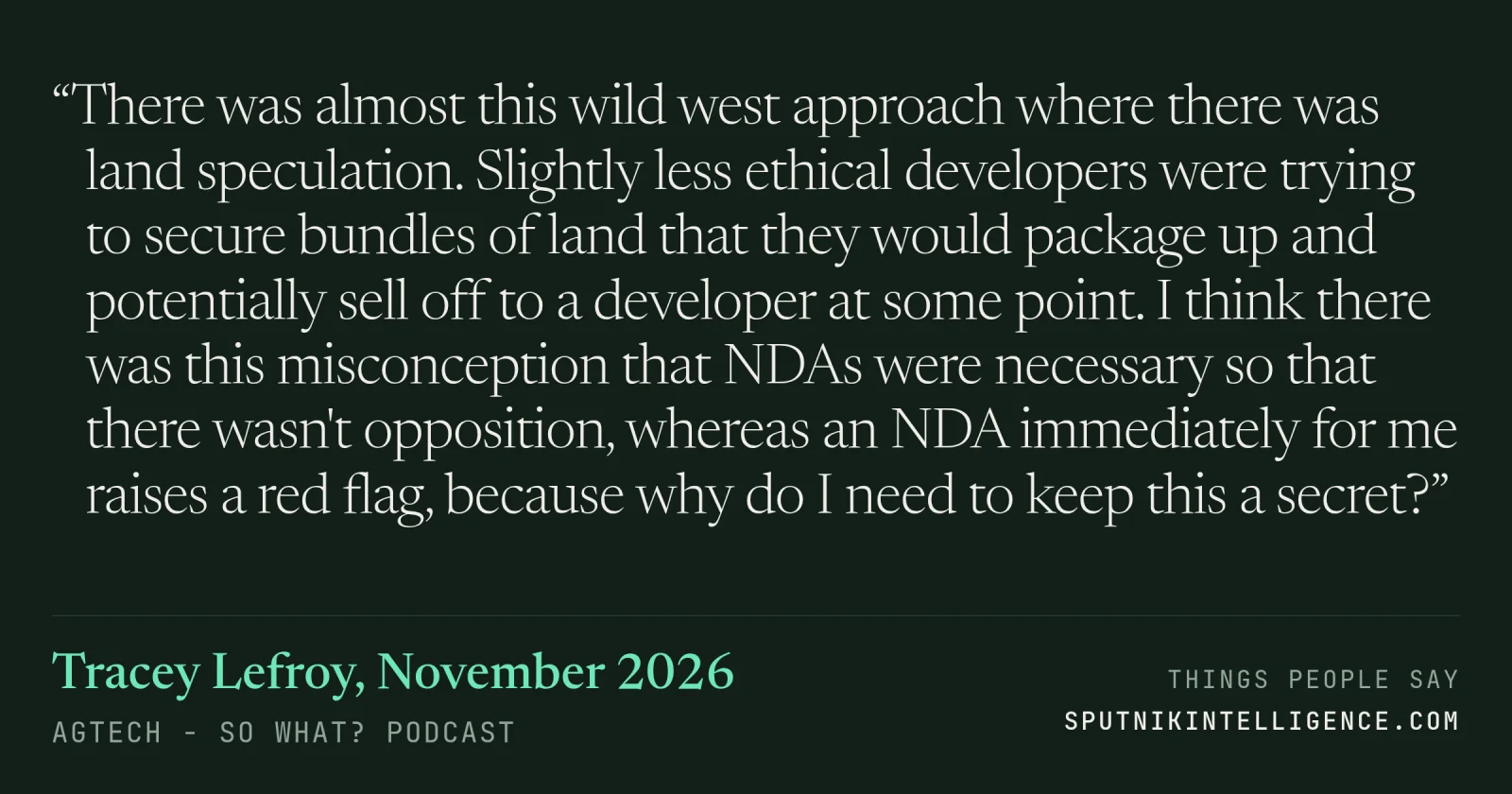
so i think in a funny way there was almost and it's not been our experience at all but there was like this wild west approach where there was land speculation so slightly less ethical developers perhaps were trying to secure bundles of land that they would package up and then potentially sell off to a developer at some point this is not my experience so it's you know not something i'm super familiar with but i think the ndas were about trying to secure as much land as they could as quickly as they could i think there was this misconception that NDAs were necessary so that there wasn't opposition whereas I kind of feel like an NDA immediately for me raises a red flag because why do I need to keep this a secret obviously there are elements that are commercial incompetence and certainly our landowner collective has been really aware of the commerciality of what we're doing but within the 10 of us we are really comfortable to share that information
Sarah Nolet
interesting let's talk about that commerciality a little bit tell me about some of the risks you were managing for and the benefits that you see from an economic perspective and maybe otherwise
Tracey Lefroy
yeah okay look there's a lot of risks and they can be risks from concern around water runoff around lay down pads through to concerns around decommissioning in 35 years so that's where it becomes really difficult because it's kind of like that being in the shearing shed and trying to think of a…
Sarah Nolet
fascinating and i should say that you mentioned being an independent consultant so you've been through and are going through this in your own farm with the landowner collective but then because of this experience you've also been asked to help others it's great because your experience ranges across…
Speaker names come from our own diarization. The position is estimated from where the line sits in the episode.
She describes a renewables forum in Perth where a session on regional engagement had no regional speakers, and she was pulled from the audience to speak for all of regional Western Australia. She uses it to argue landowners need real support in negotiations.
…session did not have one regional voice involved in it. The facilitator, who's someone who I really, really respect, turned to me and I was just sitting in the audience and asked me to speak on behalf of all regional communities in WA. And I understood why she asked that question. And I, you know,
Sarah Nolet
paper on the question. It did,
Tracey Lefroy
but it told me so much. It told me about the gap between saying that engagement matters and actually building that engagement into the process. So that gap between saying engagement matters and actually building it in is huge at the moment. So for me, I all of a sudden was trying to manufacture representation of the entire regional Western Australia on the spot. That's not engagement. That's the appearance of engagement. It's ticking a box. But it's just so important that we have people at the table earlier. And I felt really lucky to work with my neighbours doing our landowner collective and I learnt so much. But that was completely unpaid, which is fine. But it was unpaid. I was absolutely learning on the job. I was lucky enough to have the support and trust of my neighbours. But we shouldn't be doing 30-year deals on the basis of happening to have someone in the group who's willing to put their hand up and do, you know, that additional research. I don't know how it looks, but I do think there is a role for someone to come in to support these landowners and the farmers and the regional communities who has some experience just to balance up those scales a little bit.
Sarah Nolet
It's interesting. Like I don't know the competitive drivers or like the economics on the proponent side, but I could imagine just hearing what I've heard and what little I know that hiring a you to be like the regional engagement manager to basically provide the service that you're doing as part of…
Tracey Lefroy
Look, I mean, Sanders, I'm really lucky. I do some work with Sabine Heindel at the Energy Charter. And so I sit on one of their panels, which I found incredibly interesting. And I am now doing some consulting work back through the Energy Charter where a proponent engages with the Energy Charter.…
Sarah Nolet
curious, Tracy, where climate and climate resilience is in this conversation. One of the reasons for renewable energy is both energy sovereignty, but also from an emissions perspective. Are there ecological benefits? Do you guys, as the landowner hosting a project, get any kind of either…
Speaker names come from our own diarization. The position is estimated from where the line sits in the episode.
Asked whether Australia is learning from the coal seam gas era or repeating it. She says outcomes depend on how projects are governed, and contrasts mining with a chance for farming regions to keep more of the value.
…ready for 200 workers to come into your community and then regional value capture. So how are you going to capture the value from these workers actually come in? So there's been a massive focus on getting ready. There hasn't been a massive focus on how do we retain and keep that value long term.
Sarah Nolet
…and that kind of piece. It seems like we've been through this before in Australia with coal seam gas, that there's been conversations around land use transition and intersection of energy and agriculture. Do you feel like we're learning from those examples or is this a little bit of groundhog day?
Tracey Lefroy
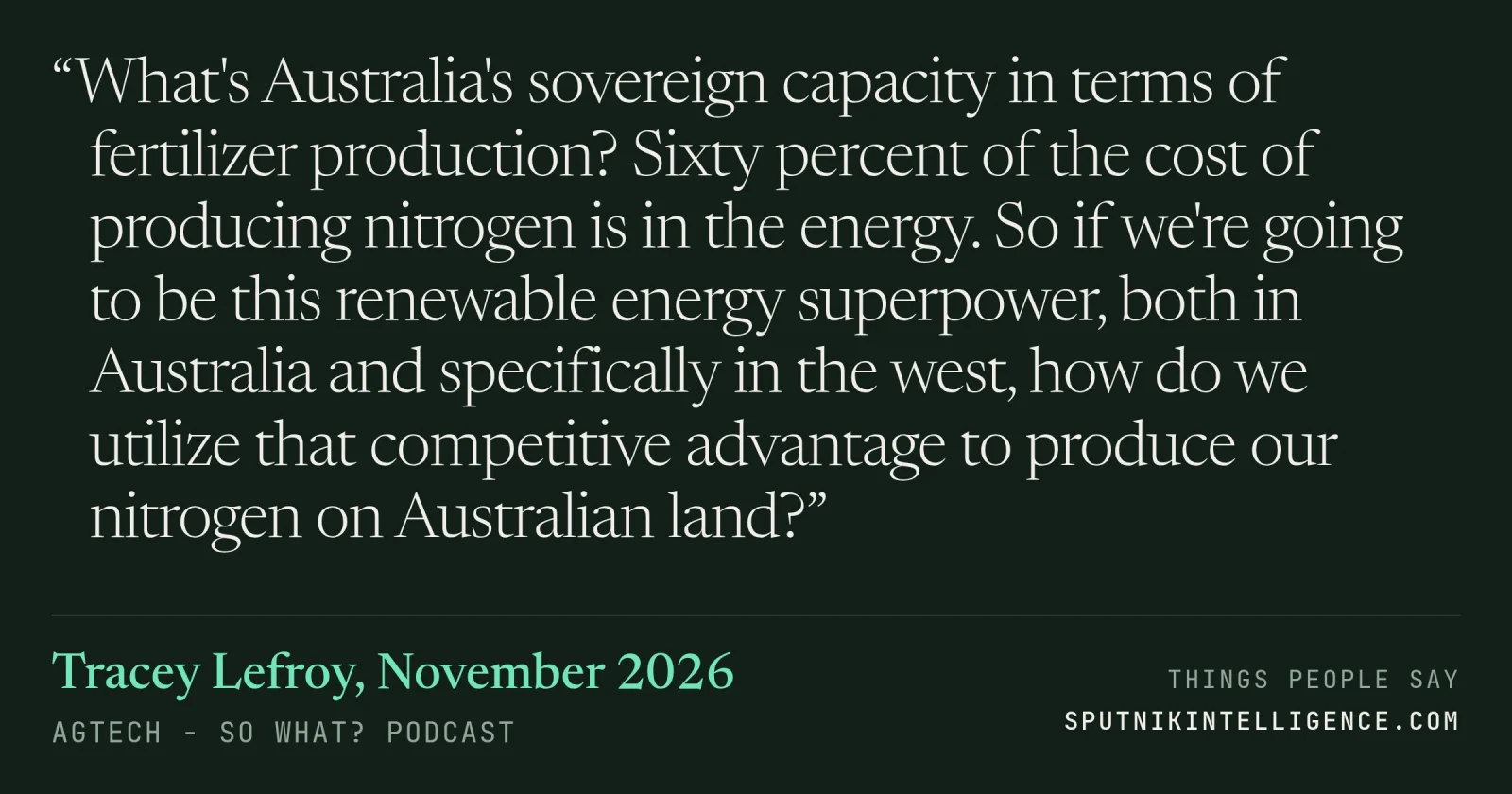
Sometimes I feel really optimistic. They're going to nail this. And then other times I feel less optimistic. But for me, it's about the governance systems. Have we specifically designed these governance systems to allow for good? Have we designed them such that we can capture this opportunity? An example, when we spoke about the nitrogen fertilizer stuff with 60% of the cost of nitrogen being energy linked, if renewable infrastructure in agricultural regions can be utilized such that it drives down input costs, that it supports regional processing, that it enables fertilizer production locally, it's a genuine transformation. And it's something that mining didn't capture. I think mining was all about extraction. And how do we change the renewable energy transition from feeling like an extractive process to actually a collaborative process where if we get the governance right and we can capture the benefits, then we'll get decent regional development. We will get community benefits and there will be a significant legacy as a result.
Sarah Nolet
Governance is one of those terms where I do feel like people think it's boring and yet it's so important. I keep going back to this question, I guess, of the frustration I hear from landowners and from regional communities about some of these projects and how they've gone and how the communities…
Tracey Lefroy
I think there are some operators out there who are purely extractors, but I feel like they are the ones we meet with opposition because if you don't take the time to build the relationships with your landowners, with your regional communities, there's going to be a lack of trust and there's going…
Sarah Nolet
paper on the question. It did,
Speaker names come from our own diarization. The position is estimated from where the line sits in the episode.