Adjodah's startup is working on recursive self-improvement (RSI), AI systems that improve themselves. He says most published methods fail when his team replicates them, and that starting from a grounded mathematical framework works better.
Yeah.
For sure, improving the numerator is good. I've yet to see, which is great that you have glimmers, where you can improve both the numerator and the denominator. I mean, that's a pretty meaningful statement, which is awesome.
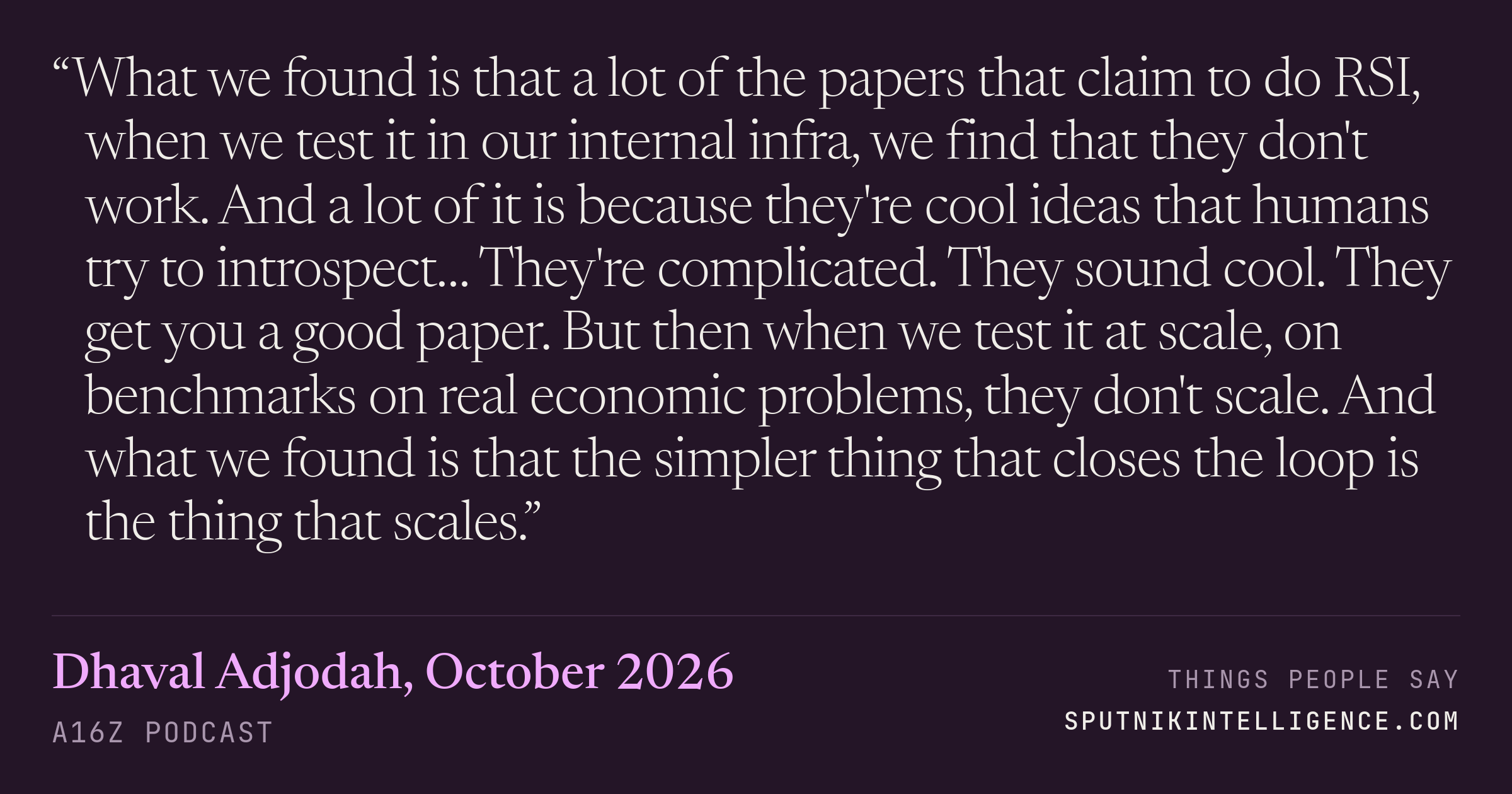
What we found is that a lot of the papers that claim to do RSI, when we test it in our internal infra, we find that they don't work. And a lot of it is because they're cool ideas that humans try to introspect and say, oh, you know, this is what I think should happen. They're complicated. They sound cool. They get you a good paper. But then when we test it at scale, you know, on benchmarks on real economic problems, they don't scale. And what we found is that the simpler thing that closes the loop is the thing that scales. I would say one thing that we do that's probably unique is that we always start…
I think Richard Feynman said once that there are two kinds of sciences, there's a stamp collections and then there are physics. So without a unified math framework, all these research are sort of just stamp collections. You could, like a lot of this paper we're reading, they're just ideas inspired…
see. I see. So
for example, there are people who are doing recursive improvements just on harness and then there are people who are only doing on weights. But weights and harnesses are not isolated components. They have impact on each other.